Просмотр новости
Найдите то, что Вас интересует
 Спутники
 РН
РН SpaceX
 Роскосмос
 NASA
NASA
СпутникиРНSpaceXРоскосмосNASAWhat can we learn from the fatal crash of a Dauphin helicopter into Morecambe Bay in 2006?
The post Pilots Who Ask Why?: Fatal mistakes on a helicopter mission appeared first on Vertical Mag.
There are accidents that are caused by very loud and obvious things: mechanical failures, fire warnings — things that are obviously wrong.
Then there are accidents caused by sneaky threats that weren’t managed well enough.
The crash of a Dauphin helicopter into Morecambe Bay in the U.K. 20 years ago is one of those.
On the evening of Dec. 27, 2006, the Dauphin flew a routine offshore sector it had flown countless times before. It had two experienced pilots. The aircraft was serviceable. It was travelling to a well-lit platform. There was nothing dramatic. Nothing urgent. There were no mayday calls.
Yet, in a very short time, the helicopter flew into the sea. Everyone on board was fatally injured.
And this didn’t happen at the edge of the flight envelope — it was right in the middle of normal operations, where most of us spend 90% of our time. That’s exactly why it’s worth seeing what we can learn from it.
 Image 1
Accident Overview
Image 1
Accident Overview
The aircraft was an Aérospatiale SA365N (also known as the Dauphin), operating scheduled offshore passenger flights from Blackpool Airport to the Morecambe Bay offshore field. (See Image 1)
The crew had already completed two sectors that evening without incident. The Blackpool Airport METAR at the time reported a visibility of 1.85 miles (three kilometers) in haze, with a scattered cloud base of 800 feet (240 meters).
It was now in night conditions, but that was nothing unusual for winter offshore flying in the U.K.
For the third sector, the helicopter departed the Millom West platform with five passengers onboard, routing to the North Morecambe platform. (See Image 2)
The co-pilot was the pilot flying, and the commander the pilot monitoring. As they approached the platform, the crew became visual at around four nautical miles (7.4 km). The heli deck and crane lights were confirmed as serviceable.
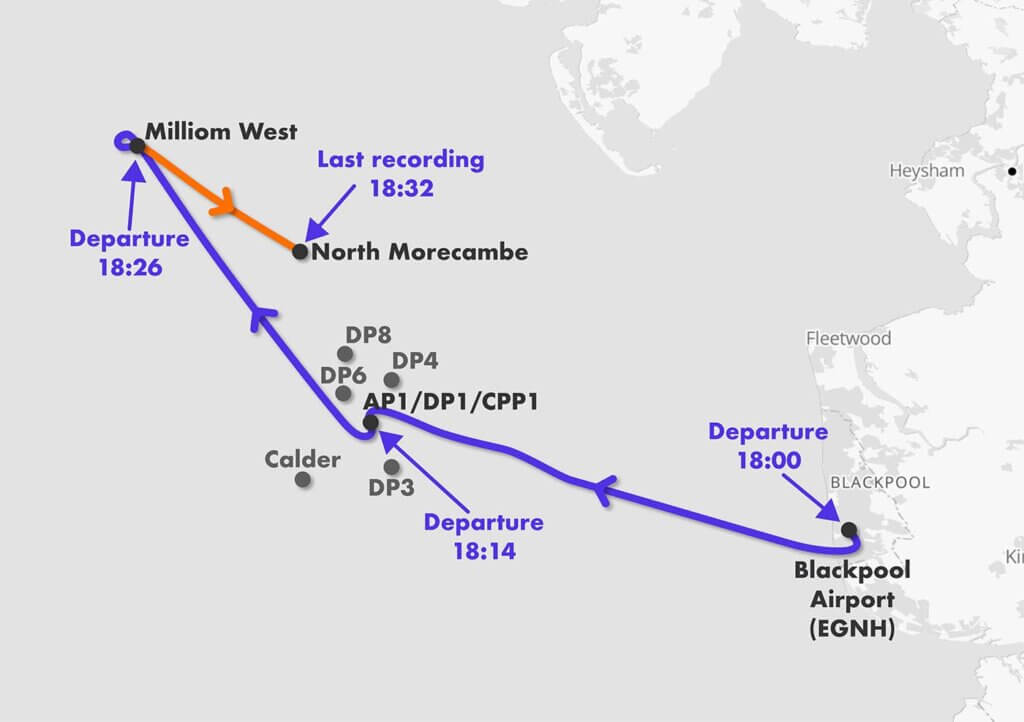 Image 2
After the 4 nm call from the commander, the crew became visual with the rig (which is about 6,800 m). The co-pilot stated:
“I got the deck now.”
The height reduced to 270 ft (80 m), and then increased back to 400 ft (120 m) before starting the descent 30 seconds later. The commander called 55 knots. On paper, the approach was established, but something was missing. At 18:32:21, the commander broke the silence:
“You get no depth perception, do you?”
The co-pilot replied:
“Yeah… not on this one. Not tonight.”
From that moment on, the inputs began to creep in. Collective increased, pedal input followed. Cyclic pitch and roll started to build. The radio height dipped, then climbed again.
Twelve seconds later, the commander checked in:
“You alright?”
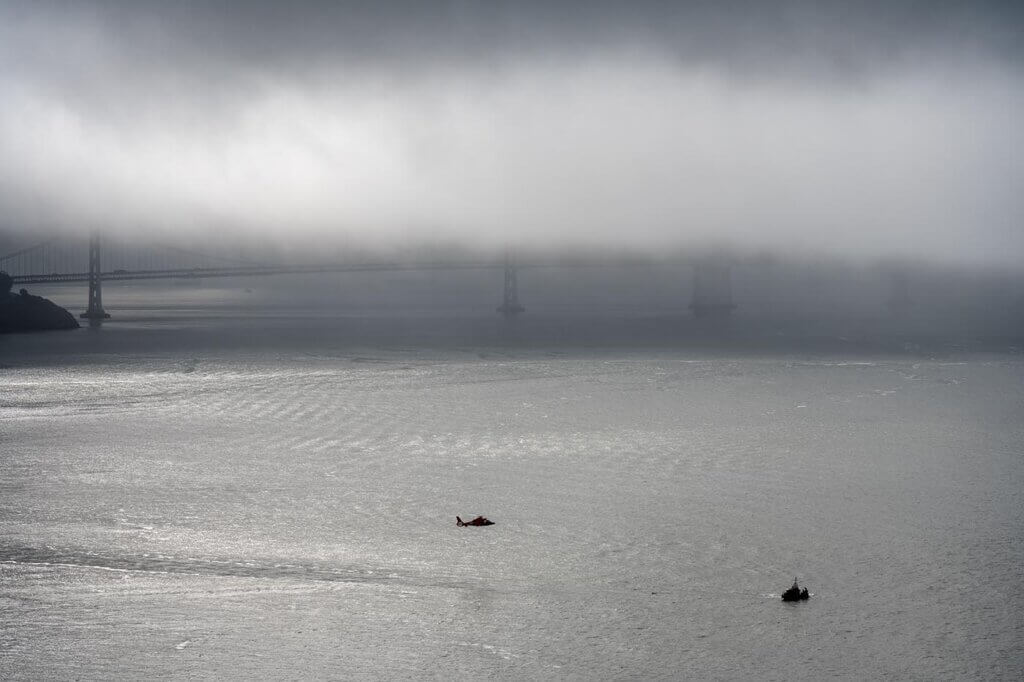 Lloyd Horgan Photo
By now, the cyclic inputs were no longer smooth. They began to oscillate, still increasing, while the collective came up faster than before. The helicopter pitched nose-down and rolled right as the altitude continued to rise, an uncomfortable combination.
At 18:32:35, the co-pilot finally said what had been building:
“No… I’m not happy, mate.”
The commander asked:
“We going round?”
Engine torque was already pushing past 100%.
The co-pilot replied:
“Yeah, take, help us out…”
The request didn’t land. The co-pilot restated:
“Help us out!”
About four seconds later, the commander took control.
“I’ve got it. I’ve got it. I’ve got it. I have control. I have control.”
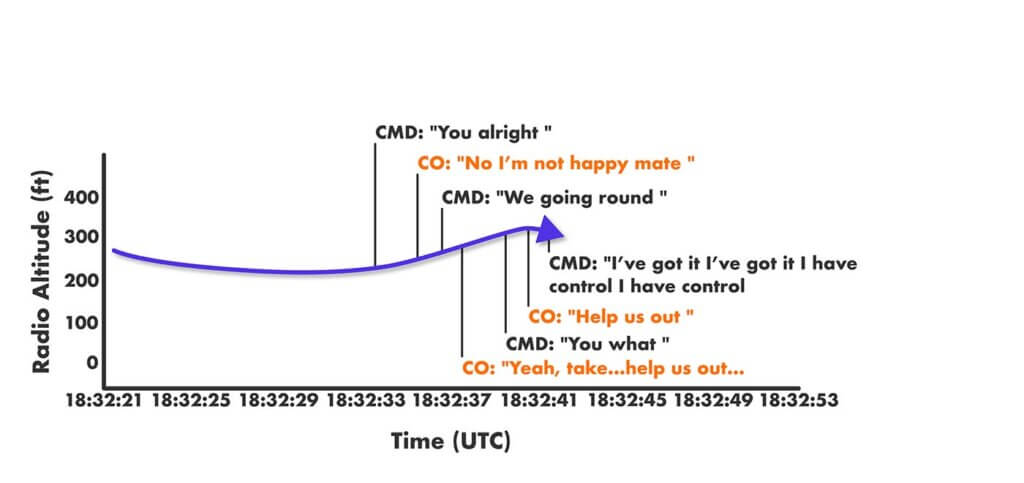 Image 3
By then, the helicopter was in a steep, accelerating upset: 38 degrees nose-down, 38 degrees of right bank, airspeed racing toward 90 knots and increasing. (See Image 3)
Radio altitude peaked at 315 ft (95 m), then unwound rapidly, a 2,000 ft/min (610 m/min) descent developing. A strong left roll input followed, then aft cyclic. The helicopter clawed back through wings-level to a shallow left bank, pitch easing to 13 degrees nose down, but this still allowed the airspeed to increase past 100 knots. Passing 180 feet (55 m), the descent continued.
Over the next six seconds, the attitude barely changed. The roll slowly crept right again. The descent rate remained high. Collective was reduced, engine torque dropped back below limits.
At 18:32:45, the co-pilot let out an expletive, not in panic, but in disappointment.
The commander asked:
“You alright?”
The co-pilot replied:
“Yep… no.”
He came across as resigned.
At 18:32:47, the cockpit remained calm as the automated voice called:
“ONE HUNDRED FEET.”
No alarms or calls. No technical failures.
The last recorded data showed 30 feet (nine meters) radio altitude. (See Image 4)
The helicopter was still 112 degrees nose down, 20 degrees right bank, airspeed 126 knots and rising. The recording ended at 18:32:50, around the moment the helicopter impacted the sea.
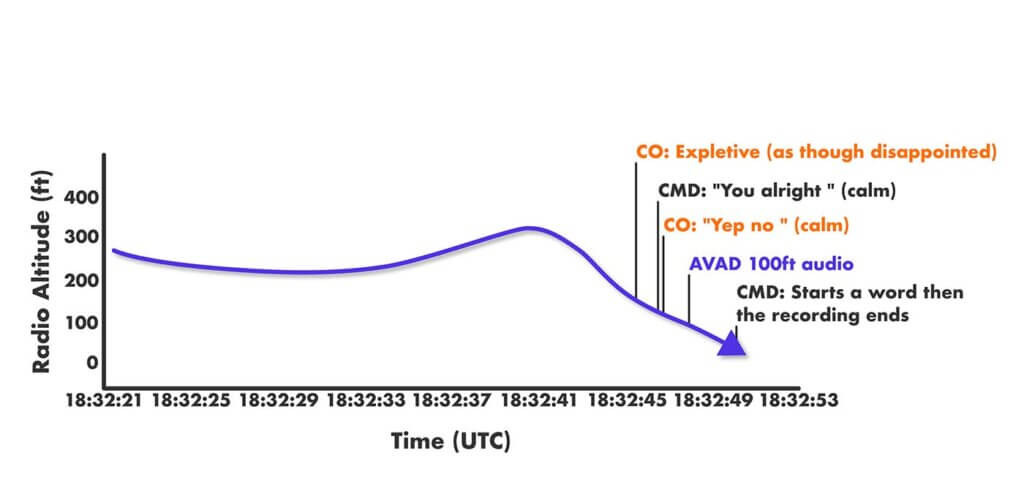 Image 4
Investigation Findings
Image 4
Investigation Findings
The AAIB investigation found several important and uncomfortable truths.
1. Visual flight with poor visual cues
Although the crew were technically “visual,” the visual environment was challenging. The AAIB noted:
“The approach profile flown by the co-pilot suggests a problem in assessing the correct approach descent angle, probably, as identified in trials by the CAA, because of the limited visual cues available to him.”
At night, over water, with overcast cloud and minimal surface texture, the human visual system struggles badly. Depth perception reduces, cues disappear, what looks like a stable approach can actually be a shallow descent at increasing speed (or the other way around).
Recognition is step one, but it doesn’t automatically give you a solution.
The investigation concluded that the approach profile flown suggested difficulty judging the correct descent angle, likely due to limited visual cues, even though the platform was in sight. It was a classic black-hole illusion.
2. Increasing workload, shrinking margin
Flight data showed steadily increasing control inputs, collective, cyclic, yaw, as the co-pilot worked harder to “make the picture fit.” This is a critical human factors trap.
When visual information becomes unreliable, pilots instinctively try to fix it, which can result in pilot induced oscillations. Workload increases. Control becomes less precise. Small corrections become large ones.
The helicopter began to oscillate in pitch and roll. Engine torque exceeded limits. Airspeed increased during descent. At this point, the aircraft wasn’t out of control, but it was rapidly approaching a point where recovery would require immediate, decisive action.
3. The transfer of control delay
One of the most sobering findings was the delay during the transfer of control. The co-pilot asked for help. The commander did not immediately take control. The exchange was ambiguous.
Only after four seconds did the commander state clearly that he had control. Those few seconds mattered.
By the time control was fully transferred, the helicopter was already descending at more than 1,500 ft/min, nose-down, accelerating, and below 300 feet (90 meters). The commander’s initial recovery inputs were correct. The aircraft responded, but there simply wasn’t enough height left.
This wasn’t a skill issue. It was a communication clarity issue under pressure.
4. Training gaps that only show up at night
Perhaps the most frustrating finding was this: a suitable synthetic training device for the SA365N existed, but was not used.
That matters because simulators are uniquely good at exposing pilots to black-hole approaches, degraded visual environments, startle and disorientation, and high-workload handovers.
The investigation concluded that the benefits of simulator-based training were missed, particularly for rare but high-risk scenarios like night offshore visual illusions.
5. Possible distractions during recovery
The AAIB mentions:
“During the attempted recovery of the helicopter from its unusual attitude, the commander was devoid of any external visual cues and was possibly distracted over concerns for the well-being of his co-pilot.”
And:
“Concerns for his co-pilot and some degree of disorientation possibly distracted the commander from his usual instrument scan to the extent that he did not notice the increasing angle of bank to the right and the helicopter’s continuing descent into the sea.”
So, even though the commander was now the pilot flying, the recovery could have been harmed due to the fact his attention might have been directed at the co-pilot, combined with disorientation.
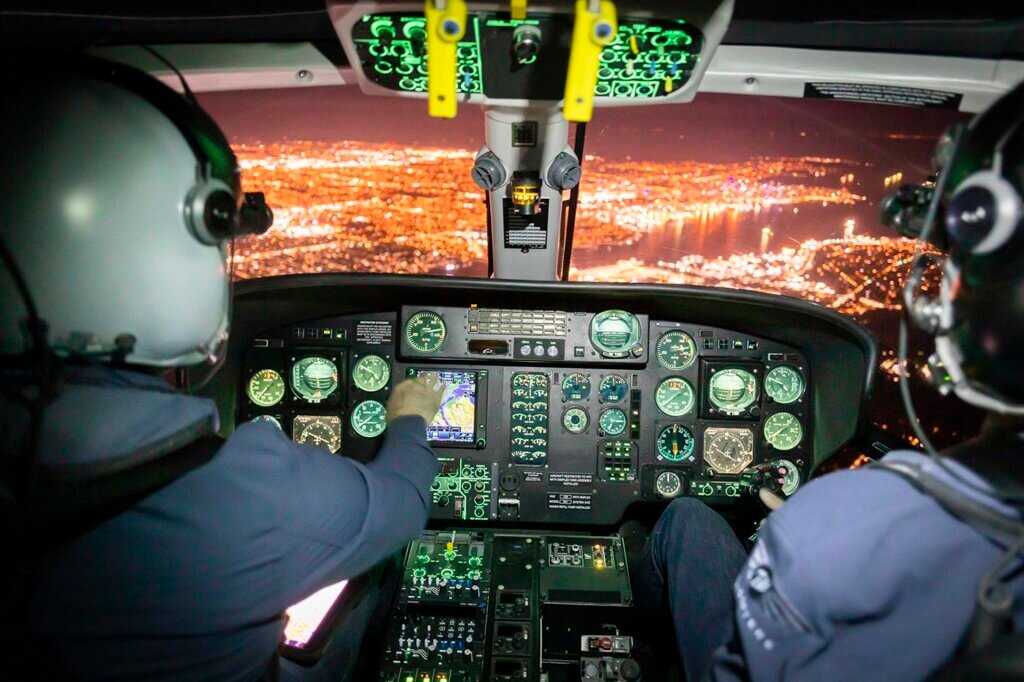 Heath Moffatt Photo
What can we learn from it?
Heath Moffatt Photo
What can we learn from it?
Here are the key lessons worth taking away.
1. “Visual conditions” does not mean “easy conditions” – consider automation!
Seeing the deck does not guarantee depth perception or closure rate awareness. If the visual picture feels wrong, it’s time for deliberate action. Switch to instruments, ask for range calls, fly the defined profile, go around early, or hand over controls in a standardized way.
If possible, use as much automation available to you to reduce workload. This is where understanding available modes and your avionics can make or break your flying. There is no shame in abandoning a visual approach that doesn’t feel right, but there is risk in trying to salvage it.
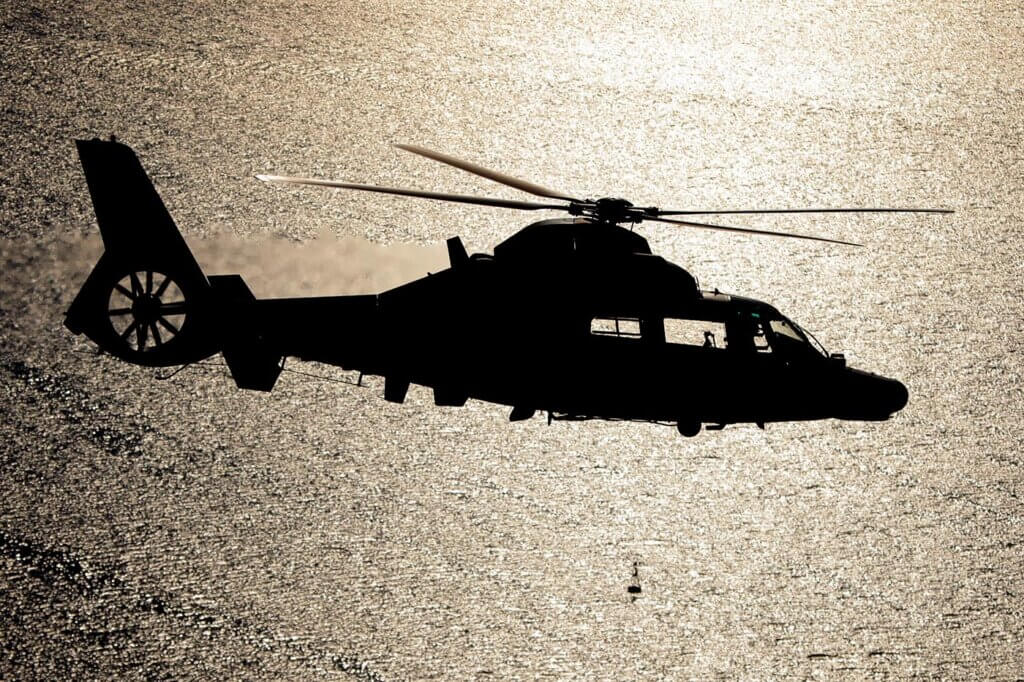 Stefanov Ognyan Photo
2. Say the hard things earlier
The co-pilot eventually said he wasn’t happy, but by the time he did, the aircraft was already unstable. An important takeaway here is that discomfort should be voiced early, and explicitly.
Not “this feels odd.” Not “I’m not quite happy,” but: “I’m disoriented. You have control.” Early honesty and corrections give margin and time to rectify the issue.
3. Transfers of control must be unambiguous
This accident reinforces a simple rule: There is no such thing as a casual handover (especially at low height).
Clear words, immediate confirmation, without assumptions. If you’re taking control, take it now, not “in a second.” Four seconds doesn’t sound like much, until you’re descending through 300 feet at night over the sea.
4. Simulators are where you should fail first
The crew were experienced and current. What they lacked was recent, realistic exposure to the exact illusion they encountered.
Simulators are great for learning how your brain lies to you under pressure. If your operation includes night offshore visuals, degraded cues, or high-workload approaches, those scenarios belong in the sim.
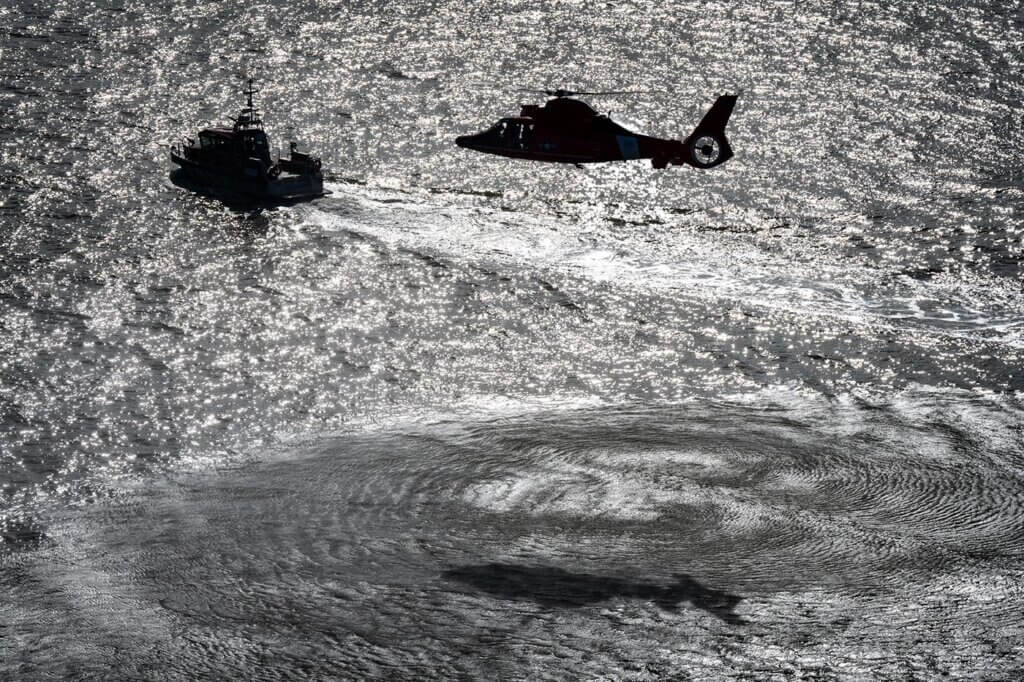 Lloyd Horgan Photo
Conclusion
Lloyd Horgan Photo
Conclusion
The threat crept in quietly during this flight, through degraded visuals, rising workload, and a few seconds of unclear communication at exactly the wrong moment. That’s what makes this accident uncomfortable, because it didn’t happen at the edge of performance or experience.
The lesson isn’t “don’t fly visually at night offshore.” It’s to recognize earlier when the picture is lying to you, speak up sooner, and make decisions while you still have height and time. And as always, use all systems available to you to the fullest extent to reduce workload and the threats of illusions, if appropriate.
| # | Наименование новости | Тональность | Информативность | Дата публикации |
|---|---|---|---|---|
| 1 | Pilots Who Ask Why? Hidden Wire Threat | 0 | 8.31 | 03-06-2026 |
| 2 | Pilots Who Ask Why? 56 seconds to live | 0 | 11.24 | 08-06-2026 |
| 3 | How longer fire seasons are reshaping helicopter maintenance | 0 | 7.92 | 01-07-2026 |
| 4 | Smoke and yaw: Lessons from the 2017 LAFD AW139 firefighting accident | 0 | 14.75 | 16-07-2026 |
| 5 | Smarter suppression: How helicopter tech aids the fight against wildfires | 0 | 9.18 | 07-07-2026 |
| 6 | Sikorsky Black Hawk: Born for battle, built for fire | 0 | 6.75 | 06-07-2026 |
| 7 | Helicopter Aircraft Maintenance Engineer | 0 | 17.96 | 21-07-2026 |
| 8 | Firefighting Pilot/H60 Pilot In Command | 0 | 15.72 | 21-07-2026 |
| 9 | Основные версии падения вертолета на Камчатке - отказ двигателя и ошибка пилотирования | 0 | 0 | 11-08-2021 |