Просмотр новости
Найдите то, что Вас интересует
 Спутники
 РН
РН SpaceX
 Роскосмос
 NASA
NASA
СпутникиРНSpaceXРоскосмосNASA5G from Space:
Intelligent Beam Management for Non-Terrestrial Networks (Part-2)
The post 5G from Space: Intelligent Beam Management for Non-Terrestrial Networks (Part-2) appeared first on Capgemini.
In Part-1 of the blog titled “5G from Space: Intelligent beam management for Non-Terrestrial Networks,” we introduced the need for beam management in LEO constellations. In this half, we’ll explore an intriguing solution to intelligent beam management.
Intelligent, O‑RAN‑native beam managementTo recap: in modern satellite deployments, one beam often illuminates multiple regions (cells) on the ground. Beam management controls which cells are illuminated, and when. The specific time-instance is determined by the Beam Allocation Management algorithm.
In this scenario, radio resources on the satellite beam must be time-partitioned among cells to meet the following requirements:
In summary, beam hopping is a capacity maximization problem within given constraints of cell configuration and traffic partitioning.
Capgemini Engineering’s research proposes a multi‑tier, intelligent beam management and resource allocation framework, specifically designed for 5G FR1 LEO NTN networks and fully aligned with 3GPP and O‑RAN principles as shown in Figure 1. Key benefits of the architecture are as follows:
Multi-level resource allocation
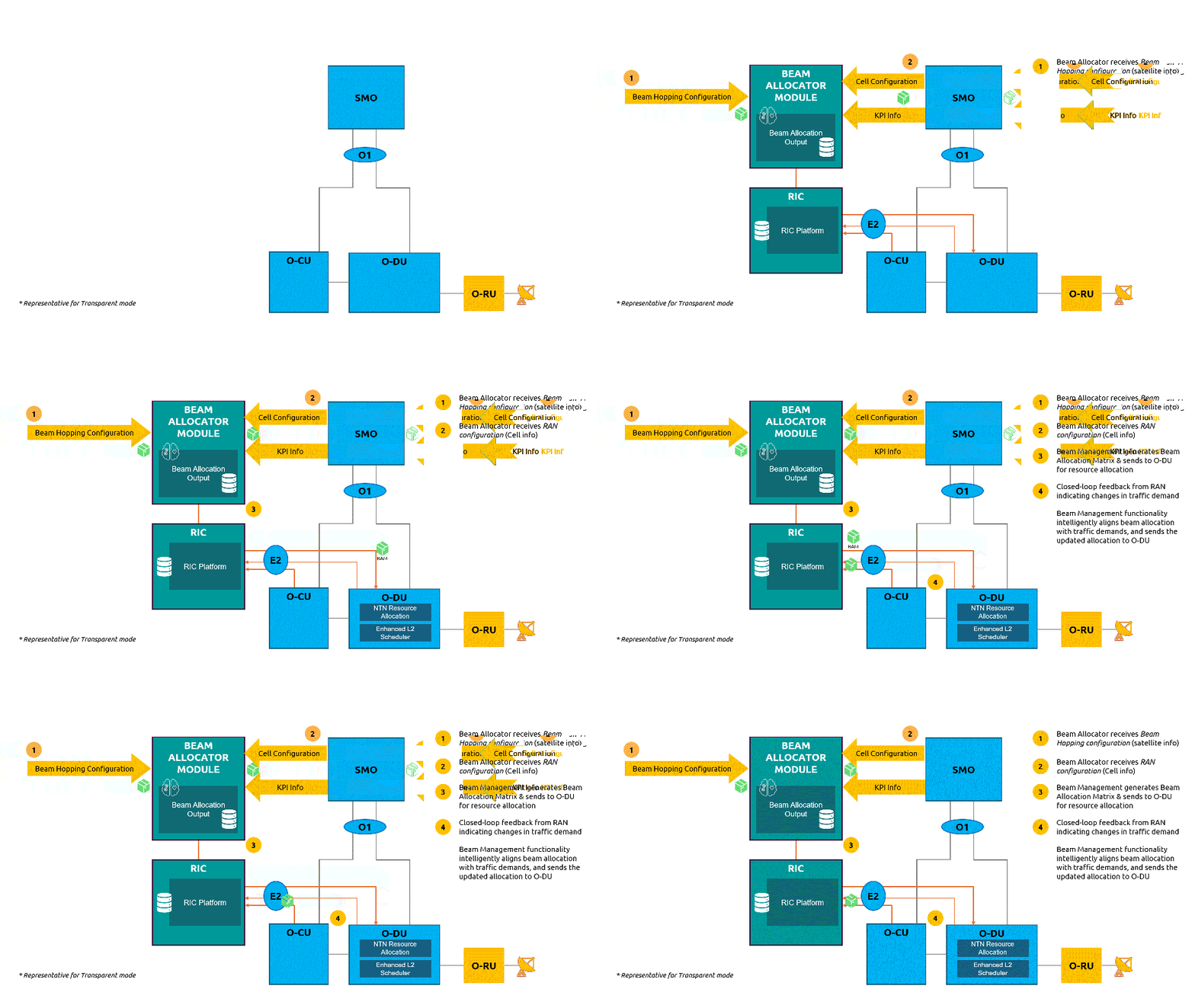
Figure 1: Capgemini’s intelligent beam management framework for 5G NTN FR1 LEO
Leveraging O‑RAN RIC and xAppsBeam management functionality can be onboarded as a xApp on Near-RT RIC inline with O-RAN architecture principles. SatRRM‑xApp (Satellite Radio Resource Management xApp):
Alternatively, depending on the type of deployment (Regenerative, Semi-regenerative or Transparent mode) and the acceptable latency for updating the Beam Allocation Matrix, the Beam Allocation Module can be flexibly placed either on the ground or on the payload.
Beam allocation algorithmA highlight of this architecture are the beam allocation algorithms which includes the following steps:
This architecture enables the satellite‑specific constraints (beam hopping, coverage, payload limits) to be managed by beam allocator module while user‑level scheduling is managed within O‑DU. The result is a demand‑aware, conflict‑free beam-hopping pattern that adapts to the dynamic needs of NTN networks.
Benefits of Capgemini’s intelligent beam management architectureFrom an operator, vendor, or enterprise ecosystem perspective, this architecture delivers tangible benefits. Instead of illuminating idle cells, satellite resources are focused on carrying actual data, which improves overall capacity by avoiding signaling conflicts and rigid, static beamhopping patterns. As a result, the network can naturally support asymmetric and realworld traffic profiles without the need for manual reconfiguration, making it both more flexible and operationally efficient.
Fully compliant O-RAN ready architectureOur approach is explicitly designed to comply with 3GPP NTN specifications and native integration with O-RAN architecture. This enables:
The intelligent beam management approach leverages the flexibility of the ORAN framework to allow operators and satellite service providers to customize policies – such as SLA weighting, latency preferences, and traffic prioritization – and deploy different beam allocation strategies without requiring changes to baseband software. By building on an open, standardsbased platform, it also enables ecosystem partners to innovate and add value on top of the solution. For operators, this results in a softwaredefined, policydriven satellite RAN and the ability to continuously evolve beam management strategies as usage patterns and business models change.
Capgemini’s differentiatorBeam management for satellite networks is an active research area and most existing studies focus on multi-beam resource allocation using frequency reuse and power control. Most existing studies do not address time‑multiplexed beam hopping combined with strict 5G signalling timing, and rarely consider realization in a standardized O‑RAN environment.
Capgemini’s research paper bridges this gap by advancing a standards‑aligned NTN beam management that explicitly focuses on beam hopping in LEO NTN networks, with detailed consideration of 3GPP‑defined scheduling and timing constraints.
Additionally, multi‑tier resource allocation architecture provides clear separation between satellite beam‑to‑cell allocation and UE‑level scheduling. The result is a realistic simulation of capacity and coverage usage under 5G NTN configurations.
SummaryOur research is a step towards making satellite‑based 5G deployments efficient and reliable. For operators and ecosystem players looking to integrate LEO satellites into their 5G networks today, the key takeaway is this: beam management is a critical part of NTN networks and ideally implemented as a programmable function in RAN with options to deploy it flexibly.
Capgemini is actively working with clients and partners to bring these concepts from research into pilots and real‑world deployments. If you are exploring NTN, LEO constellations or O‑RAN‑based satellite integration, we would be pleased to discuss how this architecture and our reference implementations can support your roadmap.
To understand why beam hopping is essential in 5G NTN and the engineering constraints that shape its design, we recommend starting with Part‑1 of this blog series| # | Наименование новости | Тональность | Информативность | Дата публикации |
|---|---|---|---|---|
| 1 | 5G from Space: Intelligent Beam Management for Non-Terrestrial Networks (Part-1) | 0 | 8.42 | 03-03-2026 |
| 2 | Managed services and global capability centers for MedTech | 0 | 6.71 | 09-07-2026 |
| 3 | Ceva integrates modem IP for satellite and terrestrial terminals | 0 | 8.65 | 06-03-2026 |
| 4 | 5G Non-Terrestrial Networks Enable Ubiquitous Global Connectivity | 0 | 13.14 | 30-03-2026 |
| 5 | Zain Bahrain and Ericsson roll out AI-powered 5G radio network | 0 | 10.91 | 27-07-2026 |
| 6 | Fraunhofer IIS tests high bandwidths for non terrestrial networks (NTN) | 0 | 6.14 | 06-05-2026 |
| 7 | KION embraces a long-term path to net-zero carbon emissions | 0 | 13.8 | 10-04-2026 |
| 8 | Du and Khalifa University explore future of intelligent 6G networks | 0 | 8.75 | 13-08-2026 |
| 9 | 🚀 5G NETWORKS выходят в космос! Система «Рассвет» использует адаптированный ... | -1 | 5.38 | 22-07-2026 |
| 10 | Coexistence Analysis of 5G C-Band Indoor Deployments and Fixed Satellite Service (FSS) in Malaysia [version 2; peer review: 2 approved with reservations] | 0 | 13.37 | 19-08-2026 |