Просмотр новости
Найдите то, что Вас интересует
 Спутники
 РН
РН SpaceX
 Роскосмос
 NASA
NASA
СпутникиРНSpaceXРоскосмосNASAThe cellular Olympics would be an amazing spectacle. Some cells move at mind-boggling speeds by jumping, gliding, swimming, expanding or shrinking.
Life in the fast lane may call to mind sprinting cheetahs and diving falcons. But there are plenty of speed demons barely visible to the naked eye. Some of the fastest living things on Earth are cells. If these cells competed in their own Olympics, who would win? Scientists have now worked out how some of the world’s smallest swimmers, sprinters and jumpers would stack up.
Competitors in the cellular Olympics wouldn’t show up dressed in their uniforms and ready to compete, says Manu Prakash. He’s a bioengineer and oceanographer at Stanford University in California. “We have to go search in puddles and ponds around the world and in the deep ocean,” he says. To compare the cells, his team collected speed data on some. They reviewed past data that scientists had gathered on others.
Some swift cells jump or glide across water. Others flail whiplike threads called flagella or swim with the help of hairlike cilia. Then there are the speedsters that don’t change position but shrink or expand.
In some cases, a cell that’s part of a larger organism makes a rapid move. That includes the stinging cells of freshwater hydra, which fire off toxins in a single shot. Other times, single-celled life forms move in a flash.
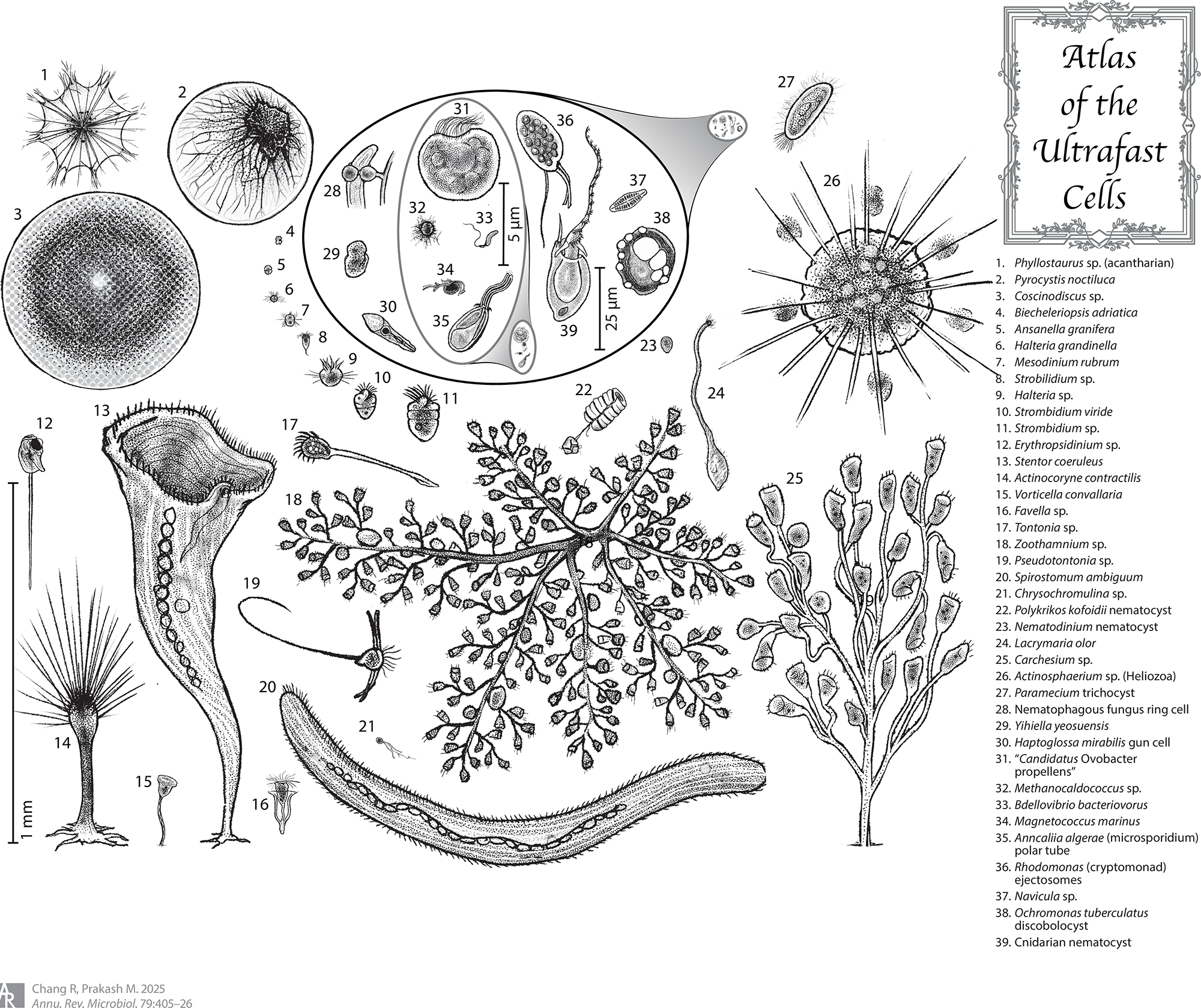 Ultrafast cells can move at speeds of 100 body lengths per second or more. They span a wide range of shapes and sizes, as shown in this illustration. Many are smaller than 1 millimeter (0.04 inch, see scale bar at lower left). Chang and M. Prakash/Annual Review of Microbiology 2025 (CC by 4.0)
On a trip to Liberia, in West Africa, Prakash saw countless specks of white in a pond. They were distributed in a peculiar pattern. “It could not have been random,” he says. He scooped out a sample and found Spirostomum, a type of single-celled organism. It can shrink its body faster than other eukaryotes — organisms whose cells wrap up their DNA in a nucleus. Speedy shrinking is part of Spirostomum’s communication, Prakash says. “It actually talks to other cells, we discovered later, using sound underwater.”
Or take Pyrocystis. These algae don’t swim and yet they make a massive migration. Prakash found these cells deep in the ocean off the coast of Hawai’i. At first, it didn’t make any sense because these cells need sunlight for photosynthesis. But Prakash and his team realized that the algae could inflate — ballooning to five times their original size — and deflate. That allows the cells to travel a kilometer (0.62 mile) from the depths to sunlit water.
Relative to the cells’ size, that’s the longest migration on the planet, Prakash says. He and teammate Ray Chang shared their comparison of ultrafast cells October 2025 in the Annual Review of Microbiology.
Prakash has found many fast cells as he’s searched for life in extreme conditions. These outlier organisms push our understanding of how life works. “This planet is filled with absurdities,” he says. “When you’re able to compare these things, you are able to understand the degree of absurdity.” And that, he says, highlights how some very special lifeforms have evolved.
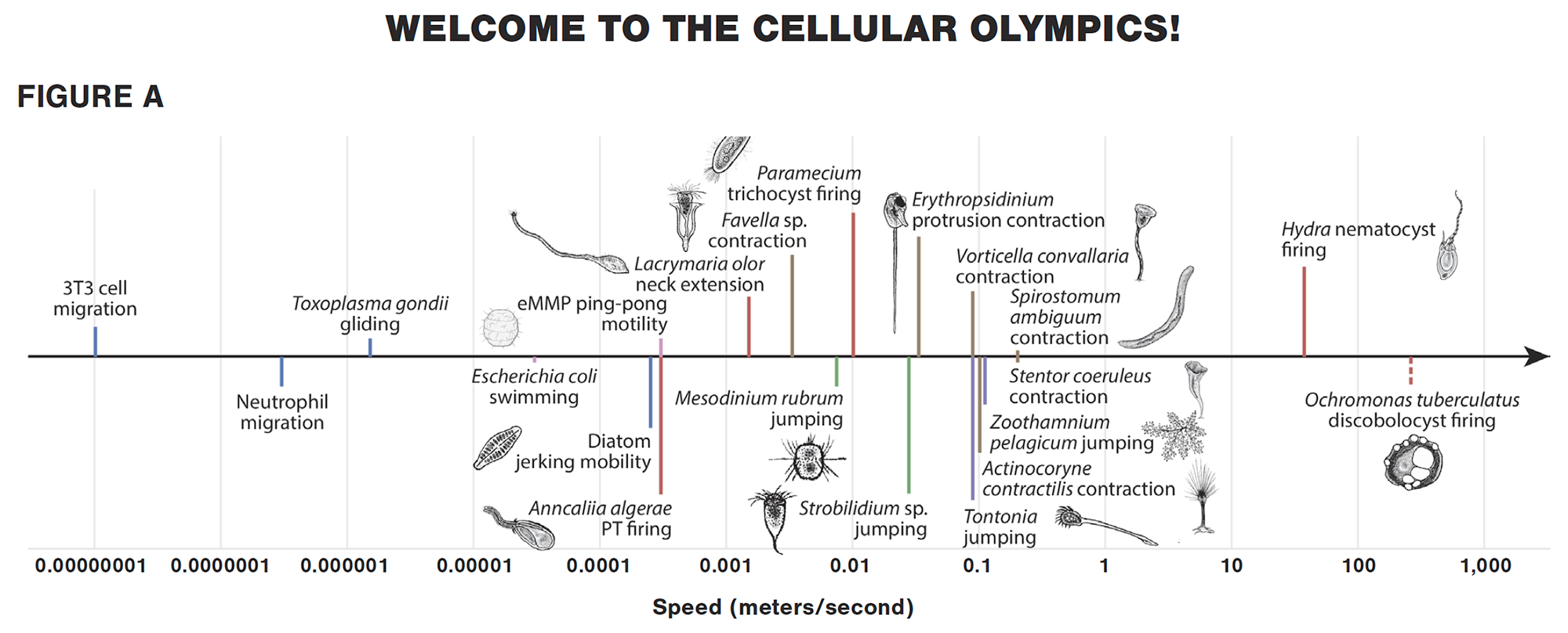
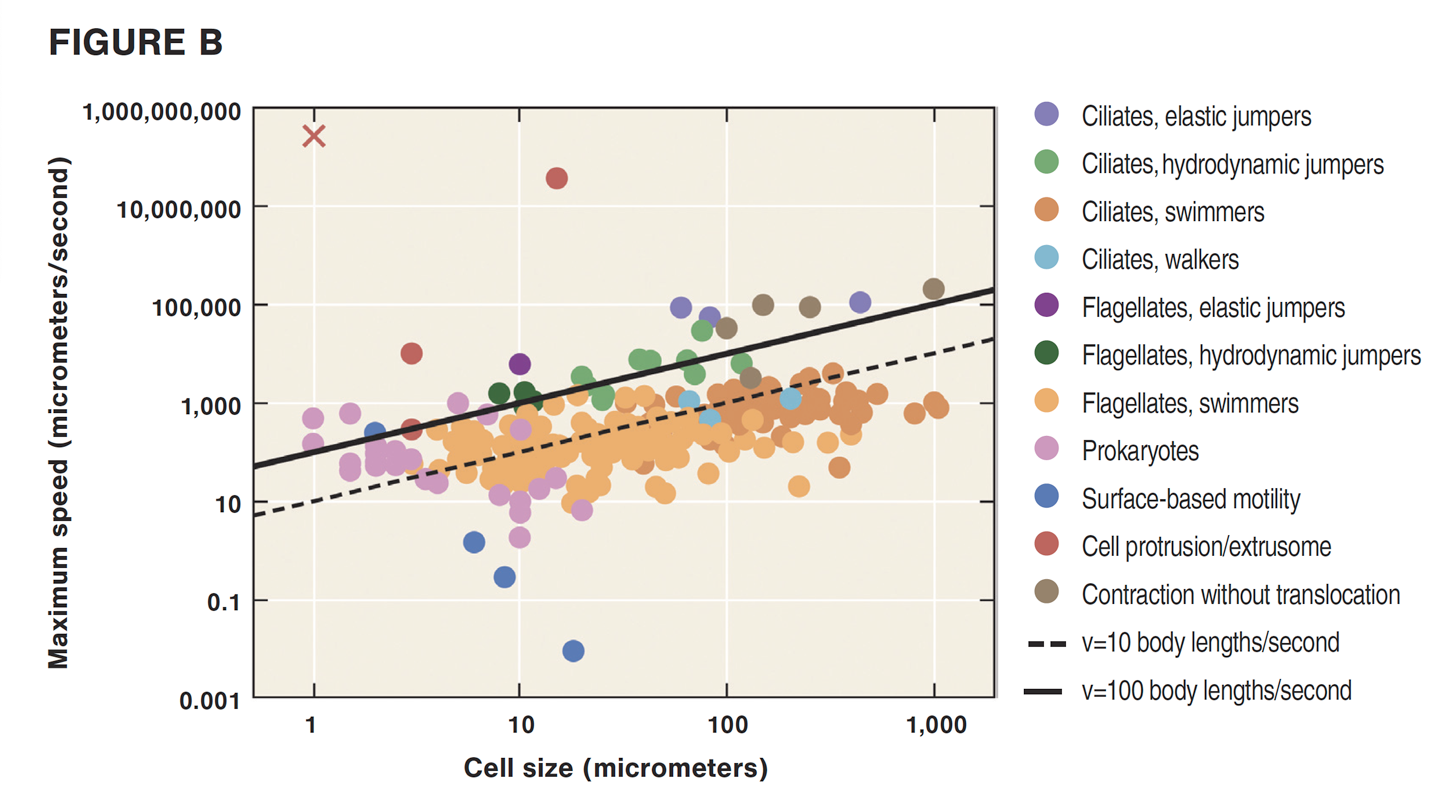 Both figures: Chang and M. Prakash/Annual Review of Microbiology 2025 (CC by 4.0)
Figure A shows the speeds of some of the fastest cells known and how they move. Figure B shows different cells’ size (x-axis) and maximum speed (y-axis).
Ciliates move using hairlike structures called cilia. Flagellates move using whiplike structures called flagella. They make many of the same types of moves, including swimming, walking, elastic jumping (movements by contracting cilia or flagella) or hydrodynamic jumping (using cilia or flagella to leap forward).
Prokaryotes include bacteria and archaea. Surface-based motility means that a cell moves along a surface. Cell protrusion or extrusome is when something pops out of a cell. And contraction without translocation means that the size of the cell changes but the whole cell’s position doesn’t.
Cells above the dashed line in Figure B move more than 10 body lengths per second. Cells above the solid line move faster than 100 body lengths per second.
algae: A group of single-celled and multicellular organisms, once considered plants (they aren’t). As aquatic organisms, they grow in water. Like green plants, they depend on sunlight to make their food.
annual: Adjective for something that happens every year.
bioengineer: Someone who applies engineering to solve problems in biology or in systems that will use living organisms.
cell: (in biology) The smallest structural and functional unit of an organism. Typically too small to see with the unaided eye, it consists of a watery fluid surrounded by a membrane or wall. Depending on their size, animals are made of anywhere from thousands to trillions of cells. Most organisms, such as yeasts, molds, bacteria and some algae, are composed of only one cell.
cilia: (singular cilium) Small hairlike features that occur on the surface of some cells and larger tissue structures. They can move and their wavelike motion can propel liquids to move in a particular direction. Cilia play an important role in many biological functions throughout the body.
data: Facts and/or statistics collected together for analysis but not necessarily organized in a way that gives them meaning. For digital information (the type stored by computers), those data typically are numbers stored in a binary code, portrayed as strings of zeros and ones.
DNA: (short for deoxyribonucleic acid) A long, double-stranded and spiral-shaped molecule inside most living cells that carries genetic instructions. It is built on a backbone of phosphorus, oxygen, and carbon atoms. In all living things, from plants and animals to microbes, these instructions tell cells which molecules to make.
eukaryote: Any organism whose cells have a nucleus. Eukaryotes include all multicellular creatures (such as plants, animals and fungi) as well as certain types of single-celled microorganisms.
flagella: (sing. flagellum) A thread-like structure that comes out of certain types of cells. The term derives from the Latin word for whip. And that's because the structures serve like oars to help these cells travel.
freshwater: A noun or adjective that describes bodies of water with very low concentrations of salt. It’s the type of water used for drinking and making up most inland lakes, ponds, rivers and streams, as well as groundwater.
microbiology: The study of microorganisms, principally bacteria, fungi and viruses. Scientists who study microbes and the infections they can cause or ways that they can interact with their environment are known as microbiologists.
migration: (v. migrate) Movement from one region or habitat to another, especially regularly (and according to the seasons) or to cope with some driving force (such as climate or war). An individual that makes this move is known as a migrant.
nucleus: Plural is nuclei. (in biology) A dense structure present in many cells. Typically a single rounded structure encased within a membrane, the nucleus contains the genetic information.
oceanographer: Someone who works in the branch of science that deals with the physical and biological properties and phenomena of the oceans.
organism: Any living thing, from elephants and plants to bacteria and other types of single-celled life.
outlier: (in statistics) An observation that lies outside the range of the rest of the data.
photosynthesis: (verb: photosynthesize) The process by which green plants and some other organisms use sunlight to produce foods from carbon dioxide and water.
planet: A large celestial object that orbits a star but unlike a star does not generate any visible light.
prokaryote: Any single-celled organism that does not have a nucleus or membrane-bound organelles.
solid: Firm and stable in shape; not liquid or gaseous.
toxin: A poison produced by living organisms, such as bacteria, algae and certain plants (such as poison ivy). Bees, spiders, snakes and other animals also produce toxins. These are referred to as venoms.
Carolyn Wilke is a former staff writer at Science News Explores. She has a Ph.D. in environmental engineering. Carolyn enjoys writing about chemistry, microbes and the environment. She also loves playing with her cat.
| # | Наименование новости | Тональность | Информативность | Дата публикации |
|---|---|---|---|---|
| 1 | Любопытная рысь, танец павлинов и детеныш носорога. 10 необычных фото диких животных | 0 | 16.25 | 11-10-2025 |
| 2 | Это варан или динозавр? Лучшие фотографии океана-2025 | 0 | 8.62 | 19-10-2025 |
| 3 | Клебо никогда не станет самым титулованным олимпийцем в истории. Объясняем почему | 0 | 8.86 | 18-02-2026 |
| 4 | От биатлона до саней. Победы российского спорта, которые вы могли упустить за праздники | 0 | 0 | 11-01-2021 |
| 5 | Белка читает, зебры танцуют, а жираф смотрит в зеркало. 10 невероятных фото диких животных | 0 | 13.45 | 13-12-2025 |
| 6 | Хватай удачу за хвост! 10 невероятных фото диких животных со всего света | 0 | 13.45 | 22-11-2025 |
| 7 | Cells pulse together as they grow—and malignant cells pulse the longest | 0 | 4.3 | 14-08-2026 |
| 8 | "Дом и семья всегда будут на первом месте". Татьяна Навка о спорте, любви и пандемии | 0 | 0 | 13-04-2020 |
| 9 | Алина Загитова. От красной балерины к дерзкой Ассоль | 0 | 0 | 01-05-2025 |
| 10 | Наука, которая объединяет: итоги недельного марафона в центре «Дом научной коллаборации» АлтГУ | 5 | 7 | 10-02-2026 |