Просмотр новости
Найдите то, что Вас интересует
 Спутники
 РН
РН SpaceX
 Роскосмос
 NASA
NASA
СпутникиРНSpaceXРоскосмосNASARansomware activity followed a recognizable pattern during the previous four years. Each year was defined by a dominant actor, its collapse, or a major supply chain incident. Black Kite’s 2026 Ransomware Report documents a more fragmented market, with multiple ransomware playbooks scaling at the same time. Monthly victim count by threat actor (Source: Black Kite) Between April 2025 and March 2026, 61 new ransomware groups entered the market, averaging more than one group per week. … More →
The post Ransomware in 2026: More groups, more victims, no slowdown appeared first on Help Net Security.
Ransomware activity followed a recognizable pattern during the previous four years. Each year was defined by a dominant actor, its collapse, or a major supply chain incident. Black Kite’s 2026 Ransomware Report documents a more fragmented market, with multiple ransomware playbooks scaling at the same time.
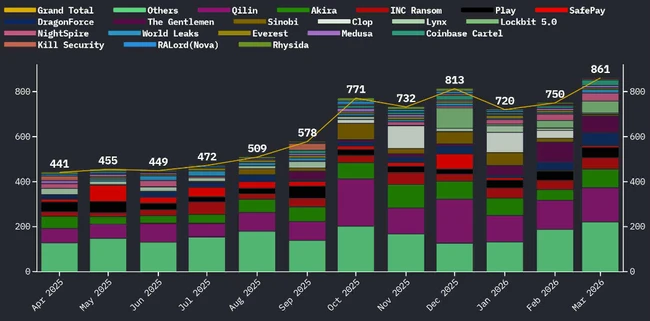
Monthly victim count by threat actor (Source: Black Kite)
Between April 2025 and March 2026, 61 new ransomware groups entered the market, averaging more than one group per week. By June 2026, the number of active threat groups had reached 146. The five largest groups accounted for 43.6% of all victims.
“Previous years were often defined by a dominant ransomware group or a single major event. This year was different. We saw more groups enter the market, while established operators continued to scale and attack volume accelerated in the second half. Those shifts fundamentally changed the shape of the ransomware landscape,” said Ferhat Dikbiyik, Chief Research & Intelligence Officer at Black Kite.
Ransomware victim trends and activityThe reporting period recorded 7,551 ransomware victims. Activity in the first half remained close to the previous year’s monthly baseline. Ransomware disclosures increased by 60% in the second half compared with the first.
The period from October 2025 through March 2026 marked a sustained increase in ransomware activity. Qilin became the largest volume operator. New groups added victim volume without displacing established operators. Several launched high-volume campaigns soon after entering the market, and some established groups declined or ceased operations.
Geographic distribution of victimsThe United States accounted for 49.3% of all observed victims and remained the most targeted country. Europe’s four most affected countries collectively recorded more than 250 additional victims during the reporting period. Several strengthened their positions in the global top 10.
Organizations operating across European markets should account for the region’s growing ransomware activity. Third-party risk programs centered on U.S. exposure profiles may leave European risks underrepresented.
Parts of Asia recorded some of the largest percentage increases. Country-level victim counts rose sharply across several markets in the region.
Industries most affected by ransomwareManufacturing remained the most targeted sector, followed by professional, scientific, and technical services. Construction, healthcare, wholesale trade, finance and insurance, information, and retail trade formed the next tier of targeted industries.
Weekdays accounted for 84.1% of all victim postings. Wednesday recorded the highest activity, and Sunday the lowest.
Organizations with annual revenue between $50 million and $100 million accounted for the largest share of victims by revenue band. The share of organizations generating more than $100 million annually declined from the previous reporting period.
Targeting patterns differed across revenue bands. Some ransomware groups ran high-volume campaigns against accessible organizations, with others concentrated on higher-value targets.
Warning signs, supply chain exposure, and attack techniquesSecurity misconfigurations, internet-facing remote access, software vulnerabilities, stealer logs, credential-related findings, and botnet activity appeared across the victim population.
Third-party services can expose organizations with strong internal controls to ransomware attacks. SaaS platforms, ERP systems, CRM applications, OAuth tokens, remote access tools, and connected business software have become common attack paths.
Encryption remained the primary method ransomware groups used to pressure victims into paying. Data theft added a second layer of extortion, and many groups combined both tactics. Qilin and Akira paired encryption with data theft, increasing operational disruption and the risk of sensitive data exposure.
AI is helping ransomware groups accelerate reconnaissance, phishing, social engineering, and extortion messaging. Lower barriers to entry are making ransomware campaigns more accessible to less experienced attackers.
Voice phishing, multilingual lures, voice cloning, and deepfake audio help attackers impersonate employees, manipulate help desks, and exploit identity-based workflows.
| # | Наименование новости | Тональность | Информативность | Дата публикации |
|---|---|---|---|---|
| 1 | Cyber Security Risk Conference 2026 | 0 | 5 | 02-07-2026 |
| 2 | Global Cyber Conference 2026 | 0 | 7 | 02-07-2026 |
| 3 | Gartner Security & Risk Management Summit – Japan 2026 | 3 | 6 | 24-10-2025 |
| 4 | Shadow AI is becoming enterprise security’s biggest blind spot | 0 | 10.21 | 23-07-2026 |
| 5 | The best-funded companies open the most phishing attachments | 0 | 9.78 | 24-07-2026 |
| 6 | Sysdig clocks first documented case of agentic ransomware | 0 | 7 | 06-07-2026 |
| 7 | Активность хакерских группировок: блокчейн как C2, business email compomise и антибот-фильтры | 0 | 10.89 | 22-07-2026 |
| 8 | Хакеры активизировали атаки шифровальщиками на туроператоров | -3 | 7 | 25-06-2026 |
| 9 | Reading between the lines of a cyber insurance policy | 0 | 7 | 16-07-2026 |
| 10 | SafePay Ransomware: FBI, CISA Advisory Urges Organizations to Take Security Measures, Warns of 600+ Victims | 0 | 10.83 | 21-10-2026 |