Просмотр новости
Найдите то, что Вас интересует
 Спутники
 РН
РН SpaceX
 Роскосмос
 NASA
NASA
СпутникиРНSpaceXРоскосмосNASADr. Dillon Pruett, Assistant Professor at the School of Communication Science and Disorders, presented at the Molecular Psychiatry Association conference from March 29 to April 1 in Lihue, Hawaii. His research, titled “The Gene VRK2 is Implicated in Genome-Wide Analyses of Stuttering, Language, and Rhythm Traits,” focused on findings from genetic analyses of stuttering involving ...
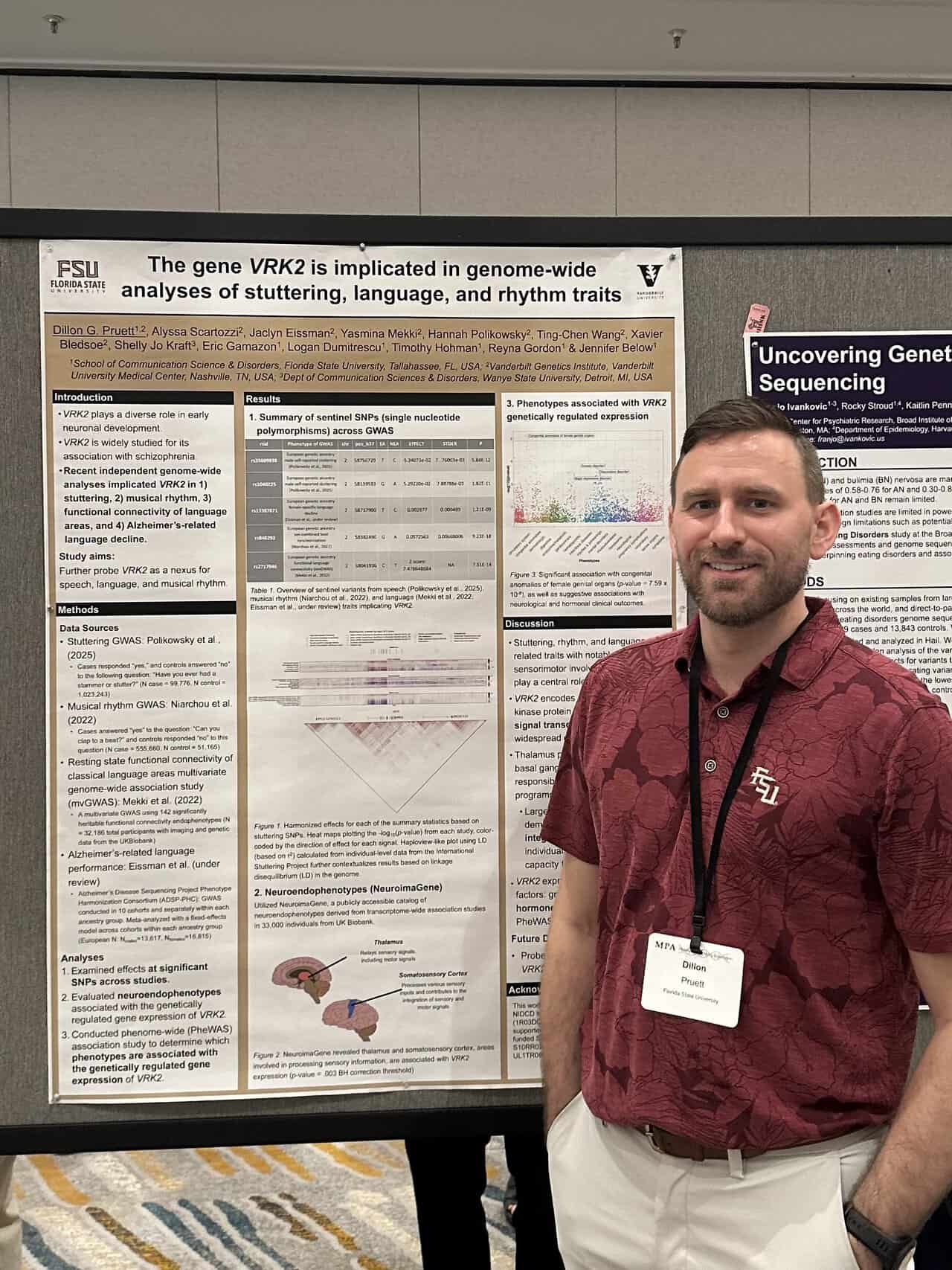
Dr. Dillon Pruett, Assistant Professor at the School of Communication Science and Disorders, presented at the Molecular Psychiatry Association conference from March 29 to April 1 in Lihue, Hawaii.
His research, titled “The Gene VRK2 is Implicated in Genome-Wide Analyses of Stuttering, Language, and Rhythm Traits,” focused on findings from genetic analyses of stuttering involving the VRK2 gene. The project served as a continuation of previous research conducted by Dr. Pruett and his team, using earlier findings to investigate further how genetic variants may influence speech and language traits.
“We conducted a large-scale genome-wide association study of stuttering, and one of the top genetic associations indicated a gene called VRK2,” said Dr. Pruett. “VRK2 was also a top association for independent genome-wide association studies of language and musical rhythm. We thought this was interesting because there are overlapping clinical associations between these traits. For example: both children and adults who stutter show greater variability on rhythm-based tasks and providing an external rhythm such as a metronome can temporarily increase speech fluency.”
 For Dr. Pruett, his research is more than an academic pursuit. As someone who stutters himself, he said his personal experiences have shaped his interest in understanding the condition and its underlying causes.
“I stutter, and I’ve always had questions about stuttering, and that has motivated my research in the field,” said Pruett. “We’ve known that stuttering tends to run in families, and the heritability of the trait is fairly high, but we’ve had a difficult time understanding the exact genetic components that are responsible for that heritability.”
Stuttering remains a relatively understudied area of research despite its impact on many individuals. “Stuttering is something that is a little bit of a niche area of research within genetics. It doesn’t get a whole lot of attentioncomparatively,” said Pruett.
With the goal of further exploring the connection between speech, language and rhythm traits, the research primarily relied on data from genome-wide association studies.
“Our main data sources were genome-wide association studies that were performed on stuttering, musical rhythm, resting state functional connectivity of classical language areas, and then Alzheimer’s related language decline. Then we did a variety of analyses to look and see how those genetic variants lined up for those traits,” said Pruett.
This year marked his second time presenting at the conference, after previously attending in March 2022. As the only Florida State University (FSU) representative presenting this year, he said the experience highlighted the kind of research being conducted at the university.
“I previously presented at this conference in March of 2022,” said Dr. Pruett. “It was good to represent Florida State and to show some of the work that we’re doing. And hopefully in the upcoming years, with the growth of FSU Health and the IPRD (Institute for Pediatric Rare Disease), this might be something that more FSU professors and students attend in the future.”
As research surrounding the VRK2 gene continues to develop, Dr. Pruett believes the findings offer a promising step toward better understanding the sensory motor processes involved in speech, language, and rhythm. While the research is still in its early stages, the connections identified between these traits may help researchers further investigate the biological mechanisms behind stuttering and eventually contribute to future clinical interventions, though he emphasized that the findings are still far from being fully validated.
“We are far away from validating those claims, but it opens doors for future novel interventions in that space,” said Dr. Pruett. “As FSU Health continues to grow, I feel like this is the space that I see myself in, providing a bridge between the basic science and the clinical world.”
For Dr. Pruett, the pursuit of answers about stuttering is both professional and personal. As research into the VRK2 gene and related speech and language traits continues, he hopes to contribute to a deeper understanding of the condition while helping build connections between scientific discovery and clinical care. Through this work, he aims to advance knowledge in a field that has historically received limited attention and inspire future research that could benefit individuals who stutter.