Просмотр новости
Найдите то, что Вас интересует
 Спутники
 РН
РН SpaceX
 Роскосмос
 NASA
NASA
СпутникиРНSpaceXРоскосмосNASASing in me, Muse, of sexy goddesses, crafty twists, and killer practical effects.
By Dana Stevens
Enter your email to receive alerts for this author.
Sign in or create an account to better manage your email preferences.
Unsubscribe from email alertsAre you sure you want to unsubscribe from email alerts for Dana Stevens?
July 15, 20264:51 PM
Sign up for the Slatest to get the most insightful analysis, criticism, and advice out there, delivered to your inbox daily.
Anyone who’s taken a course with Homer’s Odyssey on the syllabus has probably heard the ancient Greek adjective polytropos, the formal epithet that attaches to the poem’s far-wandering protagonist. Literally translatable as “many-turned,” the word has been rendered over the centuries as skilled, crafty, changeable, manifold, and complicated. As the identifying quality of an epic hero, it’s an unusual choice: What the poet asks us to consider again and again, nearly every time the character reappears in the story, is not Odysseus’ courage or prowess in battle (though he displays plenty of both) but his clever ability to adapt. Odysseus is a master of disguise and an expert appraiser of sticky situations. As much as it is a suspenseful action tale, the Odyssey is an episodic trickster narrative in which we watch the hero pull up to one magical island after another and either outsmart or be outsmarted by its denizens.
Christopher Nolan might be described as a polytropos filmmaker, a director of many turns, forever enamored of twisty plotlines, audience-teasing logic puzzles, and images that bend the space of the screen itself into a pretzel. His now three-decade-long career could be seen as an extended journey from one genre island to the next: the neo-noir thriller, the comic-book blockbuster, the sci-fi adventure, the prestige biopic. Maybe it’s because Nolan identifies with the poem’s shape-shifting hero that his adaptation of the Odyssey, a gargantuan $250 million spectacle shot entirely on IMAX cameras and piled high with A-list movie stars, somehow feels like his most personal project to date. As a viewer who has often admired Nolan’s movies more than I loved them, I might go so far as to name The Odyssey as my favorite of his films. But your mileage—like the strategies Odysseus tries out against the witches, monsters, sexy goddesses, and angry gods who slow his progress home—may vary.
The primary impression that remains after a first viewing of this nearly three-hour-long movie is one of scale. Scale, not size: Though many of the images (the towering walls of Troy, the vast bulk of the Cyclops, the endless expanse of the sea) are indeed monumental in their proportions, what’s memorable is the way Nolan’s camera, wielded as usual by the superb cinematographer Hoyte van Hoytema, shows us at once those awe-inspiring sights and the human-size details that drive the story forward. Seen from high above, the sea’s immensity contrasts with the tiny figure of Odysseus (Matt Damon) as he walks alone through the surf. An imposing shot of Odysseus’ home, a hilltop castle on the island of Ithaca, tells us less about the world he longs to return to than does a close-up of his wife, Penelope (Anne Hathaway), seen through the threads of her loom as if through a scrim. Nolan’s magic trick here is his ability to modulate between scales from grand to intimate with an ease that this often-maximalist artist has at times struggled to find. The result is a 27-century-old legend that plays like a thrilling Saturday-afternoon matinee—swordfights, sea monsters, sexy mermaids, cosmic vengeance—when it isn’t reducing the viewer to tears with a brief dialogue exchange conducted in a whisper.
The script, also by Nolan, incorporates only a small part of the opening of Homer’s poem, which is concerned with the journey of Odysseus and Penelope’s son Telemachus (Tom Holland), in search of news about the father who left him behind as an infant to fight in the Trojan War. Twenty years later, the other survivors, including the Spartan King Menelaus (Jon Bernthal), have long since returned home. But Odysseus’ continued absence has left Ithaca in a state of leaderless unrest, with dozens of suitors competing fruitlessly to win Penelope’s favor while they eat and drink their way through the absent king’s stocks of food and wine, thereby defiling Zeus’ sacred law of hospitality. Telemachus travels to Sparta to speak to Menelaus, bringing back a message for his mother from the Spartan Queen Helen (Lupita Nyong’o), whose kidnapping by the Trojan prince Paris was the cause of—or at least the patriarchal pretext for—Greece and Troy going to war in the first place.
It’s a half hour into the movie before we glimpse Odysseus in anything other than a quick flashback: He’s trekking across that empty beach, stranded on an island with no inhabitant other than the nymph Calypso (Charlize Theron). Calypso’s isle will turn out to be the final stop on Odysseus’ journey, but before he embarks for home, he has a story to tell, if he can only remember it. For the past seven years, Calypso has kept him captive by feeding him the oblivion-inducing lotus flower (a detail nabbed from a separate chapter of the original poem).
As Odysseus emerges from his lotus-eating haze, he begins to recall how, after the Greeks prevailed in the 10-year-long war, he set sail for home with a ship full of soldiers, including his loyal right-hand man Eurylochus (Himesh Patel). But early on in their trip, his men fell afoul of a cave-dwelling, human-munching Cyclops (Bill Irwin). Their short but bloody encounter with the colossal one-eyed shepherd brings the wrath of Poseidon, the Cyclops’ father, down on the crew, and the rest of their trip is beset with violent storms at sea and delays of all sorts during their frequent returns to land. At one stop they meet Circe (Samantha Morton), a witch who transforms all the men but Odysseus into pigs. Later on, they find themselves stranded on an island, their food supplies dwindling, as the sun god’s forbidden cattle graze nearby. Should the men risk committing sacrilege in order to avoid starvation?
Not every one of the film’s island-hopping sequences is as riveting as the three I mention above. A meeting with a population of armor-clad giants is over too quickly to observe much about those creatures’ culture, and given Calypso’s pivotal importance to the story, I would have liked to know more about her memory of the stoned but apparently happy seven years Odysseus spent in her company. Theron was born to play the role of an existentially lonely half-divine being, but she seems wasted in a role that doesn’t ask much more of her than to look sensational (as she does) in what appears to be a loose-woven fishnet.
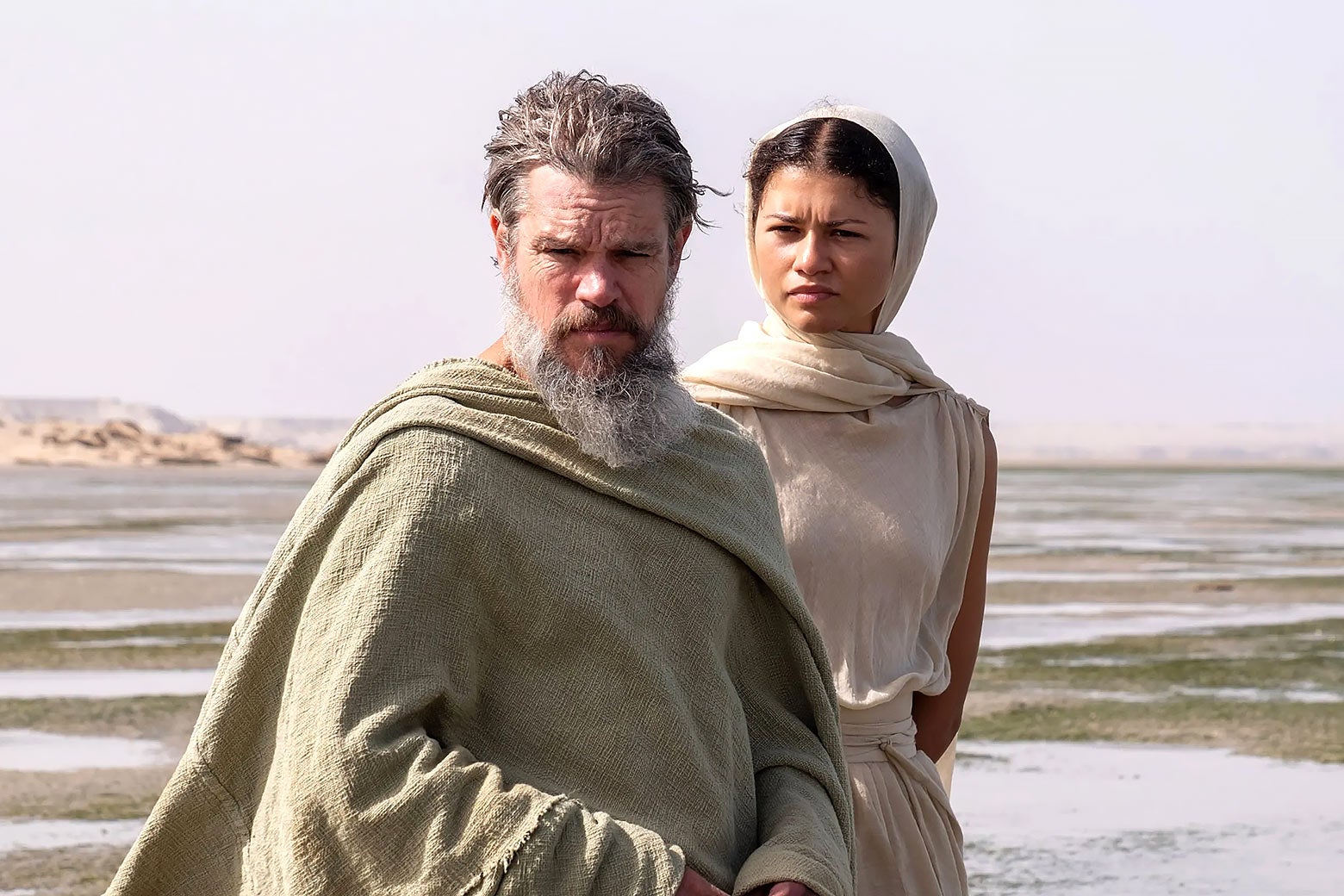
That said, The Odyssey otherwise boasts some of the best female characters yet to appear in a Nolan movie, given that creating roles for women has not typically been this director’s strong suit. Morton plays the witch Circe as a barn-burning radical feminist, whose multistage transformation of the sailors into pigs (the state she believes to be their true nature) makes for a sequence of stomach-churning body horror, and one all the more effective for its use of old-fashioned prosthetics and cinematic sleight of hand. Hathaway’s Penelope is pricklier and more ambivalent, including toward her own too-big-for-his-britches son, than might be expected of a character who’s archetypically defined by her unflagging patience and loyalty. And the goddess Athena—Odysseus’ protectress, who appears to him in the form of a linen-tunic-clad Zendaya—plays a role in the hero’s inner life that’s sometimes akin to a therapist and sometimes to an exceptionally hard-ass life coach. The Odyssey may not pass the Bechdel Test—none of the women talk to each other about anything but men, unless you count the message Helen whispers to Telemachus to take back to his mother (and even that message, come to think of it, is sort of about men too). But what the women say to one another about men, and about the broken world male violence leaves behind, is almost invariably truthful, well observed, and savage.
One subplot that’s entirely new to the Homerverse involves a couple of flashbacks to the beginning of the Trojan War, as we learn a little more about the childhoods of Sinon (played as an adult by Elliot Page), who soon gives his life so that the soldiers hidden in the wooden horse can get through the gates of Troy undetected, and Antinous (played with quasi-campy villainy by Robert Pattinson), who grows up to become the sleaziest of all Penelope’s suitors. The contrast between these two men’s value systems, the one devoted to honor and sacrifice, the other to freeloading and usurpation, highlights a key theme of The Odyssey, both poem and movie. What is the balance between divine duty and mortal fallibility? When, if ever, should our human needs and desires, however base or noble, take precedence over the gods’ laws? These are puzzles nearly every mortal character in the movie confronts directly, not in abstract conversational form but through their day-to-day struggles for survival.
Among my favorite things about this Odyssey is the film’s use of large-scale practical effects—not in every shot, given the plethora of monsters and magic beings on display, but those are seaworthy boats sailing on the real Mediterranean, not green-screen mockups. The astonishing Cyclops scenes were done with a mixture of puppetry, CGI, and animatronics, including a 60-foot-tall creature operated by Irwin himself. That Nolan filmed these scenes in an actual cave in Greece—one traditionally believed to be the birthplace of Zeus—is a mark of either hubris or divine inspiration. All I know is that the result, which deliberately references the stop-motion marvels of Jason and the Argonauts animator Ray Harryhausen, elicited gasps in the theater, some from my own mouth. No creature that appears further on packs quite the visual punch of that magnificent, melancholy one-eyed beast, but a scene when Odysseus and his crew must navigate between the six-headed monster Scylla and the deadly whirlpool Charybdis also delivers on the mythological-awesomeness front.
There will be arguments—pointless arguments—about the “historical accuracy” or presence of “anachronisms” in this adaptation of what might fairly be regarded as the oldest piece of IP in the Western world. Though the choices in costuming (Ellen Mirojnick), production design (Ruth De Jong), and music scoring (Ludwig Göransson) are all clearly the result of extensive research, the intention guiding Nolan’s choices is not to re-create a specific period in exact detail. Such a goal would make no sense, given that The Odyssey is a work of fiction, one that evolved in oral form over centuries before it was written down and incorporated imagery from all of those periods. Which historical era would a “faithful” representation be trying to capture? This movie’s vision board draws not only on the iconography of Bronze Age Greece, but on familiar Hollywood images of epic grandeur: David Lean films, sword-and-sandal sagas like Spartacus or The Ten Commandments, and those Harryhausen-animated skeletons thrillingly emerging from the earth, the way the souls from Hades do in this movie’s other great horror-adjacent scene.
The mythic era Nolan is trying to evoke doesn’t need to be measured against whatever evidence survives of real material culture in preclassical Greece. It just needs to feel like a solid and consistent world, a place where the gods (who, Zendaya’s Athena excepted, appear only in the form of natural forces like wind, thunder, and fire) are a steady, even casual presence in the everyday lives of men and women. The Homeric epics began as oral literature recited around the fire, so I guess it’s fitting that they continue to be the subject of lively fan discourse. But if all your muse can think to sing about is the anachronistic armor worn by the mighty king Agamemnon (Benny Safdie, barely visible beneath a Dark Knight–like carapace of blackened bronze ornamented with a sick-as-hell gold vertebral column), I suggest seeking out a campfire with better bards.
Very late in the film, as the disguised Odysseus is plotting how to remove the loathsome suitors from his palace, his faithful old swineherd Eumaeus (John Leguizamo) seeks reassurance from this hooded stranger: Will Odysseus really return? He will, the unknown guest assures the servant. “Bringing vengeance?” asks Eumaeus, his quavering voice still hopeful. Odysseus’ steely reply—“bringing it all”—might sound cocky, given that at this point he’s a gray-haired, battle-worn vet without a single soldier left to fight at his side. But after witnessing his journey up to this point, we know that this hero’s “all” lies less in his physical strength (though he is about to start whaling hard on those suitors) than in his mixture of craft, guile, and insight into human nature. Nolan, too, is bringing it all this time around. Thankfully, the only slaying he’s doing is metaphorical, and this audience member, for one, is ready to get slain all over again.
Read more in Slate about The Odyssey.
Get the best of movies, TV, books, music, and more.