Просмотр новости
Найдите то, что Вас интересует
 Спутники
 РН
РН SpaceX
 Роскосмос
 NASA
NASA
СпутникиРНSpaceXРоскосмосNASAIt’s a funny old world, isn’t it? A few years ago, if you wanted to record a podcast that didn’t sound like you were shouting into a tin can from the bottom of a well, you had to sell a kidney, buy a Shure SM7B, and then spend another few hundred quid on a “Cloudlifter” just to make the thing audible. But then things changed. USB mics got decent. Then XLR/USB “hybrids” turned up. And now, Maono—a company that’s been quietly churning out some surprisingly “not-rubbish” gear lately—has gone and cut the cord entirely. Enter the Maono PD200W. It’s a
The post Maono PD200W. Dynamic Microphone – Review. is original content from Coolsmartphone. If you see it on another news website, please let us know.
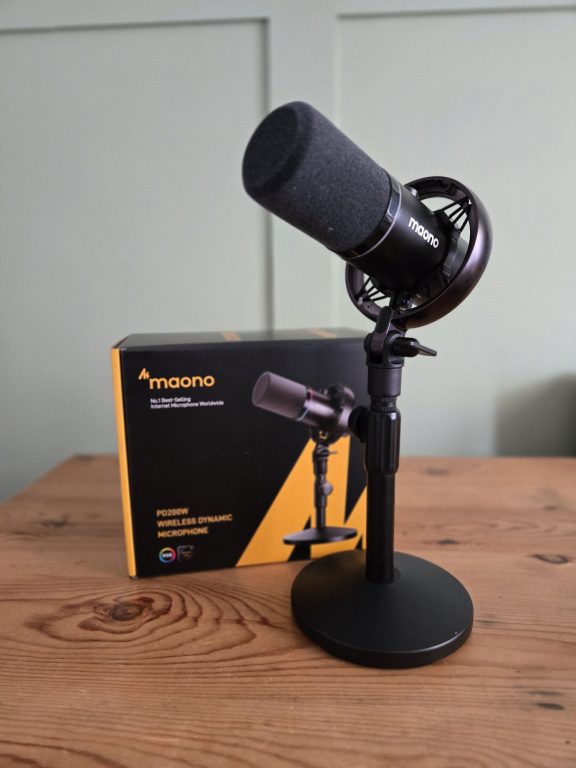
It’s a funny old world, isn’t it? A few years ago, if you wanted to record a podcast that didn’t sound like you were shouting into a tin can from the bottom of a well, you had to sell a kidney, buy a Shure SM7B, and then spend another few hundred quid on a “Cloudlifter” just to make the thing audible.
But then things changed. USB mics got decent. Then XLR/USB “hybrids” turned up. And now, Maono—a company that’s been quietly churning out some surprisingly “not-rubbish” gear lately—has gone and cut the cord entirely.
Enter the Maono PD200W. It’s a dynamic microphone that works via XLR (for the pros), USB-C (for the lazy), and 2.4GHz wireless (for the people who trip over cables).
I’ve had one in my grubby mitts for a week. I’ve recorded in my office, in my kitchen, and I even took it into the garden just to see if the neighbours would call the police.
Here is the lowdown on whether this “do-it-all” mic is a stroke of genius or just a bit too ambitious for its own good.
Design and Build: The “Heavy Metal” Vibe
The Look and Feel: “Not Just Another Plastic Tube”
First off, when you pull this out of the box, it doesn’t feel like a toy. At about £99 (though you can often find it for less if you’re “canny” with Amazon vouchers), you might expect something hollow and rattly.
Instead, you get a hefty, all-metal barrel with a matte finish that’s surprisingly good at hiding fingerprints—which is great for those of us who eat crisps while we edit.
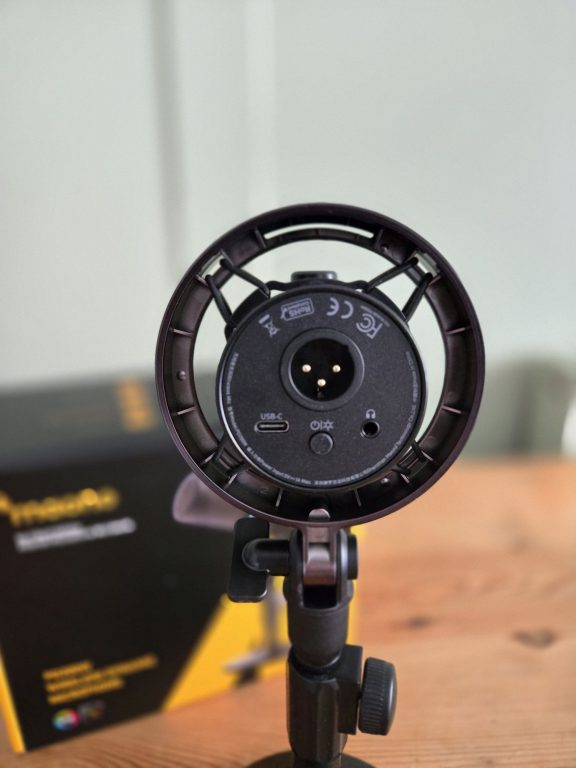
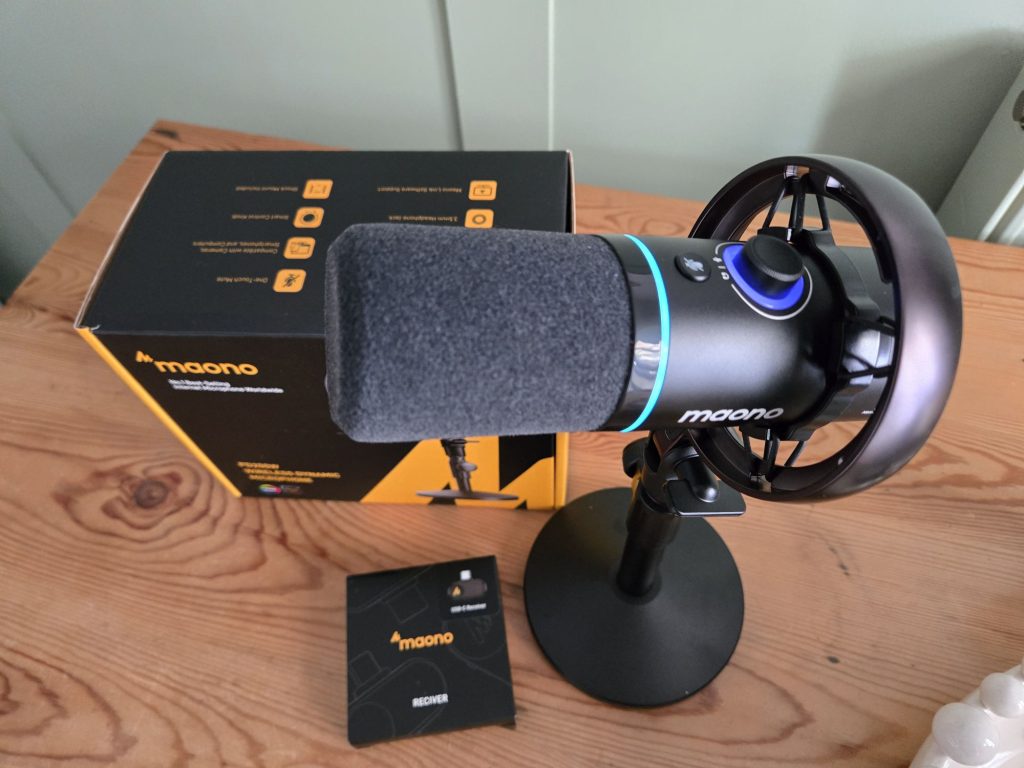
It comes with a shock mount already attached, which is a nice touch. It looks a bit like the Shure MV7’s younger, slightly more rebellious cousin. There’s an RGB ring around the middle because, apparently, it’s 2026 and if your tech doesn’t glow like a Blackpool pier, it doesn’t exist. Fortunately, you can turn the lights off if you want to look like a serious adult.
The “Dongle” Situation: Wireless Wizardry.
This is the headline act. At the bottom of the mic, tucked away like a secret, is a tiny USB-C wireless receiver.
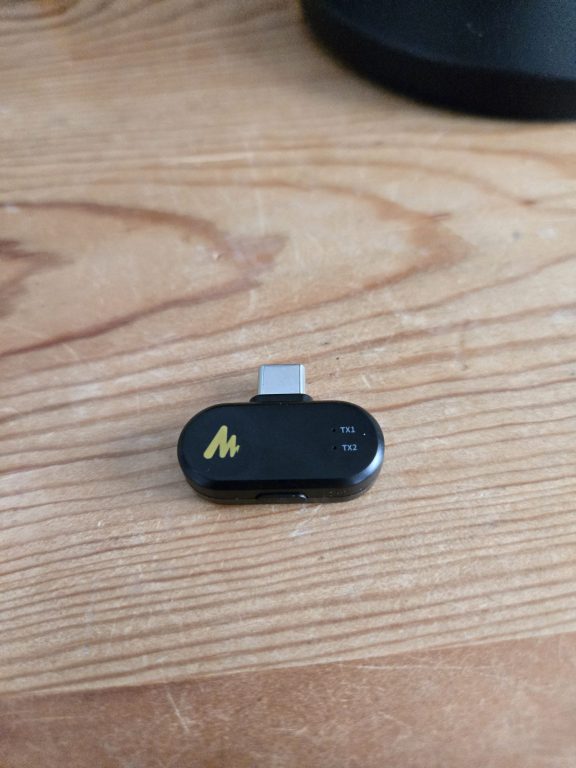
The beauty of this is simplicity. You take that receiver, plug it into your laptop, your Android phone, or even your iPhone (if you’ve got a USB-C one or an adapter), and boom—you’re recording. No drivers, no pairing menus that make you want to throw your PC out the window, and no Bluetooth lag.
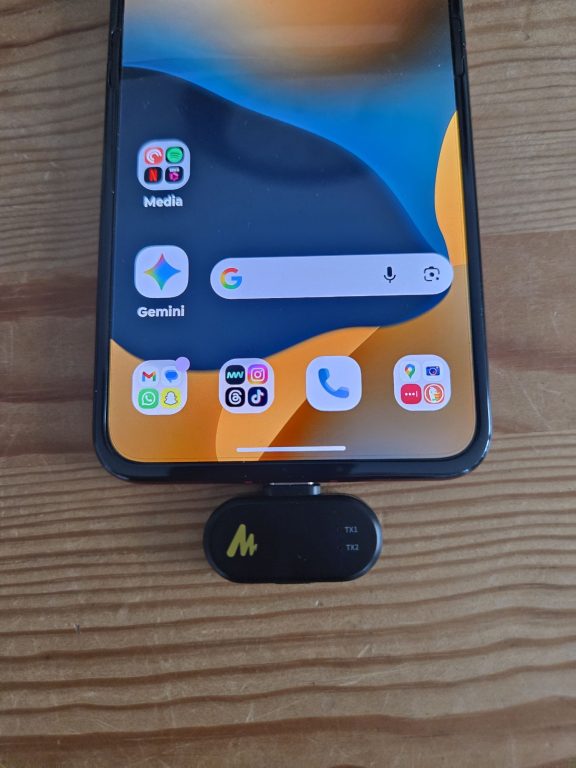
Because it uses 2.4GHz wireless (the same tech as a wireless mouse), the latency is virtually zero. I tried recording a guitar track while monitoring through the headphone jack on the mic, and I couldn’t detect any delay. That’s impressive for a sub-£100 kit.
Sound Quality: Punching Above Its Weight.
At its heart, this is a dynamic microphone. For the uninitiated, dynamic mics are the “workhorses” of the audio world. Unlike condenser mics (like the Blue Yeti), which pick up every sound from your neighbour’s lawnmower to your own heartbeat, dynamic mics are directional. They focus on what’s right in front of them and ignore the rest.
If there’s one “Bad Point” I have to flag, it’s the mute button.
On the front of the mic, there’s a physical button. When you press it, the light turns red, and you’re muted. Great. However, it’s a physical click. In a recording, that “click” is audible. If you’re in the middle of a live stream and you need to cough, your audience is going to hear a “thump-click” followed by silence. I would have loved to see a capacitive “touch” mute here, but for the price, I can live with it—just maybe don’t mash it like you’re playing Track & Field.
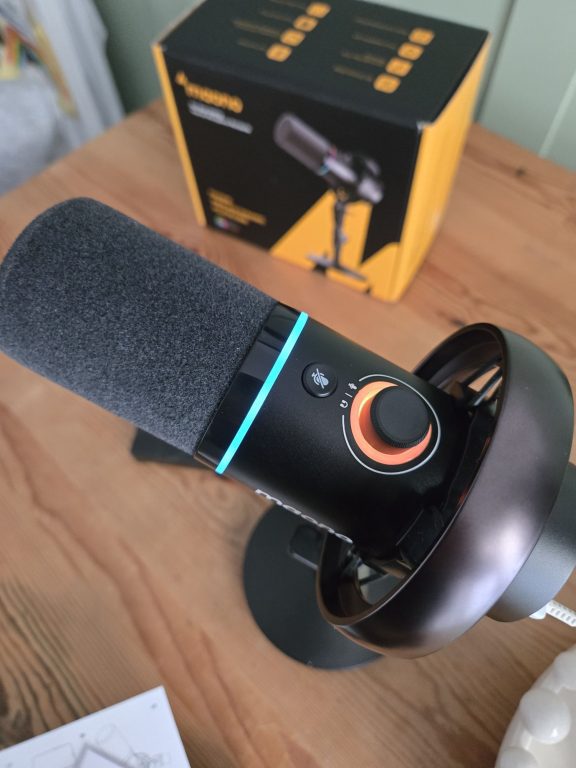
The gain knob, on the other hand, is lovely. It’s a 2-in-1 “smart knob.” You turn it to adjust how loud you are (gain), or you click it once to switch to “Headphone” mode, where the same knob adjusts the volume of the zero-latency monitoring in your ears. It’s intuitive and stops the mic from being cluttered with fifty different dials.
Software: Maono Link.You don’t need the software to use the mic, but you’d be a bit daft not to install it. The Maono Link app is surprisingly polished.
It gives you:
Usability & Portability: The “Kitchen Test”
I took the PD200W into the kitchen to record a quick “cooking podcast” (basically me complaining about how long it takes to boil an egg). Being wireless meant I could move the mic around without a 3-metre cable dragging through the flour.
The range is quoted at 60 metres. In a house with thick British brick walls, I got about 10-15 metres before it started to jitter. That’s more than enough for anyone who isn’t trying to broadcast from their shed while their PC is in the attic.
The battery life is a claimed 60 hours (with the lights off). With the RGB blasting, I got about 30 hours. Honestly, if you’re recording for 30 hours straight, you’ve got bigger problems than a dead microphone. Charging is via USB-C, and it’s relatively quick.
The VerdictGood Points:
Bad Points:
Final Thoughts.
The Maono PD200W is a bit of a disruptor. For years, if you wanted a decent dynamic mic, you had to spend £200+ and buy a load of extra gear. Maono has basically said, “Here’s everything in one box for a ton.”
It’s perfect for the “bedroom creator” who wants to sound like a pro without the pro price tag. It’s also a godsend for anyone who hates cables as much as I do. Is it perfect? No—that mute button needs a rethink. But for the money, you’ll be hard-pressed to find anything that offers this much flexibility and this level of “radio-ready” sound.
Rating: 4.0 / 5 — A “Coolsmartphone” Essential for anyone tired of sounding like they’re talking through a tin can on a string.
| # | Наименование новости | Тональность | Информативность | Дата публикации |
|---|---|---|---|---|
| 1 | The New Maono PD200W Review | 2 | 6 | 31-03-2026 |
| 2 | DJI Mic Mini 2S vs Rode Wireless Micro: Which microphone is best for you? | 0 | 18.51 | 17-08-2026 |
| 3 | OneOdio Launches the Studio Max 2 Wireless DJ Headphones: Next-Gen Ultra-Low Latency Performance for DJs, Creators, and Audio Professionals | 5 | 7 | 13-05-2026 |
| 4 | Groov-e Neo Buds – Review | 0 | 5 | 10-03-2026 |
| 5 | Plaud Note Pro – Review. The Credit-Card Sized Brain for Your Phone. | 5 | 7 | 28-04-2026 |
| 6 | Twelve South Power Capsule – Review. | 2 | 5 | 13-03-2026 |
| 7 | HiDock Showcases P1 AI Voice Recorder with Bluetooth Earphone Call Capture, Multi-Mode Recording and the HiNotes 3.0 AI Productivity Platform: A Complete Workflow for Capturing, Transcribing and Organising Conversations. | 5 | 7 | 15-04-2026 |
| 8 | Cutting the Cord (Mostly): A Deep Dive into the INIU SnapGo Air 10000mAh Power Bank. | 2 | 7 | 21-06-2026 |
| 9 | The CUKTECH 30 Ultra: Is This the End of Your Cable Nightmare? | 5 | 7 | 02-06-2026 |
| 10 | TESSAN Universal Travel Adapter – Review. | 0 | 5 | 04-03-2026 |