Просмотр новости
Найдите то, что Вас интересует
 Спутники
 РН
РН SpaceX
 Роскосмос
 NASA
NASA
СпутникиРНSpaceXРоскосмосNASAThe company has endured its worst time in a decade, after a software glitch sent the country’s biggest telco into crisis.
The first sign of trouble for Vicki Brady came as a Teams message and a voicemail from her head of operations. He’d reached for Teams because his own phone, on the network he runs, had stopped working. The Telstra chief executive was overseas on holiday, where it was still Tuesday evening, when she saw them and understood the network was collapsing.
She called him back within minutes and started the long journey home. Even her own senior staff, it later emerged, were resorting to Teams because their phones weren’t working. Half a world away, the reason was sitting in a data centre: a timing node, one of the unglamorous boxes that tells the rest of the mobile network what time it is, had restarted during routine work. When it came back up, it had travelled through time.
A software fault, triggered by the restart, wound the clock back exactly 1024 weeks. As far as that corner of Australia’s biggest mobile network was concerned, it was suddenly November 2006. John Howard was prime minister. The iPhone did not exist. And a network that depends on precise, synchronised time to authenticate the phones connecting to it began, slowly and then quickly, to reject them.
“There was a glitch in the software that reset the GPS timer,” chief financial officer Michael Ackland, who was delegated to act in Brady’s position while she was away, later said, confirming earlier reporting by this masthead. “It was a software glitch that caused the time to click back.”
By 4.20am Sydney time, the fault was propagating outwards through thousands of servers, spreading as more Australians woke up and reached for their phones. By breakfast, Victoria’s entire regional train network had stopped. Payment terminals died in cafes. Electric vehicle chargers went dark. Customers of Boost, Belong and Aldi Mobile, which piggyback on Telstra’s network, dropped out too. And, most seriously of all, hundreds of calls to Triple Zero failed to connect.
What followed was the worst week Telstra has endured in a decade: days of shifting numbers; a second fault that emerged hours after the company had declared victory; a death that was thought to be linked to a failed Telstra Triple Zero call, before police ruled this out on Friday; and a regulator now circling with penalties of up to $30 million per breach on the table.
Inside the company, executives said the crisis machine worked. “We’ve got processes that get enacted very quickly,” one Telstra executive told this masthead, describing a rolling cadence of incident meetings that ran around the clock. “I can safely say it wasn’t panic. You train for the worst-case scenarios.”
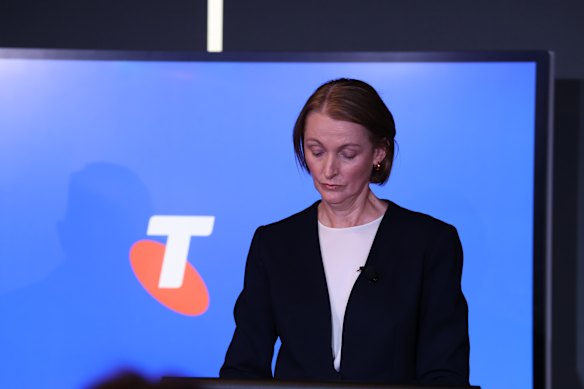
The trouble is that the numbers kept moving. On Wednesday morning, Ackland told reporters that Triple Zero calls used different network settings and were “not impacted in the same way”, though the company was investigating a small number of reports. By his second press conference that afternoon, he was apologising for letting customers down “in their hour of need”. About 300 welfare checks were under way. At 5.15pm, the company declared the network operational. Hours later, a second fault surfaced, stemming from the same software defect but requiring a different fix.
By Thursday, the tally of failed Triple Zero calls had roughly doubled to more than 600. Telstra had conducted 639 welfare checks by that afternoon, Ackland said: 170 cases were passed to police and seven people told the company they needed help. In one case that made national headlines, a 95-year-old woman in the NSW Hunter region collapsed and could not summon help through her personal alarm, which ran on Telstra’s network.
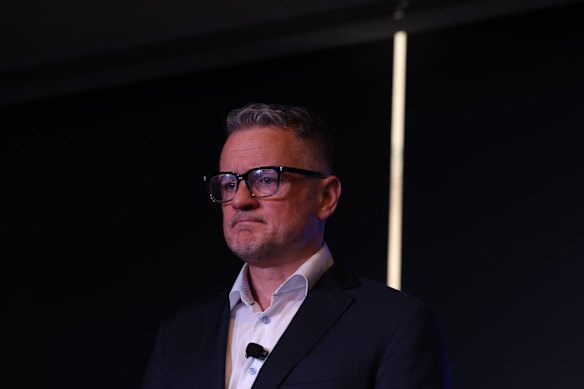
“It absolutely gradually got worse,” Ackland said on Friday, “as the time synchronisation propagated out through the network.”
The uncomfortable question for Telstra is why nobody stopped it, because the fault was entirely foreseeable. The 19.6-year GPS “week number rollover” is a well-documented quirk: the satellite system’s internal week counter maxes out at 1023 and resets to zero, and receivers without updated firmware can lurch backwards two decades. It is Y2K’s less famous cousin.
One Telstra employee pointed this masthead to ageing timing hardware in the company’s data centres that had reached end of service life in 2016, when the cost of replacement was estimated at about $US15,000 ($21,600) per server. “This is what happens when Telstra makes so many employees redundant and offshores critical roles,” the employee said. Telstra was sent detailed questions for further comment but it did not respond before deadline.
A recent former insider went further: they said that legacy systems flagged for replacement were routinely thrown into the “too expensive, too hard basket”, and that the risk that stale time synchronisation posed to network authentication once sparked a heated internal meeting. “None of this should be new or a surprise to anyone in the company,” the insider said.
Another former employee described how quality assurance is rationed under Telstra’s outsourcing contracts and that work is allocated by a quarterly points system. When the points run out, “something has to give way, usually testing”. Before 2019, they said, Telstra’s deployment procedures were rock solid; under the banner of agile delivery, corners get cut.
External warnings were on the record too. The federal government’s Cyber and Infrastructure Security Centre issued public alerts in 2024 and again last October about critical infrastructure’s dependence on satellite timing. Swinburne University professor Allison Kealy said she raised the scenario directly with Telstra this year. Asked about it on Friday, Brady said the company had engaged with Kealy “on a wide range of things” and that she welcomed the input.
Brady and Ackland both flatly reject any link between the outage and years of job cuts under the company’s Connected Future 30 strategy, under which hundreds of roles have been shed or shifted to Infosys and Accenture. “There is no indication that any restructuring of jobs has impacted on this particular issue,” Brady said. The Communication Workers Union, which called the outage “utterly shameful”, is unconvinced.
The scare, and the circusFor 36 hours, the country braced for confirmation that the outage had killed someone. Liberal senator Kerrynne Liddle posted on Wednesday night that her office had received a report of a death after a failed Triple Zero call in South Australia. Liddle did not provide any details about the alleged incident, saying she wanted to “prioritise the privacy” of the grieving family.
Police, who said they tried repeatedly to reach the senator that night before finally speaking to her office on Thursday, opened an investigation into the death of a woman at a regional hospital.
On Friday afternoon, it fell apart. SA Police confirmed that the report of a failed call was incorrect; two calls had been made from a Telstra number without difficulty. Telstra’s own network records showed no failed calls from the address and good signal strength in the area. “It’s a huge relief,” Communications Minister Anika Wells said, though she was “staggered” at the effort required to extract the information.
The scare capped an ugly political sideshow. Opposition figures floated Chinese missile tests as a cause, without evidence. Opposition communications spokeswoman Sarah Henderson made test calls to Triple Zero during the outage and was accused of tying up a system under strain. She refused to apologise, noting Telstra’s requests to “please do not test Triple Zero”. She said she “had a couple of failed calls this morning” and “obviously, I needed to know if Triple Zero was working”.
Wells, who cut short her own leave, was scathing about all of it.

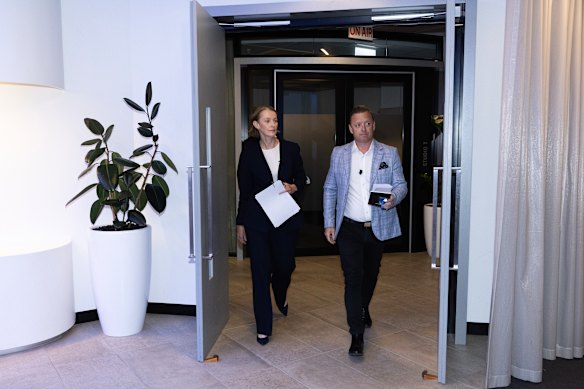
Brady’s flight landed on Friday morning. She got in a car, crossed town to the office and walked straight into a press conference. She had already briefed the prime minister that morning. “We have let our customers and Australians down, and for that I am deeply sorry,” she said. She deflected questions about surrendering her bonus to board processes, and about compensation to “business as usual” channels, an answer that landed badly with small businesses that had lost a day’s takings.
Hours later, Wells delivered the government’s verdict. “It is time for Telstra to face the music,” she said. She promised to hold the company’s “feet to the fire”. The Australian Communications and Media Authority opened its investigation on day one; Telstra must deliver a full explanatory report within 45 days, and the regulator’s conclusions will be made public.
There were mercies. Welfare checks began within minutes, against the 13 hours Optus took last September, and Wells credits the new Triple Zero Custodian regime with possibly saving lives. Even rivals offered sympathy rather than schadenfreude. “When I heard about it on Wednesday morning I had a sinking feeling,” one Optus executive told this masthead. “We’ve been there too many times.”
The fight now moves to Canberra. A bill before parliament would hand the minister new powers to mandate minimum mobile standards across the country, and Wells is daring the opposition to back it. The Greens want to go further and will push amendments in August. Spokeswoman Sarah Hanson-Young accused the regulator of being too “cosy” with the companies it polices. Hanging over all of it is the Bean review of Triple Zero, whose final and largest recommendation, a root-and-branch rewrite of the laws underpinning the emergency line, will not report until March 2027.
The industry’s defenders say Australians want cheaper plans, flawless reliability and total coverage, and that no telco can deliver all three at once. Perhaps. But Telstra has spent years charging a premium on the promise of the nation’s most reliable network, while a $US15,000 clock sat in a data centre, a decade past its use-by date, waiting to wake up in 2006.
The Market Recap newsletter is a wrap of the day’s trading. Get it each weekday afternoon.
| # | Наименование новости | Тональность | Информативность | Дата публикации |
|---|---|---|---|---|
| 1 | Software glitch blamed for crippling Telstra outage | 0 | 7 | 08-07-2026 |
| 2 | Nowhere to run to: Why angry Telstra users may stay put | 0 | 5 | 15-07-2026 |
| 3 | 'Accountability taken': Telstra execs pay outage price | 0 | 9.11 | 13-08-2026 |
| 4 | Telstra may have avoided meltdown by spending just thousands on a known problem | 0 | 5 | 10-07-2026 |
| 5 | Panne bei Telstra: Großflächiger Netzausfall legt Australien zeitweise lahm | -2 | 7 | 08-07-2026 |
| 6 | Wild conspiracy theory China's missile test caused massive Telstra outage in Australia | 0 | 7.9 | 10-07-2026 |
| 7 | Australien: Nächste Störung im Mobilfunk legt Züge lahm und sorgt für Probleme | -2 | 6 | 08-07-2026 |
| 8 | Death under investigation as Telstra admits 600 Triple Zero calls failed | -3 | 7 | 09-07-2026 |
| 9 | Telstra mobile network hit by significant outage | -2 | 6 | 07-07-2026 |
| 10 | Telstra runs hundreds of welfare checks after mobile network outage | 0 | 5 | 08-07-2026 |