Просмотр новости
Найдите то, что Вас интересует
 Спутники
 РН
РН SpaceX
 Роскосмос
 NASA
NASA
СпутникиРНSpaceXРоскосмосNASARecently published research from the Norwegian Institute of Transport Economics has provided further inputs to ETF’s campaign to protect bus and coach drivers from fatal frontal collisions. What’s more, a technical solution is now in sight. All that is needed is action by policymakers.
The post Bus drivers deserve better protection. Science says it’s possible. appeared first on ETF: European Transport Workers' Federation.
Recently published research from the Norwegian Institute of Transport Economics has provided further inputs to ETF’s campaign to protect bus and coach drivers from fatal frontal collisions. What’s more, a technical solution is now in sight. All that is needed is action by policymakers.
A danger hiding in plain sight
As previous research has shown, when a bus collides head-on, even at relatively low urban speeds, the consequences for the driver can be catastrophic. Commissioned by the Norwegian government, researchers at the Institute of Transport Economics (TOI) in Norway have been examining the extent of this problem for several years. A report published in 2025 estimated that 963 bus drivers in Europe have been killed or severely injured in frontal collisions in the past 10 years. In a more detailed analysis released on February 24 2026, researchers from TOI simulated low-speed (30km/h) collisions between two buses, varying the angle and overlap of impact. In almost every single scenario, the drivers were crushed between the seat and the steering column.
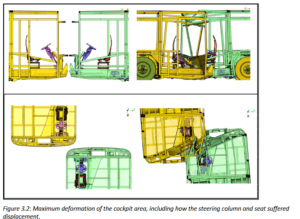
This isn’t a hypothetical concern. Three fatal accidents in Norway have already shown exactly this pattern. With bus fleets across Europe increasingly transitioning to electric vehicles, which are heavier than their diesel counterparts, the risk is only set to grow. The heavier the bus, the greater the energy of impact, and the lower the speed at which a frontal collision becomes fatal.
Today’s regulations aren’t enough
ETF, among others, has been warning that current safety regulations for buses and coaches fall short. The current standard that some transport authorities apply to buses, UN Regulation 29.03, was actually designed for trucks, not buses. And the gap between what it covers and what bus drivers actually face is very significant.
The Norwegian report from February this year found that the impact energy generated in a frontal bus collision can be up to 10 times higher than the maximum that Regulation 29.03 is designed to withstand. On top of that, the regulation tests assess impacts across the entire front of a vehicle, whereas in the real-world fatal accidents studied, the force was concentrated mostly on the driver’s area.
This means that applying Regulation 29.03 to buses and coaches is not enough. A new UN Regulation is needed to protect drivers.
A solution that’s within reach
Fortunately, the same researchers who mapped out the problem have also identified a practical solution. They propose a reinforced driver “crash-box”, an additional protective structure built around the driver’s area that, in simulations, effectively prevents the cab from deforming and the driver from being crushed.
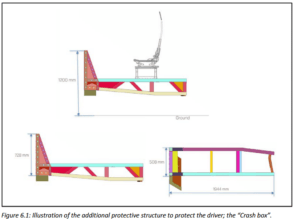
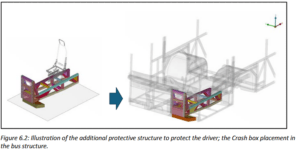
The estimated manufacturing cost would be between €900 and €1,200 per bus. For a vehicle that costs hundreds of thousands of euros, this is a small investment with potentially life-saving results.
From research to regulation: the push for change
This latest report demonstrates both the necessity and feasibility of taking action to protect bus and coach drivers. ETF demands that these findings are turned into binding international safety standards.
ETF applauds the Norwegian government’s upcoming proposal to form a dedicated bus collision taskforce in the UN’s World Forum for the Harmonisation of Vehicle Regulations (WP.29), the international body tasked with setting motor vehicle standards. This taskforce would be the first step towards the creation of a dedicated binding UN Regulation to protect bus and coach drivers from frontal collisions.
ETF and its affiliates urge all member UN governments of WP.29 to support the creation of this taskforce and to work towards the creation of a new UN Regulation. Road safety bodies, bus and coach operators, and of course ETF and its affiliates are ready to work together with governments to protect drivers.
| # | Наименование новости | Тональность | Информативность | Дата публикации |
|---|---|---|---|---|
| 1 | ETF, ITF and IRU call for stronger safety rules to protect bus drivers in frontal collisions | 0 | 5 | 29-05-2026 |
| 2 | Joint Letter: ETF, ITF and IRU call for stronger safety rules to protect bus drivers in frontal collisions | 0 | 5 | 29-05-2026 |
| 3 | ETF leaflets Driver Fatigue Day 2026 | 0 | 1 | 07-07-2026 |
| 4 | Road Transport’s simplification package must not weaken workers’ rights | -5 | 3 | 03-06-2026 |
| 5 | The road transport sector is in a long-term crisis: Three demands for structural change | 0 | 5 | 20-05-2026 |
| 6 | ETF Road Transport Section position on Road Transport simplification | 0 | 1 | 02-06-2026 |
| 7 | Court victory for posted non-EU driver in the Netherlands | 3 | 6 | 19-03-2026 |
| 8 | Every day is the longest day for drivers: ETF marks Driver Fatigue Action Day on 21 June | 0 | 5 | 18-06-2026 |
| 9 | New rules for vans from 1 July 2026 | 0 | 5 | 01-07-2026 |
| 10 | ELA report confirms urgent need for stronger social enforcement in aviation | 0 | 5 | 09-07-2026 |