Просмотр новости
Найдите то, что Вас интересует
 Спутники
 РН
РН SpaceX
 Роскосмос
 NASA
NASA
СпутникиРНSpaceXРоскосмосNASAMajorities in 16 of 17 middle-income nations say this, including roughly three-quarters of adults or more in 12 countries.
This Pew Research Center report looks at views of the U.S., U.S. President Donald Trump, and opinion of the role the U.S. is playing in the world.
Why did we do this?
Pew Research Center does research to help the public, media and decision-makers understand important topics. We have studied global views of the United States for more than two decades. We did this study to understand how people in other countries view the U.S. and Trump, now in the second year of his second administration.
Learn more about Pew Research Center and our international surveys.
How did we do this?
We surveyed 42,151 people across 36 countries: Argentina, Australia, Bangladesh, Brazil, Canada, Chile, Colombia, France, Germany, Ghana, Greece, Hungary, India, Indonesia, Israel, Italy, Japan, Kenya, Malaysia, Mexico, the Netherlands, Nigeria, Pakistan, Peru, the Philippines, Poland, Singapore, South Africa, South Korea, Spain, Sri Lanka, Sweden, Thailand, Turkey, the U.K., and the West Bank and East Jerusalem.
Interviews were conducted from February 8 to May 13, 2026. We designed the surveys so we could talk about the views of the adult population in each country. Here are the survey questions used for this report, along with responses, and the survey methodology.
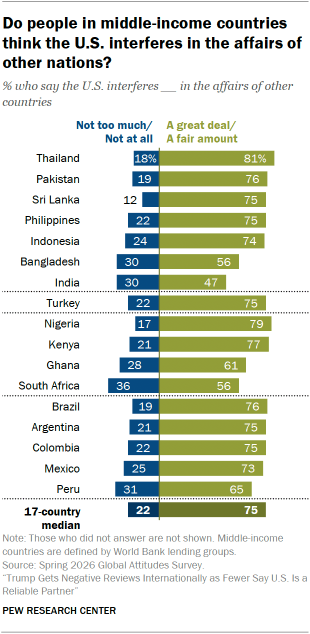
Majorities in 16 of 17 middle-income nations (as defined by World Bank lending groups) surveyed say the United States interferes in the affairs of other countries a great deal or a fair amount.
These findings come from a new Pew Research Center survey of 42,151 adults in 36 countries, conducted Feb. 8-May 13, 2026. They are part of a larger report focused on views of the U.S. and its president.
In 12 nations, roughly three-quarters of adults or more say the U.S. interferes in the affairs of other countries.
Thai adults are especially likely to say the U.S. interferes (81% hold this view). India is the only nation where this is a minority opinion. Still, Indians are more likely to say the U.S. interferes than to say it does not (47% vs. 30%; another 23% did not answer the question).
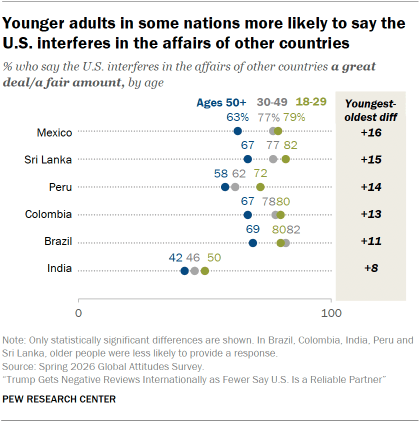
Views by age and genderIn several countries, including four of the five middle-income Latin American countries surveyed, younger adults (ages 18 to 34) are more likely than those ages 50 and older to say the U.S. interferes with other countries. For example, 79% of young people in Mexico say the U.S. interferes, compared with 63% of those ages 50 and older. (Older adults are also less likely to provide a response in many of these places.)
Men are more likely than women to say the U.S. interferes with other countries in 13 of these 17 middle-income countries. For example, 66% of men in Ghana say the U.S. interferes in the affairs of other countries, while 56% of women say the same. (Women are also less likely to provide a response in most of these places. In Ghana, women are twice as likely than men to not respond to the question.)
How do Americans’ opinions compare?A large majority of Americans (83%) also say the U.S. interferes in the affairs of other countries. Democrats and Democratic-leaning independents are more likely than Republicans and Republican leaners to hold this view, but majorities in both parties agree that the U.S. interferes at least a fair amount.
Of the four questions our survey asked about the United States’ role in the world (interference in countries’ affairs, contributions to global peace and stability, accounting for international interests and reliability as a parter) this is the only one on which majorities of partisans are aligned.
Related: Most Americans Now Say U.S. Foreign Policy Ignores the Interests of Other Countries
| # | Наименование новости | Тональность | Информативность | Дата публикации |
|---|---|---|---|---|
| 1 | Comparing how Americans and others around the world view the United States’ global role | -2 | 6 | 23-06-2026 |
| 2 | What do people in middle-income countries think about cuts to U.S. humanitarian aid? | 0 | 12.53 | 21-07-2026 |
| 3 | Americans are more dissatisfied with how their democracy is working than people in other high-income countries | -2 | 7 | 10-06-2026 |
| 4 | Majority of Americans support banning social media for kids under 16 | 2 | 6 | 01-07-2026 |
| 5 | Trump Gets Negative Reviews Internationally as Fewer Say U.S. Is a Reliable Partner | -8 | 7 | 23-06-2026 |
| 6 | NATO Gets High Marks From Member States | 5 | 5 | 06-07-2026 |
| 7 | 72% of Americans say the U.S. used to be a good example of democracy, but isn’t anymore | 0 | 9.83 | 10-07-2024 |
| 8 | ВЦИОМ: Более 60% россиян считают, что выборы в США не повлияют на отношения с Россией | 0 | 0 | 05-11-2020 |
| 9 | В США заявили, что на общественное мнение американцев пытаются повлиять из-за рубежа | 0 | 0 | 03-03-2020 |
| 10 | Опрос: больше половины американцев опасаются военной мощи России | 0 | 0 | 27-02-2019 |