Просмотр новости
Найдите то, что Вас интересует
 Спутники
 РН
РН SpaceX
 Роскосмос
 NASA
NASA
СпутникиРНSpaceXРоскосмосNASAOver 100 countries have enacted energy policy changes in response to the Middle East conflict, from tax adjustments to fuel subsidies.
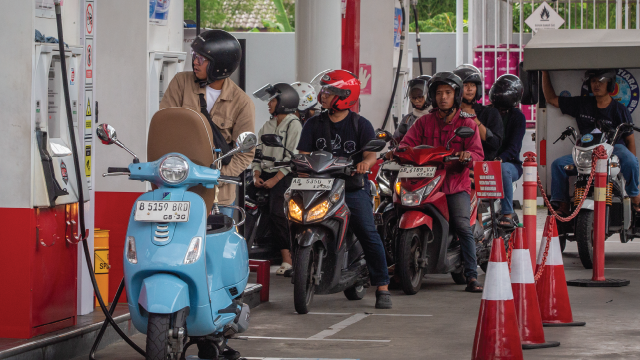 Motorcyclists line up to refuel at a gas station in Yogyakarta, Indonesia, on March 28, 2026. (Devi Rahman/AFP via Getty Images)
More than 100 countries have taken policy steps to address rising energy costs and other effects of the conflict in the Middle East, according to the International Energy Agency (IEA).
As of the IEA’s most recent update on June 12, a total of 113 countries – as well as the European Commission, the main executive body of the European Union – have made at least one such policy change in response to the war:
Many countries have lowered energy taxes in response to Iran war
Number of countries that have enacted each of the following types of policy, by IEA category

PEW RESEARCH CENTER
Many countries have lowered energy taxes in response to Iran war
Number of countries that have enacted each of the following types of policy, by IEA category
| Policy type | Number of countries | Group |
|---|---|---|
| Consumer support | 92 | Consumer support |
| Taxation | 55 | Consumer support |
| Fuel subsidies | 32 | Consumer support |
| Price caps | 23 | Consumer support |
| Other | 41 | Consumer support |
| Energy conservation | 58 | Energy conservation |
| Campaign | 40 | Energy conservation |
| Transport | 25 | Energy conservation |
| Government travel | 20 | Energy conservation |
| Work from home | 17 | Energy conservation |
| Cooling | 8 | Energy conservation |
| Schools and universities | 7 | Energy conservation |
| Structural policies | 28 | Structural policies |
| Electrification | 19 | Structural policies |
| Energy efficiency | 12 | Structural policies |
| Other | 10 | Structural policies |
PEW RESEARCH CENTER
This Pew Research Center analysis examines how countries have responded to rising energy costs and other effects of the Iran war.
We relied on data from the International Energy Agency’s 2026 Energy Crisis Policy Response Tracker. For the purpose of category totals, countries are counted once per occurrence per category, even if they enacted multiple policies that fall into that category. In Spain, for example, the following fall under “Taxation”: cut fuel value-added tax, including vehicle fuel and liquefied petroleum gas; suspend the hydrocarbon excise duty; cut electricity tax.
Related: Worldwide, a quarter of new car sales are electric vehicles or hybrids
Many countries – predominantly in Asia – have responded with more than one of these initiatives. Cambodia, India, Indonesia, Laos, Malaysia, Pakistan, the Philippines, Singapore, South Korea, Sri Lanka, Thailand and Vietnam have enacted at least six types of energy-focused policy changes to address effects of the Iran war. Laos has enacted nine types of policies, more than any other country.
The United States is not among the countries that made nationwide energy policy changes in response to the war, though President Donald Trump in May floated the idea of suspending the federal gas tax. Georgia, Indiana, Kentucky and Utah have provided some form of relief from state gas taxes.
Related: What to know about U.S. oil production and consumption in 6 charts
Energy policy responses to the Iran war have been most common in the Asia-Pacific region, where 29 countries have enacted 124 such changes (counted once per occurrence per category). In Bangladesh, for example, lawmakers have made four types of policy changes: limiting air conditioning temperatures, closing public and private universities, asking people and businesses to save energy, and capping fuel purchases for vehicles plus promoting public transportation.
In Europe, 30 countries and the European Commission have enacted 86 energy policy changes. For example, Sweden made four types of changes: halving the price of public transport passes, extending reductions on gas taxes, accelerating the electrification of public vehicles like police cars, and providing crisis support for the farming and fishing industries and assistance for electricity bill payments.
Several countries in the Asia-Pacific region have taken numerous policy steps in response to Iran war
Number of policies enacted, by country
Note: The European Commission, which is not shown, has enacted three policies.
PEW RESEARCH CENTER
Several countries in the Asia-Pacific region have taken numerous policy steps in response to Iran war
Number of policies enacted, by country
| Country/Region | ISO | Number of policies |
|---|---|---|
| Albania | 8 | 1 |
| Argentina | 32 | 2 |
| Australia | 36 | 5 |
| Austria | 40 | 2 |
| Bangladesh | 50 | 4 |
| Barbados | 52 | 3 |
| Belgium | 56 | 4 |
| Belize | 84 | 3 |
| Botswana | 72 | 2 |
| Brazil | 76 | 2 |
| Brunei | 96 | 1 |
| Bulgaria | 100 | 2 |
| Cabo Verde | 132 | 2 |
| Cambodia | 116 | 7 |
| Canada | 124 | 2 |
| Chile | 152 | 5 |
| China | 156 | 1 |
| Colombia | 170 | 1 |
| Comoros | 174 | 1 |
| Croatia | 191 | 4 |
| Cyprus | 196 | 2 |
| Czech Republic | 203 | 2 |
| Dominican Republic | 214 | 2 |
| DR Congo | 180 | 1 |
| East Timor | 626 | 2 |
| Ecuador | 218 | 2 |
| Egypt | 818 | 6 |
| Estonia | 233 | 1 |
| Ethiopia | 231 | 3 |
| European Commission | 3 | |
| Fiji | 242 | 3 |
| France | 250 | 3 |
| Gambia | 270 | 3 |
| Germany | 276 | 2 |
| Ghana | 288 | 1 |
| Greece | 300 | 2 |
| Grenada | 308 | 2 |
| Guatemala | 320 | 1 |
| Guinea-Bissau | 624 | 1 |
| Guyana | 328 | 2 |
| Haiti | 332 | 1 |
| Honduras | 340 | 1 |
| Hungary | 348 | 2 |
| Iceland | 352 | 3 |
| India | 356 | 8 |
| Indonesia | 360 | 8 |
| Iran | 364 | 1 |
| Ireland | 372 | 5 |
| Italy | 380 | 2 |
| Ivory Coast | 384 | 1 |
| Jamaica | 388 | 1 |
| Japan | 392 | 3 |
| Jordan | 400 | 3 |
| Kenya | 404 | 3 |
| Kuwait | 414 | 1 |
| Laos | 418 | 9 |
| Latvia | 428 | 1 |
| Lithuania | 440 | 3 |
| Luxembourg | 442 | 6 |
| Madagascar | 450 | 1 |
| Malaysia | 458 | 7 |
| Maldives | 462 | 1 |
| Marshall Islands | 584 | 2 |
| Mauritania | 478 | 2 |
| Mauritius | 480 | 1 |
| Mexico | 484 | 2 |
| Montenegro | 499 | 2 |
| Morocco | 504 | 1 |
| Mozambique | 508 | 2 |
| Myanmar | 104 | 3 |
| Namibia | 516 | 1 |
| Nauru | 520 | 1 |
| Nepal | 524 | 5 |
| Netherlands | 528 | 6 |
| New Zealand | 554 | 1 |
| Nigeria | 566 | 1 |
| Norway | 578 | 1 |
| Pakistan | 586 | 6 |
| Panama | 591 | 2 |
| Papua New Guinea | 598 | 1 |
| Peru | 604 | 2 |
| Philippines | 608 | 8 |
| Poland | 616 | 3 |
| Portugal | 620 | 2 |
| Romania | 642 | 2 |
| Rwanda | 646 | 2 |
| Saint Kitts and Nevis | 659 | 2 |
| Saint Lucia | 662 | 2 |
| Sao Tome and Principe | 678 | 1 |
| Senegal | 686 | 1 |
| Serbia | 688 | 2 |
| Seychelles | 690 | 4 |
| Sierra Leone | 694 | 1 |
| Singapore | 702 | 6 |
| Slovakia | 703 | 1 |
| Slovenia | 705 | 2 |
| Solomon Islands | 90 | 1 |
| South Africa | 710 | 1 |
| South Korea | 410 | 7 |
| South Sudan | 728 | 1 |
| Spain | 724 | 5 |
| Sri Lanka | 144 | 7 |
| Suriname | 740 | 2 |
| Sweden | 752 | 4 |
| Tanzania | 834 | 2 |
| Thailand | 764 | 7 |
| Turkey | 792 | 1 |
| Tuvalu | 798 | 1 |
| United Kingdom | 826 | 6 |
| Uruguay | 858 | 2 |
| Vanuatu | 548 | 1 |
| Vietnam | 704 | 8 |
| Zambia | 894 | 1 |
| Zimbabwe | 716 | 1 |
Note: The European Commission, which is not shown, has enacted three policies.
PEW RESEARCH CENTER

Andrew Prozorovsky is a research assistant at Pew Research Center.
| # | Наименование новости | Тональность | Информативность | Дата публикации |
|---|---|---|---|---|
| 1 | Около десятка нефтетанкеров Ирана после введения санкций отключили транспондеры | 0 | 0 | 07-11-2018 |
| 2 | Иранские уроки | 0 | 5 | 15-03-2026 |
| 3 | Oil falls to lowest price since start of Iran war as shipping picks up in the Strait of Hormuz | 0 | 7 | 24-06-2026 |
| 4 | Зариф: власти США гордятся тем, что их санкции убивают иранцев | 0 | 0 | 20-03-2020 |
| 5 | СМИ: президент Ирана издал указ о помощи пострадавшим от повышения цен на топливо | 0 | 0 | 17-11-2019 |
| 6 | US completes new wave of strikes on Iran: CENTCOM | 0 | 7 | 13-07-2026 |
| 7 | WSJ: продажи нефти Ираном резко сократились после вступления в силу санкций США | 0 | 0 | 27-05-2019 |
| 8 | A New Oil Crisis Stress-Tests the Global Energy Transition | -2 | 6 | 22-04-2026 |
| 9 | Bloomberg: Иран освободят от сокращения добычи нефти | 0 | 0 | 07-12-2018 |