Просмотр новости
Найдите то, что Вас интересует
 Спутники
 РН
РН SpaceX
 Роскосмос
 NASA
NASA
СпутникиРНSpaceXРоскосмосNASAThe Milky Way's arms might be farther away than we thought, meaning our galaxy is likely larger than previously believed. Here's how they made the measurements.
The post The Milky Way’s arms might not look as we thought first appeared on EarthSky.
This video shows what astronomers thought the Milky Way looked like, and what the new data indicates instead. X-ray observations suggest some of the Milky Way’s arms are farther away than most models suggest.
It’s challenging to get a good picture of what our Milky Way galaxy looks like. That’s because we’re looking at it from the inside, positioned 2/3 from the galactic center in one of the spiral arms. But new data from X-ray telescopes suggest our galaxy is bigger than we believed. That’s because at least two of the spiral arms appear more distant than previous measurements showed.
Scientists said on July 1, 2026, that NASA’s Chandra X-ray Observatory, along with ESA’s XMM-Newton Observatory, show the Milky Way’s outer spiral arms might be farther away than previously thought. Astronomers used the X-ray observatories to examine light reflections off dust clouds in the spiral arms to make their measurements.
The researchers published their peer-reviewed results in the journal Astronomy & Astrophysics on July 1, 2026.
Measuring the distance to the spiral armsThe previous measurements to the outer spiral arms in our galaxy used data based on the rotation of the galaxy. But the farther you look out in the galaxy, the less reliable the data is. Also, astronomers focus their measurements on the spiral arms on our side of the galaxy, because those on the other side of the galactic core are too obscured by gas and dust. But gas and dust make even the spiral arms on our side hard to analyze.
So, in order to measure the spiral arms, astronomers turned to a phenomenon that can occur billions of light-years away outside our own galaxy. They looked at gamma-ray bursts, some of the largest explosions in the universe.
Gamma-ray bursts occur when massive stars collapse or when the dense remnants of stars merge. We can see the light from these enormous explosions from across the universe. And when the full spectrum of light from these bursts hits our Milky Way galaxy, it bounces off the dust in the spiral arms and creates light echoes.
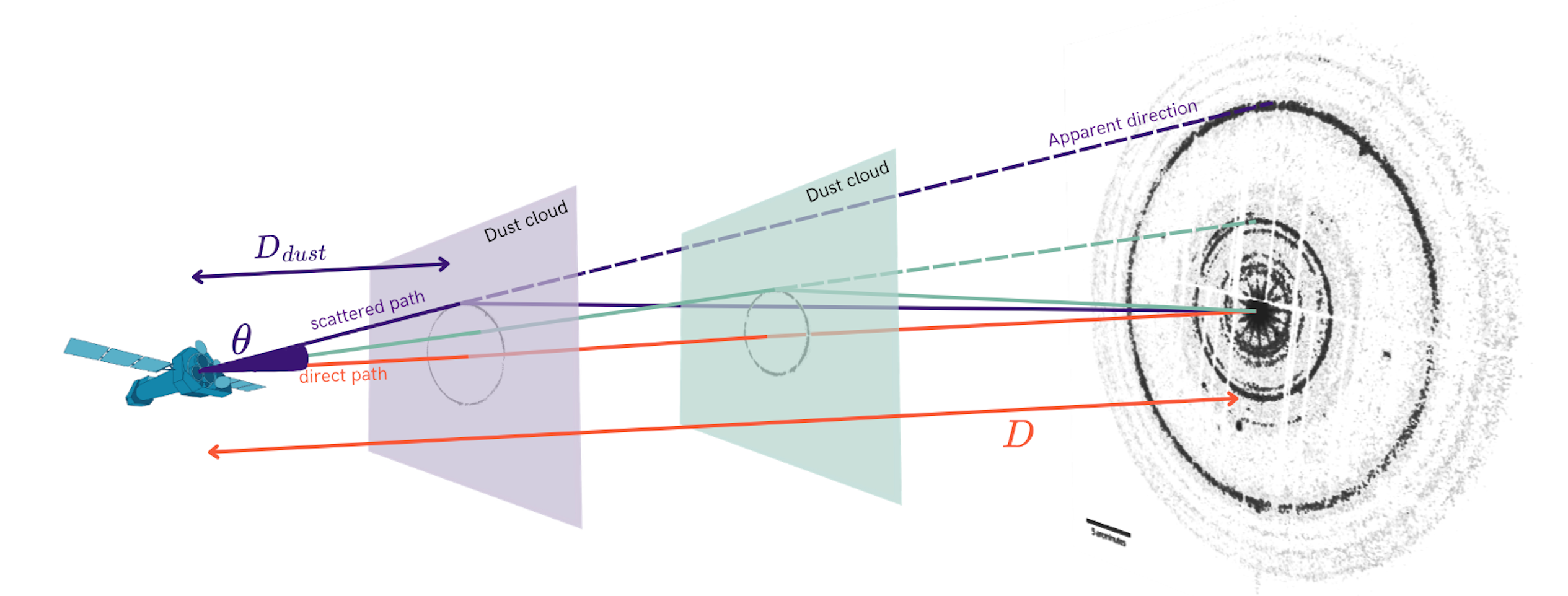
How does that work? Well, the dust in the Milky Way scatters some of the light from the gamma-ray burst. And the scattered light takes a bit longer to reach us than the light that isn’t scattered, so we register it as an echo. And this echoed light appears to us as rings. The closer the dust is, the larger the ring we see. Specifically, astronomers look at the portion of the spectrum that is in X-ray wavelengths. The diameters of the X-ray rings help astronomers determine their distance to Earth.
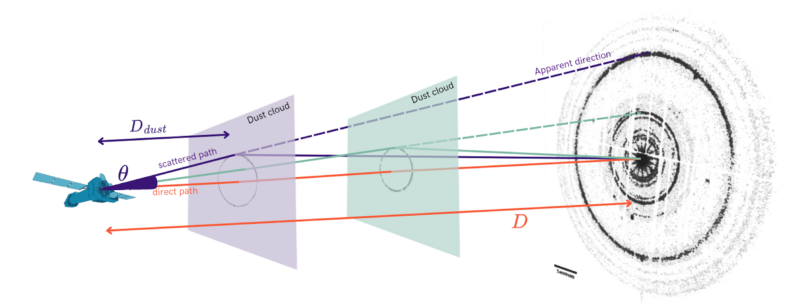 An X-ray space telescope looks at the incoming light from a gamma-ray burst. The closer the dust is that the light passes through, the larger the ring we see. Image via Vaia/ Chandra/ Harvard.
A close look at a distant event
An X-ray space telescope looks at the incoming light from a gamma-ray burst. The closer the dust is that the light passes through, the larger the ring we see. Image via Vaia/ Chandra/ Harvard.
A close look at a distant event
Lead author Beatrice Vaia of Scuola Universitaria Superiore IUSS Pavia and University of Trento in Italy said:
Reassessing the Milky Way’s armsThis is a very direct way – relying only on geometry – to precisely measure distances to the Milky Way’s spiral arms. Most other methods rely on assumptions about how the Milky Way rotates, which become increasingly uncertain in the outer regions of our galaxy.
The astronomers looked at three gamma-ray bursts that occurred close to the plane of our Milky Way. These events let them look more closely at the distance to three spiral arms: the Perseus Arm, the Outer Arm and the most distant Outer Scutum–Centaurus Arm.
Vaia said:
For the Outer Scutum–Centaurus Arm, we measured its distance to within about 1%, improving on the previous best estimate, which was accurate to only about 10%.
Ultimately, the team found that these outer spiral arms might lie around 10% farther away than previous models suggested. So, for example, the Outer Scutum-Centaurus arm had a previous estimate of 62,000 light-years from Earth. Thus, the new estimate for this spiral arm would be about 68,200 light-years away.
Of course, the researchers caution that the measurements come from just three gamma-ray bursts. Because it is so hard so see through the dense spiral arms, it is rare to find gamma-ray bursts bright enough to penetrate that dust.
A better picture of our homeBut the difference in the distance to the spiral arms can impact what we know about the Milky Way as a whole. As co-author Ilaria Fornasiero said:
This could mean that astronomers have to revise estimates of the mass of the galaxy, because that affects how wide the arms stretch.
Every improvement in measuring the distances to the Milky Way’s spiral arms helps refine our map of our galactic home. And it helps us learn more about the place we live.
 This animation shows what astronomers believed our Milky Way galaxy looked like. Then the view shifts to a Milky Way with arms extending farther out. New X-ray data suggests the Milky Way is wider due to a greater distance to its spiral arms. Image via NASA.
Bottom line: The Milky Way’s arms might be farther away than we thought, meaning our galaxy is larger than previous models showed. Astronomers used light from distant gamma-ray bursts hitting clouds in the spiral arms to measure their distances.
Kelly Kizer Whitt - EarthSky’s nature and travel vlogger on YouTube - writes and edits some of the most fascinating stories at EarthSky.org. She's been writing about science, with a focus on astronomy, for decades. She began her career at Astronomy Magazine and made regular contributions to other outlets, including AstronomyToday and the Sierra Club. She has nine published books, including a children's picture book, Solar System Forecast, and a young adult dystopian novel, A Different Sky.
| # | Наименование новости | Тональность | Информативность | Дата публикации |
|---|---|---|---|---|
| 1 | The Milky Way is even BIGGER than we thought: Research reveals how our galaxy's gigantic spiral arms stretch 10% further than previously believed | 2 | 7 | 13-07-2026 |
| 2 | Млечный Путь оказался шире, чем его рисовали на схемах. Рукава ... | 0 | 7 | 11-07-2026 |
| 3 | La Voie Lactée Réévaluée : Plus Grande, Plus Massive et Asymétrique Que Prévu | 0 | 5 | 09-07-2026 |
| 4 | Млечный Путь может оказаться гораздо шире | 0 | 7 | 06-07-2026 |
| 5 | «Эхо» космических взрывов отодвинуло внешние границы нашей Галактики | 2 | 8 | 03-07-2026 |
| 6 | 🌌 Млечный Путь оказался больше Астрономы уточнили расстояние до двух ... | 0 | 11.4 | 28-07-2026 |
| 7 | Новый метод измерения показал истинные размеры нашей галактики Млечный Путь | 2 | 8 | 09-07-2026 |
| 8 | Cosmic gymnastics: Study reveals how our Milky Way once underwent a dramatic FLIP | 0 | 6.66 | 21-07-2026 |
| 9 | Top 10 cool things about stars that you probably didn’t know | 5 | 4 | 03-07-2026 |
| 10 | Астрономы усомнились, что Вселенная одинакова во всех направлениях | 0 | 7 | 27-06-2026 |