Просмотр новости
Найдите то, что Вас интересует
 Спутники
 РН
РН SpaceX
 Роскосмос
 NASA
NASA
СпутникиРНSpaceXРоскосмосNASAWe were paid a visit by the world-famous community organizer, scholar and educator.
6 min read
If I am not for myself, who will be for me? When I am for myself alone, what am I? If not now, when?When I was hired into IE’s marketing department, I was earning minimum wage as a barista on the wrong side of town. It was, well, tiresome work, and my fingers were covered in burns and callouses, and I loved it. I loved speaking with the regulars, drawing swans in the cream, opening for business in the dark early morning. I even secretly quite liked the meager paycheck.
But life as a starving artist wore me down. Through limited success as a playwright and a dwindling bank balance, I opted for a stable job in the nice part of town.
Now, working as a copywriter for IE University is fulfilling, and doing so in a skyscraper is attractive stuff. You have a view over the city and the rural towns beyond.
And one of the top perks, by far, is when celebrated people come to visit.
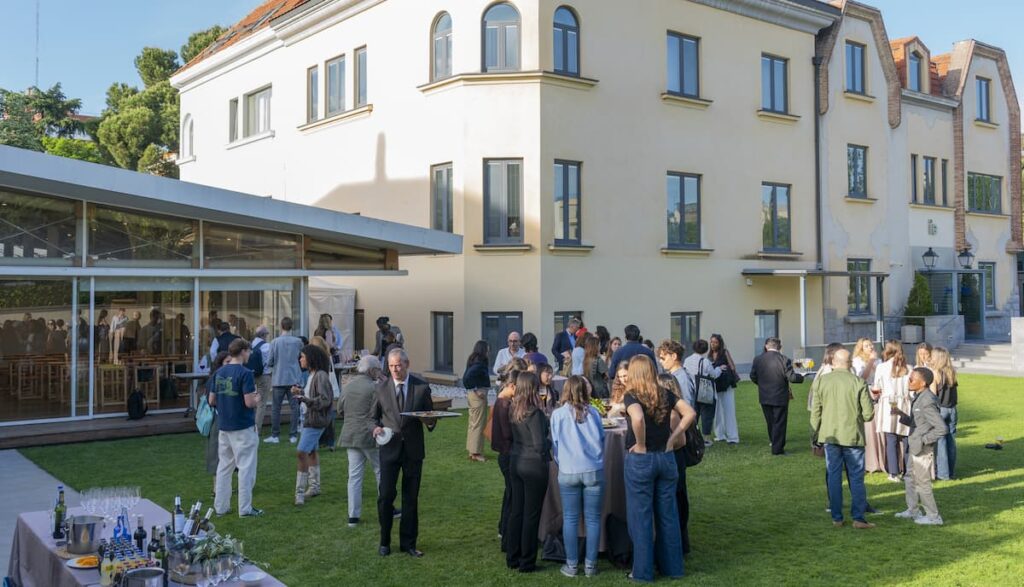
One such was Marshall Ganz. A renowned community organizer, scholar and educator who has worked with Cesar Chavez and Barack Obama to effect real change, he’s rightly world-famous. And, one day in mid-spring, I, along with students of IE School of Politics, Economics & Global Affairs, got to sit on an inner-city lawn to hear about what organizing change is all about.
So let’s talk about that.
NowWhen Marshall Ganz trained organizers for Barack Obama’s 2008 presidential campaign, they told a story of hope and possibility. Years on, sitting before a new generation of decision-makers in Madrid, Ganz described that feeling with elegance: “Hope sits between fantasy and certainty. It’s a fragile but powerful space. And it’s what allows us to imagine new possibilities and begin moving toward them, even under difficult circumstances.”
But hope is not so simple now. “In places where we don’t have strong political parties anymore—or where they barely function—we’ve ended up with what I’d call a democratic marketplace,” Ganz explained. “What I mean is: very few candidates actually compete based on ideas or collective decision-making. It’s more like competing for a brand. It’s not really about people coming together to decide their future—it’s about marketing.”
As we sat and listened, something rang true: We don’t really know what’s working about democracy anymore. And that’s a shift no one has fully accounted for.
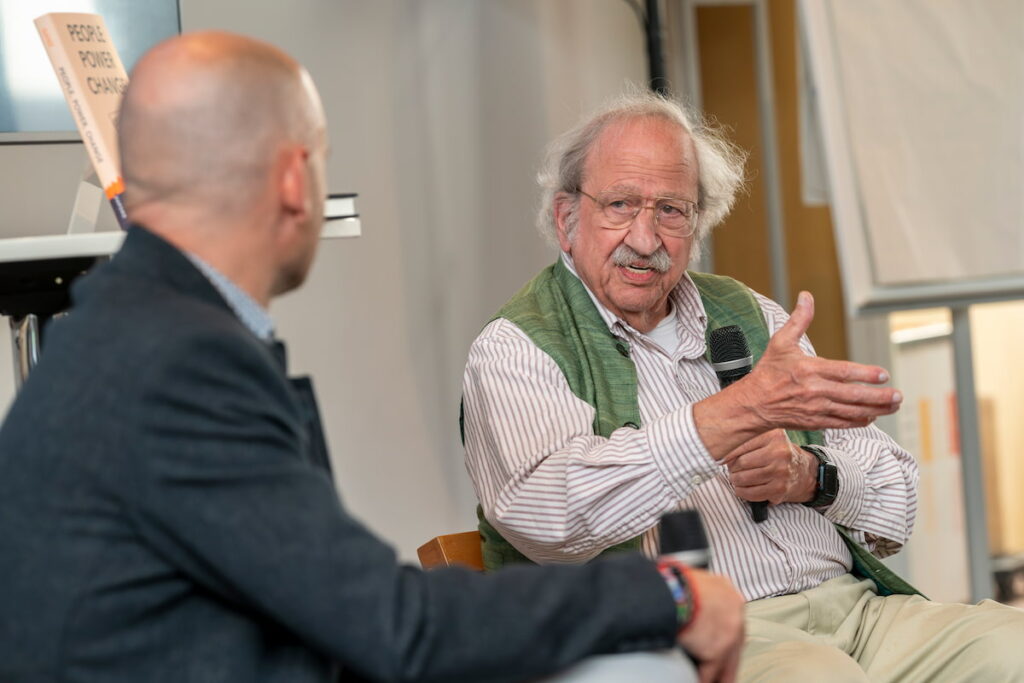
“When fast change happens, it brings a lot of anxiety, a lot of uncertainty,” Ganz explained. “It makes people question how they’re thinking about the future—because suddenly, the future is right in front of us.”
So—where do we put our energy?
PeopleWe start by organizing people. For Ganz, organizing is a “rich, diverse and ancient” tradition with roots in storytelling. And organizing can be a vocation. In campaigning for Black federal voting rights in 1964 Mississippi, or strategizing for the UFWA over several years, Ganz has distilled organizing into five practices.
Learning them is like learning to ride a bike—through trial, error and persistence: “Organizing is not about providing services to grateful clients. Nor is it about marketing products to paying customers. Organizing is about advocacy on behalf of powerless beneficiaries. It is about enabling a community to become a constituency, from the Latin con (together) and stare (to stand)—a community that chooses to come together, stand together, learn together, decide together, act together, and in the end win together.”
1. Building relationshipsTrue relationships require risk, commitment and sustained trust. In an age of superficial digital connections, Ganz insists on organizing change through intentional relationship-building.
2. StorytellingThis is where you use your heart. Stories help bridge personal values with real-world issues. Effective organizers use narrative to inspire hope, turning abstract ideals into lived experience.
3. StrategizingThis is where you use your head. Strategy is adaptive and, most of all, active. It balances the “big picture” perspective with on-the-ground realities, using feedback from both areas to respond flexibly to evolving circumstances.
4. ActingThis is where you use your hands. Or, in the case of the 1955 Alabama bus boycott, your feet. Without action, organizing is merely talk. Ganz stresses the importance of taking action, tracking participation and learning from what happens to refine future steps.
5. StructuringWhile often resisted, structure is about creating shared commitments, decision-making processes and accountability. It transforms a loose group of individuals into a functioning community capable of sustained collective work.
PowerThen, we must think critically about power. Power is relational. It is, according to Ganz, the subordination of one party who is in need of another’s resources. When this need is unreciprocated, power emerges.
“Power also has three faces,” Ganz has written. “The first face is obvious, as when someone gets arrested—we see who won and who lost. But who authorized the arrest, set the rules, enforces them? That’s the second face: who decides. Then we may ask, why has nothing been done about this problem for years, or why do many of us just take for granted that this is the way things are? To figure that out, you must ask who is benefiting and who is losing: the third face. This is when the deep structural contours of power emerge. The strategic organizing challenge is how to engage with the urgent first face—the pain points—but in a way that builds our capacity to take on the third face.”
In organizing change to redress this disparity, we also need an internal “cascade of leadership” that shares in power.
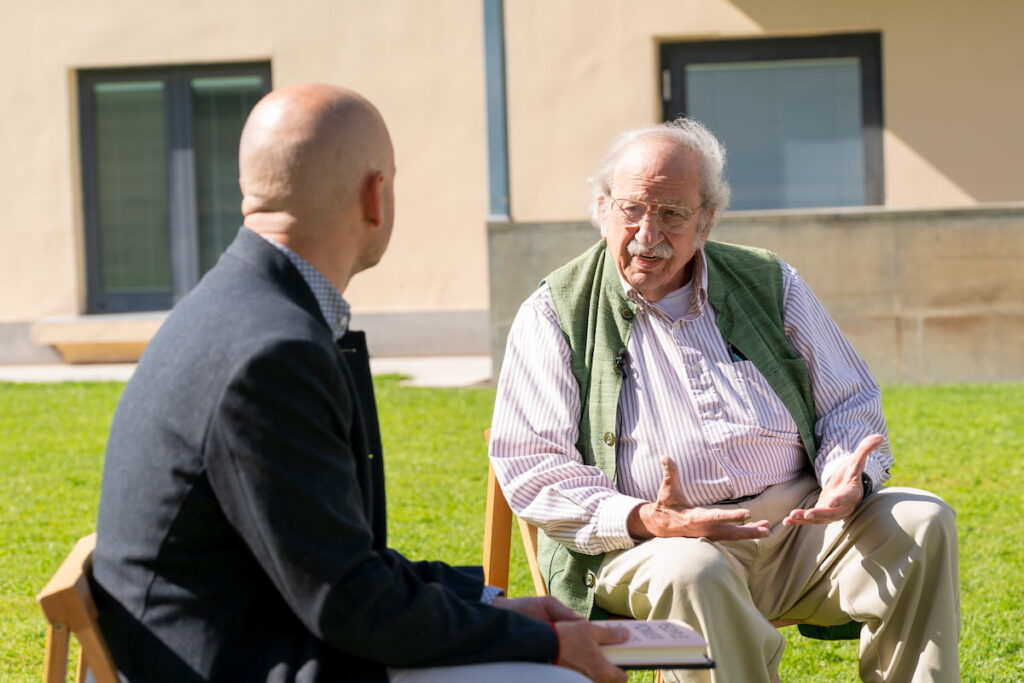
“Are you willing to give up enough control to let others lead so that you can develop the power you need to achieve your goals? Developing a leadership-rich organization depends on your answer to that questions. As one of my students put it, the test of good leadership is not how many hats you can wear at the same time. It is how many people you can enable to wear hats.”
1. If I am not for myself, who will be?Ask yourself these three questions as you consider a position of leadership. The first isn’t a selfish question but a self-regarding one. To live or lead with integrity, we must understand our own values and aspirations, as we can’t fully be present for others without being present to ourselves.
2. When I am for myself alone, what am I?To be a “who” and not a “what” means recognizing that we exist in relationship with others. Our ability to pursue our goals is deeply tied to others’ ability to pursue theirs, yet we all have moments when we treat people—including ourselves—as means rather than ends.
3. If not now, when?We learn by doing. Waiting for perfect plans can trap us in inaction when, in truth, understanding follows action. And action always involves risk and courage.
I didn’t effect any great change when I made coffee. Customers ordered, money changed hands, and they went away happy. But the neighbourhood meant a lot of locals didn’t have that money. If they asked for a cup—and they hadn’t billed up too many—I’d usually say yes. Which wasn’t any great social change. But it was a service for which I could see the impact, on a very small scale, day after day.
Now you may never have worked a service job. But we all know, I think, what it means to feel you’ve given up on something meaningful. To have strayed from our ideals. And when I listened to Ganz speak that afternoon, after nine months at IE, I realized that in those nine months in the tower, I’d lost a lot of opportunities to make a difference. And I can’t just shrug that off. We can’t shrug that off.
And there is something we can do.
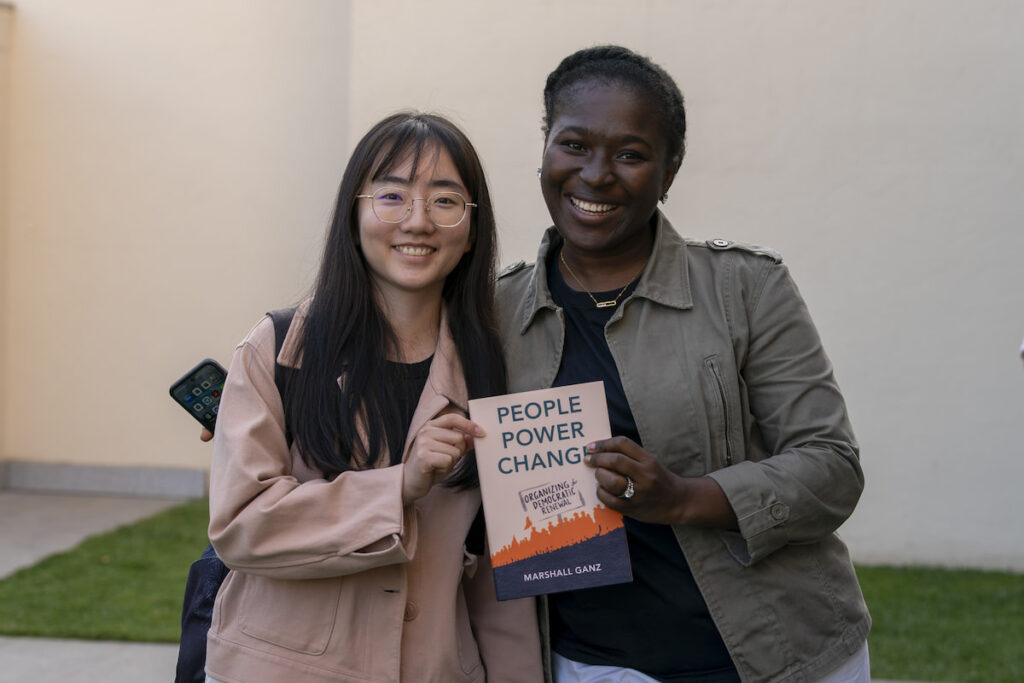
Marshall Ganz just released a book, “People, Power, Change”. It’s a message of hope to young people who want to make a real difference, at any level. Everything we’ve covered in this article is in there, with real tools for organizing change in your community. Even if that means just giving out free coffee, or starting up a club, or doing something which brings people together. And I think if we all tried to make the places we live a little better, as smart young people with the resources to act, that we could make a difference.
Democracy may not be working for us. So we must become independent—our communities must become independent. To start, we need people to meet up, to share their stories, and to start their own initiatives. And if you don’t know what to do yet, and you want to properly educate yourself, fill in the form below, and we’ll show you how to plan out the next few years of your life with real impact. Even if you’re unsure, or just interested in the topic, take a look at what we have on offer across the rest of our website.
The time is now!
Enjoy insights from top invitees including Marshall Ganz, Paolo Gentiloni and more and start organizing change.
| # | Наименование новости | Тональность | Информативность | Дата публикации |
|---|---|---|---|---|
| 1 | New era marketing with Dushinka Karani | 0 | 5 | 30-07-2025 |
| 2 | Management vs leadership: Why it matters | 0 | 5 | 01-12-2025 |
| 3 | Tech for good: How technology can solve global challenges | 5 | 7 | 26-08-2025 |
| 4 | Building the new global order: Key challenges and opportunities | 0 | 5 | 08-09-2025 |
| 5 | Real-world marketing challenges: Capstone Projects | 0 | 5 | 02-09-2025 |
| 6 | Myths vs Realities: Learning leadership with an Online MBA | 5 | 7 | 05-11-2025 |
| 7 | New Tricks for Old Bureaucracies: Joshua Schank on Making Transit Innovation Stick | 0 | 7.29 | 07-08-2026 |
| 8 | Interview preparation for business & sustainability roles | 0 | 5 | 29-01-2026 |
| 9 | How to win the attention economy: Challenger brand strategy | 0 | 5 | 14-11-2025 |
| 10 | Cross-cultural management and global team leadership | 0 | 5 | 30-01-2026 |