Просмотр новости
Найдите то, что Вас интересует
 Спутники
 РН
РН SpaceX
 Роскосмос
 NASA
NASA
СпутникиРНSpaceXРоскосмосNASAThe U.S. military has launched new strikes against Iran. The strikes began early Wednesday, hours after three merchant ships were struck in the Strait of Hormuz.

Commercial vessels are seen in the Strait of Hormuz off Bandar Abbas, Iran, Tuesday, June 30, 2026. Amirhosein Khorgooi/AP Photo hide caption
toggle caption
Amirhosein Khorgooi/AP Photo
DUBAI, United Arab Emirates — The U.S. military launched new strikes against Iran early Wednesday, hours after three merchant ships were struck in the Strait of Hormuz, in the latest exchange of fire to threaten the interim deal to end the fighting between the two countries.
The strikes came during the dayslong funeral for Iran's Supreme Leader Ayatollah Ali Khamenei, who was killed at the beginning of the war. They also were sure to add to the difficulty of negotiations aimed at fully reopening the strait, rolling back Tehran's disputed nuclear program and reaching a permanent end to the war launched Feb. 28.
In a statement posted to social media, U.S. Central Command said American forces launched the strikes "to impose heavy costs for targeting and attacking commercial shipping crewed by innocent civilians in an international waterway."
One U.S. official said the military was targeting air defense systems, coastal surveillance systems, ground-to-air missiles and launch sites for anti-ship cruise missiles and drones. Iranian port facilities are also being targeted, the official said.
A second U.S. official said the strikes would likely last for hours.
Both officials spoke on condition of anonymity to discuss an ongoing military operation.
Iranian state media reported the sound of explosions in Qeshm and Bandar Abbas. Iran's deputy foreign minister, Kazem Gharibabadi, said in a post on X that the attacks by the U.S. violated the interim agreement.
A similar spate of Iranian attacks on shipping and U.S. retaliation occurred late last month, while the new strikes also were notable for happening while President Donald Trump was in Turkey for a summit of the NATO military alliance.
U.S. revokes license for sale of Iranian oil after the attacks on tankersHours after the three tankers were struck by projectiles, the United States revoked a license that authorizing the sale of Iranian oil as part of the interim deal to end the fighting between the U.S. and Iran.
The new assaults in the fuel-shipping waterway were the most in a single day since late April, according to the U.N. International Maritime Organization. The attacks threatened to choke off the flow of traffic in the strait just as countries hoped to restore normal shipping practices and ease the global economic strain of the war.
A U.S. official said the license was revoked because Iran's actions in the strait were unacceptable and needed to be met with consequences. The official spoke on the condition of anonymity to share insight into the reasoning behind the move.
The Iranian Foreign Ministry condemned that U.S. move, saying in a statement that it violates the interim deal and that "the U.S. government bears responsibility for the consequences of this breach of commitment."
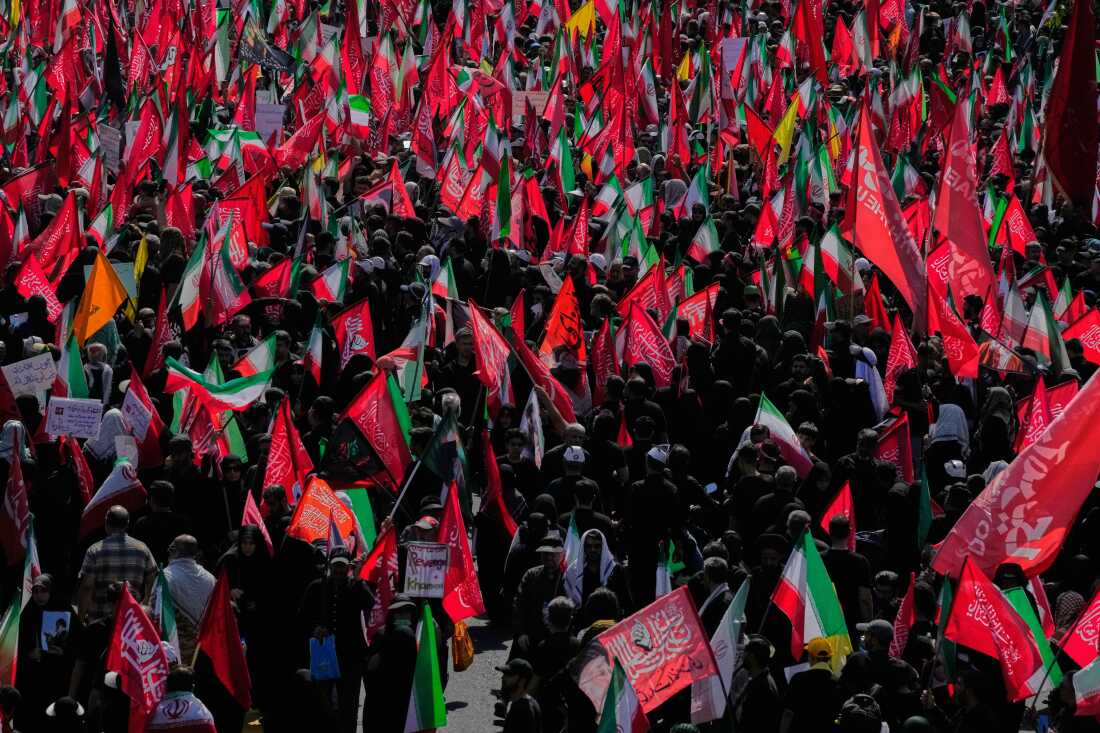
Mourners attend the funeral procession of the late Iranian Supreme Leader Ayatollah Ali Khamenei in Tehran, Iran, Monday. Vahid Salemi/AP hide caption
toggle caption
Vahid Salemi/AP
One tanker was traveling off the coast of Oman when it was hit and caught fire, the United Kingdom Maritime Trade Operations center said. Iranian state television said the liquefied natural gas tanker came under attack after ignoring warnings but did not directly claim the assault.
The other two ships sustained some damage, but no one was injured, and both continued on their way, the U.K. maritime agency said.
Tehran, which has repeatedly declared that only its approved route through the strait is safe, is suspected of attacking other ships that have used a route close to the Omani shore.
Location details provided by the U.K. agency showed that all three attacks occurred off the coast of Oman or the neighboring United Arab Emirates, making it likely that the ships were using the route near Oman.
In peacetime, a fifth of all traded oil and natural gas passed through the channel.
The license issued by the U.S. authorized the production, delivery and sale of Iranian oil through Aug. 21. U.S. Vice President JD Vance said at the time that lengthy talks with senior Iranian officials in Switzerland created a "good foundation for a successful final deal" to end the war.
U.S. sanctions on the purchase of Iranian oil had been in place since the 1979 Iranian Revolution. After the U.S. and Israel launched the war, and after the closure of the strait, the U.S. had authorized the temporary sale of Iranian oil at least twice as an incentive toward a deal.
Meanwhile, talks between Iran and the U.S. appeared to be on hold until after the burial of Khamenei.
Qatar calls attack a violation of international law
One tanker was carrying liquid natural gas south through the strait near Limah, Oman, when a projectile hit the left-side engine room and sparked a fire, the U.K. Maritime Trade Operations center said.
Majed Al-Ansari, a spokesperson for the Qatari Foreign Ministry, said the Qatari tanker Al Rekayyat was targeted in an "unacceptable attack" on international navigation and global energy security.
In a post on X, he said Qatar holds Iran "fully legally responsible."
Later Tuesday, the U.K. maritime agency reported that an oil tanker was hit on its left side as it exited the strait near the Omani-Emirati border. A third tanker was struck by a drone off Oman, the agency said.
The Joint Maritime Information Center, a multinational body overseen by the U.S. Navy, told shippers Monday that the route around Oman "has been expanded and remains available for all traffic."
Ships going to the north on the Iranian route must register with Tehran. Those going south work with Oman and the U.S.
Iran and the United States agreed as part of an interim deal to allow ships to pass without paying charges for 60 days. But Tehran insisted it must control the vessels' routes and later charge fees for passage, which would upend decades of practice in the waterway.
The U.S. and many Gulf Arab states say they will not agree to Iran charging for passage through the strait.
The data firm Kpler reported that at least 108 ships crossed through the strait last weekend using various routes.

A truck carrying the coffins of the late Iranian Supreme Leader Ayatollah Ali Khamenei and members of his family makes its way through mourners during the funeral procession in Qom, the heart of religious studies in Iran, Tuesday. Mehdi Khezrian/ISNA via AP hide caption
toggle caption
Mehdi Khezrian/ISNA via AP
Authorities flew Khamenei's body to the Shiite seminary city of Qom, where mourners honored him Tuesday.
Iranian state television aired live images of hundreds of thousands of people walking toward Jamkaran Mosque, just south of Qom, for the funeral service. Shiites believe the mosque once hosted Muhammad al-Mahdi, the 12th and last Shiite imam, who disappeared in the 9th century and is supposed to one day reappear to bring justice to the world.
Khamenei's son, Iran's new Supreme Leader Ayatollah Mojtaba Khamenei, has yet to make an appearance at the ceremonies, which began Saturday in Tehran. He is believed to be in hiding after reportedly being wounded in the airstrike that killed his father.
Khamenei's body arrived late Tuesday in Najaf, Iraq, where it was received by senior officials from both countries. Processions are planned for Wednesday in Najaf and Karbala, the two holy cities of Iraqi Shiism. Iraq has a sizable Shiite population and is home to major Shiite religious sites and centers of learning.
Khamenei, who was 86, will then be returned to Iran to be buried Thursday at the Imam Reza shrine in Mashhad, his birthplace.
| # | Наименование новости | Тональность | Информативность | Дата публикации |
|---|---|---|---|---|
| 1 | US launches new strikes against Iran after three ships were hit in Strait of Hormuz | -2 | 6 | 08-07-2026 |
| 2 | US military strikes Iran after Tehran hits 3 tankers in Strait of Hormuz | -2 | 7 | 07-07-2026 |
| 3 | U.S. launches strikes against Iran over attacks on 3 ships in Strait of Hormuz | -3 | 7 | 07-07-2026 |
| 4 | US military strikes Iran after Tehran hits 3 tankers in Strait of Hormuz | -2 | 8 | 07-07-2026 |
| 5 | US military strikes Iran after Tehran hits 3 tankers in Strait of Hormuz | -2 | 7 | 07-07-2026 |
| 6 | US military strikes Iran after Tehran hits 3 tankers in Strait of Hormuz | -2 | 8 | 07-07-2026 |
| 7 | US military strikes Iran after Tehran hits 3 tankers in Strait of Hormuz | -2 | 8 | 07-07-2026 |
| 8 | US military strikes Iran after Tehran hits 3 tankers in Strait of Hormuz | -5 | 7 | 07-07-2026 |
| 9 | US military strikes Iran after Tehran hits 3 tankers in Strait of Hormuz | -5 | 8 | 07-07-2026 |
| 10 | US military strikes Iran after Tehran hits 3 tankers in Strait of Hormuz | -5 | 7 | 07-07-2026 |