Просмотр новости
Найдите то, что Вас интересует
 Спутники
 РН
РН SpaceX
 Роскосмос
 NASA
NASA
СпутникиРНSpaceXРоскосмосNASATwo recent studies authored by Professor Carmen Gutierrez and her colleagues show that prior incarceration is associated with various geriatric health conditions and reduced life expectancy later in life.
by Emily Widra, June 9, 2026
As a consequence of the dramatic expansion of incarceration in the last 50 years, a significant and growing portion of older adults in the U.S. have experienced incarceration.1 In fact, three in every four people released from state prisons between 1991 and 2021 — more than 12 million people — would be over the age of 50 by 2026.2 Most existing research about the effects of incarceration on health and mortality have focused on the initial weeks, months, and years after people are released from prison,3 but two recent studies call attention to the health and mortality consequences of incarceration that can take place decades later, when people are 50 or older. The most recent of these studies finds that older adults who have experienced any incarceration have shorter life expectancies than those who haven’t. The other study, published in 2024, reveals troubling details about the health and wellbeing of older formerly incarcerated people compared to their peers who have never been locked up. Taken together, these studies highlight the serious health consequences in later life that stem from past incarceration.
Older adults who have ever been incarcerated face reduced life expectancyThe newest publication from Professor Carmen Gutierrez and her colleagues, published last month (May 2026) in the American Journal of Public Health, is one of the first studies to show that any history of incarceration increases mortality (death) risk for older adults. While prior research has shown that incarceration accelerates physiological aging and shortens life expectancy overall, there is little known about how incarceration impacts mortality risk in later adulthood specifically. The researchers find that older adults who have experienced any amount or form of incarceration in their lives have shorter life expectancies than their peers who have never been incarcerated.
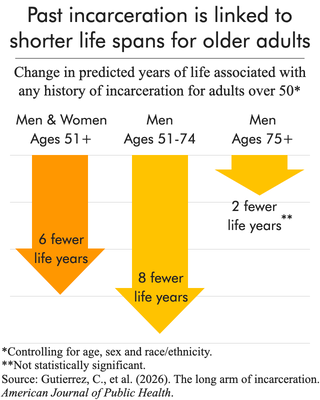
Professor Gutierrez and her colleagues analyzed the results of the 2012 and 2014 iterations of the Health & Retirement Study, a longitudinal, nationally representative survey of nearly 14,000 U.S. adults over the age of 50. As a measure of incarceration history, the survey asks a simple yes-or-no question: “Have you ever been incarcerated, that is, spent time in a jail, prison, juvenile detention center or other correctional facility?” The study also links individual responses to participants’ administrative records, including their appearance in the National Death Index. The researchers measured participants’ rates of death from any cause (i.e., all-cause mortality rates) between the 2012 and 2014 surveys and the follow-up interviews conducted in 2022, when the respondents would be roughly 60 or older.
While controlling for other characteristics like age, sex, race and ethnicity, and childhood health and socioeconomic factors, the researchers found that formerly incarcerated older people have an 88% higher hazard of premature death compared to those with no incarceration history.4 More specifically, older people who have experienced incarceration are expected to live nearly six fewer years than similar peers who have never been incarcerated. Formerly incarcerated men and women died at significantly younger average ages (74.8 and 68 years, respectively) than men and women without incarceration histories (82.3 years and 82.9 years, respectively).5 For men between 50 and 75 years old, the difference was even greater at close to eight fewer years, but after age 75, incarceration history appeared to have less of an effect on life expectancy.
In addition to its findings about mortality, this study found significant demographic differences between older adults with histories of incarceration and those with none, consistent with what we know about the socioeconomic and racial disparities of incarceration. Compared to older adults with no prior incarceration, formerly incarcerated older adults were more likely to be Black and to report childhood poverty, childhood housing insecurity, lower educational attainment, and fair or poor self-rated health (as opposed to good, very good, or excellent health). In addition, formerly incarcerated older adults were more likely to be unmarried, unemployed, and have a disability than those never incarcerated.
Incarceration is tied to serious health problems in later adulthoodAn earlier study authored by a team of academic researchers including Professor Gutierrez — published in the Journal of Gerontology in 2024 — sheds more light on the health of formerly incarcerated people in their older age, with particular focus on chronic conditions that undoubtedly contribute to their shortened life expectancy. Previous research has shown that incarceration takes a toll on both individual health and public health, but this study provides evidence that incarceration is associated with poor health outcomes specifically in later life. The researchers find that any past incarceration is associated with impairments of mobility, vision, and activities of daily living,6 as well as diagnoses of cancer, depression, and chronic lung disease among people 50 and older in the U.S.
This study is based on an analysis of data from the National Longitudinal Study of Adolescent to Adult Health (Add Health), which follows a nationally representative sample of over 20,000 people who were in grades 7-12 during the 1994-95 school year. The research team analyzed data collected from two specific groups of people7 in this massive, long-term study:
At the time of the 2015, 2016, and 2017 rounds of the Add Health study, there were 2,007 parents and 976 partners of parents who were at least 50 years old. The researchers analyzed survey responses about age-related health concerns among these nearly 3,000 older adults to compare those who reported any history of incarceration and those with no previous incarceration.8
In terms of health outcomes, the researchers found that the prevalence rates of a number of age-related conditions were higher among formerly incarcerated older adults. In the sample of parents (again, primarily mothers), those who were formerly incarcerated faced significantly higher rates of cancer, heart disease, stroke, depression, and chronic lung disease. In addition, those who had experienced incarceration were more likely to rate their own health as poor or fair, as opposed to parents without incarceration histories. When controlling for age and sex differences, parents with histories of incarceration were more likely to report difficulty walking and difficulty with activities of daily living than those parents with no history of incarceration.

Among the partner sample, made up of mostly men, the researchers also found alarmingly elevated rates of age-related health concerns associated with previous incarceration. In particular, prevalence rates of cancer, depression, chronic lung disease, and “heavy” alcohol use9 were significantly higher among formerly incarcerated people in the partner sample compared to those with no prior incarceration. In addition, formerly incarcerated partners reported difficulty with walking, seeing, and with activities of daily living at higher rates than those who reported no time spent in jail or prison. While the researchers do not explain the reason for the different findings between the parent sample and the partner sample, sex is the most obvious difference.

Aside from the findings about health concerns among formerly incarcerated older adults, the analysis of these samples also helps paint a picture of formerly incarcerated parents. First, incarceration was more common in the sample of partners (mostly men) than among the sample of parents (mostly women): 15% of partners reported any previous incarceration compared to only 4.2% of parents. Compared to parents and partners with no incarceration history, a greater portion of parents and partners with incarceration histories were Black, reported parental childhood abuse, had lower educational attainment, and reported receiving public assistance in the past 12 months. In terms of their access to healthcare, parents and partners who had ever been incarcerated were more likely to identify the emergency department as their usual source of medical care, report at least one overnight hospital stay in the past 12 months, and/or to have Medicaid or no health insurance. These differences tell us that not only are formerly incarcerated older adults particularly vulnerable to a number of serious health issues, a number of socioeconomic factors also limit their access to the appropriate and necessary care.
ConclusionMillions of formerly incarcerated people are aging into older adulthood: approximately 1 in 15 adults aged 50 or over has a history of incarceration and therefore faces both an elevated risk of death and a number of serious medical conditions. These two studies provide further evidence that incarceration is a social determinant of health and should be included in assessments of public health. In addition, the elevated mortality risk and prevalence of chronic age-related conditions among formerly incarcerated older adults in these studies supports the argument that healthcare providers need to consider individuals’ history of incarceration to better understand the health risks they may face.