Просмотр новости
Найдите то, что Вас интересует
 Спутники
 РН
РН SpaceX
 Роскосмос
 NASA
NASA
СпутникиРНSpaceXРоскосмосNASAA vast ocean current encircling Antarctica—more powerful than all the world’s rivers combined—played a surprisingly complex role in shaping Earth’s climate. The Antarctic Circumpolar Current moves more than 100 times the total water carried by all of Earth’s rivers combined. Flowing continuously around Antarctica without being blocked by land, it plays a central role in [...]
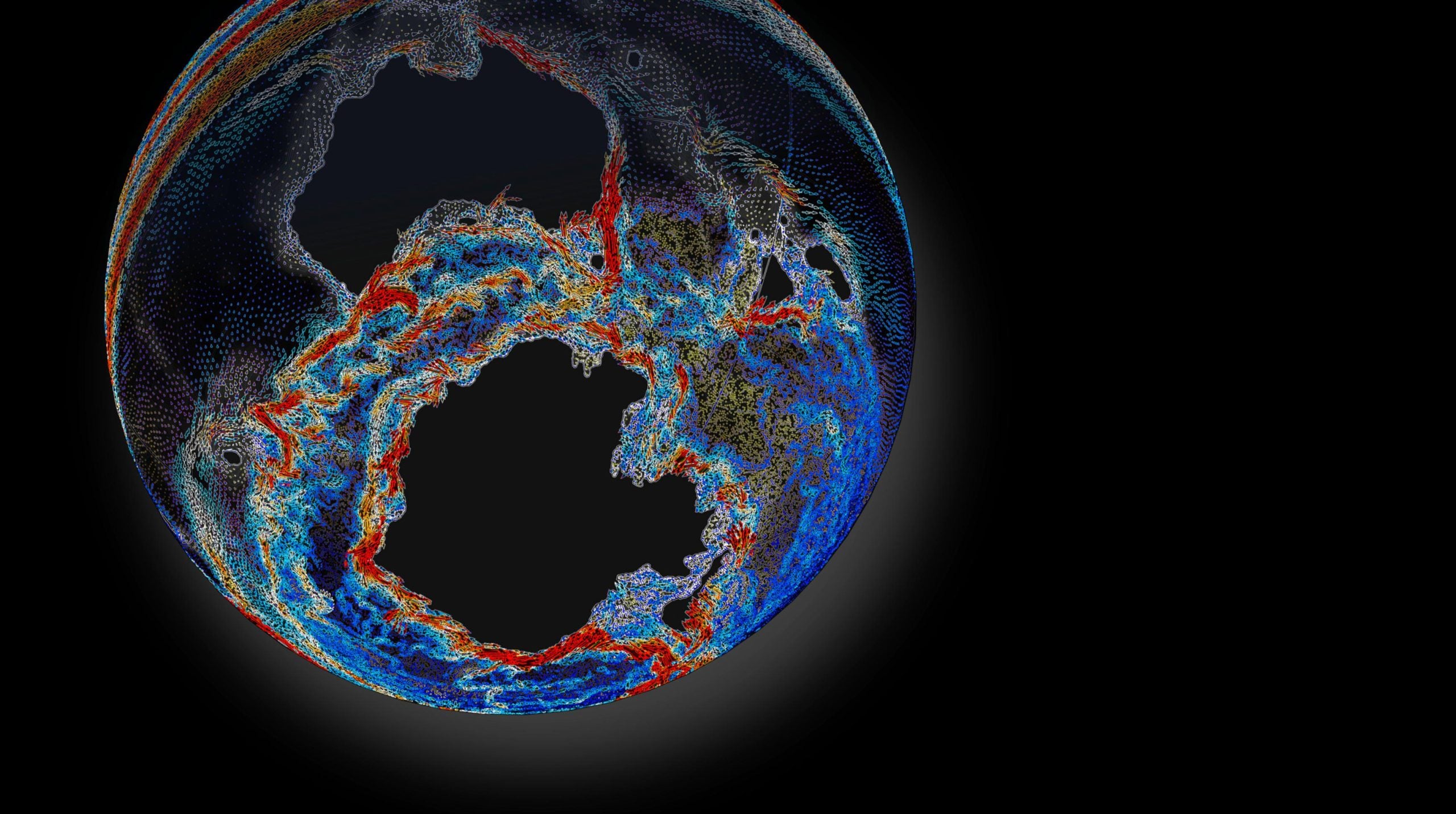 Model simulation of the Antarctic Circumpolar Current, which began to form around 34 million years ago. Credit: Alfred Wegener Institute / Hanna Knahl, Patrick Scholz
A vast ocean current encircling Antarctica—more powerful than all the world’s rivers combined—played a surprisingly complex role in shaping Earth’s climate.
The Antarctic Circumpolar Current moves more than 100 times the total water carried by all of Earth’s rivers combined. Flowing continuously around Antarctica without being blocked by land, it plays a central role in regulating the global climate. A new study published in the journal Proceedings of the National Academy of Sciences explains when and how this massive current first formed. The researchers found that opening ocean pathways alone was not enough to create it.
A Turning Point in Earth’s Climate 34 Million Years AgoRoughly 34 million years ago, Earth underwent a major shift during the transition into the Oligocene – changing from a warm, largely ice-free greenhouse climate to a cooler icehouse state with expanding polar ice. During this time, ocean passages between Antarctica, Australia, and South America widened and deepened. The Antarctic Circumpolar Current (ACC) began to develop, and the Antarctic Ice Sheet started to form.
At that time, atmospheric CO2 levels were around 600 ppm – higher than today but potentially reachable again in future climate scenarios. “In order to predict the possible future climate, it is necessary to look into the past with simulations and data to understand our Earth in warmer and more CO2-rich climate states than today,” says Hanna Knahl, climate modeller at the Alfred Wegener Institute, Helmholtz Centre for Polar and Marine Research (AWI) and lead author of the study, which now appears in the Proceedings of the National Academy of Sciences (PNAS). “But careful, the climate of the past can of course not be projected 1:1 onto the future. Our study shows that the circumpolar current in its ‘infancy’ influenced the climate very differently than today’s fully developed ACC does.”
Simulating the Birth of the Antarctic Circumpolar CurrentTo investigate how the ACC formed, Knahl and her team used climate simulations based on Earth’s geography about 33.5 million years ago, when Australia and South America were still positioned much closer to Antarctica. They combined an Antarctic Ice Sheet model from a 2024 Science study with models of the ocean, atmosphere, and land to better understand how ocean circulation evolved.
The simulated currents were then compared with geological reconstructions from the same time period to check how well the models matched real-world evidence.
Winds and Continental Movement Were CriticalThe study highlights the importance of the Tasman Gateway, a seaway between Antarctica and Australia. “There were already indications that the wind in the Tasman Gateway played an important role in the formation of the ACC. Our simulations can clearly confirm this: Only when Australia had moved further away from Antarctica and the strong westerly winds blew directly through the Tasman Gateway, the current could fully develop,” Knahl explains.
The results also suggest that the Southern Ocean looked very different in the early stages. Even though ocean passages were open, the current was not yet continuous around the continent. Strong flow appeared in the Atlantic and Indian sectors, while the Pacific region remained relatively calm.
Advanced Climate Modeling Reveals New InsightsCombining climate and ice sheet models is still a relatively new and complex approach, but it allows scientists to capture interactions across Earth’s systems more accurately. For this study, researchers from AWI’s Palaeoclimate Dynamics and Marine Geology divisions worked together with international partners from the Australian Centre of Excellence in Antarctic Science and the Antarctic Research Centre Wellington.
“With this PNAS study, we are showing – for the first time – how helpful and important it is to carry out these coupled and relatively high-resolution model simulations for the climate of the deep past. Even though they are very demanding, they provide novel insights into the interaction of ice, atmosphere, land surface, and ocean,” explains AWI palaeoclimate modeler Prof. Dr. Gerrit Lohmann, co-author of the study.
Why This Ocean Current Still Matters TodayBy reconstructing the formation of the ACC, the researchers showed how global ocean circulation was reorganized in Earth’s past. This shift had major consequences for the planet’s climate. As AWI geoscientist Dr. Johann Klages explains, “This understanding is crucial, as the formation of the ACC has strongly driven carbon uptake by the ocean. This reduction in the concentration of greenhouse gases in Earth’s atmosphere thus had the potential to initiate the cooler climate of the so-called Cenozoic Ice Age, which continues to this day with permanently ice-covered polar ice caps, in which warm and cold periods alternate. This new knowledge will therefore help us to more reliably interpret recent changes in Southern Ocean circulation more reliably.”
These findings offer valuable insight into how ocean currents, atmospheric conditions, and shifting continents worked together to reshape Earth’s climate, helping scientists better understand changes happening today.
Reference: “Configuration of circum-Antarctic circulation at the last green- to icehouse climate transition” by Hanna S. Knahl, Johann P. Klages, Lars Ackermann, Katharina Hochmuth, Lu Niu, Nicholas R. Golledge and Gerrit Lohmann, 6 April 2026, Proceedings of the National Academy of Sciences.
DOI: 10.1073/pnas.2520064123
Never miss a breakthrough: Join the SciTechDaily newsletter.
Follow us on Google and Google News.
| # | Наименование новости | Тональность | Информативность | Дата публикации |
|---|---|---|---|---|
| 1 | A Crucial Atlantic Current Is Weakening and Weather Could Change Worldwide | -1 | 7 | 15-05-2026 |
| 2 | Wie entstand die mächtigste Ozeanströmung der Erde? | 0 | 7.04 | 06-04-2026 |
| 3 | Scientists Unlock 3 Million Years of Climate Secrets Hidden in Antarctic Ice | 5 | 7 | 02-04-2026 |
| 4 | Researchers Uncover Hidden Genetic World Beneath Antarctic Seas | 5 | 7 | 30-03-2026 |
| 5 | Unusually Warm Water Detected Creeping Toward Antarctica – and Scientists Are Alarmed | -8 | 7 | 06-05-2026 |
| 6 | Why Antarctic Sea Ice Suddenly Collapsed After Decades of Growth | 0 | 7 | 07-04-2026 |
| 7 | Hidden Warm Water Beneath Antarctica Could Rapidly Raise Global Sea Levels | -2 | 6 | 14-05-2026 |
| 8 | A Hidden Arctic Ocean Crisis Is Unfolding Beneath the Melting Ice | -5 | 7 | 31-05-2026 |
| 9 | Hidden Ocean Currents Revealed in Stunning Detail by AI | 5 | 7 | 27-04-2026 |
| 10 | Antarctica’s Future May Be More Predictable Than Scientists Thought | 0 | 7 | 22-06-2026 |