Просмотр новости
Найдите то, что Вас интересует
 Спутники
 РН
РН SpaceX
 Роскосмос
 NASA
NASA
СпутникиРНSpaceXРоскосмосNASAResearchers have applied a temperature proxy to exceptionally well-preserved fossil phytoplankton for the first time. The results suggest that conditions in the North Atlantic have been cooler than previously believed since the Miocene epoch. Accurate forecasts of how Earth’s climate will respond to rising atmospheric carbon dioxide depend on climate models. To test and refine [...]
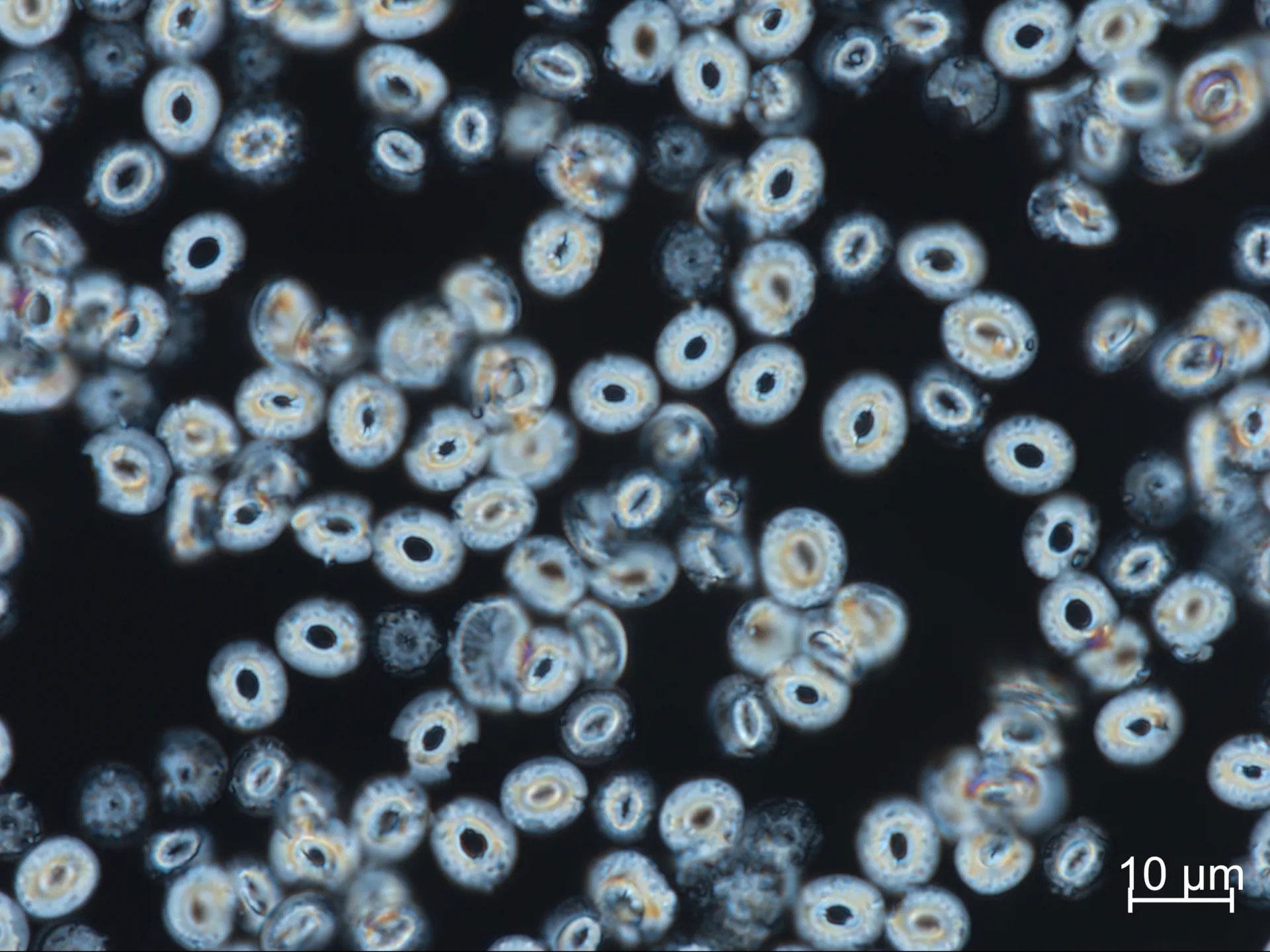 Coccolithophores form calcite plates as a kind of exoskeleton. When the organisms die, the plates sink from the upper ocean to the deep sea, carrying the geochemical signatures of their lifetime, and are deposited layer by layer on the ocean floor. Credit: Luz María Mejía
Researchers have applied a temperature proxy to exceptionally well-preserved fossil phytoplankton for the first time. The results suggest that conditions in the North Atlantic have been cooler than previously believed since the Miocene epoch.
Accurate forecasts of how Earth’s climate will respond to rising atmospheric carbon dioxide depend on climate models. To test and refine these models, scientists look to past geological periods when CO2 levels shifted in ways similar to those observed today and projected for the near future. They reconstruct these ancient conditions using measurable indicators known as proxies.
In a new study published in Nature Communications, researchers present a detailed temperature record from the North Atlantic spanning the past 16 million years—offering an important window into one such period. By applying clumped-isotope geochemistry to exceptionally pure fossil calcareous algae (coccoliths), they found that the region was significantly cooler than earlier estimates had suggested. This revised temperature record aligns more closely with climate model simulations and challenges the long-standing view of extreme warmth in high northern latitudes during the Miocene.
To better understand this discrepancy, Dr. Luz María Mejía, now at MARUM – Center for Marine Environmental Sciences at the University of Bremen, and her colleagues focused on the last 16 million years, with particular attention to the Miocene. During this interval, atmospheric CO2 levels, estimated at 400 to 600 ppm (parts per million) based on the latest IPCC report, were comparable to those projected under current emission scenarios.
“Understanding the Miocene climate, between 5 and 23 million years ago, could help us better predict the climate response to anthropogenic CO2 emissions of the near future,” says Mejía.
Fossil algae preserve climate signalsTo estimate past temperatures, the team studied clumped isotopes in fossil coccoliths, which are bonds between heavier oxygen and carbon isotopes. These coccoliths are calcite plates produced by marine plankton that serve as an external structure. The organisms, called coccolithophores, live in the sunlit surface ocean and carry out photosynthesis.
Their calcite plates preserve a chemical signature that reflects the temperature of the surrounding water during their lifetime, allowing scientists to reconstruct past ocean conditions independently of seawater chemistry. After these organisms die, their plates sink and become part of seafloor sediments, where they remain preserved over millions of years.
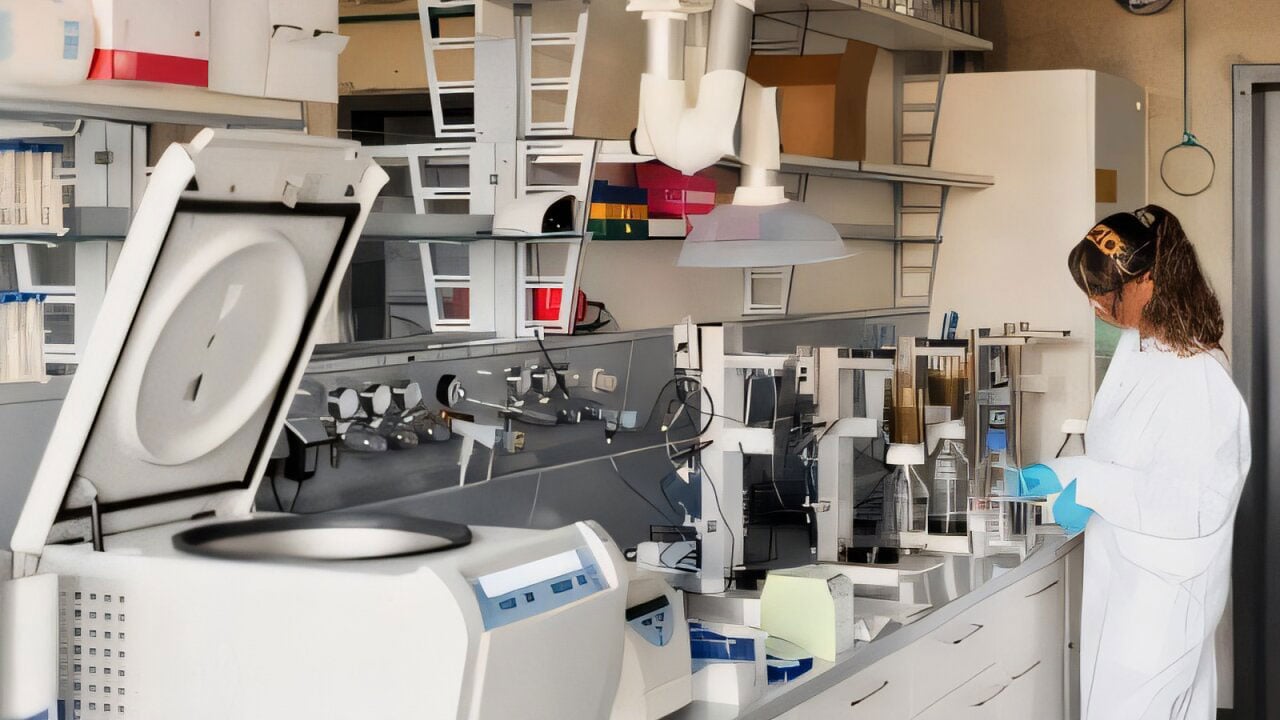 Dr. Luz María Mejía from MARUM prepares samples using the coccolith separation device her team designed at ETH Zurich. The technology for this was built in Zurich and modified for the laboratory at MARUM. Credit: Patrick Pollmeier, University of Bremen
Scientists collect these sediments by drilling into the ocean floor and extracting cores. Like tree rings, these layers contain markers that make it possible to determine their age and link them to specific geological periods. Temperature affects how frequently heavy oxygen and carbon isotopes bond within the calcite. More clustering occurs at lower temperatures and less at higher temperatures. By measuring this clustering, researchers can estimate the temperature of the water when the coccolithophores were alive.
Before analyzing the fossils, Dr. Mejía developed a method to isolate large amounts of coccoliths without contamination from other materials. The team designed a semi-automatic filtering system and combined it with centrifugation at the Eidgenössischen Technische Hochschule (ETH) Zurich (Switzerland) to produce samples of exceptional purity.
Results challenge warm Miocene paradigmThe findings differed from widely accepted expectations.
“Perhaps the most widely used and accepted temperature indicator, especially for the Miocene, is the alkenone unsaturation index, which is based on organic fossil molecules that are also produced by coccolithophores. Sea surface temperature estimates using alkenones have contributed to the widely accepted paradigm amongst the proxy and climate-model communities – that during past warm periods such as the Miocene, high latitudes were extremely warm, and the meridional temperature gradient was greatly reduced,” explains Mejía.
This idea suggests that higher CO2 levels lead to warmer oceans and smaller temperature differences between the tropics and the poles.
“This paradigm always seemed odd to me, because in the Caribbean, where I studied marine biology, I could see with my own eyes how most life struggles terribly during the warm season. How is it possible that life in general could survive and thrive at higher temperatures, including in non-tropical regions, over millions of years?” she wondered.
New analyses using coccolith clumped isotopes offer a different conclusion. The results indicate that the North Atlantic was about 9 degrees Celsius cooler than earlier estimates suggested. The researchers emphasize that this challenges the long-standing view of extreme warmth in northern high latitudes and brings observational evidence into closer agreement with climate model simulations for the Miocene.
Implications for future climate projectionsThe study suggests that temperatures in high northern latitudes during the Miocene may not have been as extreme as previously believed, and may not reach such levels in the future. The team also stresses that climate proxies must be continually re-evaluated to ensure both long-term trends and absolute temperature values are interpreted accurately.
Dr. Mejía clarifies, however, that this study is just the beginning: “We need to test more,” she says.
The next step will be to analyze fossil coccoliths from different regions and across a wider range of latitudes to develop a more complete picture of past climate conditions.
Reference: “Coccolith clumped isotopes reveal modest rather than extreme northern high latitude amplification during the Miocene” by Luz María Mejía, Stefano M. Bernasconi, Alvaro Fernandez, Hongrui Zhang, José Guitián, Madalina Jaggi, Victoria E. Taylor, Alberto Perez-Huerta and Heather Stoll, 9 December 2025, Nature Communications.
DOI: 10.1038/s41467-025-65954-y
Never miss a breakthrough: Join the SciTechDaily newsletter.
Follow us on Google and Google News.
| # | Наименование новости | Тональность | Информативность | Дата публикации |
|---|---|---|---|---|
| 1 | Warming Oceans Could Trigger a Dangerous Methane Surge | -2 | 6 | 08-05-2026 |
| 2 | Researchers Uncover Hidden Genetic World Beneath Antarctic Seas | 5 | 7 | 30-03-2026 |
| 3 | A Hidden Arctic Ocean Crisis Is Unfolding Beneath the Melting Ice | -5 | 7 | 31-05-2026 |
| 4 | Unusually Warm Water Detected Creeping Toward Antarctica – and Scientists Are Alarmed | -8 | 7 | 06-05-2026 |
| 5 | Scientists Unlock 3 Million Years of Climate Secrets Hidden in Antarctic Ice | 5 | 7 | 02-04-2026 |
| 6 | A Surprising Discovery Inside Fish Could Change What We Know About the Ocean | 5 | 7 | 05-06-2026 |
| 7 | Sharks Are Overheating as Warming Oceans Push Them to the Edge | -2 | 6 | 26-04-2026 |
| 8 | Scientists Discover Coral Reefs Are Teeming With Previously Unknown Life | 5 | 7 | 20-04-2026 |
| 9 | A Crucial Atlantic Current Is Weakening and Weather Could Change Worldwide | -1 | 7 | 15-05-2026 |
| 10 | AI Reveals Explosive Growth of Floating Algae Across the World’s Oceans | 0 | 7 | 19-04-2026 |