Просмотр новости
Найдите то, что Вас интересует
 Спутники
 РН
РН SpaceX
 Роскосмос
 NASA
NASA
СпутникиРНSpaceXРоскосмосNASA
Marketplace’s Meghan McCarty Carino speaks with Paul Vixie, vice president at AWS Security and an early internet innovator, about the rapid buildout of fiber optic networks during the dot-com boom, and what happened when the bubble burst.
Underneath a busy street in Menlo Park, California, around the corner from the coffee shop I worked at as a teen, is a series of fiber optic cables laid out during the dot com boom.
There, we met Paul Vixie, a vice president and distinguished engineer at AWS Security. But Vixie is also an early internet innovator who helped lay a lot of that same fiber, lying under the manholes on that street.
Marketplace’s Meghan McCarty Carino spoke with Vixie for a history lesson, as part of our ongoing series about AI infrastructure.
Back in the early 2000s when those cables were being laid, telecommunication companies were also spending billions of dollars to build out fast and reliable internet infrastructure betting on bigger returns.
“That was very much the feeling is we got to do everything we can within the limits of the law and the laws of physics, but we got to do everything possible to get this built as quickly as possible, because that's how the winners and losers are going to sort themselves out,” Vixie said.
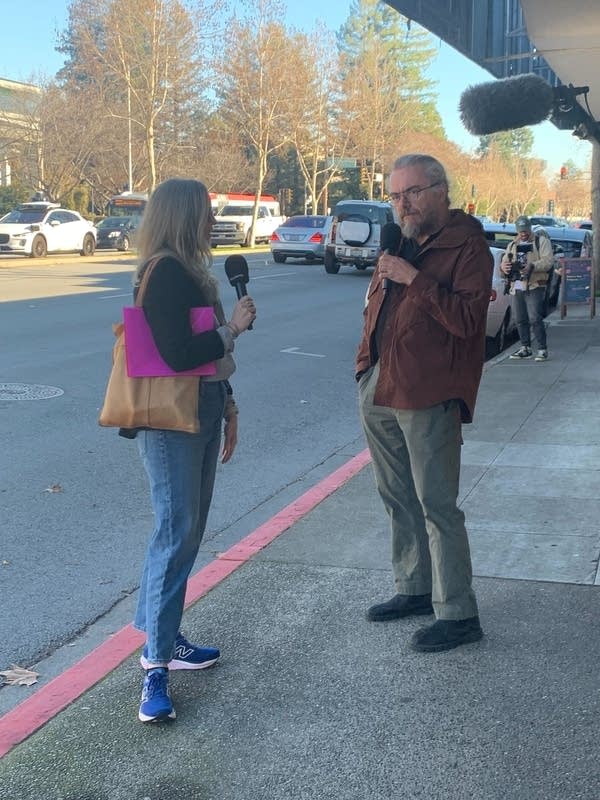
Marketplace's Meghan McCarty Carino (L) and Paul Vixie, VP and distinguished engineer at AWS, on a street in Menlo Park, California.
Daniel Shin/Marketplace
But as everyone knows, the dot-com boom went bust and in the wake of bankruptcies of telecoms and tech firms alike, layers of unused internet cables remained.
The Federal Communications Commission estimated that by 2007, about two-thirds of the 45 million miles were still “dark.”
But years later, that fiber infrastructure supported the next cycle of the internet economy - search engines, social media, streaming video, cryptocurrency and now AI.
“We now have enough fiber that anybody who wants to do something can do it,” Vixie said. “I think all of the investments that were made have ultimately paid off, even if you know, some of the companies represented on these manhole covers had to go through bankruptcy on the way.”
So even if the short term didn’t end well for various companies and the people involved, ultimately that dot-com infrastructure was used for all kinds of things.
“I'm betting that of the 12 conduits that each of these companies put into the hole in the ground where these manholes are, they're probably not even half full yet,” Vixie added. “So the future is effectively unlimited for what can be done with an information economy in the next 50 years.”
Vixie doesn’t think the current companies involved in the AI infrastructure buildout are as vulnerable as the dot com companies that went under. Ultimately, he says AI will continue to evolve regardless of what happens in this current AI boom.
| # | Наименование новости | Тональность | Информативность | Дата публикации |
|---|---|---|---|---|
| 1 | Bytes: Week in Review – Are we in an AI bubble? | 0 | 7 | 30-01-2026 |
| 2 | Raising the “speed limit” on AI’s “information highway” | 0 | 5 | 26-01-2026 |
| 3 | It's a tough time to break into cybersecurity | -2 | 5 | 15-06-2026 |
| 4 | A historic home tour of the virtual world | 0 | 6 | 27-01-2026 |
| 5 | Bytes: Week in Review - Amazon and AI, YouTube tops the media market and Meta buys an AI-only social network | 0 | 5 | 13-03-2026 |
| 6 | Are our electric grids too big to function? | 0 | 7 | 16-06-2026 |
| 7 | U.S. regulators eye rules for prediction markets | 0 | 7 | 24-03-2026 |
| 8 | A recycling startup joins the AI boom | 5 | 7 | 29-01-2026 |
| 9 | Building a home with future fires in mind | 0 | 7 | 12-01-2026 |
| 10 | Why Siri AI isn't coming to the EU | 0 | 5 | 12-06-2026 |