Просмотр новости
Найдите то, что Вас интересует
 Спутники
 РН
 SpaceX
 Роскосмос
 NASA
СпутникиРНSpaceXРоскосмосNASAIt’s a week before the Budget, but UK debt just passed £3 trillion, on the same morning as inflation jumped to 3.5%. It creates a real headache for the Chancellor, but ironically, annual borrowing is falling (very marginally). The government borrowed £4.4 billion less than it did for the same period last year. Even debt ... Read more
It’s a week before the Budget, but UK debt just passed £3 trillion, on the same morning as inflation jumped to 3.5%. It creates a real headache for the Chancellor, but ironically, annual borrowing is falling (very marginally). The government borrowed £4.4 billion less than it did for the same period last year. Even debt as a share of GDP marginally fell.
The IMF have recently said the UK has already started on consolidation, and urged it to stay the course. Not only that, but UK growth has exceeded expectations, upgraded by half a point and running faster than Japan, Italy and France, and unemployment has also fallen to 4.7%. But the truth is that the economy is in much worse shape than these headline figures suggest. This is why
The cost of servicing the debtIn September alone, the government paid £10.9bn in debt interest payments, the highest figure for any September since records began in 1997. Five months into the financial year, debt interest was running £2bn above the OBR forecast. In September, the overshoot doubled to £3.8bn.
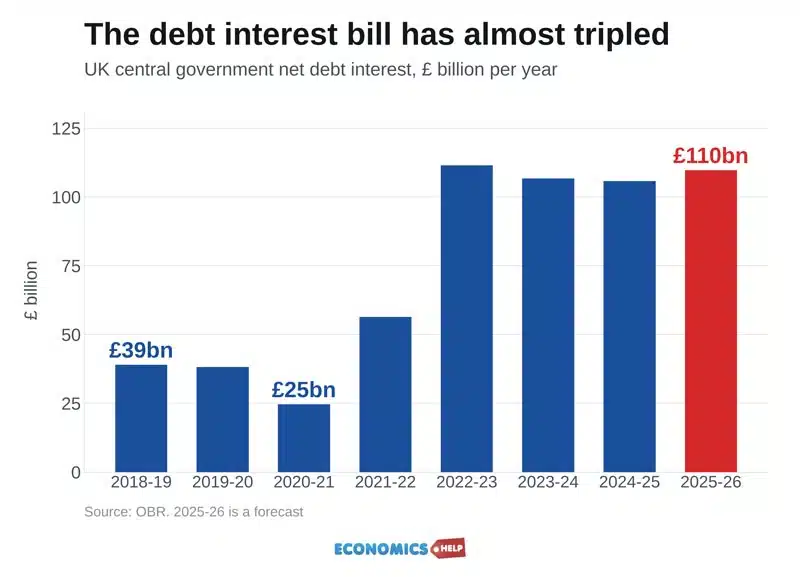
On the one hand you have a marginal reduction in the deficit and debt ratio, but the cost of servicing debt is rising fast. Before the pandemic, debt interest was just £39bn a year, but it has jumped in recent years, and with bond yields rising, it keeps getting higher. When debt interest is £3.8bn above forecast, and total borrowing £6bn above, that breaks the Chancellor’s budget. It reduces fiscal headroom, and makes the Chancellor’s choices more limited.
Why the cost of debt is rising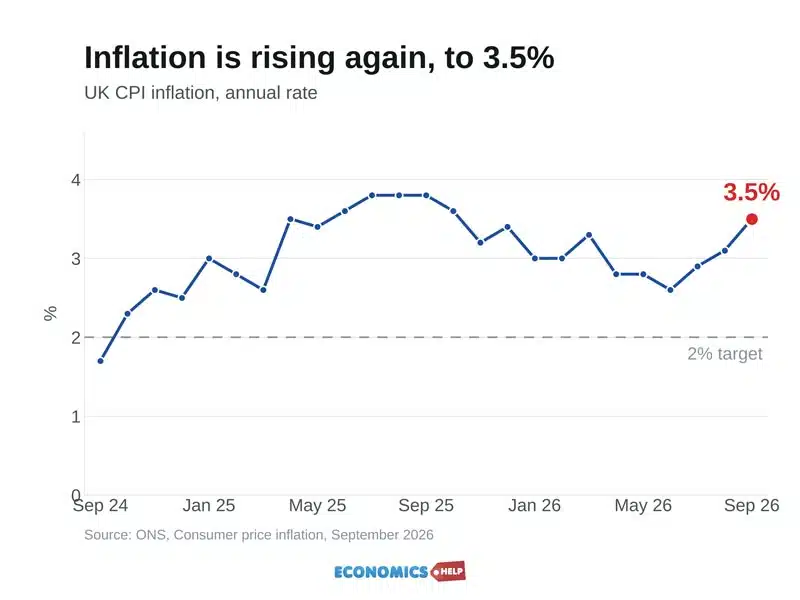
If we go back to inflation, it jumped to 3.5%, higher than predicted. The problem is that the Middle East situation is still dire, with traders raising long-term forecasts of oil prices. This has pushed petrol, diesel and transport costs higher. Diesel is at 199p, petrol 174p.
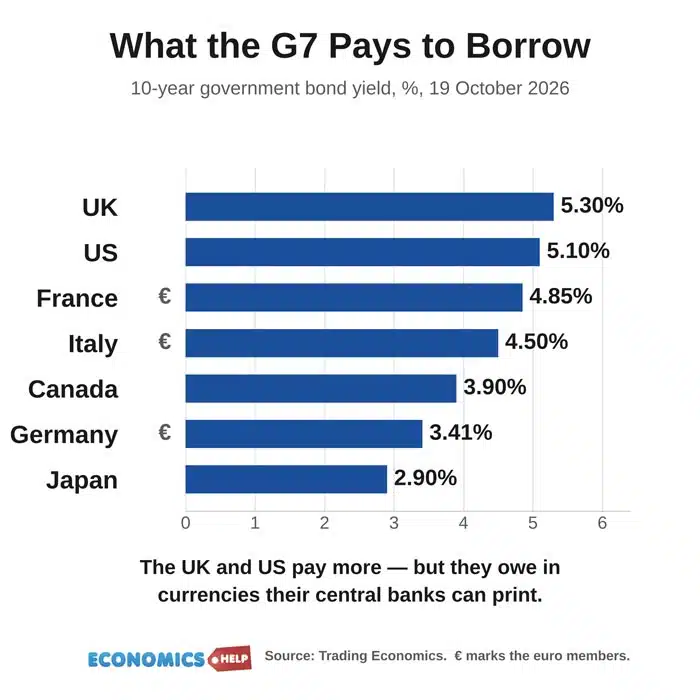
Up to September, inflation was lower than some feared, but the rise in diesel is now translating into higher inflation, and there is more bad news to come with a rise in gas pushing up energy bills in the new year. It is these higher expectations of inflation which are causing UK yields to rise. In fact, UK yields are the highest in the G7. This is not fear of UK default; it reflects the UK’s reputation for higher inflation, and to a lesser extent the Bank’s aggressive quantitative tightening, selling bonds onto the market.
The resurgence in inflation also means that the Bank of England can’t cut rates, and traders now price in more interest rate rises. So the combination of rising inflation and interest rates increases the cost of borrowing. Long-term borrowing costs on 30-year gilts have passed 6% for the first time since 1998.
What a rise in bond yields actually costs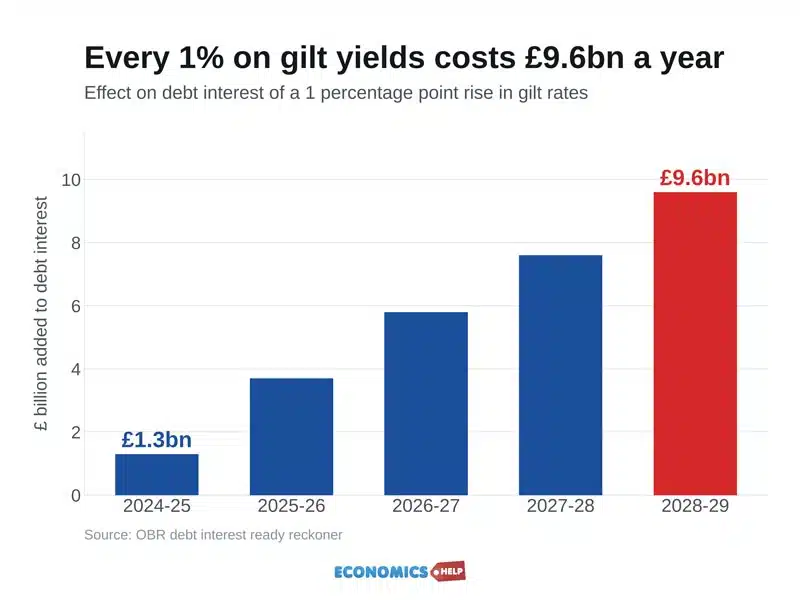
For every one percent rise in gilt yields, the debt interest bill goes up by £5.8 billion. But as old debt matures and gets refinanced at higher rates, the cost compounds. By 2028/29, 1% will cost £9.6bn every year.
The problem is that the OBR’s past projections of debt interest have been an underestimate. The Budget could see another upward revision. By 2029/30, £12 billion will be added to the cost of the same debt, just because of higher bond yields.
In this financial year, the DMO is selling £250 billion of gilts, but every gilt is sold at today’s higher yields, not yesterday’s. And the UK is reliant on foreign buyers, with overseas investors holding about 28% of UK government debt. With government debt rising around the world, there is more competition.
Putting the cost into context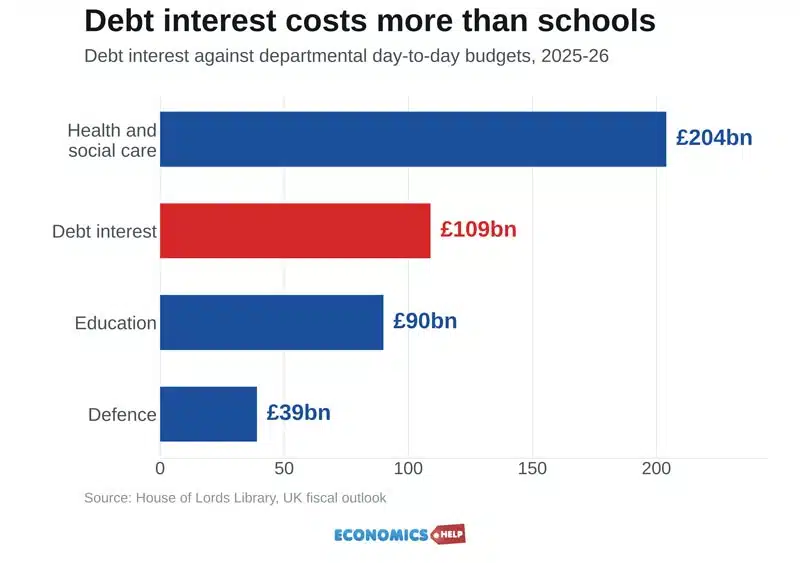
Today’s debt interest is about £109bn. The day-to-day education budget is £90bn and defence £39bn. That is £109bn buying nothing. £109bn is roughly the equivalent of 16p on the basic rate of income tax.
The headroom has halved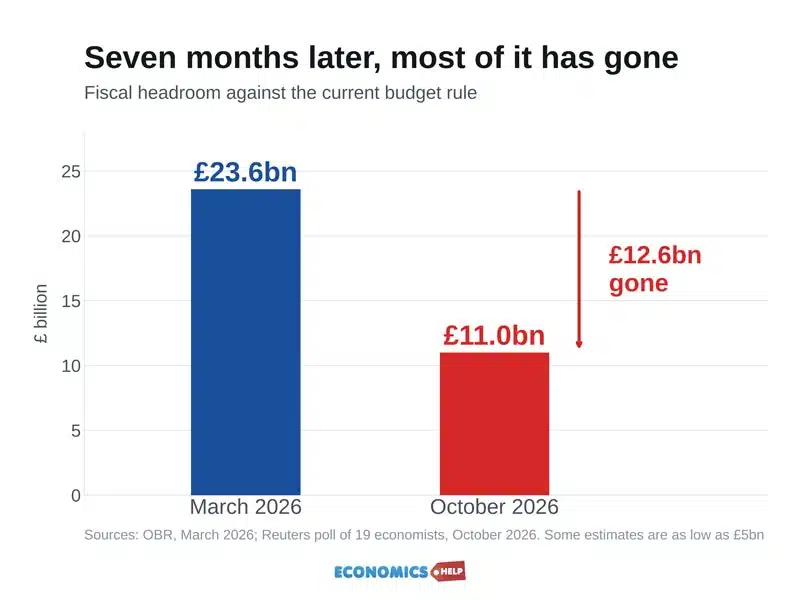
Every Chancellor sets fiscal rules and operates within the margin. Back in March, this headroom was £23.6bn, but a Reuters poll of 19 economists thinks it is now down to £11bn, some as low as £5bn. That’s over £12bn gone in a few months, not because of politically popular tax cuts or spending promises, just market conditions. If bond yields were to jump by another 70 basis points, it could wipe away all the headroom.
The IMF recently acknowledged the UK has started on consolidation, but it also called rebuilding fiscal space urgent. And whilst the UK might compare favourably to the prospect of the French budget, I would caution about getting carried away by forecasts of debt reduction.

In the past 15 years, forecasts of falling debt have consistently proved wrong. The OBR dutifully forecasts reductions in debt, but then the government doesn’t implement its own spending cuts, it doesn’t increase fuel duty as promised, or they get hit by higher borrowing costs. I’m not saying debt forecasts are useless, but they are pretty useless. I’ll believe it when I see it.
Is the UK doomed? The optimistic case
There is a more optimistic case worth making. The debt ratio is falling. In fact, a few years ago debt was marked as 100%, but the ONS later said this was a wrong calculation, and debt actually never reached 100%. Also, in recent history the UK did reach 240% of GDP, and 94% is actually below the long-term average going back to 1789.
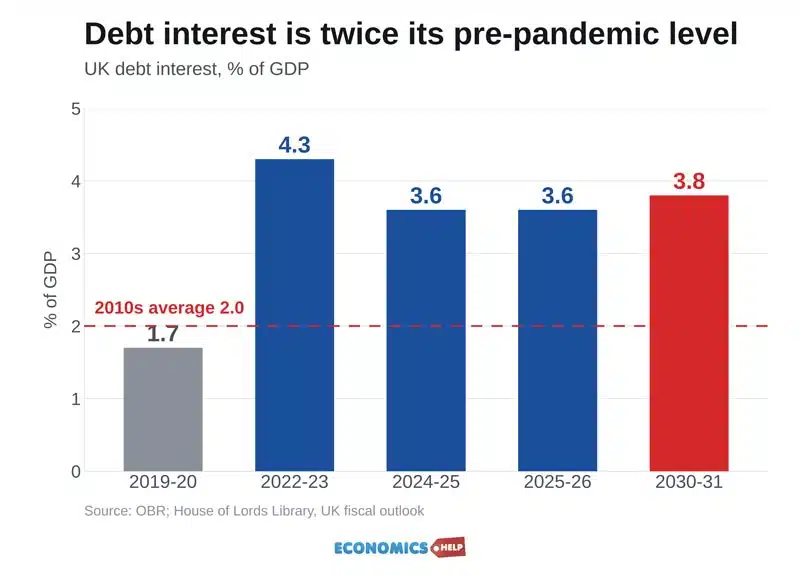
Secondly, debt interest payments are not a record as a share of GDP. It is currently 3.6% of GDP; in 2022/23 it was 4.3%, the highest since the war. It’s worth bearing in mind the 2010s were unusually low, which may have encouraged a false sense of security about borrowing.
Thirdly, the inflation spike is fairly narrow. If you look at core inflation, which strips out energy and food, it is 2.8%. Food inflation is just 1.3%. The thing driving inflation is fuel, and fuel will drop out of the annual comparison later next year. It is also worth bearing in mind that the last oil shock of 2022 caused inflation to rise to 11%, so 3.5% is considerably lower.
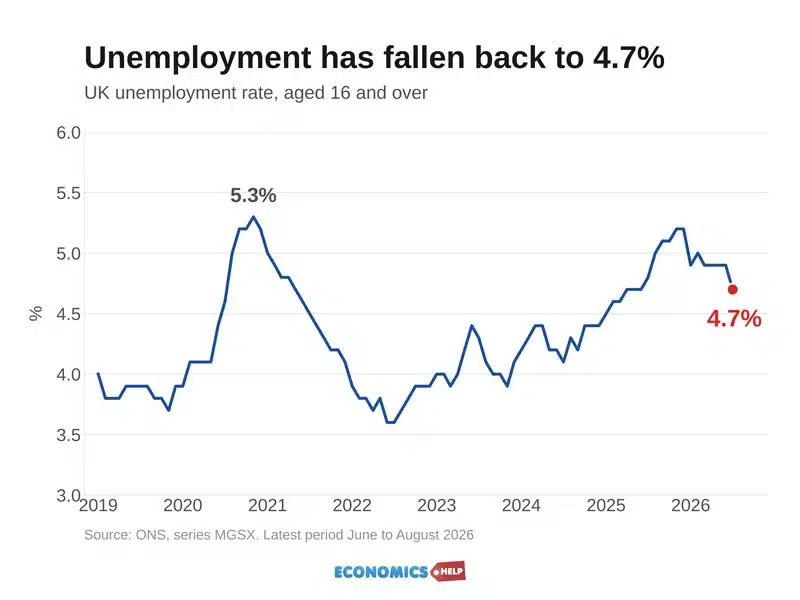
(note this is series MGSX over 16 unemployment)
Fourth, borrowing is falling, unemployment has fallen to 4.7% and economic growth has actually exceeded expectations this year. This is genuinely good news, though you have to be careful getting carried away just because we are doing marginally better than other poorly performing economies.
Fifthly, if there was a resolution to the diesel crisis or a crash in AI stocks, you would see bond yields come down, and that would provide real relief for the Chancellor.
Temporary inflation, permanent interest billDoes this mean everything is fine? Definitely not. The rise in debt interest payments doesn’t get reversed. The government is selling 30-year bonds at 6%; that is the bill for the next 30 years. £250bn sold at today’s price. So temporary inflation is being converted into a permanent interest bill.
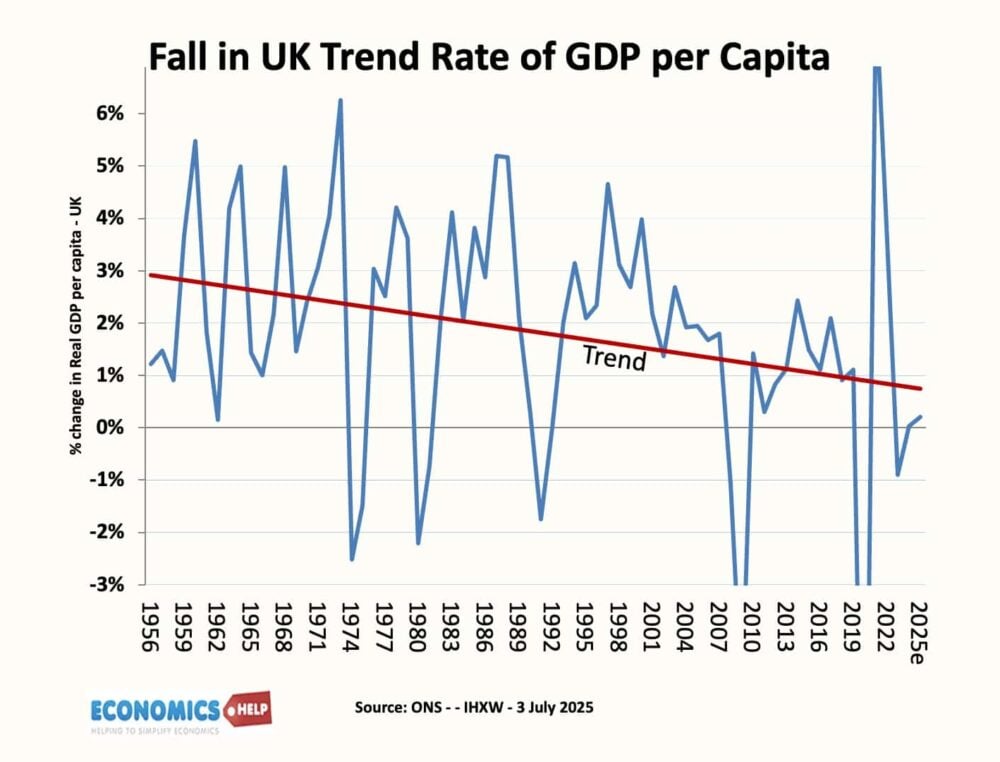
Economic data is perhaps a bit better than expected this year, and whilst that is genuinely encouraging, you really have to zoom out to see the bigger picture. It’s basically 16 years of almost no growth in real GDP per capita, and you would need a sustained period of high growth to reverse this. Unemployment of 4.7% hides the fact that there is a rise in health-related benefits and young people not in education, employment or training. And that is another budgetary pressure.

Then there is the biggest factor: we are an ageing society, causing higher pension spending, social care and health care. All the long-term pressures are for UK spending to increase faster than tax. These are OBR projections on current policy — no wonder 30-year yields are rising. Of course, if you change policy, such as increasing taxes or cutting the pension bill, this can be changed, but it is always politically difficult, especially if you want to do things like provide universal social care.
So what can the Chancellor do?He can increase taxes. But the tax burden is already at a post-war high, and there is evidence recent National Insurance increases hit employment in areas like hospitality. He can cut spending, but departments already have very strict spending limits set for the rest of the parliament. He could also change fiscal rules to allow more borrowing. But funding pension and benefit commitments by higher borrowing is likely to further increase bond yields and increase interest rate costs.
So this is the problem of being Chancellor: so much of your headroom is determined by events outside your control. What do you think the Chancellor should do? It’s not an easy job.
SourcesTejvan Pettinger. Author of “Cracking Economics” “What Would Keynes Do?” – studied PPE Oxford University (1995-99) and works as an economics teacher and writer.
| # | Наименование новости | Тональность | Информативность | Дата публикации |
|---|---|---|---|---|
| 1 | Reuters сообщило о рекордном госдолге Великобритании в £3 трлн | 0 | 14.48 | 22-10-2026 |
| 2 | Opinion: Our £3TN national debt is a powder keg | 0 | 10.97 | 10-08-2026 |
| 3 | OBR: UK Debt Set to Spiral Without Action | 0 | 6.94 | 09-07-2026 |
| 4 | Государственный долг Великобритании впервые превысил £3 трлн | 0 | 15.61 | 21-10-2026 |
| 5 | Bond Meltdown – What is Going on? | 0 | 17.8 | 30-09-2026 |
| 6 | Reuters: госдолг Британии впервые превысил $4 трлн | 0 | 19.52 | 21-10-2026 |
| 7 | ALEX BRUMMER: Only Botswana's debt has grown faster than the UK's | 0 | 14.79 | 09-06-2026 |
| 8 | Reuters: Государственный долг Британии впервые превысил 4 трлн долларов | 0 | 12.62 | 21-10-2026 |
| 9 | Госдолг Великобритании в сентябре впервые превысил 3 трлн фунтов | 0 | 11.89 | 21-10-2026 |
| 10 | Госдолг Британии впервые превысил 3 трлн фунтов стерлингов | 0 | 10.49 | 21-10-2026 |
