Просмотр новости
Найдите то, что Вас интересует
 Спутники
 РН
 SpaceX
 Роскосмос
 NASA
СпутникиРНSpaceXРоскосмосNASAAs confidence in the U.S. nuclear umbrella wanes, 10 European nations have started working with Paris on deterrence.
PARIS—France, working with European allies, is strengthening and expanding its role as a nuclear-weapons power in an effort to bolster deterrence against Russian attacks as Europe’s confidence in American security guarantees wavers.
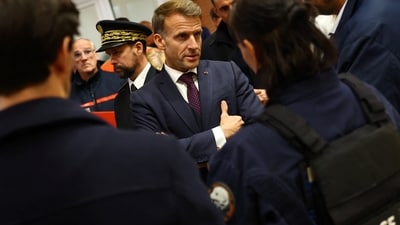
Dubbed “forward deterrence” by President Emmanuel Macron, the plan envisions deployments of French nuclear-enabled Rafale jet fighters across Europe and the creation of new infrastructure, communications, early-warning and intelligence-sharing links with these allies.
The ultimate aim is to create more strategic uncertainty for Russian President Vladimir Putin, who controls one of the world’s largest atomic arsenals and has repeatedly raised the specter of nuclear war since his armies invaded Ukraine in 2022.
“What it brings is a new complication for the adversary, because it brings another layer that the Russians will have to read,” Macron’s strategic-affairs adviser, Xavier Chatel, said at a recent security conference in Warsaw. The project also gives France “new options for dissemination of our nuclear forces in case of a nuclear escalation.”
Ten European countries—including the U.K., Germany, Poland and the Nordic nations—have joined the French initiative, with varying degrees of involvement, since Macron first announced the plan in March. The new architecture of secure communications, early warning and intelligence sharing, European officials say, could also contribute to conventional defense should the U.S. fail to protect its NATO allies.
“It’s a more geopolitically tense time and France has this strategic capacity,” said Norwegian Foreign Minister Espen Barth Eide. He said the French plan “doesn’t replace anything. It supplements the nuclear guarantees that were already there” from the U.S. nuclear umbrella.
French nuclear doctrine foresees the use of nuclear weapons when the nation’s “vital interests” are at stake. In the March speech announcing the new policy, Macron reiterated that these vital interests don’t stop at France’s borders and have a European dimension.
“Could we consider that the survival of our closest partners may be put at risk without it affecting our vital interests?” Macron said.
Macron also said France, which is believed to possess around 290 operational nuclear warheads—a fraction of the U.S. or Russian arsenals—would resume making nuclear devices for the first time in decades and would no longer disclose the size of its stockpile.
Paris has left the exact geography of its “vital interests” deliberately vague and never offered an explicit guarantee to allies. But the countries it has invited into its nuclear club offer some clues.
As of now, the 10 are the U.K., Germany, the Netherlands, Belgium, Poland, Greece, Finland, Norway, Sweden and Denmark. The three Baltic states, which are most vulnerable to Russia, aren’t included. Italy has declined to join.
“We don’t have any plans to put nuclear weapons on Finnish soil in peacetime. But we do have plans for creating a strategic dilemma for Russia,” said Finnish President Alexander Stubb. “We felt it would be useful for our security to get information, to be involved in it. We don’t know where this is going to end, it’s probably a 10- to 15-years process.”
France developed its own fully sovereign nuclear forces, outside the North Atlantic Treaty Organization, under President Charles de Gaulle in the 1960s. It doesn’t participate in the NATO nuclear planning group that unites the U.S., Europe’s other nuclear power, the U.K., and the remaining alliance members.
The U.S. operates a separate nuclear-sharing program with several European nations that involves deploying tactical nuclear weapons on allied aircraft, with any use requiring dual permission from the allied nation and Washington. The British nuclear deterrent, unlike the French, relies on American-made platforms and is under NATO command.
Doubts that the U.S. would risk nuclear war on behalf of an ally aren’t new. They were a key reason why de Gaulle—who received no reply after asking President John F. Kennedy in 1961 whether he would sacrifice New York to save Paris—sought an independent deterrent in the first place. But these doubts have intensified now that President Trump has embraced Putin’s Russia, striking energy deals and putting pressure on Ukraine.
French officials argue that the French deterrent is more credible because the security of European allies is of far more direct importance to them than to Washington.
“There is one difference between France and the U.S.—we share the same geography, we are part and parcel of the same continent, we have economic and sociological continuity with our neighbors writ large,” Chatel, Macron’s adviser, said at the Warsaw Security Conference.
That doesn’t mean France’s neighbors will be part of the decision-making. “The French will let us participate in their nuclear deterrence as much as the Americans,” quipped a government minister in another European nation involved in the project.
The retention of full French control over the nuclear force is part of a deliberate effort to make the “forward deterrence” strategy acceptable across the country’s political spectrum, including to the far-right Rassemblement National of Marine Le Pen, who, according to opinion polls, is ahead in the race for the presidency in elections next spring.
Le Pen’s party has implicitly endorsed the “forward deterrence” initiative. But a Le Pen presidency would likely undermine its appeal in Europe given her past warm relations with Putin, and the party’s overall skepticism of European commitments, some analysts warn.
“The problem is that an RN president would mean a loss of credibility on both branches—deterrence of Russia and reassurance of allies,” said French nuclear-policy expert Bruno Tertrais, deputy director of the Foundation for Strategic Research in Paris.
A senior European defense official in a partner nation agreed, saying that the intent, the focus and the scope of the partnership with France will come under renewed scrutiny—in Paris and among allies—should Le Pen come to power.
For now, France has created 10 separate steering groups with “forward deterrence” partners, and is holding talks in a hub-and-spokes bilateral fashion rather than gathering them all together in a nuclear club.
In practice, this means that defense officials in European partner nations keep calling each other to compare notes on what they had been told by France, senior defense officials say.
“Is it better than nothing? Probably. But it is not, and should not be viewed, as a substitute to U.S. extended deterrence. And the French are very clear about that, too,” said Vipin Narang, professor of nuclear security and political science at the Massachusetts Institute of Technology, who oversaw nuclear policy in the Pentagon under the Biden administration. “The fact that it is necessary pains me as a former American official. But the French have come a long way.”
While the U.S. has a much larger strategic nuclear arsenal, the belief in Paris and many other European capitals is that American strategic capabilities are reserved for protecting the American homeland, and that the real nuclear umbrella for Europe consists—at best—only of the bombs in the NATO nuclear-sharing program. The U.S. deliberately retains ambiguity on how it would respond.
These B-61 gravity nuclear bombs, designed in the 1960s to stop Soviet tank divisions sprinting from East Germany, have become increasingly obsolete in a modern war—and pose a limited threat to the Russian homeland given advances in Russian air defenses.
France’s ASMP-A nuclear-tipped cruise missiles on Rafales, by contrast, are designed to strike Russia’s main cities and have a high chance of reaching their targets, creating an entirely different level of deterrence, military officials and analysts say.
“It’s unclear if it is convincing to the Russians that the French would risk retaliation against Paris for Warsaw, for example. But the Russians are definitely paying attention,” said Nicole Grajewski, an expert on Russia and nuclear affairs at Sciences Po university in Paris.
The very nature of French nuclear doctrine and its nuclear arsenal makes it in some ways more threatening to Russia than the NATO extended deterrence led by the U.S., Grajewski added. “The B-61 bombs are not instruments for war fighting, they’re pretty much instruments of political assurance,” she said. “The French nuclear arsenal, by contrast, can reach Russia.”
Write to Yaroslav Trofimov at yaroslav.trofimov@wsj.com
| # | Наименование новости | Тональность | Информативность | Дата публикации |
|---|---|---|---|---|
| 1 | Париж обсуждает с 10 странами присоединение к программе ядерного сдерживания Франции | 0 | 9.83 | 26-10-2026 |
| 2 | WSJ: Франция привлекает союзников к ядерному сдерживанию РФ в Европе | 0 | 8.43 | 26-10-2026 |
| 3 | WSJ узнала о намерении Франция разместить в Европе истребители с ядерным оружием | 0 | 11.45 | 26-10-2026 |
| 4 | Стало известно, что Макрон планирует устроить против России | 0 | 8.57 | 26-10-2026 |
| 5 | Стало известно о новом плане Франции против России | 0 | 9.05 | 26-10-2026 |
| 6 | NATO working on plans to expand nuclear deterrence in Europe — DPA | 0 | 7.74 | 31-07-2026 |
| 7 | What France’s new nuclear-arms doctrine means for Europe | 0 | 15.88 | 03-03-2026 |
| 8 | AFP: Франция обсудит с 15 странами меры по снижению зависимости от РФ в атомной отрасли | 0 | 0 | 15-05-2023 |
| 9 | Воронцов: Страны Европы устраняют препятствия для получения ядерного оружия | 0 | 6.05 | 21-10-2026 |