Просмотр новости
Найдите то, что Вас интересует
 Спутники
 РН
 SpaceX
 Роскосмос
 NASA
СпутникиРНSpaceXРоскосмосNASAThe Indian automobile industry is currently grappling with rising input and freight costs due to geopolitical uncertainties. Prices of key commodities like HR steel and aluminum have surged significantly over the past year. Major car manufacturers have already implemented multiple price hikes and are considering more after the festive season. Despite these challenges, overall auto sales have recorded strong growth in the first half of this fiscal year.
New Delhi: The Indian automobile industry, which has seen sales surge since the GST reset, is facing a double whammy from rising input and freight costs amid mounting geopolitical uncertainties, prompting more price hikes after the festive season.
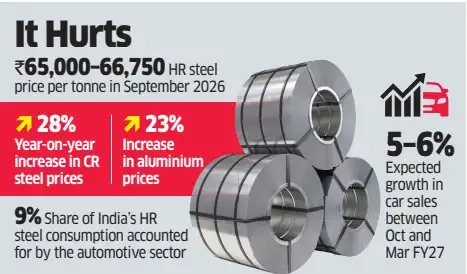
Prices of HR steel increased 30% yoy to 12-month high of Rs 65,000-66,750 per tonne in September. Ditto, CR steel trading at Rs 71,125-73,375 per tonne last month, 28% higher compared to Rs 56,000-57,000 in September 2025, as per data from SIAM Commodity Price Monitor for April accessed by ET. Meanwhile, aluminium prices were up 23% at $ 3,276.80 per tonne last month. The sector accounts for 9% of HR Steel and 21% of aluminium consumed in India.
Also read: Auto companies ride on a low base to deliver robust 22% sales in September
 ET Bureau
After high input costs, rise in freight rates due to global uncertainties takes a toll on auto companies
Coking coal, copper, zinc, polypropylene, ethylene propylene diene monomer (EPDM), and CNG are among several other commodities whose prices have peaked in the last one year affecting manufacturing costs across companies.
In Delhi, CNG prices in September 2026 were 13% higher than last year, 4% higher than the previous month, and at the highest level witnessed in the past 12 months. In Mumbai, prices were 9% higher than last year and 2% higher than the previous month.
According to the latest available monthly data, two-wheeler production increased by 10.8% yoy and passenger vehicle production rose by 16.1%. Overall, commodity costs comprise as much as 60-65% of total costs in an automobile company.
Meanwhile, the shipping freight index (Baltic Dry Index) surged to 3,408 points last month, a 60% surge compared to 2,124 points in September 2025, heightening logistics costs.
Most car companies from Maruti Suzuki to Mercedes Benz, Hyundai Motor India, Tata Motors and Toyota Kirloskar Motor (TKM) have already taken 2-3 rounds of price hikes this year and more could be around the corner post the festive season if inflationary pressures persist, senior industry executives said.
Partho Banerjee, senior executive officer, marketing and sales, of the country’s largest carmaker Maruti Suzuki, said while the company is not looking to undertake further price hikes in the festive season, it is keeping a close watch on input costs.
“We work on all options available to meet customer expectations by doing value engineering. But after a certain extent, we are forced to undertake price hikes in a calibrated manner,” he said.
Also read: India to roll out BS-VII emission norms for vehicles from April 2029 in 3 phases: Report
Sabari Manohar, executive vice-president in charge of sales, service and used car business, TKM, concurred, “Raw material prices are very volatile at this point of time. We need to closely monitor and see how it (commodity prices) impacts (manufacturing costs). Because we do have a lot of external factors at play, which may (continue to) increase pressure on the input costs.”
At the more premium end of the market, German luxury carmaker Mercedes said along with rising shipping and raw material costs, adverse forex movements have been impacting its cost base.
“Despite absorbing a considerable portion of these pressures, we had to implement three price adjustments this year ranging 1-2% across the portfolio”, Mercedes Benz India Managing Director Santosh Iyer said, adding the company was able to partially mitigate this impact with lower EMI offerings, as part of our ‘Dream days’ campaign, and retain customer sentiment.
Overall, auto sales have grown in strong double-digits in the first half of the fiscal year, on a low base, despite the price hikes undertaken by manufacturers. Industry stakeholders said with the base effect setting in in the second half of the fiscal year, growth in car sales are likely to moderate to 5-6% between October and March FY27. Total car sales this fiscal are expected to grow by about 10% to over 4.64 million units reported last fiscal.
| # | Наименование новости | Тональность | Информативность | Дата публикации |
|---|---|---|---|---|
| 1 | India's festive car-buying joyride may hit price hike bump | 0 | 8.86 | 11-10-2026 |
| 2 | Auto sales growth likely to normalise after festive inventory build-up; West Asia inflation a risk: Report | 0 | 9.86 | 23-09-2026 |
| 3 | Indian steel mills face margin squeeze as global coking coal prices rise | 0 | 6.29 | 19-08-2026 |
| 4 | Auto sales: Strong festive demand may be hit by low dealer stocks, supply constraints | 0 | 8.15 | 20-09-2026 |
| 5 | Auto components industry expected to grow 8-10% in FY27: ACMA | 3 | 7 | 07-07-2026 |
| 6 | Bigger car loans, longer tenures face rate-hike test | 0 | 10.7 | 13-10-2026 |
| 7 | Auto companies ride on a low base to deliver robust 22% sales in September | 0 | 14.62 | 15-10-2026 |
| 8 | India's auto component sector grows 12.7% in FY26, but imports outpace exports: ACMA | 0 | 7 | 07-07-2026 |
| 9 | 'Small' pains: Inflation squeeze likely to choke FMCG volume growth again | 0 | 10.98 | 14-10-2026 |
| 10 | Volvo Cars plans to raise India prices as rising input, logistics costs hit automakers | 0 | 6.23 | 12-10-2026 |