Просмотр новости
Найдите то, что Вас интересует
 Спутники
 РН
 SpaceX
 Роскосмос
 NASA
СпутникиРНSpaceXРоскосмосNASAHome insurance rates have risen so dramatically over the last decade that the average premium now exceeds the average property-tax bill in two-thirds of US counties, according to an analysis published by Bloomberg Intelligence. It points to the role of …
Home insurance rates have risen so dramatically over the last decade that the average premium now exceeds the average property-tax bill in two-thirds of US counties, according to an analysis published by Bloomberg Intelligence.
It points to the role of insurance in the larger affordability crunch that is putting pressure on households and shaping battle lines ahead of the midterm elections next month. Rates are being pushed up, in part, by extreme weather linked to climate change.
US homeowner policies, averaged at the county level, have gone up by an inflation-adjusted 45% in a decade. But some states are seeing much higher jumps — such as Nebraska, with a rise of 79%. The analysts also estimated the portion of auto premiums related to extreme weather. When that is added to home insurance premiums, the combination is now more expensive than property taxes in 75% of the nation’s counties.
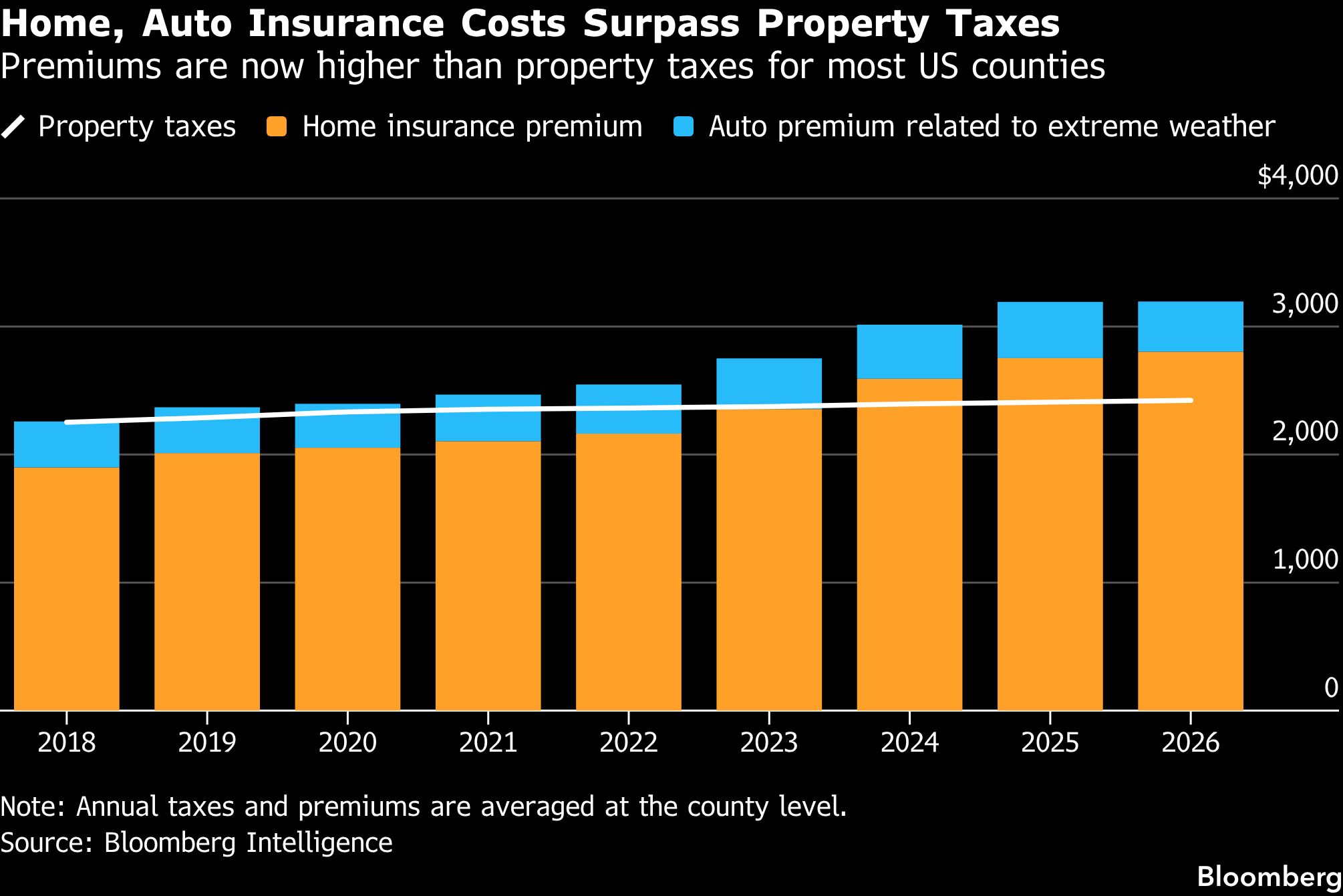
Hail and winter weather are driving rates up in the Midwest and Mountain West, led by Colorado, Utah and Minnesota. Southeastern states have some of the country’s lowest property taxes, and there, insurance premiums can now run 2.5 to 4 times the tax levy. Northeastern and Western states and big metropolitan areas pay high taxes, which makes rising insurance premiums equal a smaller percentage of the tax bill.
A property-tax revolt has been brewing around the country. But homeowners are paying a county-level average of 14% more for insurance than for property tax — 30% when auto insurance is factored in, writes Andrew John Stevenson of Bloomberg Intelligence. The frequency of hail damage is leading to higher auto insurance in the Great Plains and Upper Midwest.
The Bloomberg Intelligence analysis draws on data from the US Census, state insurance regulators and federal weather and transportation agencies.
The findings come as local governments have new disaster-related stressors on their budgets, with the Trump administration weaning states off federal recovery funding. The US has paid for 90% of disaster recovery over the past two decades, but the ratio of federal to local funds is now approaching a 50-50 split. For example, Stevenson writes, Texas received $23 billion in federal funds after Hurricane Harvey in 2017, compared with $4 billion in local spending. But after the January 2025 Los Angeles fires, the US gave California $2.6 billion while Californians spent $3.5 billion.
The shift is “a very daunting proposal for local government, local budgets, because they just don’t have that kind of capital on hand to deploy on a kind of ad hoc basis,” Stevenson said. “They would like to spend that on improving local infrastructure, period, not replacing local infrastructure.”
Disasters in 2025 reached a five-year average of $156 billion in losses, 10 times the 1985 figure when adjusted for inflation, according to a database maintained by the research nonprofit Climate Central. The net effect is likely to be pressure on municipal bonds, as local economies attend to recovery more than growth.
For homeowners, deductibles have also been rising, which makes families responsible for more recovery spending before insurers step in. That leaves them with less disposable income to spend on things likely to provide local tax revenue, such as dining out or going to sporting events.
Insurance is less affordable but no less necessary in the face of larger or more frequent disasters, said Alexandra Glickman, global practice leader for real estate and hospitality at Arthur J. Gallagher & Co. Policyholders should prepare, be aware of changing risk and be “willing to pay the premium for it,” she said.
“You can’t necessarily stop Mother Nature,” she said. But “you can make it home” with the right precautions.
Copyright 2026 Bloomberg.
Topics USA Property Homeowners
| # | Наименование новости | Тональность | Информативность | Дата публикации |
|---|---|---|---|---|
| 1 | For some in US, insurance makes up nearly 20% of housing cost: Survey | 0 | 5 | 15-07-2026 |
| 2 | Adding to Texas housing affordability challenges are soaring home insurance prices | 0 | 12.98 | 12-08-2026 |
| 3 | 71% of U.S. homeowners say their home insurance costs have gone up | 0 | 9.2 | 06-05-2026 |
| 4 | Premiums rising at double inflation rate, insurer says | 0 | 7.72 | 12-08-2026 |
| 5 | Страховые пересчитывают риски // На сколько подорожали полисы в случае складской недвижимости | 0 | 9.41 | 13-10-2026 |
| 6 | Navigating North Carolina’s home insurance affordability crisis | 0 | 16.38 | 03-06-2026 |
| 7 | Kfz-Versicherung: Preise für Autoversicherungen steigen erneut | 0 | 14.76 | 29-09-2024 |
| 8 | Home insurance premiums are falling: Here's what to do if yours seems too expensive | 0 | 12.15 | 30-10-2025 |
| 9 | US Mortgage Rates Rise for Third Straight Week | 0 | 9.48 | 24-07-2026 |