Просмотр новости
Найдите то, что Вас интересует
 Спутники
 РН
 SpaceX
 Роскосмос
 NASA
СпутникиРНSpaceXРоскосмосNASAFrom sipes and studs to three-peak mountain snowflakes and ice grip symbols, we decode winter tire lingo
 Winter tires Photo by Getty
If you’ve spent any amount of time in Canada during months in which snow and untold misery falls from our skies, you likely know (or at least begrudgingly acknowledge) that winter tires are an indispensable piece of added insurance on Canadian highways. Unique rubber compounds and creative tread designs create molecular and mechanical advantages in grip which all-season tires simply can’t match.
Mounting a full set of winter tires (and, yes, we absolutely recommend installing them in sets of four in order to create predictable traction behaviour) should be part and parcel of the budget every car owner in Canada sets aside to keep their ride fresh and passengers safe.
Contents
Heading to a garage and paying a professional to remove a car’s summer tires and install winter tires that you already own typically costs anywhere between CAD $120-$160 depending on the wheel size and the type of car.
 In this file photo, Charles Emsley from Island Park Esso in Ottawa balances and installs winter tires.
Installing and balancing one tire on a rim runs in the CAD $30-$40 range for most shops, and some will charge more for larger units such as those over 20” in size. Multiply that times four (CDN $120-$160) and you get an idea of the bill you can expect. Installing a set of four tires already mounted on their own rims/wheels usually runs the same price as a simple tire rotation ($30-$40 total); considerable savings over installing unmounted tires. So if you’ve got a relatively new vehicle and can get quality direct-fit winter rims for about CDN $100 each and tire pressure sensors for about the same price or less (CDN $800 pre-tax total), you can recoup those costs in five years of twice-a-year seasonal change-overs.
Why the ‘relatively new vehicle’ stipulation? Murphy’s Law states that any new vehicle you buy, won’t take the same rims or tires as your trade-in. So if your current ride is due for replacement in the next 1-4 years, and you’ve been using winter tires without their own rims all along, you’re unlikely to recoup any costs of purchasing winter rims.
To help our readers plan for the expense of winter tires, we’ve selected a variety of popular sizes ranging from little 14-inch hoops on an economy car all the way up to 22-inch honkers on a luxury pickup truck. Two sets of numbers are shown for each, representing an entry-level tire (sometimes from an unknown brand) and major-label rubber with a great reputation — in this instance, that means the Nokian Hakkapeliitta R5 which is arguably one of the best winter tires on sale today. Packed with technology on both the molecular and mechanical level (rubber compound and tread design, that is), these Hakkas eat up bad conditions and then come back for seconds.
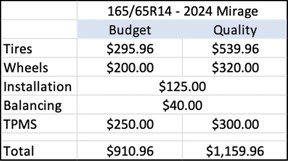 Winter Tire Cost Analysis
 Winter Tire Cost Analysis
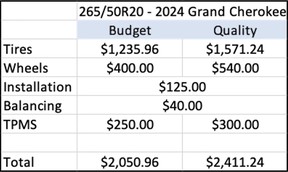 Winter Tire Cost Analysis
 Winter Tire Cost Analysis
No one likes to spend more money than necessary. Here are some ideas to sensibly save on winter tire costs without sacrificing safety or peace of mind.
To help you figure out the cost of using winter tires, here’s a calculator from the TRAC website.
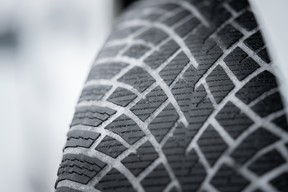 Nokian Tyres non-studded winter tire pattern
Alert readers will have noticed most winter tires shown in this post use a directional pattern with an ample number of sipes. For those of you who fell asleep in physics, sipes are those little zig-zag spaces in each tread block, designed to open slightly when pressed into a driving surface. This provides more biting surfaces in the never-ending quest for traction. If you’re still skeptical, try this experiment: take a block of Styrofoam from your next overpackaged parcel and slide it across the kitchen counter. We’ll bet it slid relatively easily across the surface.
Now, use a knife to make several shallow cuts along the Styrofoam’s surface, then push the block across the counter again. Different, huh? That’s sipes at work – or the basic concept behind them, anyway. Toss in the aforementioned directional pattern for evacuating water and a few ribs between tread blocks on the tire’s shoulder area to help tamp down the stereotypical squishy feeling one associates with winter tires, and you’ve a winter tire that gives up little in the way of winter grip but doesn’t beat its owner up with excessive road noise.
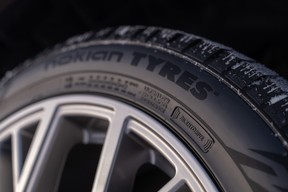 Nokian Tyres winter tire sidewall
The major puzzle pieces which make a winter tire the ideal safety companion for harsh weather are filed under molecular and mechanical. The former refers to the compound of which the rubber is made while the latter refers to the tread pattern. One can be easily seen, the other cannot – but both are equally important.
That molecular part, or rubber compound, is the secret brew of materials which tire companies invest untold amounts of time and money, chasing perfection through new manufacturing technologies and advancements in science. Yes, actual scientists work on the development of those four rubber hoops located at each corner of yer car, mainly in teams creating new rubber formulations. Winter tires use a rubber compound which is generally softer than what is found in an all-season or summer tire, retaining a skiff of flexibility when ambient temperatures drop to numbers generally associated with the planet Hoth. This helps with grip properties and explains why non-winter tires skid about when temps plummet while winter hoops provide much more control.
For example, Hankook says its i*cept tire is using a new compound made of highly refined resin and flexible polymer chain to deliver stronger ice grip and braking performance, even in severe cold. Nokian uses what it calls Arctic Grip Crystals in which thousands of microscopic crystals are embedded throughout the tread of its non-studded winter tires, acting like built-in studs to create sharp and tough grip edges inside the rubber. As the tire wears, the crystals emerge and activate a grip reserve.
Meanwhile, the mechanical part (tread pattern, remember?) is comprised of the entertaining combination of blocks, sipes, and voids – all of which create the best possible surface with which to press into winter’s worst and grab a fistful of traction. Closely examining the tread pattern of a winter tire will reveal hundreds of little zig-zags in the tread blocks – these are called sipes and are a key component of grip. When the tire is pressed into a surface, those sipes open up ever so slightly, creating extra biting surfaces with which to grab a bit of traction in slick or cold conditions. The shape of the tread blocks themselves play a similar role, as do the voids between those blocks. Rubber compounds often include ingredients like silica and the like to add tractive properties, as well.
You bet it does. As an industry standard, a tire needs to pass a specific testing regimen in order to qualify for the symbol, performing at a so-called traction index equal to or greater than 110 compared to the reference tire which is rated at 100 on packed snow. The 3PMSF standard is designed to help ensure shoppers can easily identify tires which provide a higher level of traction in foul winter conditions.
Interestingly, these testing measures evaluate a tire’s acceleration traction solely on medium-packed snow. Alert readers will quickly realize that braking and turning on snow, along with ice traction, are not components of the 3PMSF test. In fact, advancements in tire tech mean that more tires than ever before are permitted to bear the mark; that doesn’t mean the hurdle is any less difficult to clear, just that tire companies have more tools at their disposal to build such capabilities into their tires. This dovetails nicely into our next section.
 Nokian Tyres Hakkapeliitta R5
No. Why? Well, modern winter tires have valuable traction advantages compared to all-seasons simply when the ambient air temperature is below 7 degrees Celsius. There doesn’t need to be any snow on the ground to take advantage of the traction benefits found in a winter tire; its rubber compounds are useful on cold and dry pavement since it remains very pliable. Put it this way – would you rather traverse a frozen parking lot in Sorel boots or plastic flip flops? Tire experts will tell you the comparison is an apt one.
That’s the best idea, yes. Mounting a size different than then one with which a car was originally equipped can be a recipe for disaster – the tire could be too wide or too tall, either of which could cause clearance problems which may lead to premature and sudden failure. Try walking on a slippery surface in shoes three sizes too big for your feet if you’d like a real-world example of this phenomenon. Difference is, you’ll fall at walking pace instead of suffering a blowout at highway speeds.
If you are having trouble finding winter tires the same size as yer car’s original equipment size, consult a tire professional for help. It is possible to, for example, install 18-inch winter tires on a vehicle equipped with 20-inch all seasons, but the process requires math in order to find a size which is of equivalent overall height and width. And, of course, new wheels will be required. Keep an eye on overall wear; smart brands like Nokian make it easy by embedding grooves into the tread’s centre to indicate how much life remains. In fact, easy-to-read numbers wear out and vanish after reaching a corresponding percentage level of use, making it simple to know when tires are ready for replacement – and whether the tires are evenly wearing.
 Winter Tire Scene
If you wait until the first snow fall to call your service provider for a tire appointment, be prepared for a major wait. Repair shops of all types aren’t oversized nor overstaffed, so when all of their customers call at the same time for a seasonal tire change appointment, there’s an inevitable backlog. Make your appointment early; the first half of October isn’t too soon, and remember to have your vehicle’s wheel nuts retorqued or retightened after 100 km or so. If there’s anything worse than driving on tires not sufficient for winter, it’s losing one on the highway.
Sign up for our newsletter Blind-Spot Monitor and follow our social channels on X, Tiktok and LinkedIn to stay up to date on the latest automotive news, reviews, car culture, and vehicle shopping advice.
 Matthew Guy
2021 Castrol-Wakefield Automotive Writing Award, runner-up
Runner Up - 2023 AJAC Adventure and Travel Journalism Award presented by Genesis Canada
Winner - 2023 AJAC Road Safety Journalism Award presented by Volvo Canada
CONTACTEmail: matthewkguy@hotmail.com
LinkedIn: linkedin.com/in/matthewkguy
Instagram: @DudeDrivesCars
This website uses cookies to personalize your content (including ads), and allows us to analyze our traffic. Read more about cookies here. By continuing to use our site, you agree to our Terms of Use and Privacy Policy.
Edit your picks to remove vehicles if you want to add different ones.
You can only add up to 5 vehicles to your picks.
| # | Наименование новости | Тональность | Информативность | Дата публикации |
|---|---|---|---|---|
| 1 | Шипованные или фрикционные зимние шины: что выбрать для льда, снега и асфальта | 0 | 6.17 | 16-10-2026 |
| 2 | Эксперт Марков объяснил значение символов на зимних автомобильных шинах | 0 | 6.55 | 23-10-2026 |
| 3 | Подготовительные упражнения. Что нужно сделать с автомобилем до морозов | 0 | 9.03 | 15-10-2026 |
| 4 | На трассе в метель. Что делать, если стихия застала вас в дороге | 0 | 0 | 25-02-2021 |
| 5 | Vehicle Trims Vs Packages: What's The Difference? | 0 | 7 | 12-07-2026 |
| 6 | La guía definitiva para saber leer los neumáticos de tu coche | 0 | 8.05 | 02-10-2026 |
| 7 | Road trip season is here: Expert tips to save money on gas, snacks and car care | 0 | 4.33 | 23-07-2026 |
| 8 | What Are Those Little Rubber Hairs On New Tires? | 0 | 8.71 | 20-08-2026 |
| 9 | Understanding extended cab vs. crew cab pickup trucks | 0 | 5 | 28-06-2026 |
| 10 | Understanding extended cab vs. crew cab pickup trucks | 0 | 5 | 28-06-2026 |


