Просмотр новости
Найдите то, что Вас интересует
 Спутники
 РН
 SpaceX
 Роскосмос
 NASA
СпутникиРНSpaceXРоскосмосNASATo show how monkeys think about math and shapes, scientists had them play games — including some designed by kids.
There are some skills that people think set us apart from other animals. These usually include language, tool use or the ability to do some types of math. But at least some cows can use tools and cockatoos can make their own. Other animals appear to have language. And now, it seems, we’re not even the only ones with a head for math.
A new study compared preschool kids, monkeys and groups of adults who hadn’t studied geometry (the math of shapes). All appeared to understand shapes in similar ways.
Researchers shared what they learned July 20. The work appeared in Proceedings of the National Academy of Sciences.
People spend a lot of time asking what it is that makes us different from other, similar animals, such as monkeys. “We look around, we notice how weird we are in the world and we want to know how something like this happens,” says Jessica Cantlon. A cognitive neuroscientist at Carnegie Mellon University in Pittsburgh, Pa., she studies how humans and animals think.
One thing scientists thought might make us different from other primates is how we think about geometry, notes Jialin Li. She, too, is a cognitive neuroscientist at Carnegie Mellon. Tens of thousands of years ago, she notes, people were drawing “right angles, parallel lines, equal size, equal lines.” These are basic ideas behind geometry.
That led some to suspect that the human mind must process shapes in a different way than a monkey’s — a way that has nothing to do with whether we’ve been to a geometry class.
Monkeying around with shapesTo test this, Cantlon and Li needed some shapes, clever games and a bunch of people. Oh, and monkeys, too. Don’t forget the monkeys.
The scientists studied how well different groups matched shapes in a game. They compared two groups of people: Tsimane’ people from Bolivia and Himba people from Namibia. Neither group goes to schools where they would study shapes, as most U.S. students do. The scientists also compared U.S. preschoolers and two groups of monkeys — rhesus monkeys in a lab and olive baboons in a zoo.
All had to complete tests on a screen, matching shapes and angles. The monkeys worked for treats, Li notes, and some really enjoyed the games. Preschoolers worked for stickers and were a little harder to convince. “Sometimes kids reject you,” she says. “You have to bargain with them.”
For some tests with monkeys, Cantlon and Li’s team worked with Caroline DeLong. She studies animal minds at the Rochester Institute of Technology in New York. Together, the researchers developed a Primate Portal. It let a group of olive baboons at the Seneca Park Zoo in Rochester play math games.
The portal is a cabin inside the olive baboon enclosure. Outside the hut, a screen displays games for the monkeys to play. Inside the hut sits a scientist putting games on the screen and giving out treats. One big male monkey, Kalamata, is an avid gamer. “He will play for hours a day,” DeLong says. The problem is trying to give other monkeys a chance!
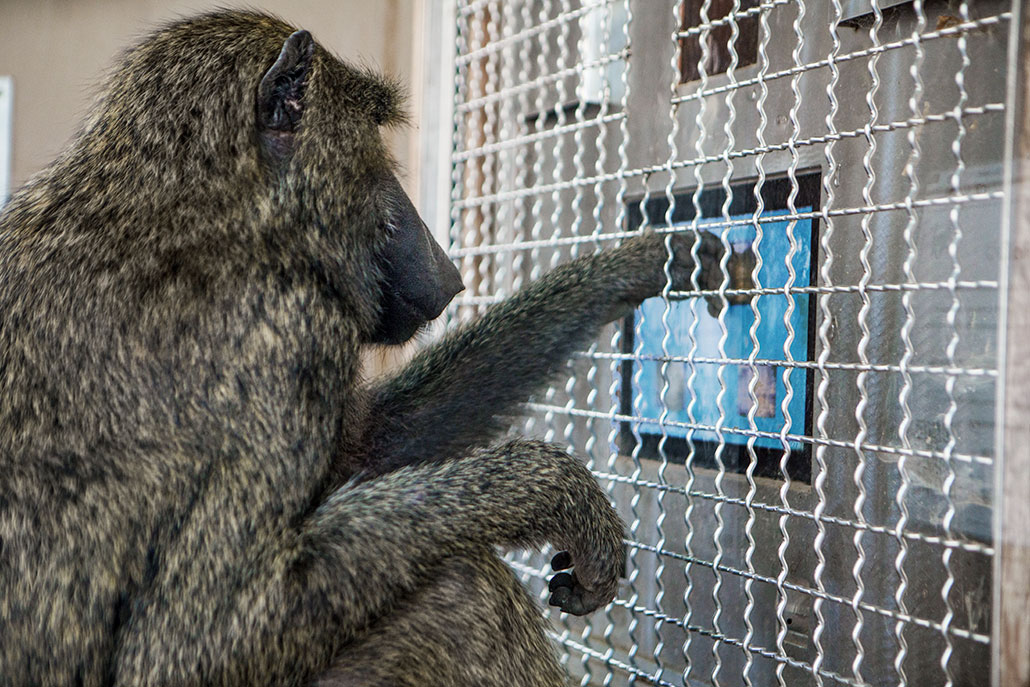 An olive baboon plays a math game at the Seneca Park Zoo. Games like this help scientists understand how both monkeys and humans think about shapes. Scott Hamilton/RITHow everyone shaped up
The researchers looked at how well each group did — and what mistakes they made. Then, they compared those mistakes to two computer models. The models were meant to mimic different ways of thinking about shapes.
Both monkey species and all of the humans made similar types of mistakes. This hinted that their minds were thinking about shapes in similar ways.
“Humans are not unique in this,” Li concludes, “but we are better.”
It’s exciting to see scientists looking at how geometric thinking came to be, says Moira Dillon, who did not take part in the study. She works at New York University in New York City, where she studies how minds develop. A model can offer one way to explain something, she says. But computer models aren’t minds. And, she notes, scientists can’t get into minds to follow how a monkey or kid thinks while playing a math game. So, she says, “I think there still remains the question of whether the mind is doing it that way.”
The new work used only two computer models, points out Véronique Izard. “Could they model it even better?” she wonders. Perhaps monkeys and humans seem very similar now, but a different model might find differences that these two missed. Izard works at the University of Paris Cité and the National Centre for Scientific Research in France. There, she studies how minds develop.
Through the Primate Portal, researchers are studying how baboons solve problems to learn more about how primate minds work.A primate portalPreschoolers weren’t the only kids involved in this research. Elementary school students are now programming games for the baboons.
To test shape knowledge, for instance, monkeys played a game called match-to-sample. A shape pops up, like a square. Then two shapes pop up, a square and a triangle. The monkey needs to pick which shape matches the first. If the monkey gets it right, it receives a piece of fruit cereal.
“It’s like a weird Froot Loop, and it does not taste good,” says Michael Sufra. Michael, 11, is a student at QUEST Elementary School in Hilton, N.Y. He coded his own match-to-sample games for monkeys. “It’s just really fun to make your own games,” he says.
He was part of a program where every kid got to code their own match-to-sample game. Michael used rocket shapes and a cartoon cat. Not only do students have to think about code, but also about the pictures, explains Cora Dimino, 12. If images are too much alike, “monkeys can’t really do that,” she says. (Her game had monkeys match animal images in different colors.)
Cora and Michael are two out of several hundred kids who have been able to make monkey games. They also watched monkeys play them. “There’s real joy in their faces when they see that,” DeLong says. And she’s shown that coding games for monkeys helps kids get better at problem-solving. DeLong hopes to even use some of the kids’ games in her monkey research.
Both Cora and Michael enjoy coding and were interested to learn that games like theirs showed that monkeys think about math much as we do. “I feel like monkeys are pretty smart, based off of what we saw,” Cora says. “It’s justice for the monkeys.”
Submit your question here, and we might answer it an upcoming issue of Science News Explores
angle: The space (usually measured in degrees) between two intersecting lines or surfaces at or close to the point where they meet.
baboon: A large ground-dwelling African monkey with a long, doglike snout and large teeth. Baboons are social animals and live in troops.
code: (in computing) To use special language to write or revise a program that makes a computer do something. (n.) Code also refers to each of the particular parts of that programming that instructs a computer's operations.
coding: (in computing) A term for creating computer programming — or software — that performs a particular, desired computational task.
cognitive: A term that relates to mental activities, such as thinking, learning, remembering and solving puzzles.
computer model: A program that runs on a computer that creates a model, or simulation, of a real-world feature, phenomenon or event.
develop: To emerge or to make come into being, either naturally or through human intervention, such as by manufacturing. (in biology) To grow as an organism from conception through adulthood, often undergoing changes in chemistry, size, mental maturity or sometimes even shape.
geometry: The mathematical study of shapes, especially points, lines, planes, curves and surfaces. Geometry can also refer to the defined shape of something (such as it had a very spherical geometry).
model: A simulation of a real-world event (usually using a computer) that has been developed to predict one or more likely outcomes. Or an individual that is meant to display how something would work in or look on others.
navigate: To find one’s way through a landscape using visual cues, sensory information (like scents), magnetic information (like an internal compass) or other techniques.
neuroscience: The field of science that deals with the structure or function of the brain and other parts of the nervous system. Researchers in this field are known as neuroscientists.
parallel: An adjective that describes two things that are side by side and have the same distance between their parts. In the word “all,” the final two letters are parallel lines. Or two things, events or processes that have much in common if compared side by side.
pixel: Short for picture element. A tiny area of illumination on a computer screen, or a dot on a printed page, usually placed in an array to form a digital image. Photographs are made of thousands of pixels, each of different brightness and color, and each too small to be seen unless the image is magnified.
primate: The order of mammals that includes humans, apes, monkeys and related animals (such as tarsiers, the Daubentonia and other lemurs).
Proceedings of the National Academy of Sciences: A prestigious journal publishing original scientific research, begun in 1914. The journal's content spans the biological, physical and social sciences. Each of the more than 3,000 papers it publishes each year, now, are not only peer reviewed but also approved by a member of the U.S. National Academy of Sciences.
programming: (in computing) To use a computer language to write or revise a set of instructions that makes a computer do something. The set of instructions that does this is known as a computer program. The term is also used, in an analogy to computer programming, to describe the way something — such as cells — have been designed to function. A person who writes or revises software is a known as a programmer.
rhesus monkey: (also called rhesus macaque) A small brown macaque with red skin on the its face and rump, native to southern Asia. It is often kept in captivity and is widely used in medical research.
right angle: A 90-degree angle, equivalent to any inside corner on a square.
smartphone: A cell (or mobile) phone that can perform a host of functions, including search for information on the internet.
square: (in geometry) A rectangle with four sides of equal length.
texting: The sending of a text message from a mobile (cell) phone.
unique: Something that is unlike anything else; the only one of its kind.
Bethany Brookshire was a longtime staff writer at Science News Explores and is the author of the book Pests: How Humans Create Animal Villains. She has a Ph.D. in physiology and pharmacology and likes to write about neuroscience, biology, climate and more. She thinks Porgs are an invasive species.
| # | Наименование новости | Тональность | Информативность | Дата публикации |
|---|---|---|---|---|
| 1 | Cuddling helps apes keep the peace | 0 | 8.71 | 29-09-2026 |
| 2 | В Москве учителя начали обучение для проведения новых курсов по математике | 0 | 0 | 17-04-2025 |
| 3 | Минпросвещения предложило использовать в школах компьютерные игры для обучения | 0 | 0 | 22-06-2019 |
| 4 | Farting fish and tooting manatees — how some animals use gas | 0 | 7.16 | 01-10-2026 |
| 5 | Exploring the brain and behavior of children who struggle with math | 0 | 9.28 | 21-09-2026 |
| 6 | Российские разработчики робособак научат их пользоваться лестницами | 0 | 0 | 06-07-2025 |
| 7 | Ученые в Перми создали математическую модель для придания роботам эмоций | 0 | 0 | 21-02-2019 |
| 8 | This Teacher Is Using Jimothy, the Viral Raccoon, to Teach Kids Inclusivity | 0 | 6.05 | 30-07-2026 |
| 9 | Дельфийские игры начались в Перми с выставок о науке и культуре | 0 | 0 | 21-05-2021 |