Просмотр новости
Найдите то, что Вас интересует
 Спутники
 РН
 SpaceX
 Роскосмос
 NASA
СпутникиРНSpaceXРоскосмосNASACasper, a 'ghost' lobster, will be studied for personality traits and what makes him white. He joins a growing rainbow of rare lobsters being studied at the Biddeford university.
3 min read
 Markus Frederich, professor of marine sciences at the University of New England, shows off Casper, a rare ghost lobster, at the university in Biddeford on Wednesday. (Shawn Patrick Ouellette/Staff Photographer)
BIDDEFORD — An extremely rare lobster is helping University of New England students learn about microbiology.
A white “ghost” lobster, fittingly named Casper, was recently donated to the university by the Maine State Aquarium in Boothbay. He joins a rainbow of several other rare, colorful lobsters, including blue, orange and calico variations.
Casper, though, is the rarest of the collection — only about 1 in every 100 million lobsters are white.
“But sometimes he looks blue depending on his diet,” remarked Markus Frederich, a professor of marine sciences whose lab houses the lobsters.
The lobsters at Arthur P. Girard Marine Science Center aren’t there just to look pretty. They’re the subjects of a series of research projects that Frederich is conducting with both undergraduate and graduate students. Using samples humanely taken from the lobsters, students are studying the DNA sequences in each lobster.
The question: Is there a mutation in the DNA that makes the lobsters different colors?
“At this point, we’ve found that the genes that were sequenced are not different from a regular lobster,” Frederich said. “We’re still working on it.”
But finding the answer is not the entire point of the research process, Frederich said. Working with the lobsters allows students to learn skills like DNA sequencing, which they can take with them throughout their careers.
The methods that students are using to extract and study DNA are the same for a lobster, a rat or even a human.
“They get all this exposure, and what an awesome thing as a student to work on these rare lobsters and do some real molecular biology,” Frederich said. “That’s what gets me excited.”
WHAT MAKES THEM TICKKade Tyrrell, a graduate student and Frederich’s teaching assistant, spends a lot of time with the lobsters. In addition to Casper, other colorful members of the rainbow include bright orange Peaches and calico Currant, who’s half blue and half orange.
“I’ve fallen in love with these guys,” Tyrrell said. “They seem to be a bit more friendly with me than anyone else.”
Beyond studying why certain lobsters are rare colors, Tyrrell is researching whether a lobster’s color can determine personality traits like aggression.
The original hypothesis, Tyrrell said, was that orange lobsters are more aggressive because they’re missing the gene that makes regular lobsters turn orange when they’re cooked.
“They just seemed more aggressive,” Tyrrell said.
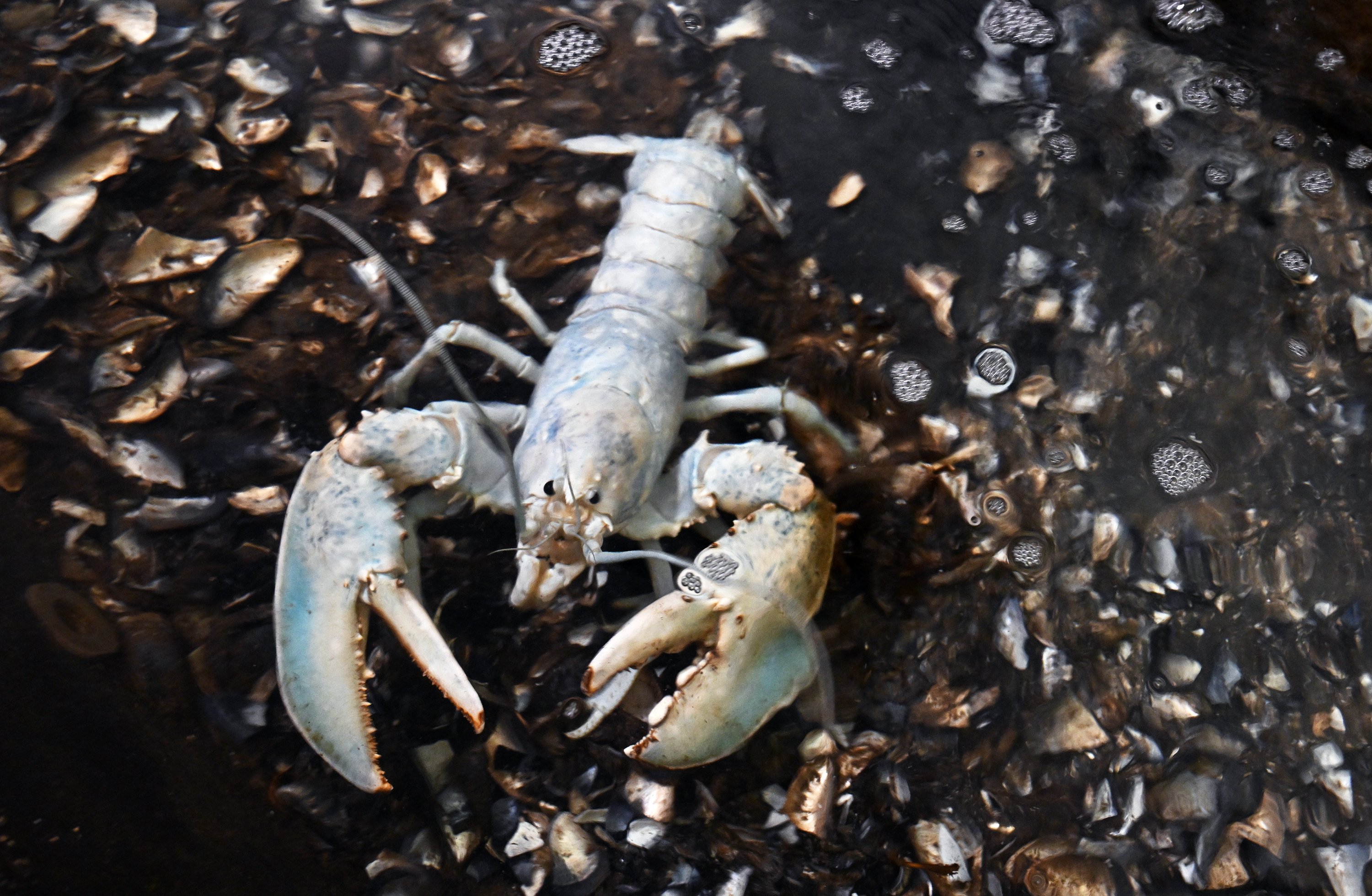 Casper, a rare ghost lobster, in a tank at the University of New England’s Arthur P. Girard Marine Science Center on Wednesday. About 1 in 100 million lobsters have coloring like Casper. (Shawn Patrick Ouellette/Staff Photographer)
While it turns out that the lack of crustacyanin in orange lobsters doesn’t make them more aggressive than other lobsters, Tyrrell said the research process has been an incredible experience for him and his classmates.
It’s important to understand, Tyrrell said, that lobsters are more than just food. They’re not just another creature in the ocean that humans can eat — they’re essential to marine biology research.
“And it sounds silly, but they each have their own personalities,” Tyrrell said. “They’re charismatic.”
WHAT COMES NEXTOn Friday, Frederich and his students will don scuba gear to release a calico lobster back into the Atlantic. (All of the lobsters will eventually be returned to the ocean.)
“Creating those experiences makes my day,” he said.
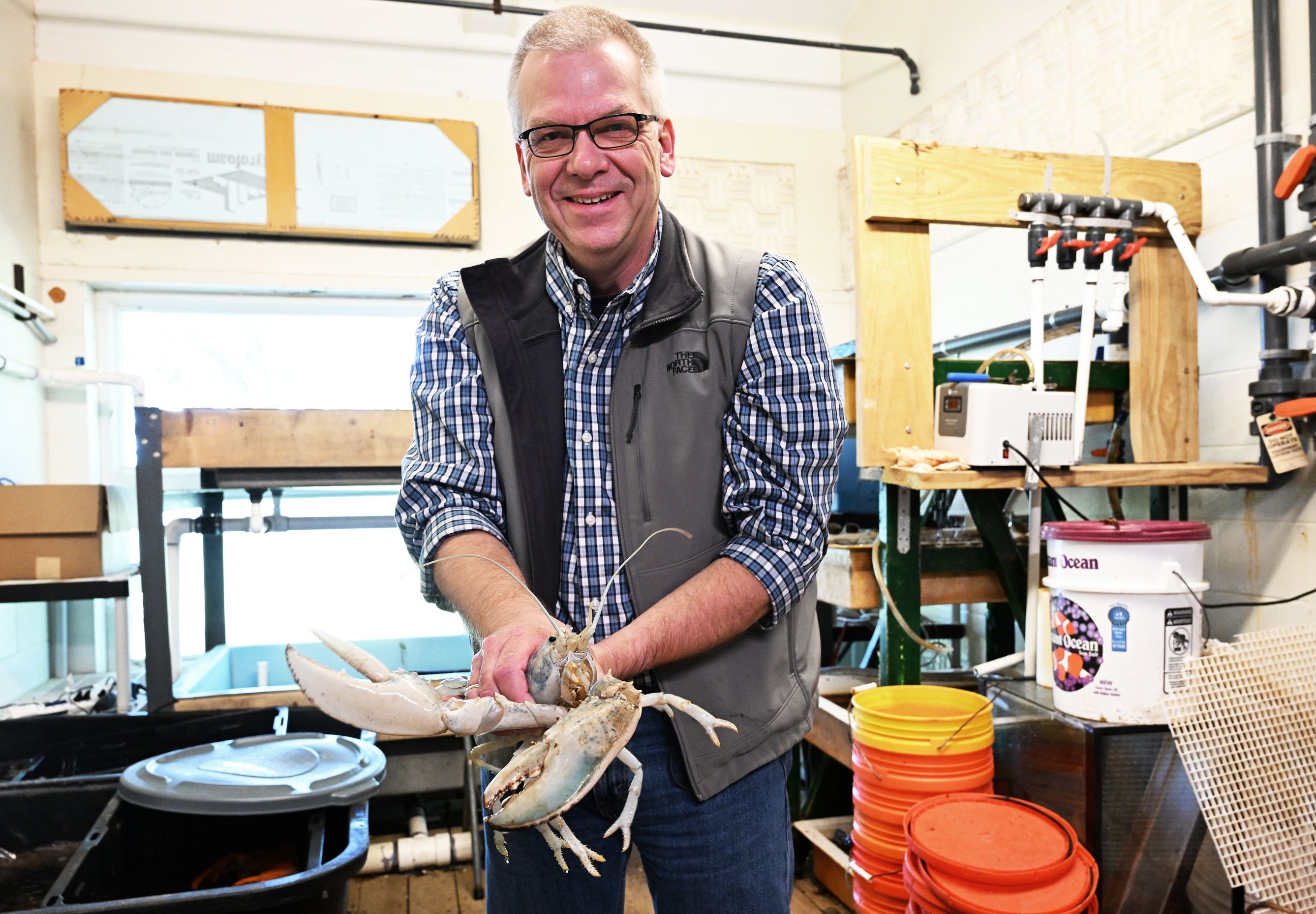 Professor Markus Frederich shows off Casper on Wednesday. (Shawn Patrick Ouellette/Staff Photographer)
Frederich and his students are also looking at the entire DNA sequence of orange lobsters, instead of just one or two strands, and determining which sequences are actually important to their color and behavior.
Soon, Frederich hopes to be able to compare orange lobsters’ DNA to other colored lobsters — but it’s expensive, and UNE is still waiting for money to fund the project.
In the meantime, Frederich is on the hunt for another blue lobster to add to the lab’s collection.
“If someone finds one, send it my way,” he said.

Sydney is a community reporter for Biddeford, Saco, Old Orchard Beach, Kennebunk, Kennebunkport and Arundel and previously reporter for the Courier and Post. Sydney grew up in Kennebunk and is a graduate... More by Sydney Richelieu
| # | Наименование новости | Тональность | Информативность | Дата публикации |
|---|---|---|---|---|
| 1 | Maine lobster defamation suit hits choppy waters | 0 | 36.09 | 01-08-2026 |
| 2 | 11 Maine boat rides and tours for water-powered fun this summer | 0 | 38 | 27-07-2026 |
| 3 | Lobster Bowl has exceeded original organizers’ hopes | 0 | 36.66 | 16-07-2026 |
| 4 | Group restoring Casco Bay’s eelgrass meadows one seed at a time | 0 | 36.82 | 17-08-2026 |
| 5 | Discarded lobster shells hit the greens as biodegradable golf tees | 0 | 7.44 | 16-10-2026 |
| 6 | UMaine System students and faculty skeptical of seven-figure ChatGPT contract | 0 | 39.2 | 11-10-2026 |
| 7 | UNE gets green light from Biddeford for pier project, Decary Hall renovations | 0 | 41.91 | 08-10-2026 |
| 8 | Baby lobster decline foreshadows major midcoast population losses, study shows | 0 | 5.73 | 15-10-2026 |
| 9 | “Weird Clams” Reveal a New Invasion Along the U.S. Northeast Coast | 0 | 17.48 | 18-07-2026 |