Просмотр новости
Найдите то, что Вас интересует
 Спутники
 РН
РН SpaceX
 Роскосмос
 NASA
NASA
СпутникиРНSpaceXРоскосмосNASAA lead official confirmed Tuesday the Army plans to give industry another shot at proposing solutions for its effort to find a second interceptor for the Indirect Fire Protection Capability […]
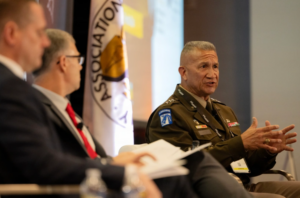 LTG Frank Lozano, Portfolio Acquisitions Executive, Fires, United States Army, speaks at the Accelerating the Arsenal: Transforming Munitions Production and Partnerships for the Future Force, during the 2026 Association of the United States Army (AUSA) Annual Meeting and Exposition at the Walter E. Washington Convention Center in Washington, D.C., Oct. 13, 2026. (U.S. Army photo by Rey Ramon)
 A lead official confirmed Tuesday the Army plans to give industry another shot at proposing solutions for its effort to find a second interceptor for the Indirect Fire Protection Capability (IFPC) Increment 2 defeat system and its Stinger missile replacement program, both of which are currently in active competition.
Lt. Gen. Frank Lozano, program acquisition executive for fires, said the Army plans to conduct shoot-offs in late fiscal year 2027 for both initiatives, as it seeks additional solutions that could help get after fielding more rapidly.
On the IFPC Inc. 2 Second Interceptor competition, which just moved into the capability demonstration phase with Lockheed Martin [LMT] and a team of Boeing [BA] and Anduril, Lozano said the Army wanted to “turn up the heat on that program.”
“I constantly get frustrated when a funding profile emerges over the [five-year budget projection plan], and then magically we lay in a five-year program. I’m like, ‘No, I actually need that capability now,’ right? So, have we thought [about] maybe what if we ran a 24-month program or a 36-month program, right? And so, in that vein, what we have decided to do is, while those two companies continue to compete, we’re going to create a shoot-off opportunity in fourth quarter ‘ 27, and I want to run an in-parallel, what I call an in-strike, competition,” Lozano said during a discussion at the Association of the U.S. Army’s annual conference in Washington, D.C.
The current interceptor for IFPC Inc. 2, which uses Dynetics’ [LDOS] Enduring Shield launcher platform, is RTX’s [RTX] AIM-9X Sidewinder missile, but the Army has previously expressed interest in pursuing a second interceptor option to defeat supersonic cruise missiles and larger caliber rockets.
Lozano has said previously that for a second interceptor “what [he’s] been communicating is an AIM 120D-like capability in an AIM-9X package, because the key is magazine depth” (Defense Daily, July 31, 2024).
The AIM-120D, better known as AMRAAM for Advanced Medium Range Air-to-Air Missile, has a longer range than the AIM-9X. AMRAAM is also built by RTX.
The Army held an industry day and has solicited information on potential additional second interceptor offerings, Lozano noted.
“We basically just said, ‘Hey, if there’s any other company who didn’t make the first cut in the phase one but, oh by the way, you continue to invest in an IFPC [Inc. 2] Second Interceptor capability, we’d love for you to come out to the range. We’ll give you range time. We’ll present targets. And we’ll allow you to recompete with an opportunity to get back into the program fold,” Lozano said. “That’s how focused and determined and hungrier we are to get that capability into the field.”
For the Army’s Stinger missile replacement program, dubbed Next Generation Short Range Interceptor (NGSRI), Lockheed Martin is currently competing against RTX, with both companies having conducted successful demonstrations of their offerings (Defense Daily, July 15).
“We ran the same bread and butter play [with an] industry day, RFI. We’re going to do a fourth quarter ‘27 shoot off for any other industry vendors that want to get into the NGSRI program,” Lozano said.
A separate RFI from over the summer detailed the Army’s aim to build 11,000 NGSRI missiles over a ten-year period beginning in FY ‘28 (Defense Daily, July 16).