Просмотр новости
Найдите то, что Вас интересует
 Спутники
 РН
РН SpaceX
 Роскосмос
 NASA
NASA
СпутникиРНSpaceXРоскосмосNASABig C-UAS Award. RTX’s Raytheon business last week said it received $729 million to provide the Ku-band Radio Frequency Sensor (KuRFS) and Coyote interceptor to the Army, Qatar and Jordan […]
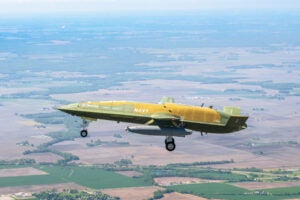 The Navy’s MQ-25A Stingray first carrier-based unmanned tanker takes its first flight on April 25, 2026 at Boeing’s facility at MidAmerica Airport in Mascoutah, Ill. The MQ-25 is the Navy’s first operational carrier-based unmanned aircraft. (Photo: Boeing)
 Big C-UAS Award. RTX’s Raytheon business last week said it received $729 million to provide the Ku-band Radio Frequency Sensor (KuRFS) and Coyote interceptor to the Army, Qatar and Jordan as part of the Army’s Low, Slow, Small UAS Integrated Defeat System (LIDS). The deal is the first international sales of KuRFS and Coyote, the company said.
MQ-25 Software Test. Boeing said last week it successfully developed and flight tested Manned Unmanned Teaming (MUM-T) software during an Emerald Flag military exercise at Eglin Air Force Base, Fla. During the event, Boeing engineers uploaded the software onto a 1900 D Beechcraft and E90 King Air aircraft and, during flight, test plots demonstrated the software’s ability to enable command and control between the two aircraft over Link 16. “Having this software embedded into the MQ-25A, we enable autonomous coordination with manned platforms — improving tanker responsiveness, reducing logistical friction, and multiplying the carrier strike group’s operational tempo,” Mark Dunn Boeing MQ-25 Avionics Integrated Product Team lead, said in a statement. Boeing said the next step for the MUM-T software is validating it via further ongoing test flight so it can be integrated into the operational MQ25A software in the future “enabling seamless teaming communications for carrier‑based refueling and coordinated strike support,” Boeing said.
…Another Flight Test. The Unmanned Carrier Aviation program office (PMA-268) on Thursday published a short video of a four-hour Oct. 6 test flight of an MQ-25A over MidAmerica St. Louis Airport in Mascoutah, Ill. The video notes said during the flight the aircraft flew over 20,000 feet and at speeds over 200 knots while executing the first automatic landing gear retraction, which the Navy noted was previously commanded manually by air vehicle pilots. “The test program expands the MQ-25A’s operational envelope and reliability, advancing the U.S. Navy’s fielding of an unmanned tanker capability to extend the reach, flexibility, and combat lethality of the carrier air wing,” the notice said. This follows a Sept. 24 award by the Navy for the first MA-25A production contract for Lot 1 Low Rate Initial production aircraft. The first MQ-25A had its initial flight test in April.
Navy Mine Countermeasures. AeroVironment, Inc., on Oct. 8 said its VideoRay subsidiary is supporting the AEVEX-led team picked for a prototype Other Transaction Agreement that follows a Navy and Defense Innovation Unit Mine Countermeasure Modernization Prize Challenge BlackSea Technologies, now part of AEVEX Maritime Systems, was one of the three firms awarded challenge prizes following demonstrations. During in-water testing, the company said VideoRay demonstrated an autonomous mine countermeasure remotely operated vehicle (ROV) launched from an AEVEX unmanned surface vessel with an autonomous launch and recovery system. Then, operators conducted missions over the horizon from a remote ground control station as the system performed vessel transit, station keeping, ROV launch and recovery, target investigation and simulated neutralization and post-engagement assessment.
TACAMO Delivery. Lockheed Martin said that its Marietta, Ga. plant delivered a C-130J-30 Super Hercules on Thursday to the Navy for modification into an E-130J Phoenix II for the Take Charge and Move Out (TACAMO) nuclear command and control mission. “The delivery re-establishes the link between the TACAMO mission and the Hercules family,” according to the company. “For three decades, the EC-130Q variant served as the Navy’s TACAMO platform, flying the mission successfully from 1963 until 1993. The new Super Hercules builds on that legacy while adding advanced avionics, communications and survivability enhancements.” Northrop Grumman, the TACAMO mission systems integrator, “will complete the conversion that will see the airframe enter service as the E‑130J Phoenix II,” Lockheed Martin said.
…TACAMO SATCOM Antennas. Phased array antenna systems original equipment manufacturer ThinKom Solutions, Inc., on Oct. 6 said Northrop Grumman purchased its ThinAir satellite communications (SATCOM) antenna for installation on the E-130J Phoenix II. The company said its antenna was chosen because it meets specific needs including high-bandwidth Beyond-Line-of-Sight, multi-orbit connectivity, anti-jam and survivability features as well as aerodynamic design.
AMTEC Filling Fast. The schedule for a new, geographically expansive and permissive test range in Morocco established over the summer by the country’s armed forces and U.S. Africa Command is filling fast with industry participants, a U.S. Army official said last week. The Africa Multidomain Training and Experimentation Center (AMTEC) “gives us the opportunity to train ourselves and then also our allies and like-minded partners over vast distances in uncongested airspace and in a contested electromagnetic spectrum,” Maj. Gen. Matthew Brown, commander, Army Southern European Task Force-Africa, said at the AUSA conference. The Army in August established the “testrange.army.mil” portal to let industry sign up to use AMTEC and as “I look at the schedule over the next 12 months, we are already nearing capacity with industry partners…to come with their capabilities to test there in Morocco.”
XTEND’s Gauntlet Award. The Defense Department has awarded XTEND AI Robotics $40.5 million for 6,000 STRIKER small drones for the company’s recent third place finish in the Close Quarters Battle category of the Drone Dominance Program’s (DDP) Gauntlet II competition. The unit cost for the STRIKER is $6,750 based on the award value. Neros, which won the Close Quarters category and placed third in the Deep Strike mission, received $100 million from DoD.
…Orqa US Award. Orqa UA, which placed second in the Close Quarters Battle category, received a $38 million order from DoD for 7,000 drones. The company said its 8-inch drone and ground control system come from its MRM2 suite of products. The unit cost for the company’s drone order is $6,100.
…And Swarm’s. Swarm Defense Technologies said its DDP award for 4,000 Kiwi one-way attack drones is worth at least $25 million. The Michigan-based company was fifth in the Deep Strike mission. The unit cost of a Kiwi is $6,250 based on the award value and quantity. The drones will be built at the company’s 40,000 square foot facility.
Low Cost Interceptor. CHAOS Industries last week introduced VESPID, its family of “very low-cost interceptors” for point and area defense against Group 1, 2 and 3 unmanned aircraft and one-way attack drones. The Los Angeles-based startup said the VESPID Mk0 is man portable and can be operated in austere environments while the Mk1 is faster, more maneuverable and “designed for high-density installations with a multitube launcher.”
New SAIC CFO. Science Applications International Corp. last week said Ken Crews, former chief financial officer (CFO) at Northrop Grumman, will join the company as CFO elect on Oct. 30. He will become CFO on Dec. 7. Prabu Natarajan, SAIC’s current CFO, will become executive vice president (EVP) of the Civilian Business Group. He will continue as EVP of Enterprise Operations.
Brett Favre F-22? The Department of the Air Force (DAF) said on Friday that the pilot of a Lockheed Martin F-22 “executed airborne tactical command and in-flight control” of an Anduril Industries YFQ-44A Fury Collaborative Combat Aircraft (CCA) prototype this month after the aircraft took off from Edwards AFB, Calif. “During the demonstration, an F-22 pilot served as an airborne ‘quarterback,’ issuing high-level tactical directives to a single YFQ-44A,” according to DAF. “The aircraft’s onboard autonomy software interpreted and executed those directives in real time, conducting dynamic flight maneuvers and simulated combat tasks.” Anduril said on Friday that “while in flight, the Raptor pilot sent an updated mission plan to Fury using a tactical data link, commanding Fury through operationally-relevant maneuvers from the cockpit of the crewed quarterback.” The Pentagon’s use of a football analogy for aircraft has a history, dating at least back to the 1990s when Army leaders referred to the Boeing-Sikorsky RAH-66 Comanche scout helicopter as the “quarterback of the digital battlefield.” The Army canceled Comanche in 2004. The Air Force goal is to have 500 CCAs by 2032, according to Air Force Secretary Troy Meink, and “an overall fleet size of “1000 that will extend reach, awareness and survivability of American airpower in contested environments,” the Air Force said on Friday.
Space Domain Awareness. BlackSky said that it has finalized a “seven figure” extension with Australia’s HEO for “fully automated, low-latency” space domain awareness (SDA) using software to analyze space sensor data. HEO was founded in 2016. “The renewal agreement marks a significant technological evolution in the partnership, incorporating access to BlackSky’s next-generation, very high-resolution Gen-3 imagery to provide unmatched clarity, quality, frequency and speed for global SDA missions across defense, intelligence and commercial sectors,” according to BlackSky. “The partnership grew quickly from an initial short-term, six-figure pilot to a growing seven-figure annual contract now entering its third year.” BlackSky said that a “fully automated tasking-to-delivery pipeline through HEO Inspect allows international defense and commercial operators to generate rapid analytics reports, identify satellite subsystems, perform anomaly detection, and map pattern-of-life behaviors enabled by object detection and identification algorithms and data fusion.”
UKR UGVs in Canada. Canada’s Dominion Dynamics last week said it has signed a memorandum of understanding with Ukraine’s TENCORE to manufacture the Ukrainian company’s TerMIT unmanned ground vehicle (UGV) in Canada. Dominion will also integrate its AuraNet autonomy stack with the tracked UGV. Initial production is slated to start in 2027.
Taiwan’s First V-BAT. Shield AI last week said it has delivered the first of 12 V-BAT unmanned aircraft systems to the Taiwan Coast Guard Administration for shipboard use. Shield AI this summer won a competitive contract for the program. The vertical takeoff-and-landing V-BATs, which can transition to horizontal flight, will be used for surveillance, coastal patrols and law enforcement operations. Shield’s local partner for the work is Aerospace Industrial Development Corporation.
PrSM Inc. 4. A senior Lockheed Martin official confirmed the company still plans to flight test its long-range Precision Strike Missile Inc. 4 prototype “by the end of the year.” “Yes and yes,” Paula Hartley, vice president of strategy and business development for Lockheed Martin’s Missiles and Fire Control, told reporters during a briefing at the Association of the U.S. Army’s annual conference in Washington, D.C. “Flight test will begin this year.” The Army late last month awarded deals to Lockheed Martin, who builds the current version of PrSM, as well as Anduril, Castelion, RTX and Mach Industries to work on their Inc. 4 prototypes intended to fire at ranges 1,000 kilometers or more, with plans for a competitive fly-off and downselect in fiscal year 2027.
Autonomous Black Hawk. SNC announced on Oct. 13 that the Army will install its Degraded Visual Environment Pilotage System (DVEPS) as the primary perception sensor to guide the service’s experimental autonomous Black Hawk Helicopter, dubbed the H-60Mx. The multi-sensor pilotage system is intended to give the optionally-piloted H-60Mx the “ability to see” through dust, fog, smoke and darkness. “Built by SNC, the sensor package fuses lidar and passive infrared imagery into a continuously updated 3D model of the terrain below, allowing an aircraft to ‘see’ through obscurants that defeat the naked eye and ordinary cameras alike,” the company said in a statement. “Once installed in early 2027, DVEPS-equipped autonomy aboard the H-60Mx OPV is intended to support the aircraft’s broader development, integration and operational testing mission, advancing not just the platform itself but the software and mission systems layered onto it, including third-party autonomy packages and air-launched effects like the ones the Army has already tested from crewed Black Hawks.”
XM1776. Hanwha Defense USA and the Army on Oct. 12 officially announced that the American version company’s K9 Mobile Howitzer picked for the service’s Mobile Tactical Cannon (MTC) program has been designated the XM1776. HDUSA was awarded a deal initially worth $100.3 million to provide six of its wheeled howitzer platforms for MTC, with the contract including an option for up to 12 more prototypes and potentially totaling up to $292.9 million. Mike Smith, HDUSA’s chief operating officer and president of land systems, told reporters recently the service placed an order for the next three prototypes beyond the initial base period order. “The XM1776 Mobile Tactical Cannon represents the launch of the U.S. Army’s new long-range precision fires modernization effort and its powerful partnership with HDUSA to produce this system at speed and scale,” Smith said in a statement.
FWS-I Order. Leonardo DRS announced on Oct. 13 it’s received a $63 million production order from the Army for continued deliveries of Family of Weapon Sights–Individual (FWS-I) thermal weapon sight system. The order was placed under the company’s current FWS-I IDIQ contract, with the company noting the capability is designed to wirelessly integrate with soldiers’ current vision devices. “This wireless connection allows soldiers to view thermal imagery from the weapon sight through their helmet-mounted display, enabling rapid target acquisition without needing to shoulder the weapon. Maintaining situational awareness provides a critical advantage in complex, high-threat environments,” Leonardo DRS said in a statement.
BiNOD Order. L3Harris Technologies said on Oct. 12 it’s received a $55 million full-rate production award from the Army to deliver its NOVA night-vision goggle systems for the Binocular Night Observation Device (BiNOD) program. “The NOVA system’s image intensifier technology provides day-and-night, all-weather situational awareness for soldiers,” L3Harris said in a statement. L3Harris said NOVA is designed “to meet the U.S. military’s needs for the next two decades and beyond.”
IBCS Variant. Northrop Grumman announced on Oct. 13 it’s received a $21 million deal from the Army to work on prototyping a new variant of its Integrated Battle Command System that features modified version of the Integrated Collaborative Environment (ICE) to provide “an enlarged, configurable workspace. The company is tasked with providing two prototypes of the new ICE configuration to the Army by June 2027. “Replacing the original tent, this design uses a more protected, expandable van whose interior extends to deploy sides from the shelter, creating additional space for soldiers, equipment and mission systems,” Northrop Grumman said in a statement. “This new configuration enables IBCS to rapidly adapt to evolving mission needs and changing environments, while increasing mobility, survivability and accelerating set up and tear down. It supports six operator workstations and four staff operation stations, maximizing combat power in a more agile footprint.” IBCS is the Army’s future air and missile defense command platform, designed to connect a wide swath of “sensor to shooter” capabilities.
| # | Наименование новости | Тональность | Информативность | Дата публикации |
|---|---|---|---|---|
| 1 | Navy Awards Boeing First MQ-25 Production Contract | 0 | 21.43 | 14-09-2026 |
| 2 | RTX Unveils New Rocket Motor-Powered Variant Of Coyote Drone Interceptor | 0 | 21.64 | 12-10-2026 |
| 3 | Low Radar Cross Section Of MQ-28 Ghost Bat Validated, Boeing Says | 0 | 5 | 01-06-2026 |
| 4 | Taiwan Signs Agreement To Co-Produce MARTAC Devil Ray T24 USVs | 0 | 17.98 | 14-10-2026 |
| 5 | RTX Nabs $1.1 Billion Mod For Nearly 2,000 Sidewinder Missiles | 0 | 5 | 29-06-2026 |
| 6 | DoD Counter-Drone Task Force Director Sees $30 Billion Annual Market By 2030 | 0 | 30.62 | 15-09-2026 |
| 7 | DIU And Air Force Collaborating On MQ-9A Follow-On | 0 | 18.46 | 16-07-2026 |
| 8 | Two Task Order Awards Notched By Lockheed Martin for GPS Ground Segment | 0 | 19.96 | 10-09-2026 |
| 9 | DroneShield Awarded $13.8 Million By JIATF-401 For Anti-Drone Systems On Southern Border | 0 | 29.53 | 02-06-2026 |
| 10 | Army Details New Next-Gen C-sUAS Missile Effort, Aims For Unit Cost Below $150,000 | 0 | 29 | 05-08-2026 |