Просмотр новости
Найдите то, что Вас интересует
 Спутники
 РН
РН SpaceX
 Роскосмос
 NASA
NASA
СпутникиРНSpaceXРоскосмосNASADuring a Canada Strong and Free Network event Danielle Smith said she will address how to handle separatists in her party after the referendum results are in
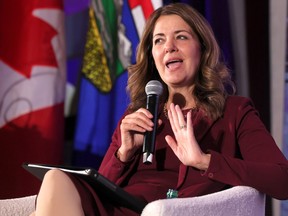 Premier Danielle Smith during her keynote speech and fireside chat with Rick Bell at the 2026 Canada Strong and Free Network Calgary conference at the BMO Centre in Calgary on Friday, October 16, 2026. Darren Makowichuk/Postmedia
With Albertans preparing to head to the polls Monday, questions are mounting over how Premier Danielle Smith will navigate divisions within the United Conservative Party over Alberta separation in the aftermath of the referendum.

Subscribe now to read the latest news in your city and across Canada.
Subscribe now to read the latest news in your city and across Canada.
Create an account or sign in to continue with your reading experience.
Create an account or sign in to continue with your reading experience.
A Leger poll released last week suggested UCP supporters are almost evenly divided on the separation question, raising questions about whether the party’s membership can get back on the same page following the Oct. 19 vote.
Former premier Jason Kenney, who founded the UCP in 2017, says the party must enforce its founding commitment to a “strong Alberta within a united Canada,” suggesting the party’s leadership could screen out separatist candidates and potentially expel members who violate its core principles.

Your weekday lunchtime roundup of curated links, news highlights, analysis and features.
By signing up you consent to receive the above newsletter from Postmedia Network Inc.
A welcome email is on its way. If you don't see it, please check your junk folder.
The next issue of Noon News Roundup will soon be in your inbox.
We encountered an issue signing you up. Please try again
“When I created the UCP in 2017, it was with a clear commitment to a federalist party supporting (a) strong Alberta in a united Canada,” Kenney told reporters at a Canada Strong and Free Network event in Calgary on Friday.
“If there are folks who want to advocate for separatism, they have every right as citizens to do so in separatist parties.”
Kenney said the UCP leadership has a responsibility to “lay down the law” with members who are “not committed to the core principles of the party,” including its commitment to Canadian unity.
He pointed to his own tenure as party leader, saying prospective UCP candidates with a history of advocating for Alberta separation were barred from running under the party’s banner.
“We invalidated all of them. Just said ‘no, sorry,’” he said. “You can’t bring separatism into it to represent us on the ballot.”
His comments come as the party faces an increasingly apparent divide over Alberta’s future, with polling suggesting a substantial portion of its supporters favour beginning the process toward a second, binding referendum on separation.
 Former Alberta Premier Jason Kenney speaks to a crowd at the Canada Strong and Free Network conference. He said separatists should be screened out by the UCP party. Dean Pilling/Postmedia
Smith, who addressed attendees at the same event shortly after Kenney’s remarks, acknowledged that “loyalty to a united Canada” is among the UCP’s founding principles.
But when asked whether she would take steps similar to those described by her predecessor — including screening out separatist candidates or expelling members who violate the party’s principles — Smith stopped short of making any commitment.
She suggested the outcome of Monday’s referendum would help determine how the party approaches members who might waver in their commitment to national unity following Monday’s vote.
If the government receives “affirmation” that remaining committed to a united Canada is a principle Albertans want the party to maintain, Smith said it would do so.
Pressed on whether that could mean taking enforcement action against members who continue to advocate for separation, the premier deferred an answer until after the vote.
“I don’t want to prejudge how people are going to interpret the result on Monday,” Smith said.
“Maybe ask me that on October 20th once I have a chance to see what people’s reaction is.”
Smith suggested some separatist sentiment within the party may prove temporary, arguing that members who have recently embraced separation could still be persuaded that “Canada can work.”
Others, she said, have turned to separatism as a way to “express their anger,” suggesting support within her party for breaking away from Canada could diminish following Monday’s referendum.
On Oct. 19, Albertans will head to the polls to vote on 10 referendum questions, including one that asks whether they want Alberta to remain a province of Canada, or begin the legal process toward holding a second, binding referendum on separation.
This website uses cookies to personalize your content (including ads), and allows us to analyze our traffic. Read more about cookies here. By continuing to use our site, you agree to our Terms of Use and Privacy Policy.