Просмотр новости
Найдите то, что Вас интересует
 Спутники
 РН
РН SpaceX
 Роскосмос
 NASA
NASA
СпутникиРНSpaceXРоскосмосNASAI don't know why hardware manufacturers find it so hard to write decent documentation. As I've said before you need to actually test your readme. The Una Watch development instructions are scattered across a bunch of different files. So here's how to go from zero to your first "Hello, World!" Glance app with the minimum of fuss. This all assumes a fairly modern Debian / Ubuntu / Pop OS Linux. …
I don't know why hardware manufacturers find it so hard to write decent documentation. As I've said before you need to actually test your readme. The Una Watch development instructions are scattered across a bunch of different files.
So here's how to go from zero to your first "Hello, World!" Glance app with the minimum of fuss.
This all assumes a fairly modern Debian / Ubuntu / Pop OS Linux.
PrerequisitesThis installs most of the tools you will need:
Copied Bash to 📋 Bashsudo apt update
sudo apt install -y git python3 python3-pip cmake build-essential
STM32CubeCLT
Visit https://www.st.com/en/development-tools/stm32cubeclt.html and download the Linux version of the tool. Inexplicably, you need to give your email address. I recommend giving a disposable one from https://10minutemail.com/
After downloading, unzip the file.
On the command line, cd into the directory containing the unzipped file.
 Bashchmod +x stm32cubeclt_*.sh
sudo ./stm32cubeclt_*.sh
You will need to agree to their licence. Just hit y.
That installs everything in /opt/st/stm32cubeclt_1.22.0/
You will need to make that available to your PATH.
Copied Bash to 📋 Bashexport PATH="/opt/st/stm32cubeclt_1.22.0/GNU-tools-for-STM32/bin:$PATH"
Clone the repo
You will need to copy the Una SDK. I keep my git repos in ~/git/ - you will need the location of the directory later.
 Bashcd ~/git/
git clone git@github.com:UNAWatch/una-sdk.git
cd una-sdk/
git submodule update --init ThirdParty/lvgl
Then update all the Python dependencies.
Copied Bash to 📋 Bashexport UNA_SDK="$PWD"
python3 -m pip install --upgrade pip
python3 -m pip install -r "$UNA_SDK/Utilities/Scripts/app_packer/requirements.txt"
Check it has all worked
Paste this into your terminal. Check for any errors.
Copied Bash to 📋 Bashwhich arm-none-eabi-gcc || true
which cmake || true
which make || true
which python3 || true
python3 -m pip --version
arm-none-eabi-gcc --version || true
cmake --version || true
make --version || true
Build the demo app
If all of the above has worked, you should be able to build the demo app with:
Copied Bash to 📋 Bashcd /tmp
mkdir -p MyAlarm
cp -r "$UNA_SDK/Examples/Apps/Alarm/"* MyAlarm
mkdir -p MyAlarm/build
cmake -G "Unix Makefiles" -S MyAlarm/Software/Apps/Alarm-CMake -B MyAlarm/build
cmake --build MyAlarm/build
Make it permanent
Store the paths permanently. If you put cloned the Una SDK to somewhere other than ~/git/ you'll need to edit this next bit of code:
 Bashecho 'export UNA_SDK="$HOME/git/una-sdk"' >> ~/.bashrc
echo 'export PATH="/opt/st/stm32cubeclt_1.22.0/GNU-tools-for-STM32/bin:$PATH"' >> ~/.bashrc
source ~/.bashrc
Build a Glance app
At the moment, the only way to build a GUI app is using the Windows only (Booooo!) TouchGFX0. So, instead, we'll make a "Hello World" glance. All it will do is draw some text.
The GlanceFloors demo app is the simplest one to copy.
 Bashcd $UNA_SDK/Examples/Apps/
cp -r  GlanceFloors/ GlanceHello
Use an IDE or a text editor to open up the new GlanceHello directory.
GlanceHello/Software/App/GlanceFloors-CMake/
to
GlanceHello/Software/App/GlanceHello-CMake/
GlanceHello/Software/App/GlanceFloors-CMake/CMakeLists.txt
- specifically the
# App configuration
section.
APP_NAME
to
GlanceHello
APP_USER_NAME
to
Hello
For a demo, you can leave the DEV_ID and APP_ID as their default values.
You will need to edit two more files.
In GlanceHello/Software/Libs/Header/Service.hpp remove the following lines:
 CPPSDK::Sensor::Connection mSensorFloors;
uint32_t                mFloorsValue;
bool                    mDataReceived;
Then save the file.
Edit GlanceHello/Software/Libs/Source/Service.cpp and replace its entire contents with this:
 CPP#include "Service.hpp"
#include "SDK/Messages/CommandMessages.hpp"
#include "SDK/Messages/MessageGuard.hpp"

Service::Service(SDK::Kernel &kernel)
    : mKernel(kernel)
    , mGlanceUI()
    , mGlanceTitle()
    , mGlanceValue()
{}

Service::~Service(){}

void Service::run()
{
    while (true) {
        SDK::MessageBase *msg;
        if(!mKernel.comm.getMessage(msg)) {
            continue;
        }

        switch (msg->getType()) {

            case SDK::MessageType::EVENT_GLANCE_START:
                if (configGui()) {
                    createGuiControls();
                } else {
                    mKernel.comm.releaseMessage(msg);
                    mKernel.sys.exit(0);
                }
                break;

            case SDK::MessageType::COMMAND_APP_STOP:
            case SDK::MessageType::EVENT_GLANCE_STOP:
                mKernel.comm.releaseMessage(msg);
                return;
                break;

            case SDK::MessageType::EVENT_GLANCE_TICK:
                onGlanceTick();
                break;

            default:
                break;
        }

        mKernel.comm.releaseMessage(msg);
    }
}

void Service::onGlanceTick()
{
    if (mGlanceUI.isInvalid()) {
        if (auto upd = SDK::make_msg<SDK::Message::RequestGlanceUpdate>(mKernel)) {
            upd->name           = APP_NAME;
            upd->controls       = mGlanceUI.data();
            upd->controlsNumber = static_cast<uint32_t>(mGlanceUI.size());
            upd.send(100);
        }

        mGlanceUI.setValid();
}
}

bool Service::configGui()
{
    bool status = false;
    if (auto gc = SDK::make_msg<SDK::Message::RequestGlanceConfig>(mKernel)) {
        if (gc.send(100) && gc.ok()) {
            if (gc->maxControls >= 3) {
                mGlanceUI.setWidth(gc->width);
                mGlanceUI.setHeight(gc->height);
                status = true;
            }
        }
    }
    return status;
}

void Service::createGuiControls()
{
    mGlanceTitle = mGlanceUI.createText();
    mGlanceTitle.pos({ kTitleX, kTitleY }, { kTitleW, kTitleH })
        .font(GlanceFont_t::GLANCE_FONT_POPPINS_SEMIBOLD_20)
        .color(GlanceColor_t::GLANCE_COLOR_TEAL)
        .setText("Hello, World!")
        .alignment(GlanceAlignH_t::GLANCE_ALIGN_H_CENTER);
    mGlanceValue = mGlanceUI.createText();
    mGlanceValue.pos({ 0, kValueY }, { 200, kValueH })
        .font(GlanceFont_t::GLANCE_FONT_POPPINS_SEMIBOLD_20)
        .color(GlanceColor_t::GLANCE_COLOR_WHITE)
        .setText("I know C++")
        .alignment(GlanceAlignH_t::GLANCE_ALIGN_H_CENTER);
}
Save the file.
Compile itOn the command line
Copied Bash to 📋 Bashcd $UNA_SDK/Examples/Apps/GlanceHello/Software/App/GlanceHello-CMake
cmake -G "Unix Makefiles" -S . -B build
cmake --build build
It should finish with a success message of [100%] Built target GlanceHelloApp
Apps
directory.
APP_ID
which is set in
CMakeLists.txt
GlanceHello/Output/
and will be called
Hello_1.5.0-rc5.uapp
or similar.
.uapp
file from your computer to the directory you just created on the watch.
If it has worked, you should see this:
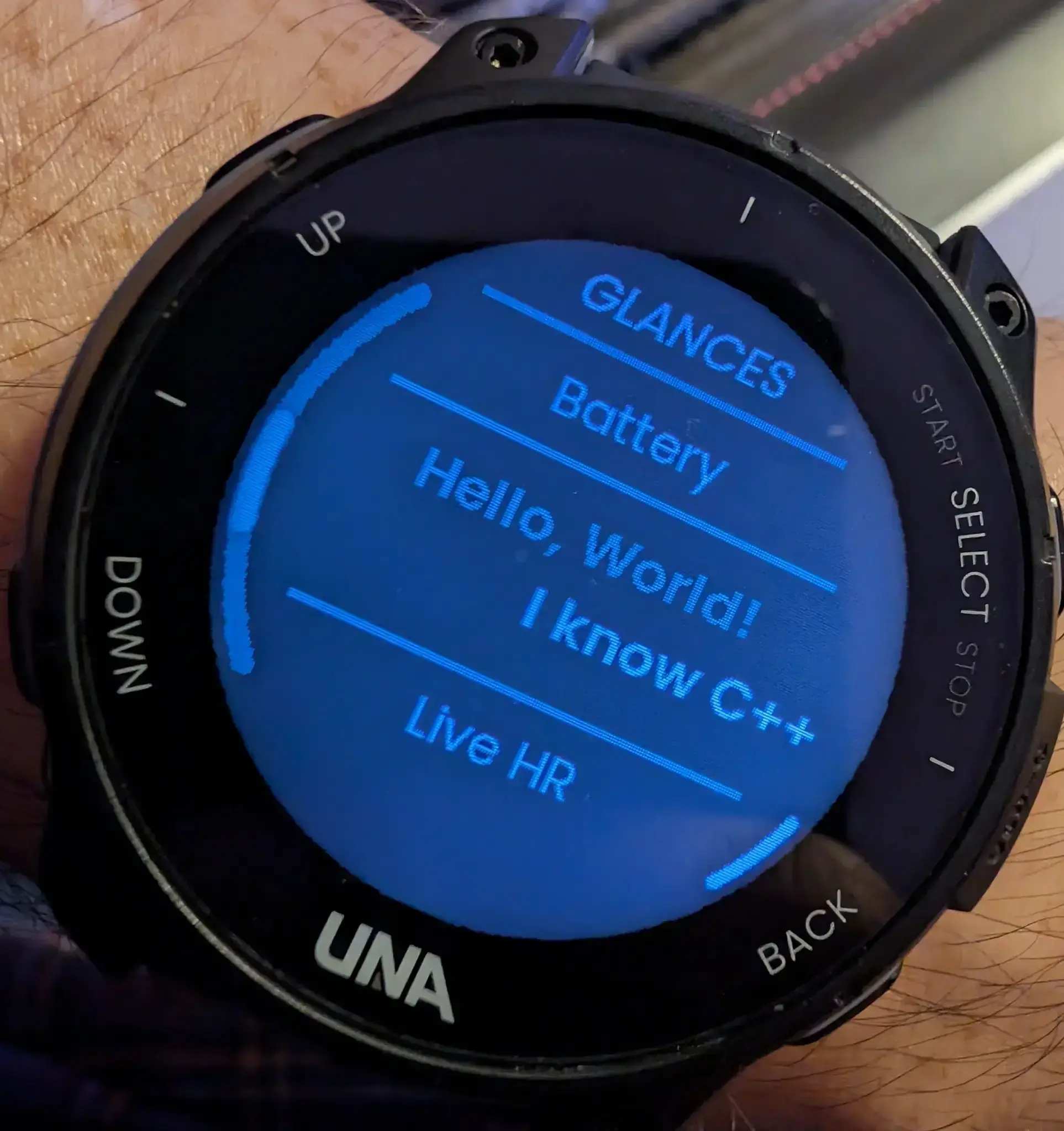
Hurrah! Treat yourself to a beer 🍻
| # | Наименование новости | Тональность | Информативность | Дата публикации |
|---|---|---|---|---|
| 1 | Gadget Review: Una Watch ★★★★☆ | 0 | 8.41 | 02-10-2026 |
| 2 | I paid people to try and follow my README | 0 | 9.9 | 11-10-2026 |
| 3 | Apple Watch mit Android? Diese Open-Source-App soll das jetzt möglich machen | 0 | 9.17 | 15-10-2026 |
| 4 | Когда Docker Compose уже мало, а Kubernetes еще слишком много: знакомство с Uncloud. Часть 1 | 0 | 10.42 | 16-10-2026 |
| 5 | nautobot-maintenance-windows 0.1.0 | 0 | 5 | 10-07-2026 |
| 6 | Starling: A New Linux Desktop Written In Swift, Own Wayland Compositor & Written With AI | 0 | 7.03 | 28-07-2026 |
| 7 | OneUptime – self-hosted observability and incident management platform | 0 | 13.67 | 30-07-2026 |
| 8 | hedron-posit 0.39.0 | 0 | 30 | 14-08-2026 |
| 9 | python-gobject-docs x86_64 | 0 | 48.89 | 28-08-2026 |
| 10 | Параноикам, экономящим SSD, принёс игрушку | -1 | 9.77 | 09-08-2026 |