Просмотр новости
Найдите то, что Вас интересует
 Спутники
 РН
РН SpaceX
 Роскосмос
 NASA
NASA
СпутникиРНSpaceXРоскосмосNASA
Astronomers using fresh data from the Vera C. Rubin Observatory have uncovered an asteroid that defies usual planetary physics, spinning at a speed so fast it should technically be tearing itself apart, but isn't.
Now, most large asteroids are not solid, single boulders. Instead, they are typically loose rubble piles, i.e. gravitationally
Astronomers using fresh data from the Vera C. Rubin Observatory have uncovered an asteroid that defies usual planetary physics, spinning at a speed so fast it should technically be tearing itself apart, but isn't.
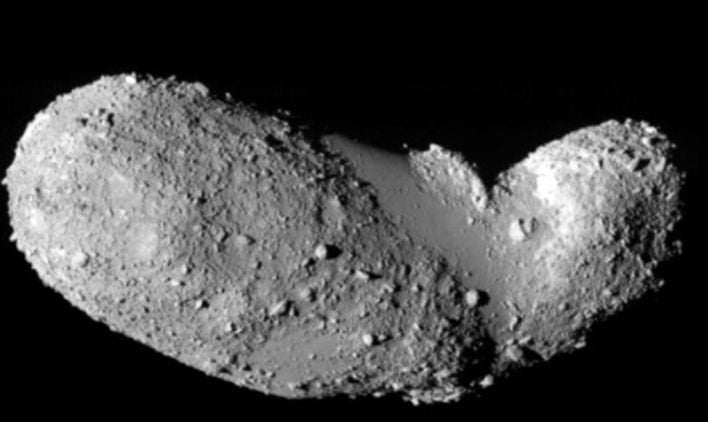 Rubble pile asteroid 25143 Itokawa - Image: ISAS/JAXA, CC BY 4.0 via Wikimedia Commons
Now, most large asteroids are not solid, single boulders. Instead, they are typically loose rubble piles, i.e. gravitationally bound collections of rock, dust, and who-knows-what. Because of this fragile makeup, objects larger than 150 meters across would face a strict physical limitation known as the spin barrier. That means if a rubble-pile asteroid rotates faster than once every 2.2 hours, centrifugal forces overcome its weak gravity, hurling its contents outward and breaking the body apart eventually.
However, a newly analyzed asteroid (ID 491384) is shattering (pun intended) those assumptions by becoming the largest ultra-fast-spinning asteroid ever detected by science. Stretching 2.53 kilometers (1.57 miles) across, this rock completes a full rotation in a mere 4.18 minutes, which equates to a spin more than 31 times faster than the aforementioned spin barrier for objects of its size. For a body extending over two kilometers across to endure such extreme rotational forces without disintegrating, it must possess substantial internal cohesive strength, pointing toward a solid, monolithic interior instead.
 Representative image of a cratered asteroid - Image: NASA
This unique discovery emerged from an analysis of light curve data collected by the Vera C. Rubin Observatory in Chile, as detailed in research led by University of Washington astronomer Dmitrii Vavilov and posted on arXiv earlier last week.
As irregular asteroids rotate through space, they reflect varying amounts of sunlight toward Earth, creating light curves that allow scientists to calculate their rotation speeds. Because survey telescopes take snapshot observations with time gaps in between, rapidly spinning objects can create misleading optical patterns. To solve this, Vavilov's team designed bespoke statistical software capable of filtering out observation gaps and evaluating the true probability of rapid spin rates.
Applying this approach to a large dataset of 9,417 asteroids monitored by Rubin, the software successfully identified 66 super-fast-rotator candidates, with asteroid 491384 and 566130 standing out as the crown jewels of the bunch.

Tech enthusiast, YouTuber, engineer, rock climber, family guy. 'Nuff said.
| # | Наименование новости | Тональность | Информативность | Дата публикации |
|---|---|---|---|---|
| 1 | Vera Rubin Observatory spots the largest ultra-fast spinning asteroid yet | 0 | 10.34 | 13-10-2026 |
| 2 | Астероиды это не просто каменные глыбы, лениво дрейфующие в космосе. ... | 0 | 6.5 | 14-10-2026 |
| 3 | Ultra-fast rotating asteroids in the news | 0 | 13.46 | 06-04-2026 |
| 4 | ☄️ Космические волчки-гиганты: два астероида делают полный оборот всего за ... | 0 | 10.99 | 14-10-2026 |
| 5 | Early data from Rubin Observatory reveals over 11,000 new asteroids | 0 | 7.18 | 06-04-2026 |
| 6 | Japan Pulls Off One of the Closest Asteroid Flybys Ever | 0 | 11.77 | 10-07-2026 |
| 7 | Scientists discover a mysterious asteroid breaking apart near the Sun | 0 | 9.49 | 14-05-2026 |
| 8 | Huge asteroid a MILE wide will zoom past Earth tomorrow - here's how to spot it | 0 | 5 | 26-06-2026 |
| 9 | NASA’s DART Impact Actually Changed an Asteroid System’s Orbit Around the Sun | 0 | 17.63 | 13-03-2026 |