Просмотр новости
Найдите то, что Вас интересует
 Спутники
 РН
РН SpaceX
 Роскосмос
 NASA
NASA
СпутникиРНSpaceXРоскосмосNASAScientists have found a species they've named the fire amoeba, which is capable of reproducing at 145°F and continuing to move up to temperatures of 147°F — a record for complex eukaryotic life.

Introducing Incendiamoeba cascadensis, which translates to "fire amoeba of the Cascade mountain range." This single-celled organism can replicate at temperatures up to 145°F, a new record for a complex organism. Felix Mikus hide caption
Felix Mikus
Angela Oliverio, a microbiologist at Syracuse University, studies the edge of what's possible.
"There's a very deep curiosity and desire to understand life at its limits and at its most extreme," she says. "And where that boundary is and what truly are our constraints."
It's not unlike ultra-elite athletes who push themselves "to the absolute max of what we think is humanly possible," she says. "But in this case, we're just expanding it to life more generally" — specifically, microscopic life.
Oliverio studies organisms called extremophiles, so named because they thrive in unusually harsh conditions, like high temperatures. The title holders in this regard are simple organisms like bacteria and a group called Archaea, with certain species living at or above 212°F, the boiling point of water.
But Beryl Rappaport, a PhD student in Oliverio's lab, says that until now, that same ability to beat the heat has been less studied in eukaryotes — a group whose members include many different species, from humans to single-celled amoebas. These organisms have more complex cells that contain a nucleus and other structures.
Rappaport says part of the reason may simply be that scientists haven't found the right eukaryotes yet. "So few have been described, especially in detail. We have a lot to learn from them."
Now, she and her colleagues have added a remarkable new organism to the pantheon: a species they call the fire amoeba that nudges a key temperature limit for complex cells upwards by another five or so degrees. The findings were published in the journal Cell.
This may seem like a modest improvement, but Oliverio considers the sub-4-minute mile for runners, which was long thought to be impossible. Once one athlete achieved it, however, it was just weeks before it happened again.
"It wasn't so much the incremental amount that this record was broken by, as much as the proof that it was possible," she says.
A little cell that likes it hotTo make this discovery, the researchers and their colleagues went on something of a fishing expedition in Lassen Volcanic National Park in northern California.
"It's one of the least-visited national parks in the US," says Oliverio.
"It's super beautiful," adds Rappaport. "Very mountainous. All of the pines. A lot of butterflies flitting around. It did experience some pretty rough fires in the past decade, so a lot of new understory growth. And then just these little steaming geothermal pockets."
One such pocket is a tributary of a little waterway called Hot Springs Creek, "that you would almost miss because it's surrounded by a lot of tall grasses," says Rappaport.
The research team decided to take some samples there by using extra-long barbecue tongs to grip a series of vials that Rappaport dipped into the steaming water.
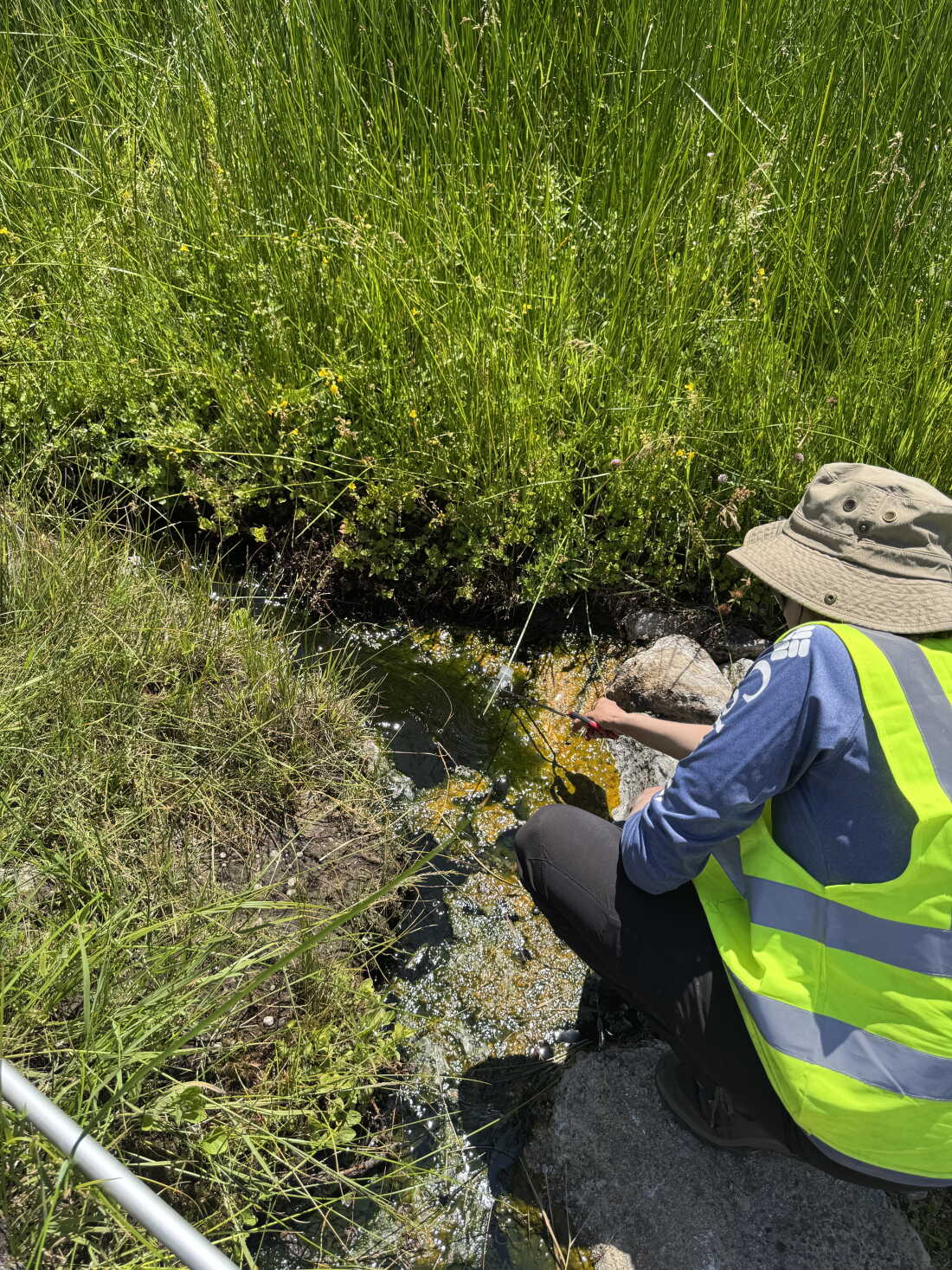
Beryl Rappaport takes a sample from a tributary of Hot Springs Creek in Lassen Volcanic National Park in northern California. Kristen Skruber hide caption
Kristen Skruber
Later, in the lab, she put the water samples under a microscope, filmed them, and sped up the footage. And that's when she saw something moving. It seemed to protrude, retract, and fluidly change its shape — as if it were performing a single cell's version of hot yoga.
"That's definitely an amoeba," she recalls thinking. "That's characteristic amoeba movement."
This amoeba, however, was able to replicate at temperatures up to 145°F. This is a new record for a complex organism. It can also continue moving around up to 147°F and protect itself in waters as hot as 158°F. When Rappaport and her colleagues studied its genome, they realized they had a new species on their hands.
The team named it Incendiamoeba cascadensis, which translates to "fire amoeba of the Cascade mountain range."
An extremophile with lessons to shareThe next question the researchers investigated was how the fire amoeba can thrive at such high temperatures.
When they compared the genome of the new species to those of other amoebas, they observed that the fire amoeba had ways of keeping its proteins and membranes stable at higher temperatures.
It's a finding that could be used to expand the search for life. "Thinking about not only what are the limits of life and what is possible here, but also what might be possible elsewhere," says Oliverio.
In addition, she argues the amoeba's temperature resilience could offer clues to help create heat-resilient crops or drugs that are stable across a wider range of temperatures.
"I can tell you from experience it's really hard to find a really cool exotic organism and actually turn it into something that has a major impact on other species," says Debashish Bhattacharya, an evolutionary biologist at Rutgers University who wasn't involved with the research.
"But there's always the potential of finding something amazing, that's for sure," he adds.
Bhattacharya says that in other extremophiles, their genomes have become more compact. "It's called genome streamlining," he says, "so they can then compete with bacteria which have smaller genomes and live in these harsh environments."
This isn't the case with the fire amoeba, which has a larger genome than its relatives. "It's taken a different path," says Bhattacharya, "so I think that's really interesting."
Oliverio finds it similarly interesting. And now that the fire amoeba has been documented, she thinks it's just the start. More scientists, she hopes, will now go looking for other complex organisms with these extreme abilities.
"Perhaps the upper temperature record will be broken again soon," she says.
| # | Наименование новости | Тональность | Информативность | Дата публикации |
|---|---|---|---|---|
| 1 | At 145 Degrees, This Amoeba Manages to Keep Its Cool | 0 | 11.82 | 25-09-2026 |
| 2 | How does a shape-shifting microbe survive extreme heat? | 0 | 11.75 | 10-07-2026 |
| 3 | Микробиологи установили максимальную температуру, при которой возможна жизнь | 0 | 9.74 | 14-10-2026 |
| 4 | Giant virus discovery could rewrite the origin of complex life | 0 | 5.76 | 20-02-2026 |
| 5 | This deep-sea enzyme survives heat that destroys most proteins | 0 | 11.14 | 19-09-2026 |
| 6 | Европейскую страну накрыла рекордная жара | 0 | 5 | 26-06-2026 |
| 7 | Life Rebounds Quickly on Volcanoes | 0 | 10 | 28-01-2026 |
| 8 | 'The corn crop is just a tinder keg': field fire concerns continue amid record-breaking temperatures in Central Illinois | 0 | 8.75 | 13-10-2026 |
| 9 | Жара во Владивостоке побила температурный рекорд | 0 | 0 | 27-06-2025 |
| 10 | La bacteria que ha aguantado 5.000 años bajo el hielo y es resistente a 10 antibióticos | 0 | 9.94 | 17-02-2026 |