Просмотр новости
Найдите то, что Вас интересует
 Спутники
 РН
РН SpaceX
 Роскосмос
 NASA
NASA
СпутникиРНSpaceXРоскосмосNASADirector of National Intelligence Jay Clayton will now helm broad domestic technology and economic policy discussions.
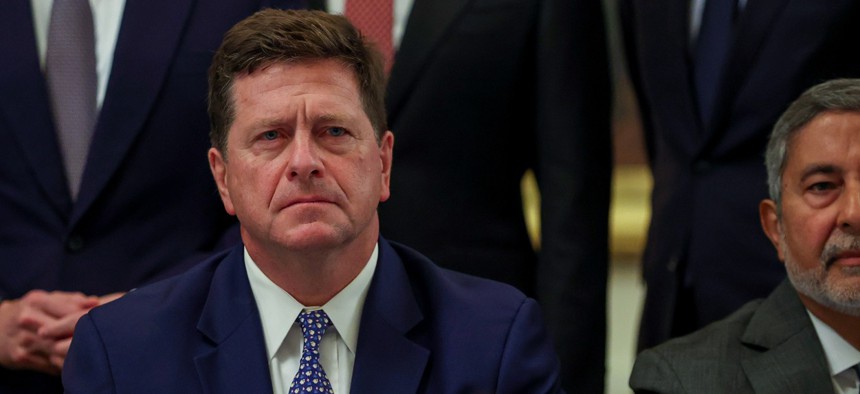
U.S. Director of National Intelligence Jay Clayton attends a meeting on artificial intelligence in the East Room of the White House on September 29, 2026 in Washington, DC. Kevin Dietsch/Getty Images
The nation's top spy is now also the White House's AI czar.
President Donald Trump named Jay Clayton, who was sworn in as director of national intelligence in July, to lead what Trump referred to in a Truth Social post as the “Super Intelligence Force” meant to coordinate the government’s engagement with various organizations, critical-infrastructure providers, and AI companies.
Last month, Trump ordered federal agencies to start calling AI "super intelligence."
According to its charter, the task force will create plans to handle AI-enabled threats, streamline breach notifications, and improve government-response capacities while aiming to avoid overregulation. Its creation follows growing public concerns over AI safety and cybersecurity risks, as well as heated political discussions over the data-center buildouts that power many of today’s AI systems.
“The risk of not being first is high,” Clayton told the Wall Street Journal in a Saturday exclusive that discussed the task force. “Not being first increases the identified, and unidentified, risks, particularly from our adversaries,” he said. “Being first will better enable us to address those risks on behalf of the American people.”
The task force has three vice chairs: Defense Undersecretary for Research and Engineering Emil Michael, Office of Personnel Management Director Scott Kupor and Federal Trade Commission Chairman Andrew Ferguson. Its members include Vice President JD Vance, Defense Secretary Pete Hegseth, and other senior advisors, alongside external advisors like venture capitalist David Sacks — who previously worked as Trump’s AI and crypto czar early in the administration — and former Secretary of State Condoleezza Rice. It will have 120 days to report on the risks and opportunities of AI and establish a plan for the federal government to tackle it.
The panel’s establishment marks a shift for an administration that has predominantly maintained a hands-off approach toward AI governance. But officials have faced mounting pressure over the past six months to respond as a new generation of sophisticated, autonomous AI models demonstrating advanced cybersecurity capabilities have repeatedly circumvented or escaped technical safeguards.
Its creation highlights a steady group of voices in the administration and tech industry that believe the time for AI safeguard discussions should begin, though Trump and other officials have largely continued to lean toward a more relaxed approach to regulating the technology.
In public discussions, officials and researchers typically frame AI development as a trade-off between slowing down for safety and accelerating to maintain an edge over foreign adversaries pursuing AI for military and economic gains.
China has especially become a major player in the global AI race. Clayton’s appointment to the task force appears to signal a shift by the administration to cast AI as a geopolitical and national-security subject area.
His dual role is a unique move for the White House, placing the current DNI — who oversees the 18 U.S. spy agencies — at the helm of broad domestic technology and economic policy discussions. Clayton brings a background as a corporate lawyer and former SEC chairman, distinguishing him from tech-focused people from Silicon Valley.
AI has already transformed how spy agencies digest vast troves of collected data and build intelligence products, among other things.
Sen. Mark Warner, D-Va., the vice chairman of the Senate Intelligence Committee, said that he welcomed the administration’s attention toward the fast-evolving technology but said Clayton’s new title lacks a coherent strategy.
“We still do not know what authority this new role will have, whether it will include developing safety standards or reviewing the most advanced models, or how it fits into the administration’s broader approach to AI,” Warner said in a statement. “That lack of clarity is especially concerning as leading AI companies themselves are confronting increasingly capable systems that can evade safeguards and exploit cybersecurity vulnerabilities.”
“I hope this appointment is an opportunity for the administration to move beyond slogans and toward a serious, coordinated national strategy for AI,” he said.
| # | Наименование новости | Тональность | Информативность | Дата публикации |
|---|---|---|---|---|
| 1 | Trump names national intelligence director Jay Clayton to lead a new federal AI task force | 0 | 4.21 | 04-10-2026 |
| 2 | Senate confirms Clayton as Trump’s next intelligence director | 0 | 8.79 | 29-07-2026 |
| 3 | Pulte lingers as intel chief while senators say it's time for 'the temp' to move on | 0 | 5.68 | 31-07-2026 |
| 4 | Джея Клейтона утвердили на пост главы нацразведки США | 0 | 6.5 | 28-07-2026 |
| 5 | Democrats press intel nominee Jay Clayton in tense confirmation hearing | -2 | 6 | 15-07-2026 |
| 6 | Senate GOP seeks to speed up DNI confirmation process, Thune says | 0 | 5 | 16-06-2026 |
| 7 | Trumps neuer Geheimdienstkoordinator Jay Clayton steht vor einer heiklen Mission | 0 | 10.33 | 30-07-2026 |
| 8 | Новым главой аппарата сотрудников Белого дома станет конгрессмен Марк Медоуз | 0 | 0 | 07-03-2020 |
| 9 | Байден назначил своего бывшего советника руководителем аппарата сотрудников Белого дома | 0 | 0 | 12-11-2020 |
| 10 | Avi Loeb announced to lead new "UAP Science Advisory Council" for White House | 0 | 10 | 13-07-2026 |