Просмотр новости
Найдите то, что Вас интересует
 Спутники
 РН
РН SpaceX
 Роскосмос
 NASA
NASA
СпутникиРНSpaceXРоскосмосNASAThe service’s “biggest acquisition program” is fostering new companies, acting secretary says.
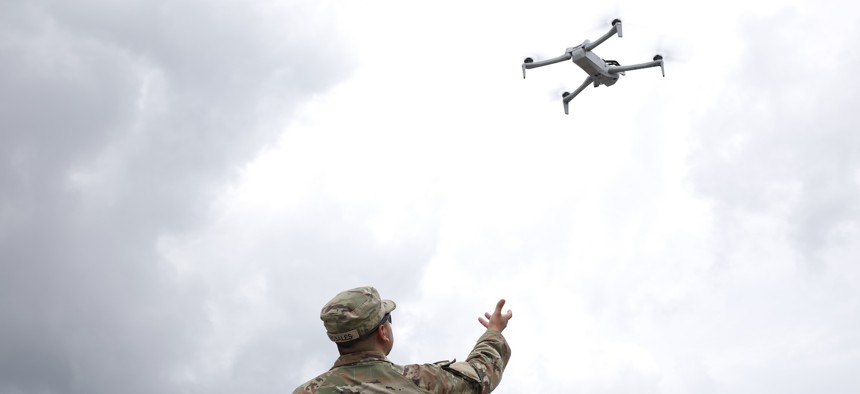
A soldier with the 101st Airborne 2-327 Multi-Purpose Company catches a drone in the Pentagon parking lot on June 14, 2025. Getty Images / Samuel Corum
The U.S. Army is planning a "rodeo" to round up problems that slow the deployment of new weapons, and rope in new ways to improve supply chains and make parts in more places, the service’s acting chief said today.
The “Manufacturing Rodeo,” planned sometime in 2027, will serve as a sort of public competition to expose where the industrial base is failing to meet demand and where new players are providing innovative approaches.
“We need to strain the nation's larger industrial base. We're going to stress-test the supply chain, the manufacturing processes, and see where it breaks,” Adam Telle said at the Association of the U.S. Army’s annual conference in Washington, D.C.
Production bottlenecks and a lack of suppliers for many key parts have plagued the Army for decades. The Government Accountability Office, among others, has detailed many breaking points. But, Telle said, those reports don’t capture how bad the problem could become as the Army seeks new drones and counterdrone weapons with components made by companies far from the service’s control.
For instance, he said, the Army needs to “make millions” of one-way attack drones.
“It may look simple, but it's a flying supply chain. If somebody else controls one part, they can break the whole thing,” the acting chief said.
Parts for such drones are largely made in China, which uses its market dominance to help other autocratic states like Russia and Iran attack U.S. forces and partner militaries in Europe.
Telle, who did not name any adversary, said that “an economy that's an extension of the national-security apparatus” can be “ruthlessly efficient” in deploying weapons.
“Over there, you flip a switch, and by law, by design, the economy is nationalized,” he said.
The acting Army chief listed steps the Pentagon has taken to overcome bureaucratic sluggishness in developing and deploying new technologies, such as pushing more acquisition authority down to battalion-level commanders, getting more self-sustained power on U.S. bases, and introducing a program to allow private companies to test new weapons on U.S. Army ranges. New private ranges, such as Second Bend Labs, are also renting time and space to defense startups eager to gain a foothold.
Telle said fostering new companies is more important than any single program.
“When someone tells you the Army's biggest acquisition program is this tank or that helicopter or this missile system, tell them they're wrong. The biggest acquisition program in the Army is building a system of seamless, frictionless, symbiotic relationship with American ingenuity.”
| # | Наименование новости | Тональность | Информативность | Дата публикации |
|---|---|---|---|---|
| 1 | Army’s new command plans to streamline autonomous warfare acquisition | 0 | 9.03 | 09-10-2026 |
| 2 | Army brings back ‘night court’ audit of programs, shifting more than $100M | 0 | 10 | 12-10-2026 |
| 3 | NRO looks to illuminate supply chain risks | 0 | 6.29 | 20-08-2026 |
| 4 | Army re-evaluating munitions procurement goals as Iran war continues | 0 | 14.35 | 13-10-2026 |
| 5 | Defense Business Brief: A radar-maker’s answer to the drone boom; the Army’s private capital appetite; One lawmaker’s caution for contractors | 0 | 5 | 01-07-2026 |
| 6 | Army overhauls software acquisition to speed delivery | 0 | 11.94 | 27-08-2026 |
| 7 | US Army to stage counter-drug training exercises in South America | 0 | 12.94 | 12-10-2026 |
| 8 | Fleet Technology Targets Inspections, EV Procurement, and Parts Sourcing | 0 | 8.34 | 07-08-2026 |
| 9 | Army Modernization: Better Schedule and Cost Information Needed to Support Scaling Battlefield Network | 0 | 11.25 | 20-08-2026 |
| 10 | GSA’s digital roadmap looks to enhance agencies’ services, CIO says | 0 | 8.44 | 03-08-2026 |