Просмотр новости
Найдите то, что Вас интересует
 Спутники
 РН
РН SpaceX
 Роскосмос
 NASA
NASA
СпутникиРНSpaceXРоскосмосNASAWASHINGTON, Sept. 22, 2026 — Commercial cameras can be powerful, producing images with exquisite details that mimic real life. In the lab, specially designed cameras can photograph […]
The post A Normal Camera That Can Detect Solar Cell Efficiency appeared first on AIP Publishing LLC.
From the Journal: Journal of Applied Physics
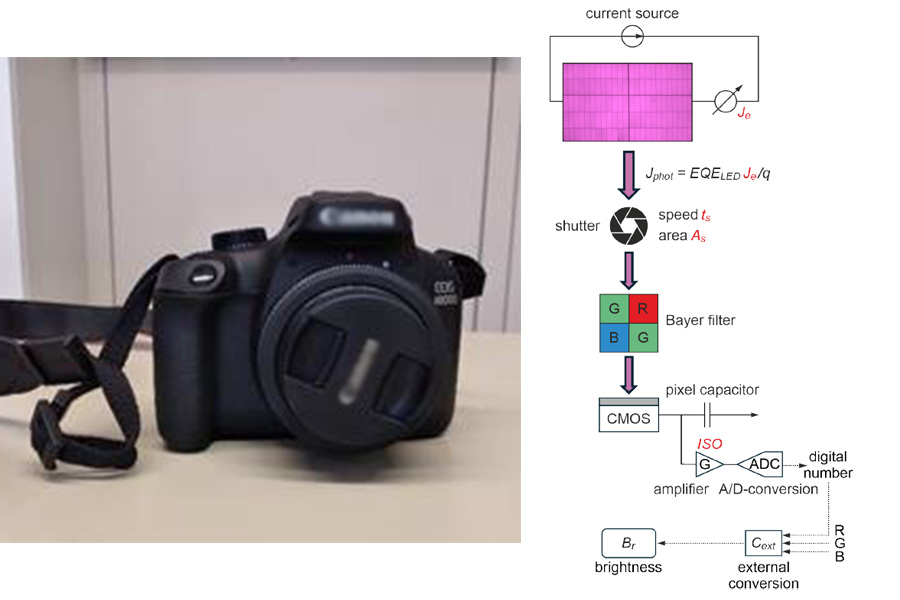 The researchers presented a methodology to use a commercially available camera to measure solar cell efficiency. Credit: Werner et al.
WASHINGTON, Sept. 22, 2026 — Commercial cameras can be powerful, producing images with exquisite details that mimic real life. In the lab, specially designed cameras can photograph objects in the infrared region, invisible to the naked eye.
In The Journal of Applied Physics, by AIP Publishing, researchers from the University of Stuttgart, the Research Center Jülich, and the German company Solarzentrum Stuttgart modified a commercially available camera for something usually done in the lab: measuring the electroluminescence of solar cells.
Electroluminescent quantum efficiency is commonly used to determine the efficiency of solar cells. The value is directly related to the cell’s voltage, and, generally speaking, the higher the luminescent quantum efficiency, the better the solar cell. It’s also normal to measure this value with a camera — albeit an expensive, industrial camera that must be carefully calibrated.
“Our approach shows that even a relatively inexpensive consumer camera can provide quantitative results when its physical response is properly modeled and calibrated,” said author Jürgen Werner.
The camera they used was already primed for their experiment since it lacked an internal infrared-blocking film, something that is normally present in most commercial cameras. These modified cameras can also be used for artistic infrared photography or photos of the night sky.
The researchers added a long-pass filter in front of the camera lens to decrease visible background light, providing an infrared electroluminescence image that could later be analyzed based on brightness.
“An electroluminescence image contains much more quantitative information than simply showing bright and dark regions,” said Werner. “With a suitable physical camera model and calibration, it can provide absolute luminescent quantum efficiency and, therefore, information about the local quality of a solar cell or module.”
The researchers plan to expand the camera’s capabilities in future work, keeping an emphasis on using commercially available technology.
“Our next step is to use the calibrated camera to determine quantum efficiencies and open-circuit voltages of further, previously uncharacterized solar cells and modules,” Werner said. “The same model should also be applicable to photoluminescence measurements and potentially to measurements performed in daylight.”
The article “New camera model for absolute quantum efficiency measurements from electroluminescence of solar cells or modules” is authored by Jürgen H. Werner, Georgette Udo, and Liviu Stoicescu. It will appear in The Journal of Applied Physics on Sept. 22, 2026 (DOI: 10.1063/5.0349589). After that date, it can be accessed at https://doi.org/10.10.1063/5.0349589.
###
Article TitleAuthorsJürgen H. Werner, Georgette Udo, and Liviu Stoicescu
Author AffiliationsUniversity of Stuttgart, Forschungszentrum Julich, Solarzentrum Stuttgart
Journal of Applied Physics is an influential international journal publishing significant new experimental and theoretical results of applied physics research.
| # | Наименование новости | Тональность | Информативность | Дата публикации |
|---|---|---|---|---|
| 1 | Is solar's growth finally slowing in the US? | 0 | 14.13 | 25-09-2026 |
| 2 | ACEEE Names 2026 Champions of Energy Efficiency in Buildings | 0 | 15 | 04-08-2026 |
| 3 | The Effect of Variations in Mass Fraction of Al2O3 Nanofluid on Thermal and Electrical Efficiency in Photovoltaic Thermal Systems Using Computational Methods | 0 | 10.13 | 13-07-2026 |
| 4 | How Tesla’s solar business works in 2026 after killing Solar Roof | 0 | 12.38 | 26-08-2026 |
| 5 | Publication - TSAE Month in Photos | 0 | 10 | 30-09-2026 |
| 6 | Publication - TSAE Month in Photos | 0 | 10 | 30-09-2026 |
| 7 | EPTS 2026 | 0 | 60 | 06-03-2026 |
| 8 | Gecko Skin’s Water-Retaining Secrets | 0 | 19.07 | 25-08-2026 |
| 9 | Aptera solar EV makes up to 4.75 kWh a day, independent test shows | 0 | 17 | 27-08-2026 |
| 10 | Making Snoring a Bit More Palatable | 0 | 11.7 | 18-08-2026 |