Просмотр новости
Найдите то, что Вас интересует
 Спутники
 РН
РН SpaceX
 Роскосмос
 NASA
NASA
СпутникиРНSpaceXРоскосмосNASAU.S. adults hold a wide range of opinions on what's acceptable for news organizations to report and how the government should treat journalists.
This report from the Pew-Knight Initiative looks at how Americans think about freedom of the press, as well as the related First Amendment concept of freedom of speech, in the United States today.
Why we did thisPew Research Center has asked about press freedom and free speech both domestically and globally for the past decade. The topic has become especially relevant amid the changing media environment and the evolving concept of “the press”; the growing role of technology companies as gatekeepers to news and information; and President Donald Trump’s tense relationship with the news media, which has led some groups and individuals to raise concerns about whether press freedom is being restricted.
It is a good time to take a fresh look at Americans’ views on press freedom in the U.S. – how they define it, what they think about its status and how they weigh it against other ongoing challenges in the news environment.
Learn more about Pew Research Center and our research on news habits and media.
How we did thisWe surveyed 3,507 U.S. adults from March 23 to 29, 2026, and 3,488 U.S. adults from June 22 to 28, 2026. Everyone who took part in these surveys is a member of the Center’s American Trends Panel. The surveys represent the views of the full U.S. adult population.
We also conducted 10 online focus group discussions led by SSRS with 74 U.S. adults, held from May 20 to June 4, 2026. These discussions do not represent the entire U.S. population. This report shares findings and quotes from the focus groups to help illustrate and add detail to the survey results. Quotes were lightly edited for spelling, punctuation and clarity.
Here are the survey questions used for this report, the detailed responses and the methodology.
This is a Pew Research Center report from the Pew-Knight Initiative, a research program funded jointly by The Pew Charitable Trusts and the John S. and James L. Knight Foundation. Find related reports online at https://www.pewresearch.org/pew-knight/.
The First Amendment protects the freedom of the press from restrictions by the government, and most Americans say this is highly important to the well-being of society. But there are few press freedom absolutists, and Americans hold a wide range of opinions on how press freedom should play out in practice.
For example, few say it is always acceptable for the government to force journalists to reveal unnamed sources. But many see this as warranted in some cases.
There are also lines that some Americans think news organizations should not regularly cross, like publishing confidential information from government sources or classified details during a military conflict.
These attitudes often differ along party lines. In the midst of the second Trump administration, Democrats (including independents who lean Democratic) tend to be more likely than Republicans and GOP leaners to oppose government actions toward news organizations, and to have a broader perspective of what is acceptable for journalists to report and publish.
This is part of a broader Pew Research Center study from the Pew-Knight Initiative exploring U.S. adults’ views of press freedom today. Read key findings from the full study, which included two surveys of U.S. adults and a series of 10 focus groups.
How should the U.S. government act toward journalists?Should the U.S. government be able to give journalists special access in exchange for positive coverage? What about forcing journalists to reveal their sources, or taking away a news organization’s broadcast license?
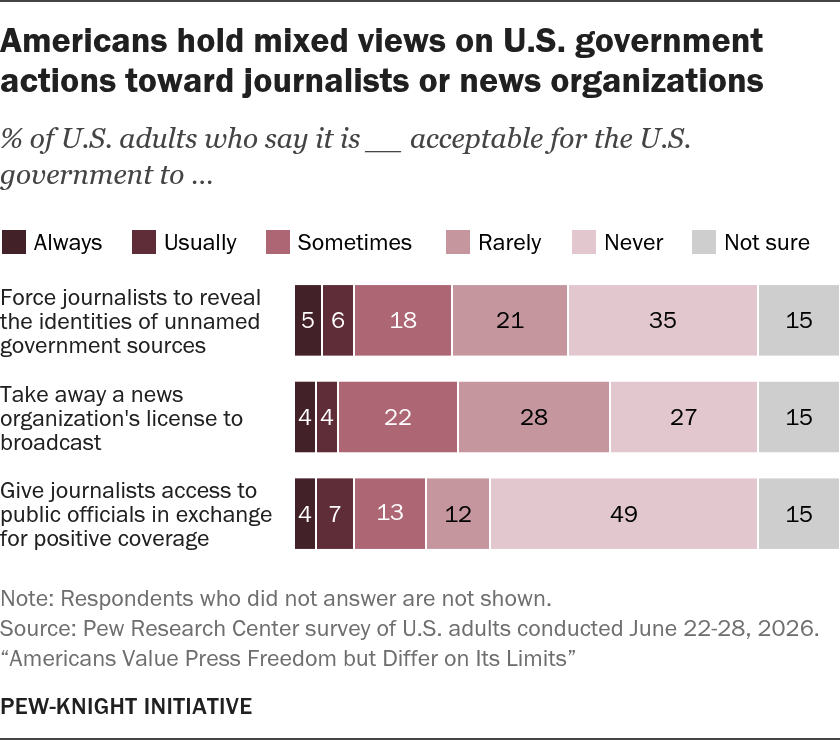
Far more U.S. adults say these government actions are never acceptable than say they are always acceptable. For example, 35% say it is never acceptable for the U.S. government to force journalists to reveal the identity of unnamed government sources, compared with 5% who say this is always acceptable.
Americans hold mixed views on U.S. government actions toward journalists or news organizations
% of U.S. adults who say it is __ acceptable for the U.S. government to …
Note: Respondents who did not answer are not shown.
Source: Pew Research Center survey of U.S. adults conducted June 22-28, 2026.
“Americans Value Press Freedom but Differ on Its Limits”
PEW-KNIGHT INITIATIVE
Americans hold mixed views on U.S. government actions toward journalists or news organizations
% of U.S. adults who say it is __ acceptable for the U.S. government to …
| Always | Usually | Sometimes | Rarely | Never | Not sure | |
|---|---|---|---|---|---|---|
| Force journalists to reveal the identities of unnamed government sources | 5 | 6 | 18 | 21 | 35 | 15 |
| Take away a news organization’s license to broadcast | 4 | 4 | 22 | 28 | 27 | 15 |
| Give journalists access to public officials in exchange for positive coverage | 4 | 7 | 13 | 12 | 49 | 15 |
Note: Respondents who did not answer are not shown.
Source: Pew Research Center survey of U.S. adults conducted June 22-28, 2026.
“Americans Value Press Freedom but Differ on Its Limits”
PEW-KNIGHT INITIATIVE
But many fall somewhere in the middle depending on the circumstances. Nearly half of Americans say it is usually (6%), sometimes (18%) or rarely (21%) acceptable for the government to do this, and an additional 15% say they are not sure.
Who are the press freedom absolutists? Some groups are currently more likely to say government interventions are never acceptable:
While government actions make up a key part of the press freedom debate – especially when it comes to legal protections in the First Amendment – Americans also think there should be limits to what is acceptable for journalists and news organizations to do in their reporting.
Americans hold mixed views on what’s acceptable for news organizations to do in their reporting
% of U.S. adults who say it is __ acceptable for U.S. news organizations to …
Note: Respondents who did not answer are not shown.
Source: Pew Research Center survey of U.S. adults conducted June 22-28, 2026.
“Americans Value Press Freedom but Differ on Its Limits”
PEW-KNIGHT INITIATIVE
Americans hold mixed views on what’s acceptable for news organizations to do in their reporting
% of U.S. adults who say it is __ acceptable for U.S. news organizations to …
| Always | Usually | Sometimes | Rarely | Never | Not sure | |
|---|---|---|---|---|---|---|
| Record police or other law enforcement officers making an arrest in public | 42 | 22 | 18 | 5 | 4 | 8 |
| Keep a source’s identity secret | 27 | 29 | 23 | 6 | 4 | 10 |
| Publish information about a politician’s personal life | 12 | 18 | 33 | 15 | 12 | 9 |
| Publish confidential information from government sources | 9 | 12 | 26 | 19 | 23 | 11 |
| Publish classified details about military operations during an active conflict | 5 | 4 | 15 | 19 | 47 | 10 |
Note: Respondents who did not answer are not shown.
Source: Pew Research Center survey of U.S. adults conducted June 22-28, 2026.
“Americans Value Press Freedom but Differ on Its Limits”
PEW-KNIGHT INITIATIVE
The survey asked about five hypothetical actions a news organization might take:
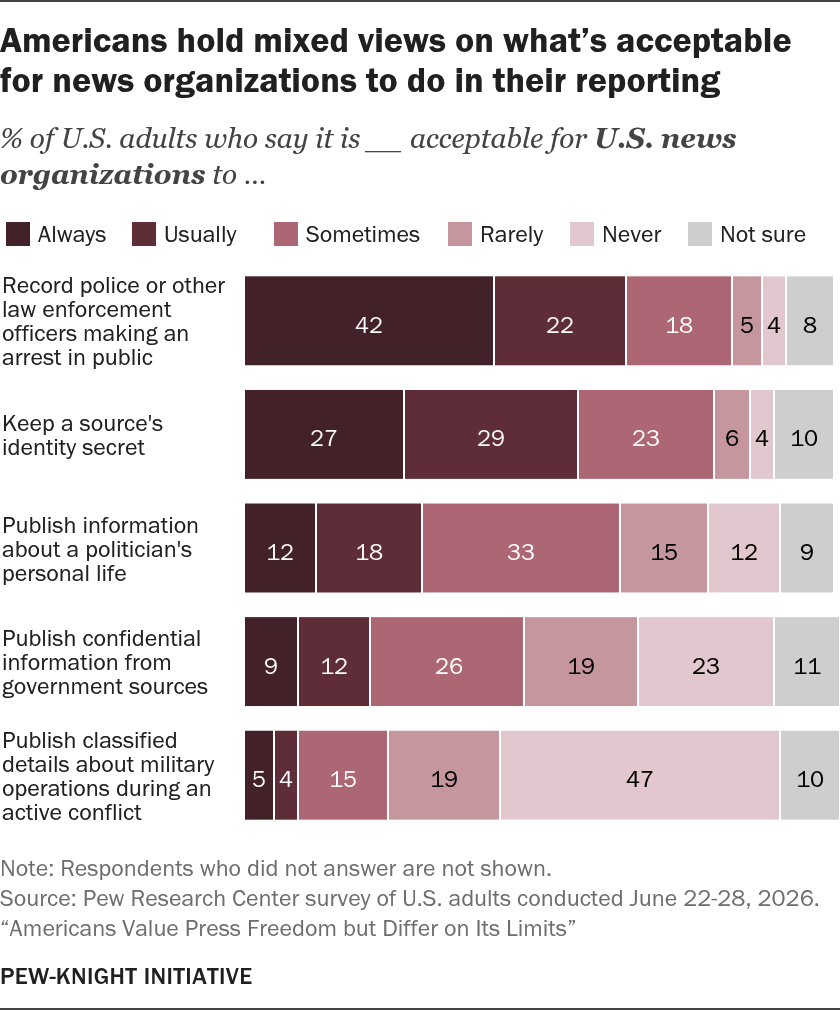
None of these are seen as always acceptable by most Americans. But U.S. adults are most likely to think it’s acceptable to record law enforcement officers, with a majority saying this is always (42%) or usually (22%) acceptable. Meanwhile, most say that publishing classified details about ongoing military operations is rarely (19%) or never (47%) acceptable.
There is even less consensus on the other actions, although majorities say it is at least sometimes acceptable for news organizations to keep a source’s identity secret or publish information about a politician’s personal life.
In focus groups, participants expressed similarly mixed views about journalists keeping sources’ identities secret.
“Knowing the identity of that person, that allows me to know whether or not to trust the reporting,” said a right-leaning man in his 40s. “Then if they’re able to keep the leaker or whatever, the source identity, a secret, can’t they just always claim a secret government source leaked this information to me and that’s it? They don’t need to ever prove or show you who the leaker was. That opens up such a Pandora’s box in my mind.”
A left-leaning man in his 50s expressed a different view: “The need to be able to protect your sources – those are things that I don’t want to see tampered with. I want to see that protected.”
Democrats are broadly more accepting than Republicans of all these actions by news organizations. For instance, Democrats are far more likely than Republicans to say recording police making arrests in public (55% vs. 30%) or keeping a source’s identity secret (36% vs. 19%) is always acceptable. And 60% of Republicans say it is never acceptable to publish classified details about military operations during an active conflict, compared with 35% of Democrats who hold this view.
What consequences do Americans think news organizations should face for publishing false information?Our research consistently finds that false information is a challenge for Americans as they navigate the news. And the new survey shows that when forced to choose, many people prioritize accurate reporting over press freedom.
Americans expect a correction for false info published by news orgs, but have mixed views on other consequences
% of U.S. adults who say each of the following should happen __ if a U.S. news organization publishes false information
Note: Respondents who did not answer are not shown.
Source: Pew Research Center survey of U.S. adults conducted June 22-28, 2026.
“Americans Value Press Freedom but Differ on Its Limits”
PEW-KNIGHT INITIATIVE
Americans expect a correction for false info published by news orgs, but have mixed views on other consequences
% of U.S. adults who say each of the following should happen __ if a U.S. news organization publishes false information
| In all, almost all or most cases | In some cases | In few, almost no or no cases | Not sure | |
|---|---|---|---|---|
| The news organization should issue a public correction | 81 | 7 | 5 | 6 |
| The U.S. government should require the news organization to take down the story | 44 | 17 | 28 | 11 |
| The U.S. government should fine the news organization | 32 | 23 | 32 | 13 |
| The news organization should fire the journalist who reported the story | 30 | 33 | 24 | 13 |
Note: Respondents who did not answer are not shown.
Source: Pew Research Center survey of U.S. adults conducted June 22-28, 2026.
“Americans Value Press Freedom but Differ on Its Limits”
PEW-KNIGHT INITIATIVE
We asked Americans what they think should happen when a news organization publishes false information.
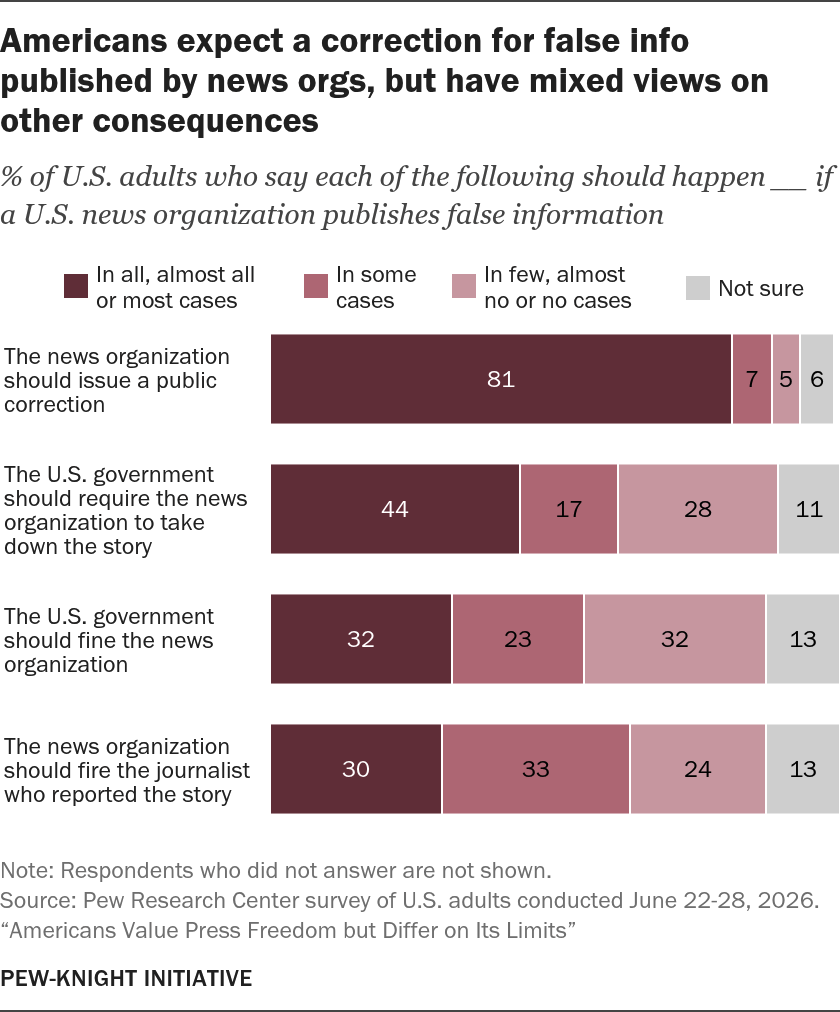
Most U.S. adults (81%) say that in all, almost all or most cases,the news organization should issue a public correction. Far fewer (30%) say the news organization should usually fire the journalist who reported the story.
There are mixed views on whether the U.S. government should step in – either by requiring the organization to take down the story or issuing a fine. For example, 32% of Americans say the government should usually fine news organizations for false information, 23% say this should happen in some cases, and 32% say it should happen in few, almost no or no cases.
Some groups are more likely to support these consequences, including:
Republicans are more likely to say a news organization should face a fine, fire journalist if it publishes false info
% of U.S. adults who say each of the following should happen in all, almost all or most cases if a U.S. news organization publishes false information

Source: Pew Research Center survey of U.S. adults conducted June 22-28, 2026. “Americans Value Press Freedom but Differ on Its Limits”
PEW-KNIGHT INITIATIVE
Republicans are more likely to say a news organization should face a fine, fire journalist if it publishes false info
% of U.S. adults who say each of the following should happen in all, almost all or most cases if a U.S. news organization publishes false information
| Rep/Lean Rep | Dem/Lean Dem | |
|---|---|---|
| The news organization should issue a public correction | 83 | 81 |
| The U.S. government should require the news organization to take down the story | 49 | 39 |
| The U.S. government should fine the news organization | 40 | 25 |
| The news organization should fire the journalist who reported the story | 37 | 23 |
Source: Pew Research Center survey of U.S. adults conducted June 22-28, 2026. “Americans Value Press Freedom but Differ on Its Limits”
PEW-KNIGHT INITIATIVE
Across focus groups, participants debated whether false information was published intentionally and who should judge what is true or false when deciding what consequences they think should come from a news organization publishing false information.
Many participants said they felt news organizations themselves should take accountability and face reputational costs rather than government penalties. Some said they were wary of giving the government any role, fearing it could be weaponized against reporting that criticizes the government.
But others were more open to harsher consequences, including enforcement by government agencies, lawsuits, and the firing or even prosecution of journalists in egregious cases.
| # | Наименование новости | Тональность | Информативность | Дата публикации |
|---|---|---|---|---|
| 1 | How Americans define press freedom in their own words | 0 | 7.43 | 15-09-2026 |
| 2 | Americans Value Press Freedom but Differ on Its Limits | 0 | 8.75 | 15-09-2026 |
| 3 | How Americans think about censorship of news in the U.S. | 0 | 5.99 | 15-09-2026 |
| 4 | How much do Americans know about the First Amendment? | 0 | 5.78 | 15-09-2026 |
| 5 | How Americans think about corporate and political influence on the news | 0 | 8.67 | 15-09-2026 |
| 6 | How Americans view the relationship between the government and the news media | 0 | 4.9 | 15-09-2026 |
| 7 | U.S. Media Freedom: Perceptions Hit New Low | 0 | 7.49 | 29-09-2026 |
| 8 | Quiz: How much do you know about the First Amendment? | 0 | 5.5 | 15-09-2026 |
| 9 | Commentary: The White House attacks press freedom | 0 | 8.57 | 23-09-2026 |
| 10 | Views of the U.S. providing military assistance to Israel and humanitarian aid to Gaza | 0 | 4.03 | 15-09-2026 |