Просмотр новости
Найдите то, что Вас интересует
 Спутники
 РН
РН SpaceX
 Роскосмос
 NASA
NASA
СпутникиРНSpaceXРоскосмосNASAAn Intertek lab in the UK found just 3.4 ppm of lithium in a sample of Donut Lab’s “solid-state” battery, and the Finnish startup is now using that result to argue its cell is neither lithium-ion nor sodium-ion.
But the report measured just two elements, on a cell Donut Lab took apart itself. And nine months after CES, there’s still no production vehicle running on the battery.
more…
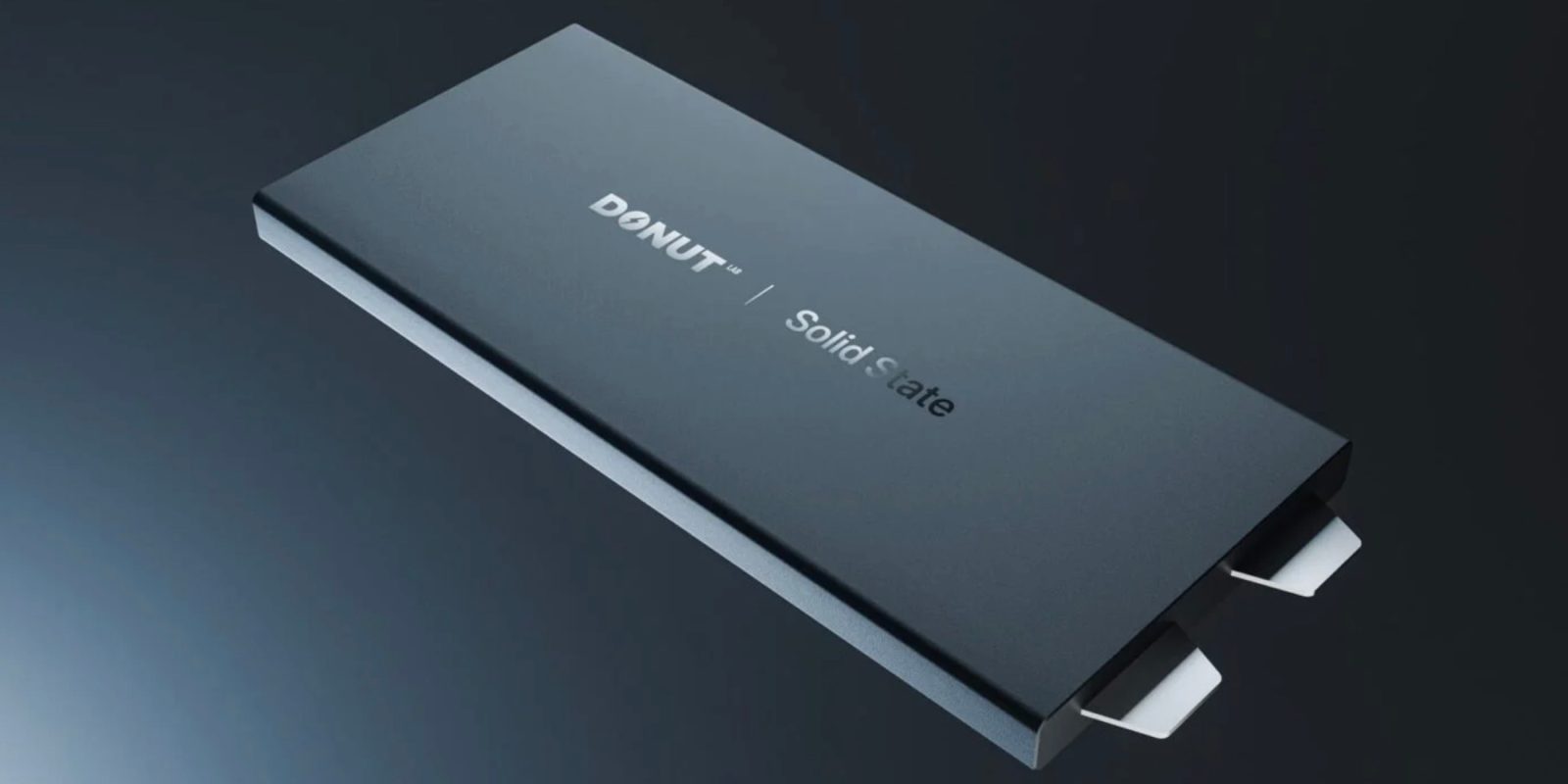
An Intertek lab in the UK found just 3.4 ppm of lithium in a sample of Donut Lab’s “solid-state” battery, and the Finnish startup is now using that result to argue its cell is neither lithium-ion nor sodium-ion.
But the report measured just two elements, on a cell Donut Lab took apart itself. And nine months after CES, there’s still no production vehicle running on the battery.
A two-element testThe Finnish startup says the goal was to end the debate over what’s inside its cell. “We wanted to put this speculation to rest with an independent test demonstrating that it is neither a lithium-ion nor a sodium battery,” CEO Marko Lehtimäki said in the announcement.
That speculation didn’t come out of nowhere. In June, battery researcher Ziroth and more than 20 experts concluded that the cell Donut Lab sent to VTT behaved like a high-nickel lithium-ion cell with a graphite anode, based on its voltage curve and swelling data.
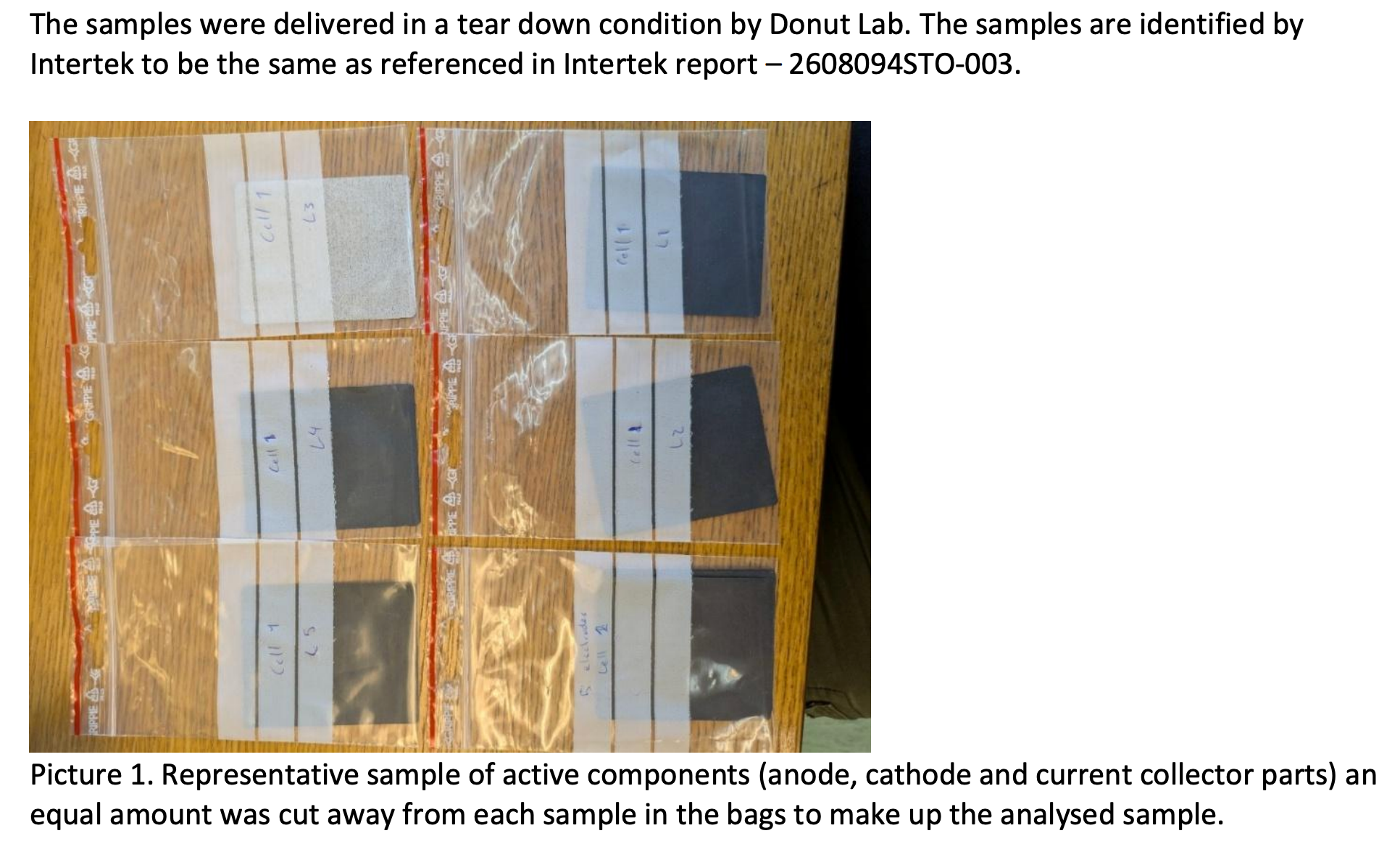
Intertek’s report, from its lab in Wilton, UK, is short. Analysts cut about 0.5 g of material from anode, cathode, and current collector pieces, digested it in nitric acid, diluted it to 50 ml, and ran it through an ICP-OES instrument. Results: 3.4 ppm lithium and 632 ppm sodium by weight.
A lithium-ion cell carries lithium in the percent range. So if that sample is what Donut Lab says it is, there’s essentially no lithium in it.
The lab work itself is fine. The problems start with everything around it.
What the report doesn’t showStart with the scope. The job Donut Lab ordered was literally “Quantification of Li and Na by ICP-OES.” Nothing else was measured. The report tells you two things the cell isn’t and zero things about what it is. Potassium, magnesium, zinc, and aluminum were never tested, and Donut Lab still won’t name its chemistry beyond “widely available, affordable and geopolitically secure materials.”
Then there’s the sample. According to Intertek, “the samples were delivered in a tear down condition by Donut Lab.” Intertek didn’t open a cell. It matched the pieces to another Intertek report (2608094STO-003) that hasn’t been made public, and the analyzed sample is labeled simply “Pouchcell – Cell 1.” The words “Donut Battery” appear nowhere in the report, and nothing ties this sample to the V1.5 cell that VTT tested for energy density.
The press release also says the samples included “the electrolyte situated between” the anode and cathode. Intertek’s report says otherwise, three separate times: only anode, cathode, and current collector parts were analyzed. In a solid-state battery, the electrolyte layer is a pretty important place to look for lithium.
And the report went through three versions in five days. The first was issued September 17. A September 21 revision updated the “sample description and origin of samples,” and a September 22 revision made a “wording change requested in experimental.” That’s a lot of editing for a report with a single two-column results table.
Finally, Intertek notes that “opinions and interpretations contained herein are outside the scope of UKAS accreditation.” The line that “it is not even possible to build a functional battery with such small amounts of active materials” comes from Donut CTO Ville Piippo, not the lab.
It makes the 409 Wh/kg claim harder to believeNear-zero lithium and sodium fits one theory that has followed Donut Lab since CES: a supercapacitor or hybrid capacitor, with carbon electrodes and an electrolyte that doesn’t rely on either element. That would line up with the fast-charging and cycle-life claims. It wouldn’t line up with energy density.
Earlier this month, VTT measured 409.3 Wh/kg on a Donut “V1.5” cell, cycled between 2.3 V and 4.25 V. That’s a textbook lithium-ion voltage window, and 409 Wh/kg is a number advanced silicon-anode lithium-ion cells already hit.
No rechargeable chemistry without lithium or sodium has come anywhere close to that in a real cell. So either Donut Lab has quietly invented a chemistry that beats every battery lab on the planet, or the cell VTT tested and the pieces Intertek analyzed aren’t the same thing. This report doesn’t tell us which.
Electrek’s TakeWe don’t care much anymore whether Donut Lab’s battery is solid-state and these vague and limited tests that may or may not prove otherwise do very little to Donut Lab’s credibility.
Solid-state cells exist. QuantumScape, Factorial, Samsung SDI, and Toyota all have them running in labs and prototype vehicles, and all of them are still working toward mass production. A startup with a promising solid-state prototype is not news in 2026.
The only thing that made Donut Lab interesting was the production claim. At CES in January, it said it had the “world’s first solid state battery that is ready for use in OEM vehicle manufacturing,” with Verge motorcycles delivering to customers in Q1 2026. Lehtimäki said it was “already in production.”
We’re now at the end of September. There’s no production vehicle on the road with this battery, the Q1 “production” bikes were pre-production units, and Lehtimäki himself admitted that the 409 Wh/kg cell “is not even the cell that’s going to be shipped to customers.”
So the claim that set Donut apart turned out to be wrong, and every new report since has been built to answer a different question than the one that matters.
With electricity rates up almost 10% last year and expected to keep climbing, going solar is one of the best ways to protect yourself against rising costs. And with lease and PPA options, you can do it with zero upfront cost and start saving immediately. If you want to find the best deal, check out EnergySage. It’s a free service with hundreds of pre-vetted installers competing for your business, so you save 20 to 30% compared to going it alone. No sales calls until you pick an installer. Get your free quotes here. – ad*


FTC: We use income earning auto affiliate links. More.

| # | Наименование новости | Тональность | Информативность | Дата публикации |
|---|---|---|---|---|
| 1 | Donut Lab hits 409 Wh/kg in battery lab test, but credibility is gone | 0 | 17.62 | 02-09-2026 |
| 2 | These EVs retain their battery best, largest-ever study finds | 0 | 24.21 | 03-09-2026 |
| 3 | Geely’s AI fast charging ‘heals’ EV batteries for 20% more cycle life | 0 | 18.84 | 25-09-2026 |
| 4 | Tesla’s solar factory dragged into patent war between Chinese suppliers | 0 | 15.74 | 30-09-2026 |
| 5 | Podcast: Tesla Semi launch, Geely’s battery healing fast-charging, Rivian R3, and more | 0 | 19.77 | 25-09-2026 |
| 6 | NIO (NIO) Q3 deliveries rise 25%, but September growth slows to 7.7% | 0 | 26.11 | 01-10-2026 |
| 7 | Tesla Semi launch sneak peek: several customers are being announced | 0 | 17.21 | 24-09-2026 |
| 8 | Aptera (SEV) now says it needs $25M to start production, stock drops 15% | 0 | 18.09 | 01-10-2026 |
| 9 | NIO sells 30% of battery swap unit to Geely at more than $2 billion | 0 | 18.38 | 28-09-2026 |
| 10 | 18-Year-Old Scientist Develops New Way to Predict the Health of Aging EV Batteries | 0 | 5.39 | 27-08-2026 |