Просмотр новости
Найдите то, что Вас интересует
 Спутники
 РН
РН SpaceX
 Роскосмос
 NASA
NASA
СпутникиРНSpaceXРоскосмосNASAMicrosoft has finally admitted that Windows 11 may no longer correctly back up your files, even if you’ve configured the feature ‘File History.’ According to our tests, the bug affects almost everyone who installed the September 2026 update, but most users may not realize why backups have silently stopped working. This issue specifically affects File […]
The post Microsoft confirms Windows 11 quietly stopped backing up your files due to a new bug in September 2026 update appeared first on Windows Latest

Microsoft has finally admitted that Windows 11 may no longer correctly back up your files, even if you’ve configured the feature ‘File History.’ According to our tests, the bug affects almost everyone who installed the September 2026 update, but most users may not realize why backups have silently stopped working.
This issue specifically affects File History, which is a handy feature that lets you back up your personal files and folders to protect them from accidental loss or damage.
When the September 2026 update rolled out, I found multiple issues, and most were not even acknowledged by Microsoft. One of them was a bug where File History stopped working after Windows 11’s mandatory September 8 update, but it was not until September 22 that Microsoft admitted it.
That update is Windows 11 KB5124008, which advances Windows 11 25H2 to Build 26200.9445 and version 24H2 to Build 26100.9445:
 If you see Windows 11 Build 26200.9445 in Settings > System > About, you’ve got the Sept patchWhat is File History, why you should use it, and how Microsoft broke it
For those unaware, or if you’ve never used File History, it allows you to back up your system automatically and maintains multiple copies of your files, so you can basically go back in time and restore a particular file’s state. For example, if you accidentally delete or edit a file and do not have a separate copy, you can use File History to restore previous versions of files or folders.
Microsoft’s support document calls File History one of the great features of Windows 11 and explains that it’s one of the most straightforward ways to secure your personal files or folders.
“One of the great things about File History is that it automatically backs up all your libraries. This includes default libraries like Documents, Pictures, Videos, and Music, as well as any custom libraries you have created. If you have folders elsewhere that you want to back up, you can add them to an existing library or create a new library for them,” Microsoft noted in a document.
When you set up File History, you have to connect an external drive or a network drive, and Windows periodically backs up your files. And if you want to restore a file or the system itself, you can browse the different versions or backups generated by File History on your external drive or network location and restore the one you need.
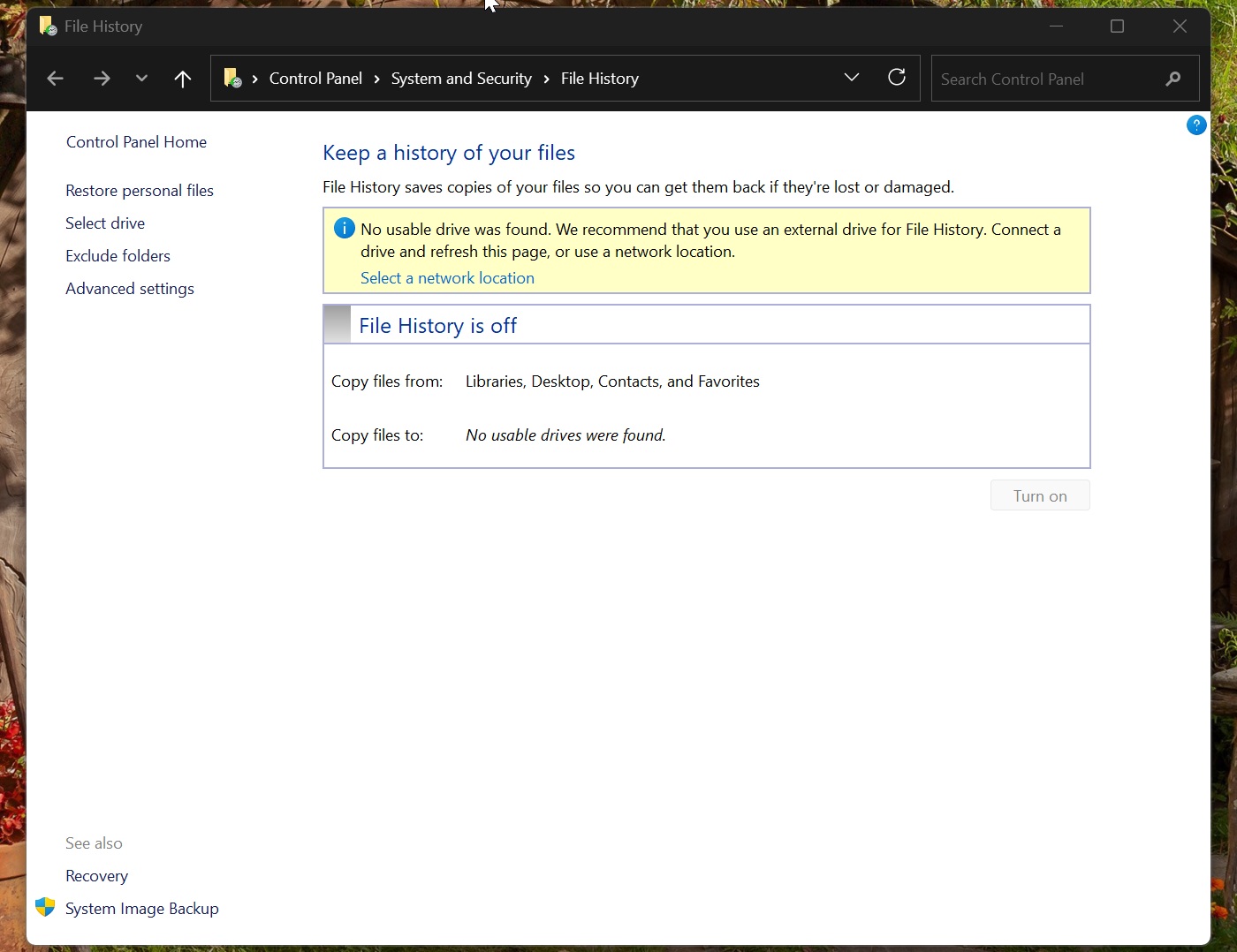
It’s really straightforward, and it’s also why I always use it across my PCs. I hadn’t realized it had stopped working until some users told me that the September 2026 update had a major File History bug.
In our tests, Windows Latest later found that File History was no longer able to recognize drives, even when they were connected, and there were no hardware or network issues.
Two weeks after breaking backups on all PCs, Microsoft has now shared the following statement:
“After installing the September 2026 Windows security update KB5124008, some customers using File History, might be unable to create or update backups. File History, available through Control Panel > System and Security > File History, is used to back up files to an external drive or network location.” – Microsoft.
In our tests, Windows Latest found that PCs incorrectly warn that you need to reconnect your drive even when the backup drive is configured and functioning properly. It also happened with a new SSD I bought for myself last week, and the same drive works correctly in File Explorer or other third-party apps.
Microsoft noted that the “Reconnect your drive” alert is false, and there’s nothing wrong with your external drive, as it’s a bug in Windows 11. Moreover, you’ll run into another bug where the “Last backup” timestamp is either outdated or shows an incorrect time, so File History fails to show the correct timeline of backed-up files, which was the whole point of the feature.
“In some cases, Event Viewer might record application crash events referencing FileHistory.exe and KERNELBASE.dll,” the company noted.
Other issues caused by the September 2026 updateFile History is just one of the problems Windows Latest has been tracking since the September update. Here’s everything broken so far:
After we found issues in the September 2026 Patch Tuesday update, Microsoft rolled out an emergency update, KB5129195, on September 14. It advances Windows 11 25H2 to Build 26200.9457 and version 24H2 to Build 26100.9457.
This update fixed at least two big bugs, including RDP errors and a bug that broke Linux-based apps, such as Claude Cowork. It also fixed the multichannel audio issue, but it did not fix the File History problem, according to Microsoft’s statement.
Now, there’s a third update rolling out in September, and it’s Windows 11 KB5124010, September’s new optional update (preview). Released on September 22, it advances Windows 11 25H2 to Build 26200.9550 and version 24H2 to Build 26100.9550. And I can confirm that File History now works again, but it’s not fully patched up for everyone.
File History still has issuesThere’s still a bug where File History does not work correctly when you click Execute now in Control Panel.
One affected user told us:
“Clicking the “Execute Now” button in “Control Panel” > “System and Security” > “File History” fails to synchronize the “Last copied date and time” with the latest save time. The D drive functions normally; files can be accessed and saved without issue. Even after modifying a file, confirming a successful save, and clicking “Run Now,” the latest backup time and file version do not update as expected. When saving or adding files, it still displays “No previous version available, or the old file does not have a latest date under ‘File Properties’ → ‘Previous Versions‘.”
While File History seems to be working a bit now, it’s not fully patched up. Also, the partial fix is included in an optional update, and lately, these optional updates are buggier.
For now, you can use OneDrive and wait until October 13, which is when the October 2026 Patch Tuesday update rolls out.
| Date | Update | Windows 11 25H2 build | Windows 11 24H2 build | Event description |
|---|---|---|---|---|
| September 8 | KB5124008 – Patch Tuesday | 26200.9445 | 26100.9445 | The mandatory update rolls out, followed by File History failures and the other issues listed above. |
| September 14 | KB5129195 – Emergency update | 26200.9457 | 26100.9457 | Microsoft fixes Remote Desktop, Plan9 folder sharing, and multichannel audio. File History remains broken. |
| September 22 | KB5124010 – Optional preview | 26200.9550 | 26100.9550 | Microsoft acknowledges the File History bug and lists a fix in the optional update. |