Просмотр новости
Найдите то, что Вас интересует
 Спутники
 РН
РН SpaceX
 Роскосмос
 NASA
NASA
СпутникиРНSpaceXРоскосмосNASAThe public in Ireland were the least likely to identify environmental causes for the epidemic out of Ireland, the UK, and the US.
Doctor uses stethoscope for patient cardiology checkup. In the clinic, a physician conducts an examination of patient with obesity, heart and lungs. Theme: preventive healthcare and wellness.
Obesity
The public in Ireland were the least likely to identify environmental causes for the epidemic out of Ireland, the UK, and the US.
PEOPLE IN IRELAND were least likely to blame environmental difficulties in living healthily as the cause of the obesity epidemic, a study has found.
The country’s Economic and Social Research Institute (ESRI) examined the views of people in Ireland, the UK and US and how they compared to experts’ beliefs about the causes of obesity.
Members of the public believed that individual decisions about diet and exercise had caused the obesity epidemic, while experts instead highlighted how modern life made it difficult for people to eat healthily and get enough exercise.
The public in Ireland were the least likely of the three countries to identify environmental causes.
The ESRI’s behavioural research unit compared perceptions of 2,400 adults across Ireland, the UK and the US with those of 51 experts working in obesity healthcare, research and policy.
It revealed a substantial gap, not only about what had caused the obesity epidemic, but also who was responsible for addressing it and what policies may be most effective.
While most members of the public did recognise at least one environmental cause, such as greater availability of unhealthy food, they rated individual choices as just as important or more so.
By contrast, experts pointed the finger at changes to food production and availability, marketing, portion sizes and car-dependent neighbourhoods.
Both the public and experts perceived obesity to be a serious public health issue, but the public believed individuals were much more responsible for the obesity epidemic than businesses or governments.
Experts instead attributed significantly more responsibility to governments and businesses, aligning with scientific evidence that the epidemic is largely driven by environmental causes.
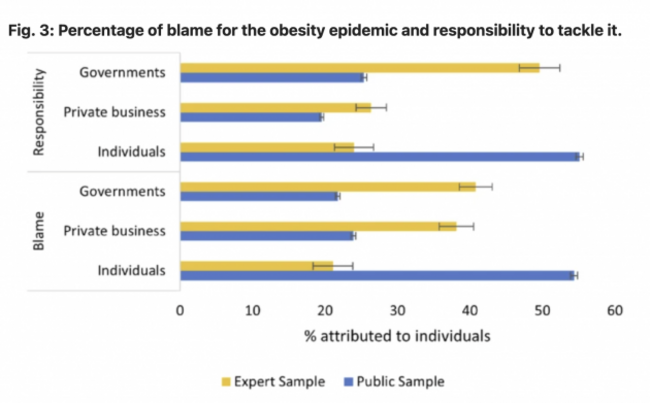
The public tended to support policies such as information campaigns and subsidies for healthier foods, while experts viewed more interventionist policies, such as taxes and regulations on the fat, salt and sugar content of certain foods as both fairer and more likely to be effective.
Those members of the public who did recognise responsibility of businesses and governments also had views on policies that were closer to expert views.
“These findings show that while people believe obesity is a serious public health issue, many are not aware of the strength of environmental influences,” Dr Deirdre Robertson, lead author of the report, said.
“The individual choice narrative contributes to stigma and can undermine public health efforts to reduce rates of obesity.”
Chief medical officer for Ireland Professor Mary Horgan: “This research shows the need for a shift in the public dialogue around obesity – this disease is not a personal failing.
“Obesity is a complex, multi-faceted problem and needs a multipronged solution, with every sector of society playing its part.
“The [Irish] department of health is currently working on the next obesity policy action plan which will seek to transform the food environment, look for ways to modify the built environment to encourage physical activity as the default position, and to address the social and commercial determinants of obesity.”
| # | Наименование новости | Тональность | Информативность | Дата публикации |
|---|---|---|---|---|
| 1 | Should sunbeds be banned? | 0 | 7.23 | 27-05-2026 |
| 2 | Dietary Guidelines confusing consumers? | 0 | 7.46 | 11-05-2026 |
| 3 | England will ban selling energy drinks to under-16s next year - will Ireland follow suit? | 0 | 7.54 | 17-07-2026 |
| 4 | The protein premium: how much extra do we pay, and how stupid are we to pay it? | 0 | 5.29 | 29-09-2026 |
| 5 | Early intervention in psychosis services supports strong recovery in young people, data shows | 0 | 15.24 | 10-08-2026 |
| 6 | Six burning questions around the Mary McAleese debacle as high-profile resignation rocks Irish sport | 0 | 17.14 | 09-09-2026 |
| 7 | DAFT.IE PROPERTY MAGAZINE | 0 | 8.92 | 01-01-1970 |
| 8 | Hot school lunches need a rethink. Could including cold options be the answer? | 0 | 6.73 | 26-09-2026 |
| 9 | Taking CAP from 'hobby farmers' is not going to strengthen Ireland's food security problem | 0 | 7.56 | 27-09-2026 |
| 10 | Consumers want more fiber, need education | 0 | 8.98 | 06-02-2026 |