Просмотр новости
Найдите то, что Вас интересует
 Спутники
 РН
РН SpaceX
 Роскосмос
 NASA
NASA
СпутникиРНSpaceXРоскосмосNASAIt’s been over two years since Salt Lake City’s Affordable Housing Incentives (AHI) program took effect, and city council members got a feel for the sort of impact the program has had on the city. On Tuesday, the council heard its first update on the AHI program since it passed back in December 2023 and […]
It’s been over two years since Salt Lake City’s Affordable Housing Incentives (AHI) program took effect, and city council members got a feel for the sort of impact the program has had on the city.
On Tuesday, the council heard its first update on the AHI program since it passed back in December 2023 and took effect in April 2024.
Since then, the city’s planning chief told council members that, as of March 15, projects that have utilized AHI incentives have totaled 1,338 total dwelling units around the city, whether those units are under review or have received some level of city approval. Of those units, 973 were affordable dwellings.
The city has received 32 AHI applications total, with 13 of those applications later being withdrawn. Of the remaining 19, eight projects have received final approvals, seven have preliminary approvals and four were under review. Those numbers are as of March 15 when planning staff gathered the data for the report.
Nick Norris, the city’s planning director who detailed the program to council members, was quick to note the city’s AHI program requires anywhere from five to 40% of the total dwellings be affordable, and not all of the affordable units are directly due to the AHI program.
“In this instance, not all of those affordable dwellings have been approved just because of our Affordable Housing Incentives,” Norris told the council. “Most of those are LIHTC-funded projects anyway, and they would be coming here. But what they’ve been able to do is get more units than they normally would have because they can go up — either increase building height, which is most of what’s happened in terms of the number of dwellings — but also in some zones it allows other types of housing to be built.”
Passage of the AHI program essentially allowed multiple building forms — like rowhouses, duplexes, triplexes and fourplexes — to be constructed in any of the city’s residential zones, including single-family zones, in exchange for meeting certain affordability requirements. The AHI program includes guidelines for both for-sale and rental units.
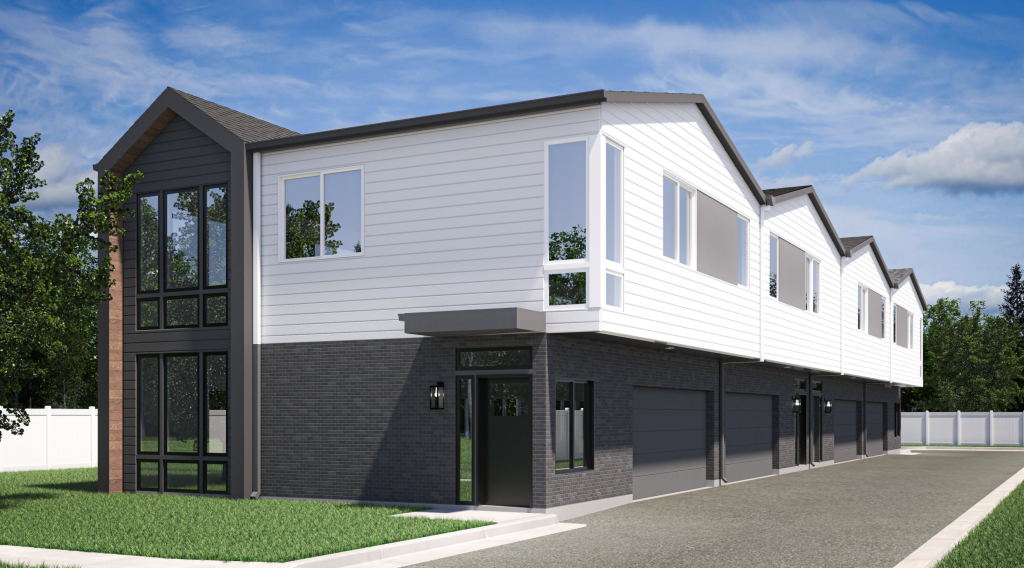
A rendering of the 1300 South townhomes in Glendale, which is using an AHI density bonus on a single-family-zoned lot. Image via Straightline Architecture
As Norris said, the program can also be used in more intense zones, like in mixed-use or downtown zones, to add extra story on multifamily projects. He also noted that of the 19 projects going through some stage of development, two have been finished. Both were completed late last year.
Norris added that most of those affordable units, 641 units or 66% of the total affordable dwellings, have been used to offer units at 60% AMI. Of the total, two units have been offered at 100% AMI, which is allowed specifically in for-sale housing units created by the program.
In a shock to Norris and planning staff, he said of the 19 projects screened by the city, around half (8) were in single-family zones.
“That surprised us a little bit, I think,” he told the council. “In fact, the two completed projects we have were both in one of those zones.”
Norris added that five applications were in R-1-5000 and three were in R-1-7000. The MU-8 and MU-11 zones each saw three applications, while MU-6 (which included the old TSA-UC-T zone) saw two applications.
Unit sizeAnother aspect that surprised Norris was the amount of bedrooms in the approved units. Of the projects that have a building permit issued, the majority of units had two or more bedrooms. Of the 473 units in projects with a permit issued, 160 (units 33.8%) had two bedrooms, 92 (19.4%) had three bedrooms and 51 (10.7%) had four or more bedrooms, according to materials presented to the council. Norris said those numbers were a reflection of two projects, each with a broad range of larger units.
Studio and one-bedroom units totaled 42 (8.8%) and 128 (27%) respectively.
Project sizeThe vast majority of the total dwellings in AHI applications (1,307) were for multifamily projects, which accounted for 10 of the applications. Fourplexes and duplexes accounted for four and three applications, respectively. Fourplex applications totaled 20 total dwellings and six affordable dwellings, while duplexes totaled eight dwellings and five affordable dwellings.
Norris also noted that five applications sought extra building stories, while eight applications sought to build housing types only permitted in their zone via AHI. Six applications sought reduced parking.
But many of the applications sought staff-level approvals, which includes aspects like permitting multiple buildings on a single lot, building units without street frontage, permitting units on a reduced lot width and reduced ground floor use, among other aspects.
Restrictive covenantsNorris later said that all these AHI applications require a restrictive covenant, which eats up quite a bit of staff time and takes time before the covenants can be recorded against the property. Restrictive covenants are the piece that ensures applicants follow through on AHI requirements, Norris said. Covenants not only spell out the unit count and affordability levels, but also what happens in the event of a default and the city’s responsibilities.
The restrictive covenants come with some issues, Norris said, as the city attorney’s office must review each document, despite the fact that planning staff has templates for the covenants. He said many of the covenants have also had the same issue.
“One of the things that we’re running into is that, almost every applicant wants to negotiate some of those covenants, and we have told them we’re not negotiating the covenants — that’s not something we’re going to do,” Norris said.
Another issue with the covenants is some conflict with the lending institutions, and the planning office has been able to modify their own requirements. Norris said this is particularly important for LIHTC projects, which “requires certain things that we don’t want to conflict with, and our intent was if somebody already had pretty strict financial requirements associated with their money, to not get in the way of that.”
After a question from Council Member Chris Wharton, Norris said his office was surprised that nearly all applicants wanted to negotiate the covenants. Some, like with LIHTC projects, made sense, but Norris said, “I don’t think we envisioned it taking months, maybe weeks, for it to run (its course).”
Going forward, Norris said the restrictive covenants could potentially use some touch ups. One, he said, was to reduce the burden on city attorneys and eliminate negotiations as much as possible. That way, Norris said, the AHI applications can be streamlined and the covenants recorded more quickly.
In progress: Expanding Housing OptionsAfter his presentation, Wharton asked if the AHI program could inform the pending Expanding Housing Options (EHO) initiative, which would further allow building in single-family zones.
Norris said unlike the EHO initiative, AHI doesn’t cap unit sizes. He cited one application for a duplex where each unit was over 2,000 square feet, whereas EHO, in its current iteration, would cap home sizes at 1,200 square feet.
“Expanding Housing Options is intended to produce the smaller scale homes, so that they’re more attainable without having a need necessarily for subsidized funding,” Norris said. “Almost every project that we’ve had, except for I think two of the duplexes, have had some affordable housing incentive dollars going to it.”
Council Member Dan Dugan asked if the number of applications surprised the planning office, and Norris said the low number of applications wasn’t a surprise.
He added, “Going in, we didn’t anticipate this being used in the low-density districts all that much, we already knew there was a low kind of a low expectation. But I don’t think that in the first two years we expected more properties in those zones to apply than in the other zones. Some of that is just a reflection of the time upon which the Affordable Housing Incentives went into effect.”
Projects that utilize AHI must submit an annual report one year after getting a certificate of occupancy, though Norris said both completed projects have yet to hit the one year mark. It’s likely the council will hear an update on AHI in the future.
What’s certain is the council will be discussing the EHO initiative in the coming months, which is poised for debate and potential changes by the city council. It’s not clear when the Salt Lake City Planning Commission will vote on the EHO initiative, nor is it clear when the city council could debate the initiative.
| # | Наименование новости | Тональность | Информативность | Дата публикации |
|---|---|---|---|---|
| 1 | Planning Commission sends single-family zoning rewrite to council | 0 | 19.93 | 24-09-2026 |
| 2 | Salt Lake City small-lot zoning changes face first hurdle this week | 0 | 19.91 | 09-09-2026 |
| 3 | Salt Lake City single-family zone overhaul sees changes before Planning Commission | 0 | 19.99 | 11-06-2026 |
| 4 | Utah lawmakers tease new housing bills ahead of 2027 session | 0 | 21.14 | 02-09-2026 |
| 5 | Utah lawmakers to consider allowing smaller homes in every city | 0 | 21.41 | 18-08-2026 |
| 6 | Salt Lake City votes to hike property taxes 12.5%, hints at another next year | 0 | 20.6 | 17-06-2026 |
| 7 | Salt Lake City ranked dead last in study for recent graduate job prospects. Here’s why. | 0 | 17.17 | 18-05-2026 |
| 8 | The Rio Grande Plan is dead! Long live the Rio Grande Plan! [Opinion] | 0 | 16.8 | 06-07-2026 |
| 9 | Seattle’s Social Housing Experiment Hits Its First Snag | 0 | 11.13 | 16-09-2026 |
| 10 | Malaga project for 1,000 affordable homes without progress two years after announcement | 0 | 10.36 | 29-09-2026 |