Просмотр новости
Найдите то, что Вас интересует
 Спутники
 РН
РН SpaceX
 Роскосмос
 NASA
NASA
СпутникиРНSpaceXРоскосмосNASASpaceX's Starship Flight 14 reached orbit for the first time, deployed 26 Starlink V3 satellites and completed its first orbital and deorbit burns before a Pacific splashdown.
SpaceX's Starship Flight 14 reached orbit for the first time on September 28, marking a major milestone for the world's largest and most powerful rocket as the spacecraft successfully deployed 26 Starlink satellites before returning to Earth.
Starship lifted off from SpaceX's Starbase facility in South Texas at 7:48 a.m. Central Time. The mission achieved several firsts for the spacecraft, including orbital insertion, satellite deployment and a controlled splashdown in the Pacific Ocean.
The flight was not without problems. One engine on the Super Heavy booster shut down during ascent, while one of Starship's three main engines later shut down prematurely. Despite the engine problems, the spacecraft completed its orbital insertion burn, deployed all 26 satellites and performed a deorbit maneuver before splashing down north of Hawaii.
Starship lifts off from StarbaseThe flight began at 7:48 a.m. Central Time on September 28. The Super Heavy booster launched with all 33 Raptor 3 engines firing and began its climb over the Gulf of America.
One booster engine shut down during the initial ascent. Despite the issue, Super Heavy continued through stage separation, allowing Starship to begin its journey toward orbit.
The two stages then separated through a hot-staging maneuver, with Starship's upper stage igniting its engines and continuing upward.
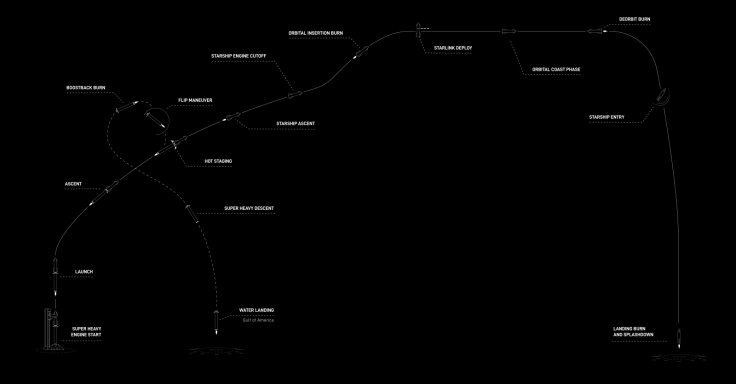 SpaceX’s Starship Flight 14 mission profile shows the planned launch, orbital insertion, Starlink deployment, reentry and splashdown sequence.
SpaceX
SpaceX’s Starship Flight 14 mission profile shows the planned launch, orbital insertion, Starlink deployment, reentry and splashdown sequence.
SpaceX
After separation, Super Heavy performed a directional flip and began its boostback burn. The booster relit 31 of the planned 33 engines for the maneuver.
SpaceX had intentionally designed the boostback burn to use the remaining liquid oxygen in the booster's main tank. The test was intended to provide data that could help prepare the vehicle for future attempts to return directly to the launch site.
Super Heavy later began its landing burn before splashing down in the Gulf. The booster ultimately triggered its flight termination system after the landing burn ended as part of a demonstration of its safety hardware.
Starship reaches orbit despite engine shutdownStarship also experienced an engine problem during its ascent. One of its Raptor vacuum engines shut down early.
1 of 3
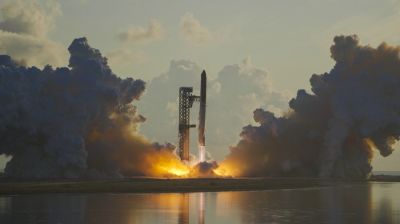 SpaceX's Starship Flight 14 launches from Starbase, Texas, on September 28, 2026
SpaceX/X
SpaceX's Starship Flight 14 launches from Starbase, Texas, on September 28, 2026
SpaceX/X
The spacecraft compensated by using its remaining five engines for longer than originally planned. Flight controllers later determined that the three sea-level engines needed for later maneuvers were healthy and gave the "go" for orbital operations.
At about 25 minutes into the flight, Starship performed its orbital insertion burn using a single Raptor sea-level engine. The maneuver successfully placed the spacecraft into orbit around Earth for the first time.
26 Starlink satellites deployedAfter reaching orbit, Starship deployed all 26 Starlink V3 satellites. Contact was established with every satellite through laser links, ground stations, and Starlink user terminals.
The satellites will now undergo on-orbit checks and gradually raise their orbits before being used to provide service to customers.
The deployment was one of the most important parts of Flight 14 because it marked Starship's first delivery of a meaningful payload into orbit.
Starship performs its first deorbit and splashdownAfter the satellite deployment, Starship entered a coast phase around Earth. Because of the engine issue during ascent, SpaceX's flight control team chose to shorten the spacecraft's time in orbit and begin the return earlier than planned.
Starship performed its first-ever deorbit burn using a single Raptor sea-level engine. The maneuver sent the spacecraft back toward Earth for atmospheric re-entry.
The vehicle then completed its landing sequence, relighting all three sea-level engines before performing the landing flip and splashing down at the planned location in the northern Pacific Ocean.
Why Flight 14 mattersFlight 14 demonstrated several capabilities SpaceX needs for Starship's future, including reaching orbit, deploying satellites, performing an orbital maneuver, surviving atmospheric reentry, and completing a controlled ocean splashdown.
The mission also provided data from two engine shutdowns that occurred during flight. SpaceX will use the results to improve future Starship missions as it works toward making the vehicle fully reusable.
| # | Наименование новости | Тональность | Информативность | Дата публикации |
|---|---|---|---|---|
| 1 | Два витка вокруг Земли на скорости 26 тыс. км в ... | 1 | 12.14 | 28-09-2026 |
| 2 | SpaceX впервые вывела Starship на орбиту в ходе 14-го испытательного полёта | 1 | 14.76 | 29-09-2026 |
| 3 | Старт, размещение спутников и посадка Starship Flight 14 С базы ... | 1 | 9.39 | 29-09-2026 |
| 4 | Два витка вокруг Земли на скорости 26 тыс. км в час и 26 запущенных спутников Starlink V3. Starship впервые вышел на орбиту, но полет свой завершил досрочно | 1 | 10.98 | 28-09-2026 |
| 5 | Военная Хроника SpaceX завершила 14-й испытательный полёт Starship — первый, ... | 1 | 7.08 | 29-09-2026 |
| 6 | Возврат Starship после первого орбитального полёта (и 14-го испытательного) и ... | 0 | 9.96 | 28-09-2026 |
| 7 | Starship впервые вышел на орбиту Земли Сегодня SpaceX запустила Starship ... | 0 | 7.24 | 28-09-2026 |
| 8 | SpaceX's Starship reaches orbit after engine issue, to deploy 26 Starlink satellites | 0 | 8.68 | 28-09-2026 |
| 9 | Live: 14-й запуск Starship и первый в его истории выход ... | 0 | 8.31 | 28-09-2026 |