Просмотр новости
Найдите то, что Вас интересует
 Спутники
 РН
РН SpaceX
 Роскосмос
 NASA
NASA
СпутникиРНSpaceXРоскосмосNASAIndia's space sector is undergoing significant changes as private companies engage in rocket production and management. The Indian Space Research Organisation is shifting its focus towards more ambitious missions and projects. This transition follows the introduction of the Indian Space Policy 2023, which emphasizes private sector participation. Concerns have been raised by ISRO employees regarding the agency's future and potential loss of capabilities.
Early this month, nine employee bodies of the Indian Space Research Organisation (ISRO) wrote a letter to chairman V Narayanan, who is also secretary of the Department of Space, on the future of the agency. The gist of their concern: Will the entry of the private sector diminish one of India’s crown jewels? Will ISRO, they asked, be reduced to a “residual R&D boutique while the realisation of the nation’s launch vehicles and the operation of its launch infrastructure pass out of public hands?”
It is a worry anchored in the space agency’s stellar achievements. ISRO has, for decades, been a lone ray of sunshine, inspiring and innovating despite the odds and even while working from within the lethargic, labyrinthine sarkari system.
The worry also comes on the trail of the private sector’s surprisingly quick strides into space, triggered by the Indian Space Policy 2023. This advance was spurred by startups and supplemented by increased corporate participation.
Across the world, as states yield their monopoly to nimbler, venture-backed space startups, India is also betting that partnering with private enterprises can turn a national symbol into a global commercial titan. This transition is a delicate balancing act and requires clarifying ISRO’s role—to its employees and the public at large.
ISRO has to empower commercial players without eroding its core capabilities and public trust.
BIG BOOMThe global shift to private enterprises in the space sector has been mostly triggered by NASA deciding to encourage private investment in the 1980s, guided in no small measure by the realisation that routine flights to lower Earth orbit (LEO) was inhibiting its ability to invest in bigger missions. The winding up of its space shuttle programme also influenced the policy since it meant that NASA would otherwise have to rely on Russian rockets for critical activities like human spaceflight.
In 2006, NASA created the Commercial Orbital Transportation Services (COTS) programme, which eventually brought in the likes of Boeing and SpaceX. The latter’s innovations like partially reusable rockets have contributed to a substantial lowering of cost to access space.
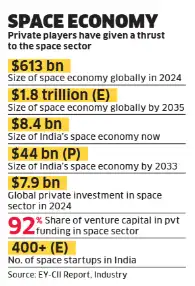
The cost of sending 1 kilo of payload to LEO used to be $20,000-50,000 a couple of decades ago. It has now come down to $1,500-5,000, according to sources. Thanks to this lowering of costs, the number of satellites launched into space grew from just 72 in 2005 to 4,510 in 2025.
Cheaper launches made new space businesses—from earth observation to broadband constellations and defence applications— commercially viable.
There has been a massive increase in commercial activity in space, triggering an equally big boom in the space services segment. This is the backdrop against which ISRO has sought to change.
India watched these changes unfold for more than a decade. But translating them into domestic policy proved slower.
ISRO’s efforts around private involvement in space started rather disastrously with an ill-fated deal with Devas Multimedia in 2005, which resulted in a decade-long court battle. The controversy made policymakers more cautious about private participation for years.
ISRO withdrew into a shell, hindering early efforts to build private sector momentum in space—like TeamIndus’ work on an independent moon mission in 2018.
The orbit shifted after 2020, with a wave of space startups and sectoral reforms. It culminated in the formalisation of private participation in the 2023 space policy.
 ET Bureau
Also read: ISRO clarifies: No plan to privatise space agency, role to remain central
OPENING UPThe growth of India’s private space sector has been faster than many expected, with 400- odd startups cumulatively raising nearly $800 million. Big corporations have also joined in
Manish Singhal, founding partner at pi Ventures, an early backer of rocket-maker AgniKul Cosmos, says a massive supply-demand gap, especially in launches, was evident by then. “There were a lot more satellites waiting to go up into space and not enough options available to them.”
Pawan Kumar Chandana, cofounder of rocket-maker Skyroot Aerospace, agrees. The depth of the space business opportunity is immense, he says. The new space policy has allowed the private sector to “build rockets and satellites and do independent business as well as to get access to public infrastructure so that we can take the country to the next orbit”. He adds: “For, though we are a space power, India only has 2% share in the overall market.”
While startups are innovating and building rockets from scratch, a key aspect of the space policy has been to transfer the manufacture of mature launchers like small satellite launch vehicles (SSLVs) and polar satellite launch vehicles (PSLVs) to the private sector, thereby freeing ISRO to focus on increasing the number of launches, which are critical. When SpaceX did 170 launches last year, ISRO could do only 5.
Without enough rockets, India cannot compete for payload. Experts in the sector say that expecting ISRO to scale up manufacturing of rockets or even satellites is not practical.
The government allocated a mere Rs 13,705.63 crore (about $1.65 billion) to the Department of Space, which oversees ISRO, for FY27. NASA’s FY26 budget, meanwhile, is $24.4 billion. Supplementing India’s space budget with private capital is crucial to increase India’s share in the global market.
The opportunity to manufacture mature launchers has caught the eye of big corporations. Larsen & Toubro, which has supplied hardware to launch-vehicle programmes for decades, is moving further up the value chain. Its consortium with Hindustan Aeronautics Ltd (HAL) has been contracted for end-to-end production of five PSLV-XLs.
The next step could be Launch Vehicle Mark-3 (LVM3). ISRO has initiated the process of transferring technology for the heavy lift launcher to a private Indian company or consortium, with L&T and the Adani Group reportedly among entities considering an expression of interest.
This should bring in economies of scale, helping India compete better on cost with the likes of SpaceX in the global launch services market.
Most experts underline that this shift does not mean ISRO’s role will diminish, as its employee unions seem to worry.
BN Suresh, former ISRO scientist and ex-director of the Vikram Sarabhai Space Centre, points to the agency ’s continuing responsibilities in meeting the demands of the nation in areas such as remote sensing even as it pursues ambitious missions requiring advanced research and development.
Also read: Indian space sector booming with private players; India aims for 8-10% global share
NEXT STAGEThe government’s decision to give private sector a larger share of hardware production is an evolution rather than a simple transfer of responsibility, says Suresh. He adds that ISRO has to play a handholding role to accelerate the progress in private enterprises.
Astrobase cofounder Neeraj Khandelwal says, “ISRO is the central pillar around which everything else can grow.”
A senior figure in India’s space ecosystem underlines, on condition of anonymity:
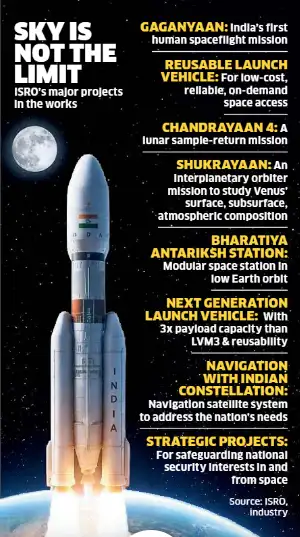
Unlike what conversations seem to suggest, ISRO is not being privatised. It is the commercial opportunities around space that are being opened to private capital and that will help the country. Once private sector participates in the routine work of launching rockets and manufacturing satellites, it will create more bandwidth in ISRO to target bigger projects like an Indian space station, the Venus mission, or the next generation launch vehicle.”
Awais Ahmed, founder and CEO of space technology company Pixxel, too, says the policy will help ISRO focus on even more inspirational projects and missions.
Subba Rao Pavuluri, founder of Ananth Technologies and former ISRO scientist, sees the interplay between the space agency and private industry as a natural progression of the sector’s transition. “Whenever change comes, there is confusion, but that doesn’t mean there is problem,” he says, pointing to similar changes in sectors such as telecom and defence.
 ET Bureau
The senior figure, who has spoken to ET on condition of anonymity, also suggests that ISRO and the broader space ecosystem should do a better job of communicating to internal stakeholders like employee unions what this transition entails. This is also a key demand of the unions.
As their letter says, “Serving employees have an earned right to be informed, consulted and protected. Natural justice and good administration require that policy of this magnitude be explained to the workforce by the Department itself.”
The concerns are likely to come into focus on October 7, when the ISRO Pensioners Association will hold a conference on the “Future of ISRO” in Thiruvananthapuram. Several former officials are expected to attend it. The intention, according to people associated with the conference, is to place before the prime minister their concerns about the direction in which the organisation is headed. “There is not enough staff strength, and the government is not doing enough recruitment. There is concern about the very existence of ISRO. We feel the relationship and the communication are strained,” says an official of the association, on condition of anonymity.
Over the decades, ISRO has built not just rockets but massive engineering capabilities by designing, manufacturing and integrating launch vehicles in-house. Some employees worry that transferring these activities to the private sector could, over time, erode institutional capability. It is up to ISRO to allay those fears, both by action and communication.
ET’s queries to ISRO remained unanswered at the time of going to press.
Apart from the issue around the unions, an air of positivity hangs around the sector. “Space technology has a multiplier effect on industry,” says Jayaraj Rajapandian, head of aerospace and defence, Tata Elxsi, a design and technology services company. If Indian firms can solve the exacting engineering problems posed by space, he says, those capabilities can spill over to aerospace, defence, railways, automotive and healthcare sectors where safety and mission-critical engineering are important.
For Rajapandian, a larger role for industry comes with a corresponding increase in responsibility. Companies will need to invest in advanced tools and machinery, develop specialised talent, work with global OEMs and manufacturing partners, and strengthen processes around quality assurance, risk management, certification and lifecycle support.
It should help India find its rightful space commercially. And as the private sector takes over routine launches and manufacturing, ISRO can add another dimension to make India’s space story even more remarkable. It can become an institution that pushes the boundaries of science rather than be one that simply builds rockets.
As Pavuluri says, “In the space economy, everyone will have a role to play.”
SPACE FOR MORE: Space-tech startups & their focus areasSKYROOT AEROSPACE: Develops Vikram series of launch vehicles
AGNIKUL COSMOS: Builds customisable small-satellite launch vehicles
PIXXEL: Builds hyperspectral imaging satellites to observe changes on Earth
DHRUVA SPACE: Supplies modular satellite platforms, launch and groundstation services, and related systems for space missions
DIGANTARA: Tracks satellites and debris in orbit, provides intelligence data for safer space operations
GALAXEYE: Combines radar and optical satellite imagery to provide Earth observation in different weather and lighting conditions
BELLATRIX AEROSPACE: Manufactures propulsion systems that help satellites stay in orbit, as well as orbital transfer vehicles
SATSURE: Uses satellite imagery, remote sensing and AI to generate data for various sectors
PIERSIGHT: Uses radar satellites and vessel data to monitor maritime activity
MANASTU SPACE: Develops environment friendly propulsion systems for satellites
Source: Websites of companies, industry.