Просмотр новости
Найдите то, что Вас интересует
 Спутники
 РН
РН SpaceX
 Роскосмос
 NASA
NASA
СпутникиРНSpaceXРоскосмосNASAIn situations where banks are inundated with liquidity, the natural tendency among many lenders is to push loans and go down the credit matrix. The fear is that such aggressive lending to generate returns that cover the interest outgo on deposits and other costs may show up as sticky assets a few years down the line.
Synopsis
In situations where banks are inundated with liquidity, the natural tendency among many lenders is to push loans and go down the credit matrix. The fear is that such aggressive lending to generate returns that cover the interest outgo on deposits and other costs may show up as sticky assets a few years down the line.
Listen to this article in summarized format
 ReutersThe RBI is concerned that surplus system liquidity could prompt aggressive lending.
Mumbai: The Reserve Bank of India (RBI) has cautioned banks against waging a loan price war.
Banks are sitting on a mountain of money in the wake of the inflows from foreign currency non-resident (FCNR) deposits which have been swapped with the central bank for rupees.
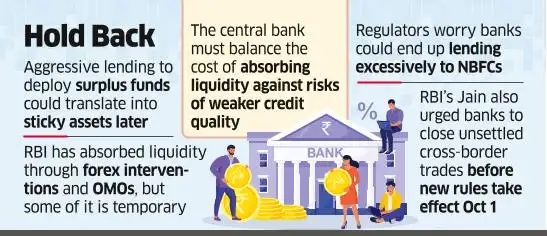
In situations where banks are inundated with liquidity, the natural tendency among many lenders is to push loans and go down the credit matrix. The fear is that such aggressive lending to generate returns that cover the interest outgo on deposits and other costs may show up as sticky assets a few years down the line.
The concern was conveyed by senior RBI deputy governor Rohit Jain at a meeting with senior bankers here on Tuesday, a person who participated in the discussion told ET.
Also read | High-level panel on banking likely by October-end
After accounting for renewal of earlier FCNR deposits, banks have received fresh inflows of around ₹11 lakh crore. RBI has mopped up close to ₹2.5 lakh crore liquidity through the foreign currency intervention routes like swaps and spot dollar sale, and another ₹3.5 lakh crore through open market operations of bond sale and borrowing from banks in the long-term reverse repo window.
 ET Bureau
However, some of these liquidity absorption measures (like the reverse repo) are shorter-term in nature and the money sucked out will flow back into the money market after a month. While money market has been tight this week, liquidity will return with government spending.
"Banks have parked money in government bonds and with RBI which is only a temporary solution in the absence of other avenues. Unless a bank can generate a mark-up of around 2.5% on the loan and generate a net interest margin of 3%, it does not make sense. Banks are betting that credit demand, particularly retail credit would pick up in the next few months. While it has, the year-or-year retail credit growth at 16% is still below the total credit growth of little less than 19%. So, it's natural for RBI to sensitise the banks," said a bank CEO.
The conundrum before the monetary authority is striking a balance between the cost of sucking out liquidity and letting a low interest rate worsening credit quality. Besides the direct cost of liquidity absorption as measurable from the reverse repo interest RBI pays to banks, the indirect cost is reflected in movements in bond yields and forward premium in the forex market.
"Given the liquidity situation, a few large companies are entering the bond market to raise money, it's important for retail loan demand to pick up," said another banker.
According to an analyst, there's always a lurking regulatory concern that banks may end up with excessive lending to non-banking finance companies (NBFCs). "Loans to NBFCs are growing at a significantly higher rate. NBFCs along with fintech firms could on-lend to borrowers whose credit-worthiness may sometimes be a cause of worry," he said.
Also read | Bandhan Bank promoter to gradually reduce stake to meet RBI norms
This liquidity management challenge has emerged at a point when the monetary policy committee (MPC) has to take a call on a possible interest hike. "While there may be a broad unanimity among MPC members about raising interest rate, particularly after the rate increase by the US Fed, they have to decide on the timing so as not to impact consumption at the start of the festival season," said the treasurer of a large private bank.
In the course of the meeting Jain reiterated the urgency to close the unsettled cross-border trades of clients with the new trade payment regulations coming into force from October 1. "RBI also urged banks to explore ways to simplify procedures for foreign portfolio investors and popularise facilities for retail customers in accessing foreign exchange and government securities," said another person.
Read More News on
...moreless
| # | Наименование новости | Тональность | Информативность | Дата публикации |
|---|---|---|---|---|
| 1 | Банки предлагают вкладчикам зафиксировать повышенную доходность на фоне снижения ключевой ставки | 0 | 5.5 | 28-07-2026 |
| 2 | RBI proposes new interest rate rules for regulated entities, seeks public comments | 0 | 8.44 | 12-08-2026 |
| 3 | Editorial. Hawkish Fed | 0 | 10 | 18-06-2026 |
| 4 | ЦБ не видит угроз для ценовой стабильности в росте кредитования в 2020-2022 годах | 0 | 0 | 23-12-2019 |
| 5 | Российские банки предупредили о новом раунде повышения ставок по кредитам и ипотеке | 0 | 0 | 11-02-2022 |
| 6 | ВТБ считает преждевременным ужесточение выдачи ипотеки при высокой долговой нагрузке | 0 | 0 | 17-12-2019 |
| 7 | ЦБ обеспокоен ростом долговой нагрузки заемщиков в сегменте потребкредитования | 0 | 0 | 11-03-2019 |
| 8 | India Ratings lifts bank credit growth forecast, but warns of margin pressures | 0 | 13.29 | 27-08-2026 |
| 9 | ВТБ пока не планирует повышать ставки по кредитам | 0 | 0 | 23-07-2021 |
