Просмотр новости
Найдите то, что Вас интересует
 Спутники
 РН
РН SpaceX
 Роскосмос
 NASA
NASA
СпутникиРНSpaceXРоскосмосNASATariff rates may be the headline issues, but when it comes to CUSMA, like everything Trump touches, it’s complicated
 U.S. President Donald Trump (right) meets with Canadian Prime Minister Mark Carney in the Oval Office at the White House on May 6, 2025 in Washington, D.C. Photo by Anna Moneymaker /Getty
The good news is that a “DEAL” has been made to reduce tariffs on Canadian-made automobiles being exported to the United States. The bad news is that almost no one knows what that deal is.
Normally this would be easily dismissed as standard Liberal politics. You know, treat the electorate like mushrooms — keep them in the dark and feed them, well, you-know-what.
Except that doesn’t seem to be true this time. Rather, this seems more like a case of the players — that would be Donald Trump and Mark Carney — not knowing what the deal actually is. Not because they’re stupid — at least one of them doesn’t seem to be — but because the “meat” of this deal still seems very much undecided. So, while we know — or think we know — that the final ‘nominal’ duty on Canadian-built cars will be 15%, we still don’t know what deductions will be allowed, how those deductions will be calculated, or whether they will be enough to allow automakers to prosper in Canada.
Here, then, is a summary — a short summary! — of all the things we know, things that we think we know, and a little of the vast expanse of what we have absolutely no clue about.
 In an aerial view, BMW vehicles are displayed for sale on a lot at the BMW of South Austin dealership on May 16, 2025 in Austin, Texas Photo by Brandon Bell /Getty
The one number that pretty everyone agrees on is that the nominal tariff rate — that is, before any deductions — on Canadian-built autos will be 15%. That, however, is the total sum of confirmed data. At least, as we went to press.
The big question is what will be allowed to be deducted from that number to reduce our “effective” tariff rate. The choice is fairly binary. The Americans want automakers to only be able to deduct the value of parts built in the U.S., while Mexico and Canada want to be able to deduct what’s called Regional Value Content (RVC, or basically parts built in America and Mexico and Canada).
Here, again, the choices are fairly stark. Using the RVC-deductibility rate for most Canadian-built cars — you can see how the following is calculated here in Monday’s Motor Mouth — the effective tariff on cars shipped south of the border would be somewhere between 2.5% and 4%. If you use the American system — allowing only for content built in the U.S. of A to be deducted — that number would range from 7.5% to 9%. Even if you don’t bother to look up how those numbers were calculated, know this: the former (2.5% to 4%) is probably manageable for Canadian automakers; the latter (7.5% to 9%) is not. It really is a go/no-go situation.
Those raw numbers are also the easiest part of this agreement to understand. More complicated — much more! — is how we define and measure the value of those deductions.
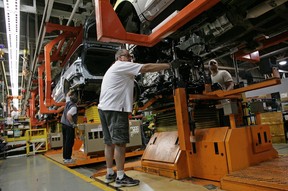 Ford employees work on the line at an assembly facility in Oakville, Canada Photo by Getty
The basics of the rules of origin governing auto parts is fairly simple, with “American content” being fairly self-explanatory and “Regional Value Content” simply the value of the parts made in Mexico, Canada, or the United States used in a locally assembled vehicle.
Exactly what percentage of the total each must represent to be compliant is still a mystery, however. Current rules say 75% of those constituent parts must be built by one of the three signatories. However, the Americans have proposed bumping that RVC requirement up to 82% and adding a new rule, that American content needs to be 50%.
That said, there’s been no specificity as to what that new 50% requirement constitutes. Is it 50% of the total value of the car? Or is it half of the Regional Value Content, which would, if you do the math, make the overall American content required either 37.5% (using current CUSMA rules) or 41% (Trump’s preferred reference number)? It makes a big difference, the former (again, either 37.5% or 41%) a lot easier for Canadian automakers to hit than the latter (50% if it’s applied against the total landed cost of the vehicle).
Like so much of these negotiations, little is known about this aspect of the past two weeks of discussions. We know the American politicians want it. We know Canadian automakers don’t. Other than that, nada.
 Steel coils are seen in a yard at ArcelorMittal Dofasco’s steel mill on June 9, 2025 in Hamilton, Ontario Photo by Cole Burston /Getty
Now some 18 months into trying to understand how cross-border auto-tariffing works, the most important conclusion I’ve reached is that it’s complicated. As in, I know only one non-OEM analyst — that would be Stephen Beatty, Driving’s former tariff-whisperer — who fully understands all the details. What I can say is that the more I dive into CUSMA’s tariff machinations, the more Byzantine they become.
Here’s one example called “tariff inversion.” As we all know, like Canadian-built cars, steel produced in Canada has been heavily tariffed. As a result of these negotiations, according to the Financial Post, those steel tariffs will now be reduced to 25%. However, that’s still higher — quite a bit higher — than the 2.5% to 4% we’re hoping that Canadian cars heading south will be charged.
In other words — and hence the term “inversion” — the duty on raw materials is higher than it is on the finished product made of that material. That means, all things being equal, an American-built car using imported steel would be more expensive than its Canadian counterpart, the exact opposite effect The Donald was looking for when he started this silliness.
Until now, nothing has been done to counter this anomaly. Have the Americans figured it out yet? Will they do something to right this inversion? Perhaps something as ham-handed as forcing Canadian automakers to buy American steel — and aluminum! — to build our cars when we, of course, have plenty of both here in Canada? Again, how the steel tariffs affect the viability of exporting cars to the United States is not something that’s being discussed in the mainstream media.
 U.S. President Donald Trump speaks with Canadian Prime Minister Mark Carney at a working lunch with leaders of G7 and the Middle East, on June 16, 2026 in Evian-les-Bains, France Photo by Evelyn Hockstein /Getty
Motor Mouth has discussed the “roll-up” of tariffs and the discrepancy between Canadian and American interpretations of how CUSMA says — Article 4.5.4 to be exact, if you wanna look it up yourself — it should be applied. Essentially, rolling up means that, if a country adds enough local value to a part (currently 75%, but that could go to 82% as I mentioned above) they can then value that part as 100% local.
A simple example would be if a piston was forged in Germany or Japan, then sent Canada for finishing. If sufficient work were done — machining valve pockets, ring lands, and, of course, its final circumference — to deem it 75% built here in the Great White North, roll-up rules would then allow us to claim 100% of its worth as Regional Value Content.
America does agree that roll-up is allowable for small bits — again, something like a piston — but inadmissible for what CUSMA calls “super core parts.” These include engines, transmission, suspension sub-assemblies, and the like. Parts, in other words, whose value is large enough that, were roll-up allowed, they would make reaching the Regional Value Content CUSMA demands a lot easier. Little wonder, then, that America doesn’t currently allow Canadian or Mexican automakers to apply roll-up values in their calculation of the RVC they can deduct from their tariff rate.
Some 18 months into trying to understand how cross-border auto-tariffing works, the most important conclusion I’ve reached is that it’s complicated—the more I dive into CUSMA’s tariff machinations, the more Byzantine they become
That would be but a sidenote in all these CUSMA shenanigans were it not for one fact: a trade tribunal already ruled against the American interpretation of the rules more than three years ago, and yet we’ve still adhered to that interpretation of how roll-up can be applied. According to experts — like so many these days, wishing to remain anonymous — that’s because the Canadian government hasn’t been willing to push to have roll-up universally applied.
In other words, Canadian automakers have been operating under rules that have long been judged wrong simply because our politicians didn’t want to poke the bear. Now that said Ursus horribilis has been awoken, could the Canadian government use those long-ignored roll-up rules as a bargaining chip? Would formal recognition of how they are screwing us be worth anything at the negotiation table? Not known. But, if Carney and LeBlanc have been listening to outside experts, it might well be worth throwing into the basket of “concessions” offered on the basis that it won’t hurt us too much. Or at least, not more than we currently being hurt.
 Rows of Seagull EVs (also known as the Dolphin Surf) from China’s BYD sit next to the company’s Xian cargo ship at a port Photo by BYD /Weibo
Three short months ago, all we could talk about was Chinese EVs. Canadian politicians were promoting the idea we would soon have a larger selection of (barely) more affordable electric vehicles while their American counterparts were threatening us with all manner of malfeasance for daring to deal with BYD and Geely. Forget just tariffing Chinese EVs out of their country, Congress is so incensed that it proposed a law last May — the Protecting America from Chinese Cars Act — that would prevent (Chinese-)EV-loving snowbirds from driving their BYD or Geely across the border on their way to Florida.
Since then, however, not a peep.
That doesn’t mean that some tit-for-tat isn’t being discussed. Almost assuredly, Trump has asked for Carney to cancel the entente he signed with China. The PM, on the other hand, needs to burnish his environmental bona fides, so he’ll be loathe to chase all those Chinese ZEVs from our shores. Could the compromise be that Canada caps the annual tariff rate quota at the 70,000 units that are scheduled in the final year of the deal? I don’t know, but it beggars belief to think that the subject hasn’t been discussed.
Chalk it up as one more thing we don’t know about a “DEAL” supposedly sufficiently finalized that the Prime Minister is already asking that American booze be put back on provincial shelves. The CUSMA, to butcher an otherwise perfectly fine axiom, is in the details, and we still don’t know any of ’em.
Sign up for our newsletter Blind-Spot Monitor and follow our social channels on X, Tiktok and LinkedIn to stay up to date on the latest automotive news, reviews, car culture, and vehicle shopping advice.
 David Booth
David Booth is Driving’s senior writer as well as the producer of Driving.ca’s Driving into the Future panels and Motor Mouth podcasts. Having written about everything from the exact benefits of Diamond Like Coating (DLC) on motorcycle camshafts to why Range Rovers are the best vehicles for those suffering from opioid-induced constipation, Booth leaves no stone unturned in his quest for automotive veritas. Besides his long tenure with Driving, he was the editor in chief of Autovision magazine for 25 years and his stories have been published in motorcycle magazines around the world including the United States, England, Germany and Australia.
EducationGraduating from Queen Elizabeth High School in 1973, Booth moved from his Northern Quebec hometown of Sept-Iles — also home to Montreal Canadiens great, Guy Carbonneau — to Ottawa to study Mechanical Engineering at Carleton University. There, he wrote a thesis on the then-burgeoning technology of anti-lock brakes for motorcycles and spent time researching the also then-burgeoning use of water tunnels for aerodynamic testing.
ExperienceAfter three years writing for Cycle Canada magazine and another three working for the then oldest magazine in Canada, Canadian Automotive Trade, Booth, along with current Driving writer Brian Harper and then Toronto Star contributor Alex Law, created an automotive editorial services group that supplied road tests, news, and service bulletins to what was then called Southam newspapers.
When Southam became Postmedia with its purchase by Conrad Black and the subsequent introduction of the National Post, Booth was asked to start up the then Driver’s Edge section, which became Driving.ca when Postmedia moved into the digital age. In the past 41 years, Booth has tested well over 500 motorcycles, 1,500 passenger cars, and nearly every significant supercar of the last 30 years. His passion — and proudest achievement — is Motor Mouth, his weekly column that, after some 30 years, remains as incisive and opinionated as ever.
PersonalBooth remains an avid sports enthusiast — read: fitness freak — whose favorite activities include punching boxing bags until his hands bleed and running ski hills with as little respect for the medial meniscus as 65-year-old knees can bear. His true passion, however, remains motorcycles. If he’s not in his garage tinkering with his prized 1983 CB1100RC — or resurrecting another one — he’s riding Italy’s famed Stelvio Pass with his beloved — and much-modified — Suzuki V-Strom 1000.
Booth has been known to accept the occasional mojito from strangers, and the apples of his eye are a certain fellow Driving contributor and his son, Matthew, who is Global Vice-President of something — though he’s never quite sure what. He welcomes feedback, criticism and suggestions at David@davebooth.ca.
This website uses cookies to personalize your content (including ads), and allows us to analyze our traffic. Read more about cookies here. By continuing to use our site, you agree to our Terms of Use and Privacy Policy.
Edit your picks to remove vehicles if you want to add different ones.
You can only add up to 5 vehicles to your picks.
| # | Наименование новости | Тональность | Информативность | Дата публикации |
|---|---|---|---|---|
| 1 | Trump’s crusade against tariff cheats may tangle up trade in red tape | 0 | 10 | 21-09-2026 |
| 2 | Trump is hellbent on tariffs. Here are 5 implications | 0 | 11.1 | 25-07-2026 |
| 3 | The tariffs that just won’t die | 0 | 8.92 | 22-07-2026 |
| 4 | Trump’s Canadian Tariffs Make No Sense | 0 | 9.37 | 22-07-2026 |
| 5 | Higher Drug Prices, No Tariffs: U.K. Trade Pact Shows How Trump Is Coaxing Countries to Pay More for Meds | 0 | 7.35 | 03-12-2025 |
| 6 | США могут ввести пошлины на импорт автомобилей из ЕС при отсутствии сделки | 0 | 0 | 22-01-2020 |
| 7 | Trump’s Tariffs Were Ruled Illegal. Where Are the Refunds for Small Businesses? | -2 | 6 | 18-03-2026 |
| 8 | U.S., Canada race for deal to avert Trump’s threat of 50 percent tariffs | 0 | 16.9 | 15-08-2026 |
| 9 | Handelsblatt: автоконцерны ФРГ ведут переговоры с США по вопросу пошлин | 0 | 0 | 29-05-2025 |


