Просмотр новости
Найдите то, что Вас интересует
 Спутники
 РН
РН SpaceX
 Роскосмос
 NASA
NASA
СпутникиРНSpaceXРоскосмосNASA
AMD has updated its performance estimates for its upcoming 6th Gen EPYC 9006 "Venice" server CPUs, and the latest numbers make an aggressive case against Intel and NVIDIA in high-density data center workloads. A new AMD white paper, titled "AMD EPYC Server CPU Architecture And Performance Overview" revises the company's modeling for Venice
AMD has updated its performance estimates for its upcoming 6th Gen EPYC 9006 "Venice" server CPUs, and the latest numbers make an aggressive case against Intel and NVIDIA in high-density data center workloads. A new AMD white paper, titled "AMD EPYC Server CPU Architecture And Performance Overview" revises the company's modeling for Venice and compares the 256-core EPYC 9996 against Intel's 128-core Xeon 6980P and NVIDIA's 88-core Vera CPU.
The updated analysis places particular priority on agentic AI infrastructure, where CPUs handle tasks such as orchestration, databases, web services, caching, APIs, retrieval, and other work surrounding accelerator-based AI inference. This work is now comprising a larger and larger percentage of the actual workload of Agentic AI, reinforcing the role of CPUs in the datacenter, once thought to merely be orchestration for GPUs that do all the 'real' work.
 Enterprise and Cloud Native Workloads Comparison - Image: AMD
AMD expects that the EPYC 9996 will deliver 2.4× the performance of Xeon 6980P in server-side Java, 2.5× in OpenSSL, 3.5× in MongoDB with YCSB, 2.9× in Redis Benchmark, 3.7× in NGINX with WRK, and 2.6× in transaction processing based on TPC-C. Those results are normalized to a 128-core Xeon 6980P system and represent the CPU-heavy enterprise and cloud-native portions of an agentic AI infrastructure stack. Notably, Vera was not included in this modeling, but not because AMD didn't have numbers to compare against.
 Normalized rack-level system performance at 100kW - Image: AMD
Besides, the more eye-catching update comes at the rack level. AMD has revisited its earlier 100-kW rack-capacity model from June, which estimated how much aggregate workload throughput each platform could deliver within a fixed rack-level power envelope. The company says the previous analysis put 5th Gen EPYC 9965 at 2.37× the rack-level throughput of its NVIDIA Vera baseline. The revised study now models the 6th Gen EPYC 9996 at 3.4× Vera's rack-level performance.
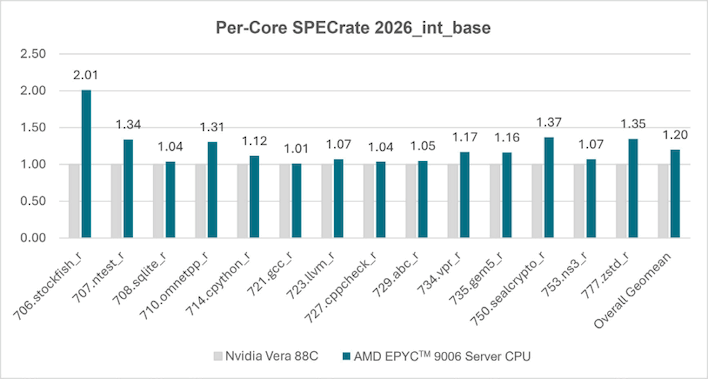 AMD says that Venice beats Vera on every test in SPECint2006. - Image: AMD
This is partially because the underlying methodology has changed. AMD's earlier rack estimate was based on a six-workload geometric mean that included SPECrate 2017 Int, while the updated model incorporates SPECrate 2026 Int, server-side Java, NGINX, Redis, Memcached, and TPROC-C. That makes the latest figure a refreshed model rather than simply adding Venice to the old chart. There's also a small but interesting change for AMD's previous-generation part. The earlier 9965 estimate was 2.37× Vera, while the new chart shows the 9965 at about 2.3× in the revised model. In other words, AMD appears to have rerun the calculations rather than simply carrying its previous numbers forward.
However, it's critical to keep in mind with these rack-scale comparisons that AMD is modeling performance rather than publishing results from physical 100-kW racks containing both Venice and Vera hardware. The company describes the figures as estimates based on a combination of benchmark data and system-level assumptions, so they absolutely should not be treated as apples-to-apples measurements of shipping systems.
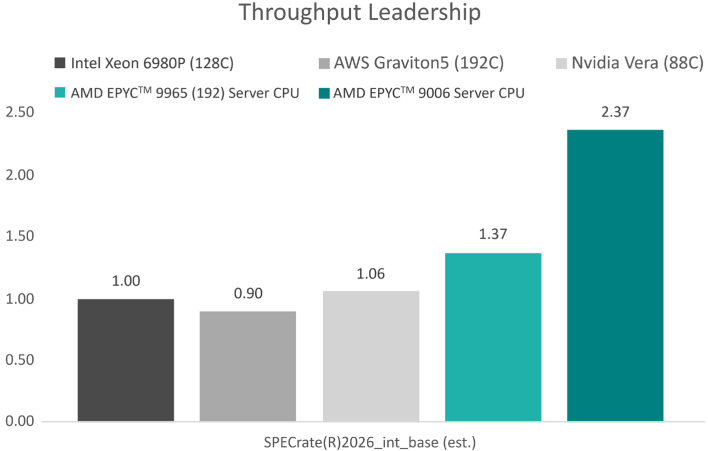 AMD claims leadership throughput even with its current-gen parts. - Image: AMD
But AMD's also making a broader argument about the role of CPUs in agentic AI. Rather than treating the CPU as merely a host for an accelerator, the company says increasingly complex AI workflows require substantial CPU resources for orchestration, retrieval, database access, tool execution, networking, and response generation. The latest EPYC 9996 figures reinforce AMD's pitch for Venice as a high-core-count CPU designed to maximize useful work under real-world rack constraints rather than simply chasing peak processor performance.
 EPYC Venice represents a significant step forward for AMD. - Image: AMD
Still, Vera is a more specialized CPU than Venice, and it has a very different architecture at the platform level. While these simulations put NVIDIA's new chip behind AMD's finest, NVIDIA claims the win in its own testing using different benchmarks and constraints. It's entirely possible that Vera may end up being a better choice for some workloads. We'll just have to wait for independent benchmarks on real hardware to know for sure.

A 30-year PC building veteran, Zak is a modern-day Renaissance man who may not be an expert on anything, but knows just a little about nearly everything.
| # | Наименование новости | Тональность | Информативность | Дата публикации |
|---|---|---|---|---|
| 1 | AMD 晒 256 核 EPYC 9996 官方跑分,代际吞吐量提升约 73% | 0 | 33.29 | 19-09-2026 |
| 2 | До 1 ГБ кэша: AMD представила серверные процессоры EPYC Zen 6 | 0 | 13.6 | 25-07-2026 |
| 3 | AMD EPYC 9006 Venice Announced & Looks Poised To Be A Grand Slam | 0 | 10.98 | 23-07-2026 |
| 4 | AMD EPYC 9996 „Venice“: 256 Zen-6-Kerne sollen Intels Xeon und NVIDIAs Vera unter Druck setzen | 0 | 21.62 | 25-07-2026 |
| 5 | AMD EPYC 9006 Venice Unveils 256 Cores in Official Launch | 0 | 15.92 | 24-07-2026 |
| 6 | AMD представит новые процессоры Zen 6 на мероприятии Advancing AI 22–23 июля в Сан-Франциско | 0 | 7 | 10-07-2026 |
| 7 | AMD сообщила, когда будут представлены процессоры Zen 6 Компания планирует ... | 0 | 5 | 10-07-2026 |
| 8 | Zen 6 для десктопов задержится, но будет прорывом уровня Zen ... | 1 | 8.93 | 19-08-2026 |
| 9 | AMD 確認會在 Advancing AI 2026 發表 Zen 6 處理器架構的 EPYC 處理器 | 0 | 5 | 10-07-2026 |
| 10 | Intel Granite Rapids WS vs. AMD Threadripper Zen 5 SMT Performance | 0 | 12.51 | 17-09-2026 |
