Просмотр новости
Найдите то, что Вас интересует
 Спутники
 РН
РН SpaceX
 Роскосмос
 NASA
NASA
СпутникиРНSpaceXРоскосмосNASAThere's no bright star marking due south from the Southern Hemisphere. But the Southern Cross points the way.
The post The Southern Cross: your guide to due south first appeared on EarthSky.
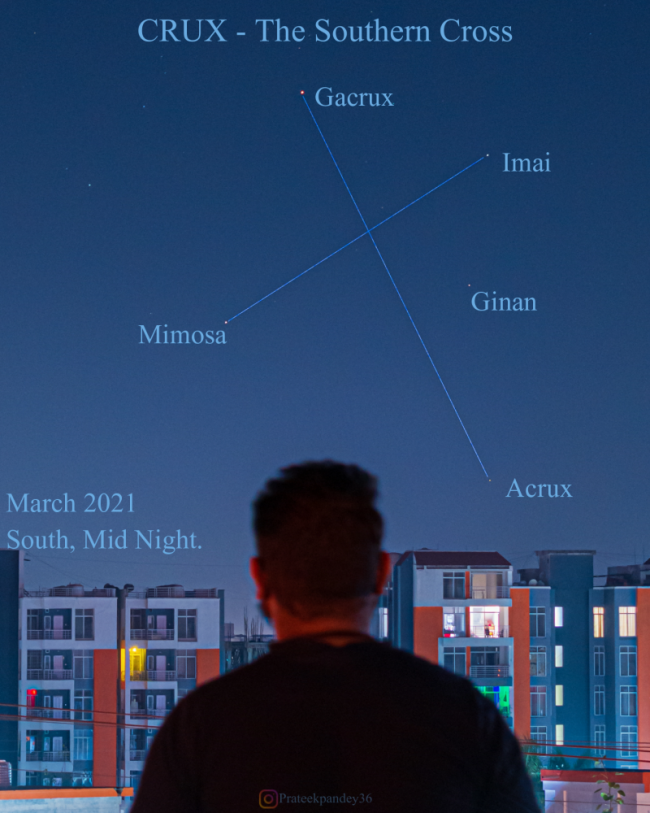 View at EarthSky Community Photos. | Prateek Pandey in Bhopal, India, caught the Southern Cross while at its highest point around midnight (its midnight culmination) on March 6, 2021. In April and May, the Southern Cross reaches its highest point in the sky earlier in the evening. Thank you, Prateek!The Southern Cross is your guide to due south
Did you know you can use the constellation Crux, the famous Southern Cross, to find the south celestial pole and the direction due south? That is, you can if you are south of the equator, and can see both Crux and the sky’s south pole.
Even for us in the Northern Hemisphere, the Southern Cross is legendary. We’ve all heard of it. It appears on both the Australian and New Zealand national flags.
And you might already know that the south celestial pole is the point in the sky directly above Earth’s southern axis. It’s the point around which the entire southern sky appears to turn.
Here are three different methods for finding the south celestial pole, using the Southern Cross. Once you find it, you can draw a line downward from celestial south to find the earthly direction due south.
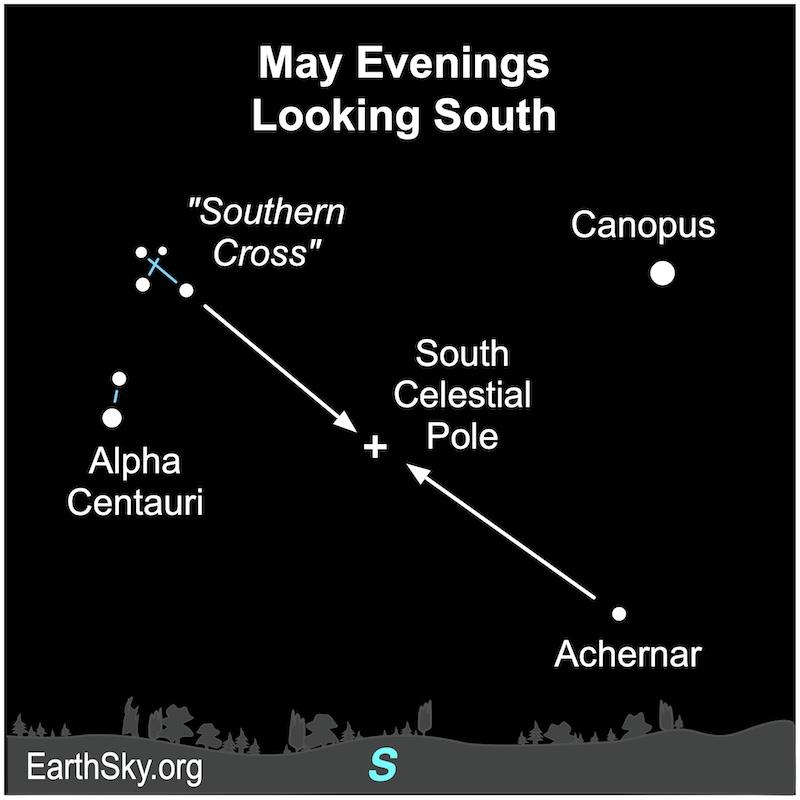 Method #1. The south celestial pole is located halfway between Gacrux, the head of the Southern Cross, and the bright star Achernar. For a practical trick, place one hand at the Cross and the other at Achernar. Now bring them together in a clap! Your hands should meet right at the south celestial pole. Chart via EarthSky.
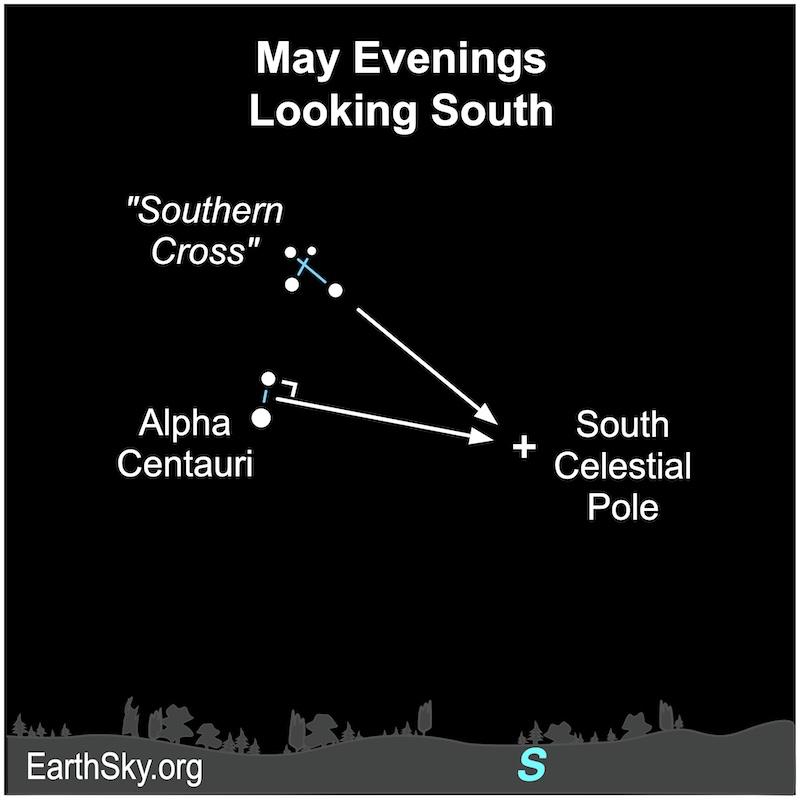 Method #2. Draw an imaginary line extending the long axis of the Southern Cross, and another one bisecting the 2 “Pointer Stars,” Alpha and Beta Centauri. The south celestial pole lies at the intersection between those 2 lines. Chart via EarthSky.
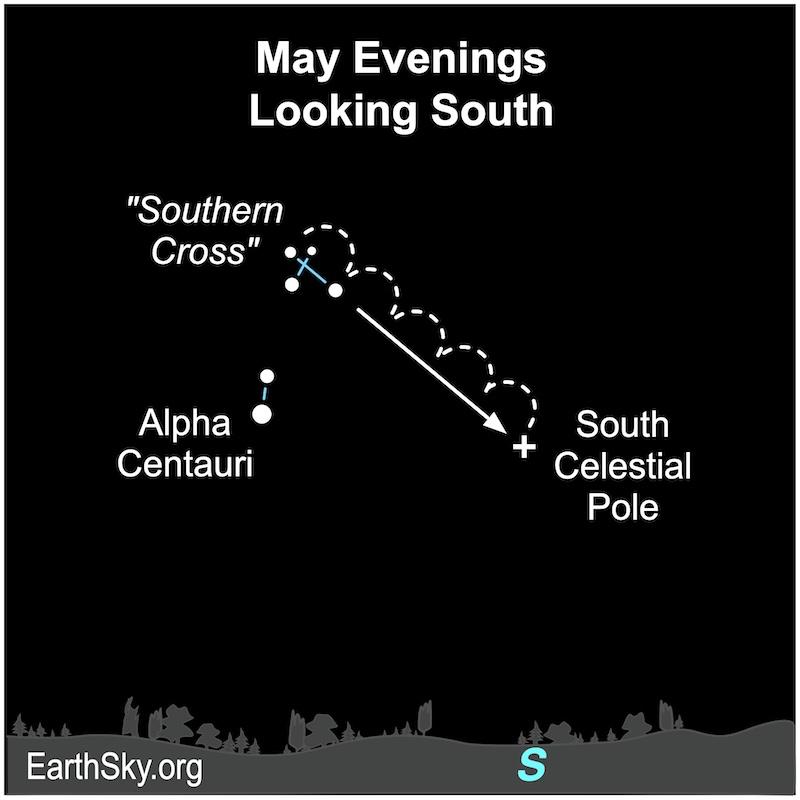 Method #3. To locate the south celestial pole, extend the long axis of the Southern Cross, from the head of the cross through its foot, 4 times its own length. Chart via EarthSky.Prefer video?
Prefer to get your information via video? Here’s a video showing how to use the Southern Cross to find the south celestial pole and due south (assuming you are in the Southern Hemisphere).
Why do we need 3 methods?
In the Northern Hemisphere, there’s a moderately bright star – which modern astronomers call Polaris or the North Star – marking the north celestial pole. It’s not exactly on the sky’s north pole. It’s approximately 0.5 degrees from that pole. But close enough! If you watch throughout the night from the Northern Hemisphere, you’ll definitely notice that Polaris, the North Star, stays fixed in the northern sky. Meanwhile, the whole northern sky full of stars (or at least the part you can see from your latitude) wheels around it.
The stars that circle the pole never rise or set. They’re called circumpolar stars.
And that’s why there are lots of Northern Hemisphere stories about people finding their way when lost, by using Polaris as a guide to true north.
But the Southern Hemisphere doesn’t have a similarly bright star marking its pole. So we provide three ways to find it!
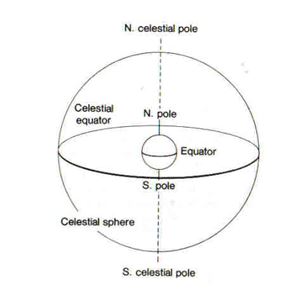 The north and south celestial poles lie above Earth’s north and south poles. Image via OneMinuteAstronomer.com.The height of the south celestial pole depends on your latitude
Here’s what’s true for both earthly hemispheres. The height of your celestial pole depends on your latitude.
So if you are at the North or South Pole of Earth – in wintertime, when it’s dark out – and you look straight up, you’ll be looking toward the celestial pole of your sky. If you’re in the Northern Hemisphere, you’ll see Polaris there. At that moment, the sky’s pole will make an angle of 90 degrees with your horizon.
But if you then travel toward Earth’s equator, the height of the pole in your sky will begin to shift. If you move 10 degrees toward the equator, the pole will likewise shift by 10 degrees. Now instead of being 90 degrees from your horizon, the pole of your sky will be 80 degrees up. Travel 20 degrees toward the equator from the pole, and the pole of your sky will be 70 degrees up … and so on.
So from 35 degrees N. or S. latitude, for example, you will find the celestial pole at a height in your sky equal to 90 degrees minus 35 degrees; in other words, you’ll find it in the north, or south, 55 degrees above your horizon.
And if you were at the equator, you could not see either the north or south celestial pole.
 The entire southern sky turns around the south celestial pole, a point in the sky captured here behind the antennas of the Atacama Large Millimeter/submillimeter Array (ALMA) in Chile. In the Northern Hemisphere, the moderately bright star Polaris marks the north celestial pole and direction north. But there’s no bright southern star to mark the south celestial pole. Babak Tafreshi, a Photo Ambassador for the European Southern Observatory, captured this photo in 2012. Read more about this image via ESO.The Southern Cross isn’t the only way
The Southern Cross isn’t the only route to finding celestial south and the direction due south. There are several others way to find south. If you’re interested, try this Wikipedia page. The illustration below, which I found on Wikimedia Commons, shows how to use the Large and Small Magellanic Clouds to find celestial south.
Happy gazing, southern (and northern) friends!
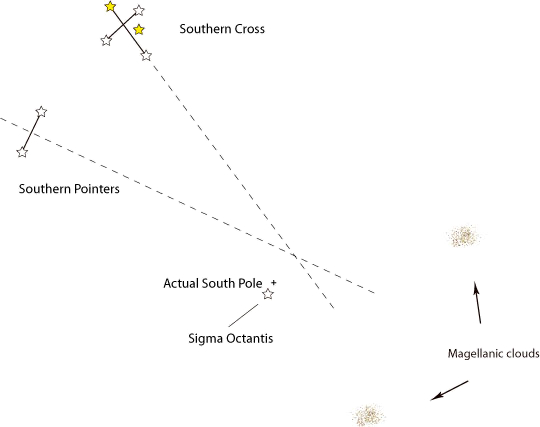 You can also find the South Celestial Pole, and due south, using the famous Large and Small Magellanic Clouds. These “clouds” are actually satellite galaxies orbiting our own larger Milky Way galaxy. If you spot them on a clear, moonless night in the Southern Hemisphere, make an equilateral triangle, the third point of which is the south celestial pole. Image via Michael Millthorn/ Wikimedia Commons.
Bottom line: There’s no bright star marking due south from the Southern Hemisphere. But the Southern Cross points the way.
Read more: How to see the Southern Cross from the Northern Hemisphere
The EarthSky team has a blast bringing you daily updates on your cosmos and world. We love your photos and welcome your news tips. Earth, Space, Sun, Human, Tonight. Since 1994.
| # | Наименование новости | Тональность | Информативность | Дата публикации |
|---|---|---|---|---|
| 1 | 💫 Как найти Полярную звезду на небе — три простых ... | 0 | 7.43 | 23-08-2026 |
| 2 | 🌟🌌 Созвездие Южная Корона. Основные сведения Латинское название: Corona Australis ... | 0 | 7 | 29-06-2026 |
| 3 | Роскосмос учит ориентироваться по звёздам: как за три шага найти Полярную звезду | 0 | 5.41 | 23-08-2026 |
| 4 | Роскосмос учит ориентироваться по звёздам: как за три шага найти Полярную звезду | 0 | 5.41 | 23-08-2026 |
| 5 | Южное полярное сияние с МКС | 0 | 1 | 04-07-2026 |
| 6 | Самую яркую звезду неба можно найти на карте России ⭐ ... | 0 | 8.01 | 03-08-2026 |
| 7 | ✨ Небо над Параналем в движении На широте обсерватории Паранал ... | 0 | 9.99 | 29-08-2026 |
| 8 | APOD: 2026 August 28 – The Sky Turns Above Paranal | 0 | 9.48 | 28-08-2026 |
| 9 | Немного космической красоты из Чили, где местный астрофотограф запечатлел суточное ... | 0 | 7.6 | 28-07-2026 |
