Просмотр новости
Найдите то, что Вас интересует
 Спутники
 РН
РН SpaceX
 Роскосмос
 NASA
NASA
СпутникиРНSpaceXРоскосмосNASASun activity archive for July 2026. A daily record of flaring, big filaments and prominences, and other sorts of activity, on our local star.
The post Sun activity archive for July 2026 first appeared on EarthSky.
An M flare has finally broken the activity lull on the sun. Sunspot region AR4492 in the northwest sparked the M1.9 blast at 17 UTC yesterday, just before rotating off the Earth-viewed side of our star. It was not an especially strong flare, but it lasted a long time, and sent a huge burst of solar material into space. Specialists are currently waiting to see if some of this coronal mass ejection (CME) might be heading toward Earth. From our perspective, the blast seemed to smother the planet Jupiter, which was edging away from our star after it reached solar conjunction – when it reached the far side of the sun from Earth – on Wednesday. Don’t miss this beautiful coincidence of perspective above!
Past 24 hours on the sun(11 UTC July 30 – 11 UTC July 31)Flare activity: Solar activity reached moderate levels. The sun produced a total of 16 flares: one M flare and fifteen C flares over the past day.
Sunspot regions: Currently, our star shows eight numbered active regions on the side we see from Earth. Three of them show a beta-gamma magnetic complexity: AR4498, AR4499, and AR4501. All three showed slight growth during this period. In particular, AR4499 developed a delta configuration in its leader spots, then returned to a gamma configuration. The rest of the sunspot regions on the Earth-viewed solar disk show either alpha or beta configurations.
Blasts from the sun? Observers spotted a chunk of solar stuff hurled into space during the M1.9 event from AR4492. Specialists are now modeling and analyzing this coronal mass ejection (CME) to determine whether a component is heading our way. Notably, LASCO C3 registered a partial halo event during the blast.
Past 24 hours in space weatherSolar wind: Solar wind conditions continued at low levels throughout the whole period.
Bt, Bz and magnetic coupling: The interplanetary magnetic field remained at weak levels. Meanwhile, the Bz component kept shifting between southward and northward , though a southward orientation predominated. A sustained south-oriented Bz component can deliver auroral displays.
Earth’s magnetic field: Earth’s magnetic field stayed quiet throughout the period, with the Kp index sitting at 1–2. At 11 UTC on July 31, the Kp index sits just at level 1.
 Sun news for July 31, 2026. This zoomed-in video shows the M1.9 flare from active region AR4492, which broke a multi-day lull in solar activity. The flare peaked at 17 UTC on July 30 in the sun’s northwest quadrant, just before AR4492 rotated toward the western limb. Image via NOAA.
 Sun news for July 31, 2026. The northwest stole the show for the entire period! A huge, eye-catching prominence rose over the horizon, arcing gracefully into view. Image via NOAA.Sun news July 30: Chunks of solar stuff on their way to Earth
Forecasters have confirmed that two chunks of sun-stuff are on their way to Earth. These bursts, fired by the sun on July 26 and 27, are fairly faint, and should give our magnetic field only glancing blows between today and August 1. Even so, they might trigger G1 (minor) geomagnetic storming in the coming days. That’s because the waves of solar stuff may combine with fast solar wind streaming from a coronal hole. So fingers crossed for clear skies, all you aurora hunters!
Past 24 hours on the sun(11 UTC July 29 – 11 UTC July 30)Flare activity: Solar activity stayed low, with only faint C flares. Our sun produced a total of nine C flares over the past day.
Sunspot regions: The Earth-facing solar disk filled up fast, with nine numbered active regions visible today. A newcomer that emerged in the northeast quadrant became the first to reach the 4500 label, now officially numbered AR4500. After that came AR4501 in the southeast. These active regions have been changing rapidly. Today, three of them show a beta-gamma magnetic complexity: AR4498, AR4499, and AR4501. The rest of the sunspot regions on the Earth-viewed solar disk show either alpha or beta configurations.
Blasts from the sun? Observers spotted no new coronal mass ejections (CMEs) in available coronagraph imagery. However, we still await the arrival of the CME produced on July 26 from AR4494, which should reach Earth on July 30. In addition, the filament eruption we saw at 6 UTC on July 27 sent a component our way. It may deliver a faint glancing blow, with an arrival time around August 1.
Past 24 hours in space weatherSolar wind: Solar wind conditions averaged moderate-low levels during the whole period.
Bt, Bz and magnetic coupling: The interplanetary magnetic field stayed at weak strength during this period. Meanwhile, the Bz component pointed southward for the first half of the period, until 21:30 UTC on July 29. After that, it turned mostly northward for the rest of the period. At the time of this writing, it swung back to a south orientation. As always, a sustained south-oriented Bz component favors auroral displays.
Earth’s magnetic field: Earth’s magnetic field stayed quiet throughout the period, with the Kp index sitting at 0–2. At 11 UTC on July 30, the Kp index sits just above level 1.
 Sun news for July 30, 2026. This WSA-ENLIL model run from NOAA’s Space Weather Prediction Center tracks chunks of solar stuff, or coronal mass ejections (CMEs), on their way to Earth. The model maps solar wind density and speed as material travels out from the sun, helping forecasters estimate when it will arrive. A couple of faint CMEs are now inbound. They may deliver glancing blows over the coming day, which could trigger G1 (minor) geomagnetic storms in the days ahead. Image via NOAA.
 Sun news for July 30, 2026. This video shows another filament eruption, from the same area as yesterday’s, at 19:57 UTC on July 29. Once again, a dark, rope-like filament lifted off and hurled plasma into space. The GOES-19 SUVI instrument captured the eruption in its 304 angstrom wavelength channel. Image via NOAA.Sun news July 29: Flare activity drops as our star takes a breather
Our star is going through a lull. Its tally of six C flares over the past day was half of the previous day’s total. The main hope of an uptick in activity lies with active region AR4498, which fired all of the past day’s flares. Now located near the northeast horizon, it currently carries a modest beta configuration. As it moves into a more central location, a better analysis of its magnetic configuration will become possible. Let’s see how this sunspot group develops.
Past 24 hours on the sun(11 UTC July 28 – 11 UTC July 29)Flare activity: Solar activity continued at low levels with faint flares. Our sun produced a total of six C flares.
Sunspot regions: The Earth-facing solar disk shows seven numbered active regions today. Among them is a newcomer that emerged in the southeast quadrant, now officially numbered AR4499. All of the sunspot regions on the Earth-viewed side of our sun show simpler alpha or beta configurations. As noted, all flare production of the period centered on AR4498. The rest stayed stable or in decay, with no flare production or significant behavior to report.
Blasts from the sun? Observers registered no new coronal mass ejections (CMEs) in available coronagraph imagery. However, the CME produced during the M3.2 (moderate) flare at 15:29 UTC on July 26 from AR4494 is on its way to Earth. Forecasters estimate arrival late on July 30. In addition, the filament eruption we saw at 6 UTC on July 27 sent a component our way. It may deliver a faint glancing blow, with an arrival time around August 1.
Past 24 hours in space weatherSolar wind: Solar wind conditions averaged moderate-low levels during this period. Meanwhile, a large coronal hole now sits over the central meridian in the sun’s southern hemisphere. It lies too far south to squarely face us, but a portion of the fast solar wind it produces may start reaching Earth in the next few days.
Bt, Bz and magnetic coupling: The interplanetary magnetic field (IMF) started the period at moderate levels. Then it slowly decreased to weak strength at the time of this writing. Meanwhile, the Bz component pointed southward for most of the period, with a few weak northward fluctuations. As always, a sustained south-oriented Bz component favors auroral displays.
Earth’s magnetic field: Earth’s magnetic field stayed quiet throughout the period, with the Kp index remaining at 1–3. At the end of our observation period, at 11 UTC on July 29, the Kp index sits just above level 1.
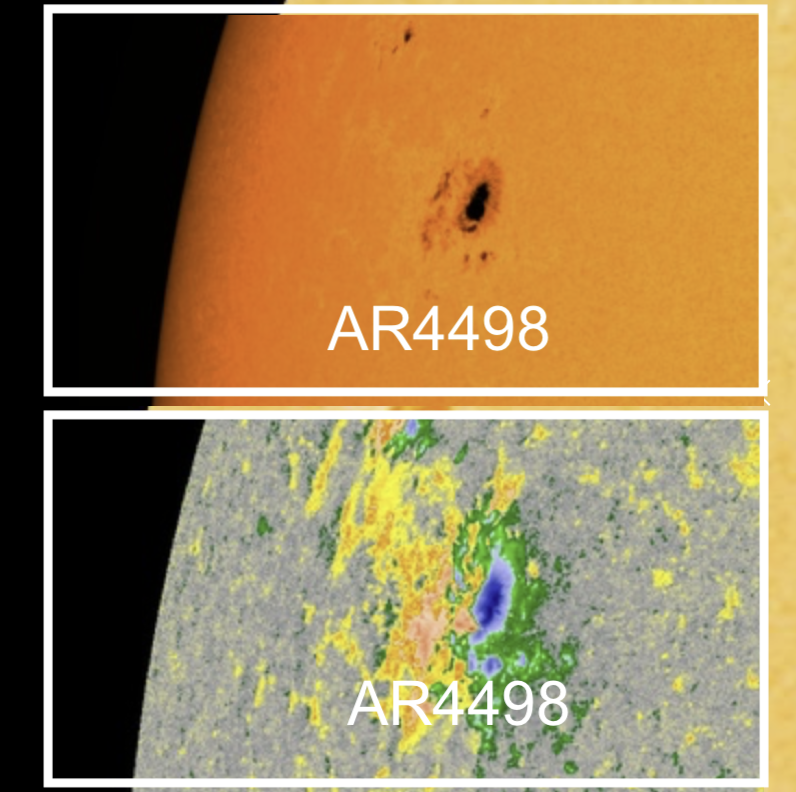 Sun news for July 29, 2026. These two panels show active region AR4498, today’s sole flare producer, near the sun’s northeast limb. The top panel shows the visible solar surface, or photosphere. The bottom panel shows a magnetogram of the same region, which maps its magnetic field. Image via NASA SDO.
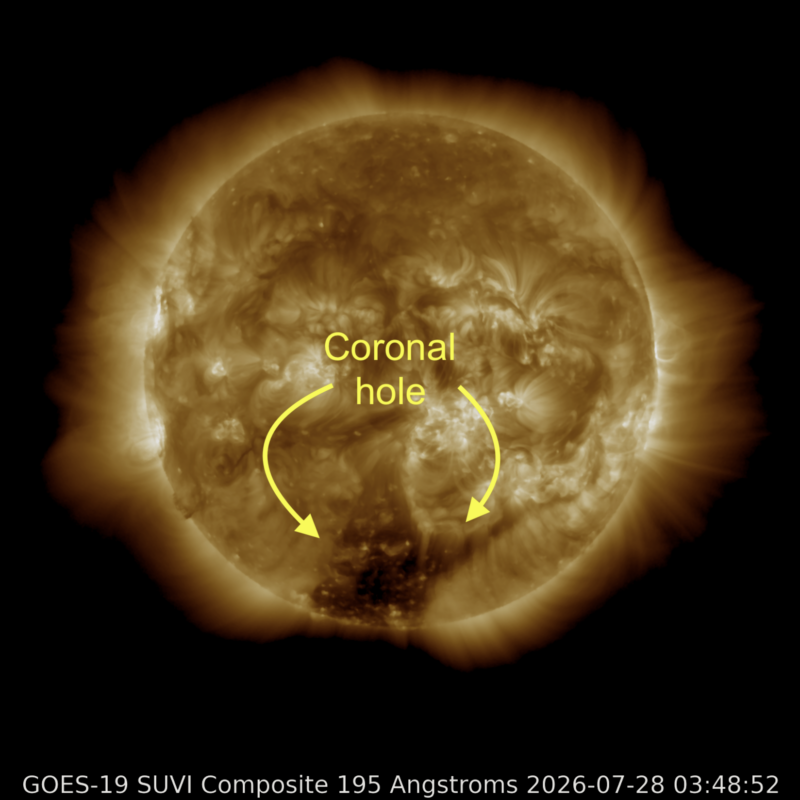 Sun news for July 29, 2026. This image shows a large coronal hole now sitting over the sun’s central meridian. A coronal hole is a region in the sun’s atmosphere, or corona, where the magnetic field opens out into space, letting fast solar wind escape. It appears dark because the escaping plasma leaves the region cooler and less dense. This hole lies too far south to face us squarely. Even so, some of the fast solar wind it produces may reach Earth in the coming days. The GOES-19 SUVI instrument captured this view in its 193 angstrom wavelength channel. Image via NOAA.
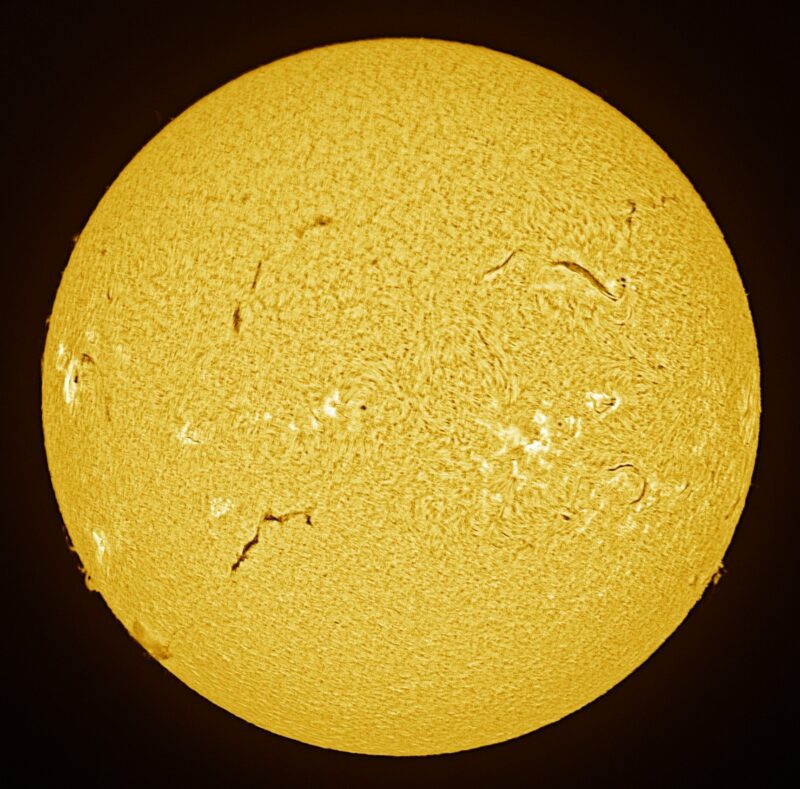 Sun news for July 29, 2026. View at EarthSky Community Photos. | Jim Militello in Tucson, Arizona, captured this filtered image of a calm sun this morning. Thank you, Jim!Sun news July 28: A synchronized double sun eruption
The sun returned to a low flare level over the past day, producing C-class (common) flares only. But our star still surprised us by blasting out two synchronized eruptions. The first started at around 6 UTC on July 27. It was a huge filament eruption, hurling tons of plasma into space. The event was centered over the sun’s central meridian, or midline, just north of where it meets the solar equator. Remarkably, as this filament eruption began, a huge prominence appeared on the sun’s northwest horizon. That signaled a similar event on the far side.
Past 24 hours on the sun(11 UTC July 27 – 11 UTC July 28)Flare activity: Solar activity returned to low levels. Observers logged 12 flares, all C-class flares.
Sunspot regions: The Earth-facing solar disk shows 5 numbered active regions today. Among them is a newcomer just over the northeast shoulder of our sun, now officially numbered AR4498.
Blasts from the sun? Observers spotted a coronal mass ejection (CME) during the M3.2 (moderate) flare at 15:29 UTC on July 26 from AR4494. Initial analysis shows a chunk of solar stuff heading our way, with an arrival time late on July 30. Meanwhile, the filament eruption we report above hurled a separate CME into space. Analysis of its propagation path is ongoing.
Past 24 hours in space weatherSolar wind: Solar wind conditions continued at low levels as the influence of a coronal hole high-speed stream waned.
Bt, Bz and magnetic coupling: The interplanetary magnetic field started the period at weak levels. Then it increased to moderate strength starting at 15:30 UTC. Meanwhile, the Bz component fluctuated mildly between north and south. That was insufficient to drive significant geomagnetic activity.
Earth’s magnetic field: Earth’s magnetic field stayed quiet throughout the period, with the Kp index remaining at 1–3.
 Sun news for July 28, 2026. The sun blasted out 2 synchronized eruptions over the past day. See them? Bam! Bam! More below. Image via the SUVI instrument (304-angstrom wavelength channel) aboard NOAA’s GOES-19 spacecraft.Sun news July 27: Sun-stuff could reach Earth today
A blast of solar material that was launched from the sun on July 24 should give Earth a glancing blow later today. This impact could disturb our magnetic field, possibly triggering G1 (minor) or even G2 (moderate) geomagnetic storms. So aurora watchers in northern Scotland, Scandinavia and similar high-latitude locations should stay alert! Meanwhile, an M3.2 (moderate) flare from AR4494 yesterday afternoon showed signs of blasting more solar material into space. Confirmation remains pending; we’ll let you know in tomorrow’s sun update if this blast is confirmed and, if so, whether it could be on its way to Earth.
Past 24 hours on the sun(11 UTC July 26 – 11 UTC July 27)Flare activity: Solar activity reached moderate levels. Observers logged 7 flares: 2 M-class flares and 5 C-class (common) flares.
Sunspot regions: The Earth-facing solar disk displayed at least 6 numbered active regions, with one new region numbered during the period.
Blasts from the sun? Observers detected two CMEs during the period. However, limited coronagraph imagery complicates the analysis.
Solar wind: Solar wind conditions continued to ease as the influence of a coronal hole high-speed stream waned. Speeds steadily decreased to background levels over the period.
Bt, Bz and magnetic coupling: The interplanetary magnetic field (IMF) stayed weak. Meanwhile, the Bz component fluctuated mildly between north and south. That was insufficient to drive significant geomagnetic activity.
Earth’s magnetic field: Earth’s magnetic field stayed quiet throughout the period, with the Kp index remaining at 0–2.
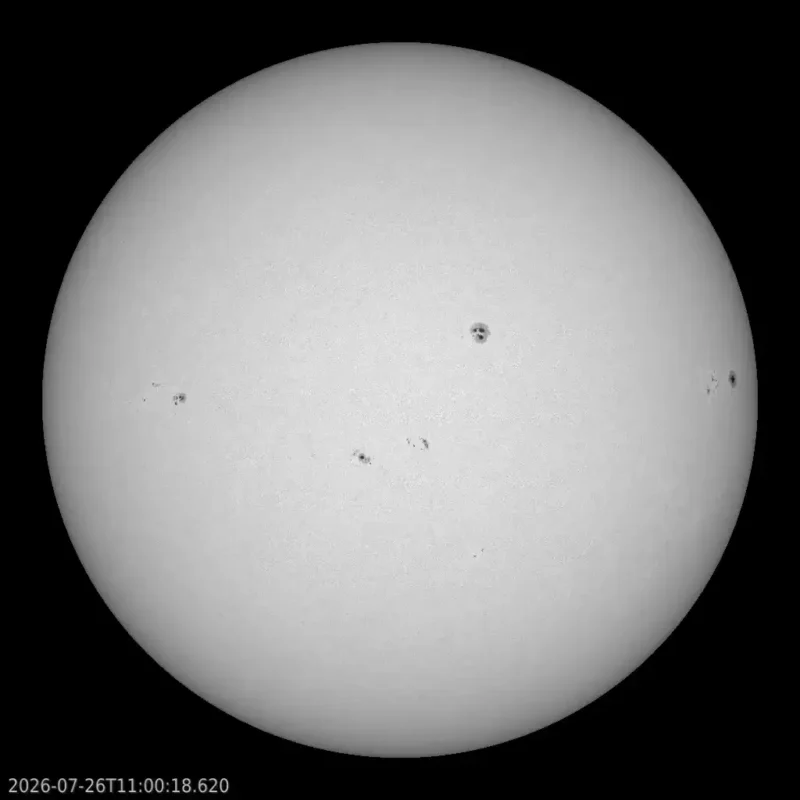 Sun news for July 27, 2026. This image features active region AR4494, the source of the strongest flare of the past day. The M3.2 (moderate) flare peaked at 15:28 UTC on July 26. It might have sent a blast of sun-stuff into space. Meanwhile, another burst of solar material should glance our magnetic field later today. Image via NASA SDO.Sun news July 26 (UTC): CME headed for Earth as solar activity stays low
The sun kept a low profile over the past 24 hours, producing only C (common) flares. But a coronal mass ejection (CME) launched on July 24 is now bearing down on Earth. Models predict arrival as early as late today.
Meanwhile, the solar wind continued to ease from a coronal hole high-speed stream. Speeds settled from around 535 km/s down to near 495 km/s, and the geomagnetic field stayed quiet.
The real story lies ahead. Initial WSA-ENLIL+Cone modeling predicts the July 24 CME could reach Earth around 19:25–19:56 UTC today. Kp indices could reach 5–6, indicating G1 (minor) to G2 (moderate) geomagnetic storm conditions. So if the CME’s magnetic field turns southward upon arrival, aurora watchers from Seattle, Minneapolis, Edinburgh, and possibly Toronto and Chicago could be in for a treat overnight Sunday into Monday.
Past 24 hours on the sun(11 UTC July 25 ? 11 UTC July 26)Flare activity: Solar activity remained at low to moderate levels. Observers logged 9 C (common) flares, with no M (moderate) or X (strong) events during the period.
Sunspot regions: The Earth-facing solar disk displayed 7 numbered active regions.
Blasts from the sun? Observers spotted no new Earth-directed coronal mass ejections in available coronagraph imagery during the period. However, a CME from July 24 remains the primary focus, with Earth arrival expected imminently.
Solar wind: Solar wind conditions reflected a slowly weakening coronal hole high-speed stream (CH HSS), with possible weak transient features mixed in. Speeds gradually decreased from about 535 km/s to 495 km/s over the past day.
Bt, Bz and magnetic coupling: The interplanetary magnetic field (IMF) total strength averaged a weak 4 nT. Meanwhile, the Bz component pointed predominantly northward through approximately 06:15 UTC on July 25. After that, it began weakly oscillating between +/?4 nT. A northward Bz generally keeps Earth’s magnetic shield closed, limiting aurora potential. However, the upcoming CME arrival could change that rapidly. The phi angle remained mainly in a negative (toward-sun) sector, consistent with the polarity of the geoeffective coronal hole.
Earth’s magnetic field: Earth’s magnetic field stayed quiet over the past day, with Kp values remaining at 0–2 under diminishing CH HSS influences. No geomagnetic storm levels occurred. The SIDC noted two isolated unsettled periods over Belgium (Kp ~3) on July 24 (13–14 UTC) and July 25 (11–12 UTC). Globally, though, conditions stayed subdued. This quiet spell should end with the CME arrival later today or tomorrow.
What’s ahead? Sun–Earth forecastFlare activity forecast: Forecasters expect low to moderate levels over the next three days, with a decreasing chance for M-class (R1–R2) flares through July 28. AR4493 continues to decay as it approaches the west limb, reducing its flare threat. The best candidates for M-class activity are AR4494 (beta-delta, with ongoing flux emergence) and AR4496 (beta, growing, well-positioned in the east). AR4495 also showed renewed vigor late in the period and bears monitoring. The chance for an X-class event remains very low.
Geomagnetic activity forecast:
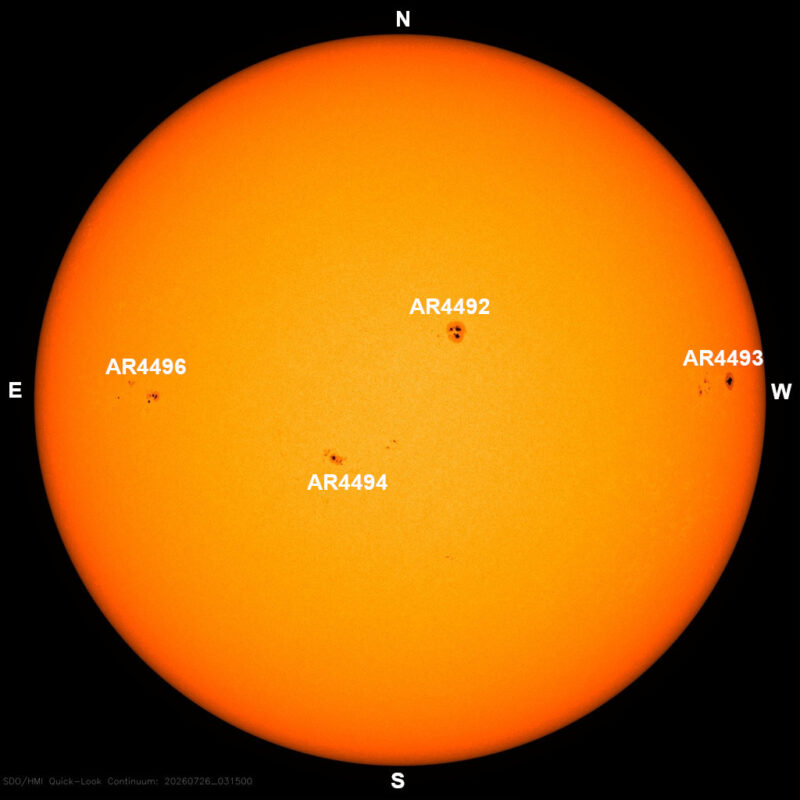 This image shows sun activity – with the most active regions labeled – as of 3 UTC on July 25, 2026. Original image, without labels, via NASA SDO. Courtesy of NASA/SDO and the AIA, EVE, and HMI science teams, with labeling by EarthSky. Armando Caussade posted today’s sun. Why are east and west on the sun reversed?Sun news July 25: Low flare action. Big filament eruptions
Right now, the sun is going through a low-action period in terms of flare production. During our observation period, the sun produced only 5 C-class flares. That’s despite several active regions carrying enough potential to trigger M flares, or even X flares. For now, though, they remain calm with low flare activity. But not everything is quiet on our star. A couple of fiery filament eruptions, among others, caught our attention. The first occurred at around 4:24 UTC on July 24. This huge filament eruption in the southeast quadrant hurled a large amount of plasma into space. Shortly after, at around 12 UTC on July 24, a tremendous explosion on the far side revealed itself as a fast prominence on the southeast horizon. These events prove the point: the sun may be in a calm flaring period, but calm is not the same as boring. We will continue to bring you the latest solar news.
Past 24 hours on the sun(11 UTC July 24 – 11 UTC July 25)Flare activity: Solar activity continued in a low level period over the past day. During the last 24 hours, our sun produced only C-class (common) flares: five C flares in total.
Sunspot regions: Today, the solar disk as we see it from Earth shows five labeled active regions. Among them is a newcomer in the northeast, now numbered AR4496.
Blasts from the sun? Observers spotted a filament eruption in the southeast, associated with a C2.4 flare. The coronal mass ejections (CMEs) hurled into space during this event are now under modeling and analysis. However, first analysis shows a potential Earth-bound component that may arrive late on July 27 or early July 28.
Past 24 hours in space weatherSolar wind: Solar wind speeds averaged moderate-high levels throughout the whole period. Consistent effects from fast solar wind from a coronal hole appear to drive these conditions.
Bt, Bz and magnetic coupling: The interplanetary magnetic field (IMF) showed weak strength. Meanwhile, the Bz component pointed weakly northward through most of the period. Then, just at 8 UTC this morning, it moved slightly southward. It has remained south-oriented until the time of this writing. As always, a sustained south-oriented Bz component can drive geomagnetic activity.
Earth’s magnetic field: Earth’s magnetic field ranged from very quiet to quiet levels during this period. Kp index = 0-2. So what happened to the anticipated G1 storm? The chunk of solar stuff either arrived early, showing up as yesterday’s storming levels, or it arrived today too faint to disturb Earth’s geomagnetic field. At the time of this writing, the Kp index sits just above level 0.
 Sun news for July 25, 2026. This video shows a huge filament eruption in the sun’s southeast quadrant at around 4:24 UTC on July 24. The dark, rope-like filament lifted off and hurled a large amount of plasma into space. First analysis shows a possible Earth-bound component that could arrive late on July 27 or early July 28. The GOES-19 SUVI instrument captured the scene in its 304 angstrom wavelength channel. Will we see auroras? Stay tuned. Image via NOAA.
 Sun news for July 25, 2026. This video captures a tremendous explosion on the sun’s far side, revealed as a fast prominence rising over the southeast limb at around 12 UTC on July 24. Even though the blast came from beyond the visible disk, its towering plasma peeked over the edge into view. The GOES-19 SUVI instrument captured the scene in its 304 angstrom wavelength channel. Image via NOAA.Sun news July 24: Sun stuff jolts Earth’s magnetic field. More tonight?
Earth’s magnetic field got a jolt last night. Fast solar wind from a coronal hole, combined with a complex knot of solar winds known as a co-rotating interaction region (CIR), triggered G1 (minor) geomagnetic storm levels. As a result, auroral displays were possible at high latitudes. And we anticipate more disturbance tonight. A couple of coronal mass ejections (CMEs) that left the sun on July 20 and 21 should arrive today, delivering glancing blows. So don’t put those cameras away! The auroral show may continue with more G1 storming possible.
Past 24 hours on the sun(11 UTC July 23 – 11 UTC July 24)Flare activity: Solar activity continued at low levels over the past day. During the last 24 hours, our sun produced only C-class (common) flares: nine C flares in total.
Sunspot regions: Five numbered active regions populate the solar disk today as we see it from Earth. Among them, AR4495 received its official label during this period.
Blasts from the sun? Observers spotted no Earth-oriented coronal mass ejections (CMEs) in available coronagraph imagery during our observation period.
Past 24 hours in space weatherSolar wind: Solar wind speeds were low early in the period. Then, at 17:00 UTC on July 23, speeds jumped to moderate-high levels. They remained there for the rest of the period. The wind stays under the effects of fast solar wind from a coronal hole, combined with a co-rotating interaction region (CIR).
Bt, Bz and magnetic coupling: The interplanetary magnetic field showed strong levels late on July 23. At 17 UTC, it decreased to weak strength. Meanwhile, the Bz component deflected mostly southward through the first half of this period. At 3 UTC this morning, it moved slightly northward. It then ended the period nearly neutral. A sustained south-oriented Bz component can drive geomagnetic activity.
Earth’s magnetic field: Earth’s magnetic field ranged from quiet to active levels during this period, reaching geomagnetic storm levels. At the moment of this writing, the Kp index sits below level 3.
 Sun news for July 24, 2026. This model predicts the movement of a couple of coronal mass ejections (CMEs) hurled out by the sun on July 20 and 21. These blasts may give Earth a glancing blow today, possibly triggering G1 (minor) geomagnetic storms tonight. Image via NOAA/ Space Weather Prediction Center.
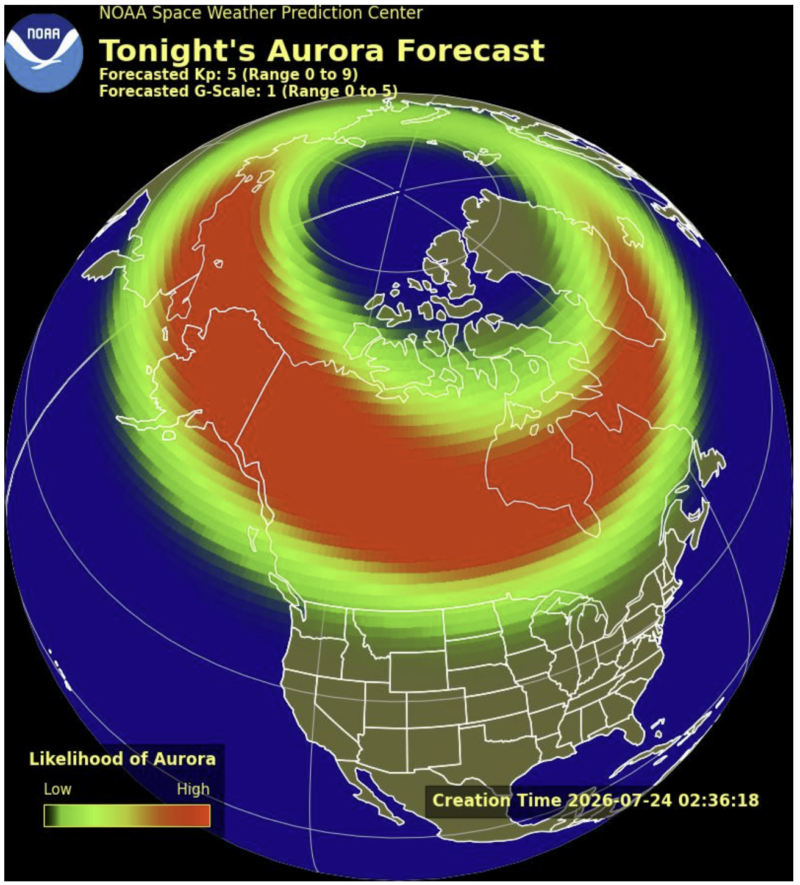 July 24, 2026. Last night G1 (minor) geomagnetic levels were reached at 20:07 UTC on July 23. More G1 intervals are anticipated tonight with a glancing blow from two chunks of solar stuff that left the sun on July 20 and 21. Aurora forecast image via NOAA.
 July 23, 2026. A gorgeous filament eruption was observed over the solar north pole. It came from the far side of our sun starting at 15:21 UTC on July 23. An eye-catching event! GOES-19 SUVI 304 angstrom. Image via NOAA.Sun news July 23: Flaring drops, but potential remains
After two days of multiple M flares, sun activity has eased back to low levels, with only C-class flares produced over the past 24 hours. Still, sunspot region AR4493 refuses to quiet down completely. This powerhouse fired 10 of the day’s 13 flares, including the strongest, a C5.3. It also continued growing. Indeed, it remains both the largest region and the most magnetically complex on the disk, holding onto its beta-gamma-delta configuration. So the potential for bigger blasts has not gone away. Forecasters still give M flares a 55% chance today, with X flares at 10%.
Past 24 hours on the sun(11 UTC July 22 – 11 UTC July 23)Flare activity: Solar activity returned to low levels over the past day. Our sun produced only C-class (common) flares during the last 24 hours: 13 C flares in total.
Sunspot regions: The Earth-viewed side of our sun continues to show four numbered active regions today.
Blasts from the sun? A filament eruption in the northwest, near active region AR4493, hurled a coronal mass ejection (CME) into space at 10:45 UTC on July 21. This CME is partially Earth-bound. However, it was a faint event. Therefore, forecasters anticipate no significant effects at arrival.
Past 24 hours in space weatherSolar wind: Solar wind continued at moderate to moderate-high levels. It remains under the effects of fast solar wind from a coronal hole, combined with a co-rotating interaction region (CIR).
Bt, Bz and magnetic coupling: The interplanetary magnetic field kept showing moderate strength. Meanwhile, the Bz component showed a southward extension through the first half of this period. Then it moved slightly northward. It ended the period nearly neutral. As always, a sustained south-oriented Bz component can drive geomagnetic activity.
Earth’s magnetic field: Earth’s magnetic field was at quiet to unsettled levels during this period, with Kp values of just 2–3. At the moment of this writing, the Kp index sits below level 3.
 Sun news for July 23, 2026. Sun activity returned to low levels today, with only C flares. The GOES-19 satellite’s SUVI instrument captured this view of a serene sun in its 171 angstrom wavelength channel, which traces the graceful magnetic loops arcing above active regions. Image via NOAA/ Space Weather Prediction Center.
 Sun news for July 23, 2026. This video from the SOHO LASCO C3 coronagraph shows Jupiter, the bright star-like object, moving into the field of view from the left. LASCO C3 blocks the sun’s blinding face with an occulting disk. As a result, it reveals the faint corona (outer atmosphere), passing planets, and any bursts of solar material heading out into space. Image via NASA/ ESA/ SOHO.Sun news July 22: 23 flares from new powerhouse sunspot region!
Newcomer sunspot region AR4493 continues to be a prolific flare producer. Over the past day, it provided nearly all the flare activity observed from the Earth-viewed solar disk. That included two M flares and 21 C flares, for a total of 23 blasts out of the day’s 24 flares. And this region still has its beta-gamma-delta configuration, the highest possible level of magnetic complexity. That means it surely has more big flaring in store! Stay tuned.
Past 24 hours on the sun(11 UTC July 21 – 11 UTC July 22)Flare activity: Solar activity stayed at moderate levels over the past day. During this period, the sun sparked a total of 24 flares: 2 M-class (moderate) flares and 22 C-class (common) events.
Sunspot regions: The Earth-viewed side of our sun shows four numbered active regions today. Among them is a newcomer emerging from the southeast horizon, now numbered AR4494.
Blasts from the sun? Observers detected no Earth-directed coronal mass ejections (CMEs) in available coronagraph imagery over the past day.
Past 24 hours in space weatherSolar wind: Solar wind continued at moderate to moderate-high levels. The arrival of fast solar wind from a coronal hole, combined with a co-rotating interaction region (CIR), has been driving this rise.
Bt, Bz and magnetic coupling: The interplanetary magnetic field is showing moderate strength. Meanwhile, the Bz component underwent several extended southward deflections. A sustained south-oriented Bz component can drive geomagnetic activity.
Earth’s magnetic field: Earth’s magnetic field stayed quiet to active during this period, with Kp values of just 2–4. At the moment of this writing, the Kp index sits above level 3.
 Sun news for July 22, 2026. This video shows the M3.6 flare from powerhouse active region AR4493, the day’s leading flare producer. AR4493 fired 23 of the day’s 24 flares, including an M3.6 at 6:35 UTC on July 22 and an M1.7 at 17:27 UTC on July 21. The GOES-19 satellite’s SUVI instrument captured the eruption in its 131 angstrom wavelength channel, which highlights the hot plasma of solar flares. Image via NOAA.
 Sun news for July 22, 2026. The sun blasted out two beautiful, eye-catching prominences. Interestingly, the two erupted almost in sync, one on the southwest corner and the other on the northwest corner. Both came from the far side of the sun, arcing over the horizon into view. The GOES-19 SUVI instrument captured them in its 304 angstrom wavelength channel. Image via NOAA.Sun news July 21: New sunspot region arrives with a bang
A lull on the sun has been shattered by a volley of 3 M flares from new sunspot region AR4493. This region emerged from nothing and grew rapidly in the past couple of days, and now displays a beta-gamma-delta configuration, which is the highest possible level of magnetic complexity. That means it could have plenty more big flares in store! Stay tuned.
Past 24 hours on the sun(11 UTC July 20 – 11 UTC July 21)Flare activity: Solar activity increased from low to moderate levels over the past day thanks to three M flares. Flare production also registered a notable jump. Yesterday, the sun fired just three C-class (common) flares and one B-class (weak) event. This period, it fired 18 flares: 3 M-class plus another 15 C flares.
Sunspot regions: Currently, the sun shows 4 numbered active regions on the side we see from Earth. Among them is a newcomer, now numbered AR4493.
Blasts from the sun? The coronal mass ejections (CMEs) produced during the three M flares of this period remain under modeling and analysis. Forecasters are working to determine if any could reach Earth.
Past 24 hours in space weatherSolar wind: Solar wind conditions averaged at background levels throughout most of the period. However, at 7:30 UTC this morning, speeds increased to moderate levels. The arrival of fast solar wind from a coronal hole, combined with a co-rotating interaction region (CIR), caused this rise.
Bt, Bz and magnetic coupling: The interplanetary magnetic field showed similar behavior. It stayed weak during almost the entire period. Then, at 6:30 UTC this morning, the Bt component started to increase. By the end of the period, it showed strong levels. Meanwhile, the Bz component pointed southward the whole period. A sustained south-oriented Bz component may drive geomagnetic activity. In short, the calm is passing. The coronal hole’s fast wind is arriving.
Earth’s magnetic field: Earth’s magnetic field stayed quiet-to-unsettled during this period, with Kp values of just 1–3. No geomagnetic storm conditions occurred. Auroras remained confined to the highest latitudes around the auroral oval. At the moment of this writing, the Kp index sits at level 3.
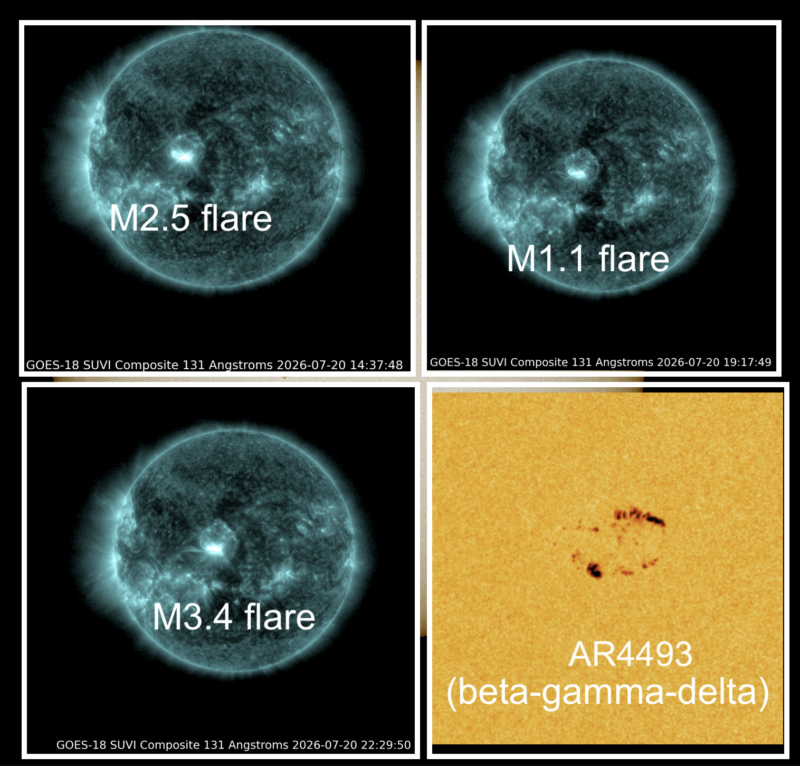 Sun news for July 21, 2026. These four panels show the fiery debut of new active region AR4493. From left to right and top to bottom: the M2.5 flare at 14:36 UTC, the M1.1 flare at 19:20 UTC, and the M3.4 flare at 22:25 UTC, all on July 20, as captured by the GOES-19 SUVI instrument. The final panel shows the AR4493 sunspot region itself, seen in visible light by NASA SDO’s HMI intensitygram. Images via NOAA and NASA.
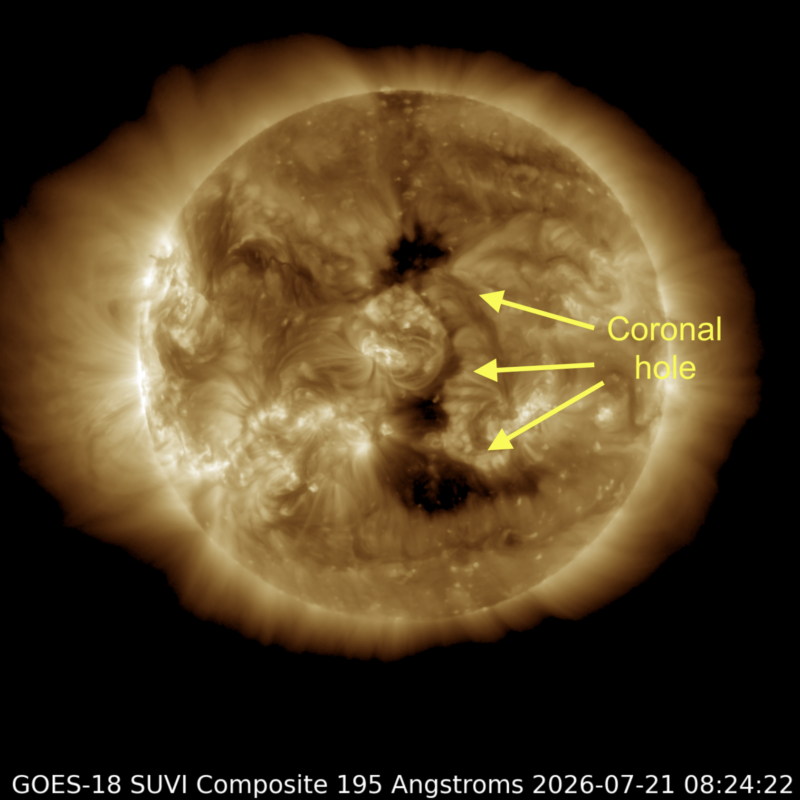 Sun news for July 21, 2026. This image shows the large coronal hole, a dark region of lower density in the sun’s outer atmosphere. Its fast solar wind stream is arriving now and could spark G1 (minor) geomagnetic storms and auroras on July 22. The GOES-19 SUVI instrument captured this view. Image via NOAA.Sun news July 20: Fast solar wind on its way to Earth
A large coronal hole we saw a couple of weeks ago has passed around the far side of the sun and returned to our star’s Earth-facing side. This “hole” in the sun’s outer atmosphere has just crossed the center of the solar disk. That means the fast solar wind streaming from it is on its way to our planet, and should reach our magnetic field late on July 21. As a result, geomagnetic activity could climb to G1 (minor) geomagnetic storm levels by July 22. Stay tuned!
Past 24 hours on the sun(11 UTC July 19 – 11 UTC July 20)Flare activity: Solar activity remained low over the past day. Observers recorded three C-class (common) flares and one B-class (weak) event.
Sunspot regions: The Earth-facing solar disk displayed three numbered active regions.
Blasts from the sun? Forecasters cataloged four coronal mass ejections (CMEs) during the period. However, none should impact Earth.
Past 24 hours in space weatherSolar wind: Solar wind conditions remained at background levels throughout the period.
Bt, Bz and magnetic coupling: The interplanetary magnetic field stayed weak. The Bz component fluctuated gently between moderately northward and southward, but the southward dips were not sustained enough to drive geomagnetic activity. These are textbook quiet solar wind conditions: the calm before the coronal hole wind arrives.
Earth’s magnetic field: Earth’s magnetic field stayed quiet throughout the entire period, with Kp values of just 0–2. No geomagnetic storm conditions occurred. Auroras remained confined to the highest latitudes around the auroral oval. Moreover, the short summer nights in the Northern Hemisphere further limited any visibility.
 Sun news for July 20, 2026. The solar wind is currently calm, but we’re expecting bursts of high-speed wind from a coronal hole. That’s a region where the sun’s magnetic field opens up into space, allowing the super-hot atmosphere to stream more easily from the sun, giving us the fast solar wind. This artist’s animation shows the coronal hole blowing the fast wind toward Earth and its magnetic field (not to scale). Images via NASA/ SVS.Sun news July 19 (UTC): Quiet Sun, but a fast wind is coming(11 UTC July 18 ? 11 UTC July 19)
The sun took a breather over the past 24 hours. Flare production stayed at low levels, with only a handful of modest C-class flares recorded. The Earth-facing disk hosted just two small, magnetically simple sunspot regions. Neither showed much ambition. However, new activity is stirring just beyond view. Multiple low-level flares came from at least one region rotating onto the northeast limb. This hints at fresh magnetic complexity that could boost activity in the days ahead. Meanwhile, the solar wind stayed sluggish, averaging around 325 km/s. Earth’s magnetic field also stayed quiet under benign conditions. But don’t let the calm fool you. A large coronal hole is poised to send a fast wind stream toward Earth by July 21 and 22, with speeds potentially reaching 700 km/s. That arrival could push geomagnetic conditions to G1 (minor) geomagnetic storm levels. Consequently, aurora watchers at high latitudes should stay on the alert.
Past 24 hours on the sunFlare activity: Solar activity remained at low levels. Observers logged four C (common) flares during the period.
Sunspot regions: The Earth-facing solar disk displayed two numbered active regions. Both are small and magnetically simple.
Blasts from the sun? Observers spotted no Earth-directed coronal mass ejections (CMEs) during the past day.
Past 24 hours in space weatherSolar wind: Solar wind speeds remained sluggish. They decreased from around 370 km/s to 325 km/s over the period, well within background levels.
Bt, Bz and magnetic coupling: The interplanetary magnetic field (IMF) stayed weak, with total field strength (Bt) reaching only 5 nT. The Bz component fluctuated gently between +3 and -3 nT. It never sustained a southward orientation long enough to drive any geomagnetic response. These are textbook quiet-time conditions.
Earth’s magnetic field: Earth’s magnetic field stayed quiet throughout the period, with Kp values ranging from 0 to 2. No geomagnetic storm levels occurred. Local indices at Chambon-la-Forêt (Ak = 11) and Wingst (Ak = 8) confirmed the globally quiet picture. As a result, aurora stayed confined to the high-latitude auroral oval, with no enhancements visible at lower latitudes.
What’s ahead? Sun–Earth forecastFlare activity forecast: Forecasters expect low levels to continue through July 19–21, with a slight chance for M-class (R1–R2) flares. The new region or regions rotating onto the northeast limb near N15 will drive any uptick in activity. As they come fully into view for better analysis, the M-class probability may increase.
By contrast, AR4489 and AR4491 should not produce significant flaring, given their simple alpha magnetic configurations. Likewise, the chance of an X-class flare remains very low.
Geomagnetic activity forecast:
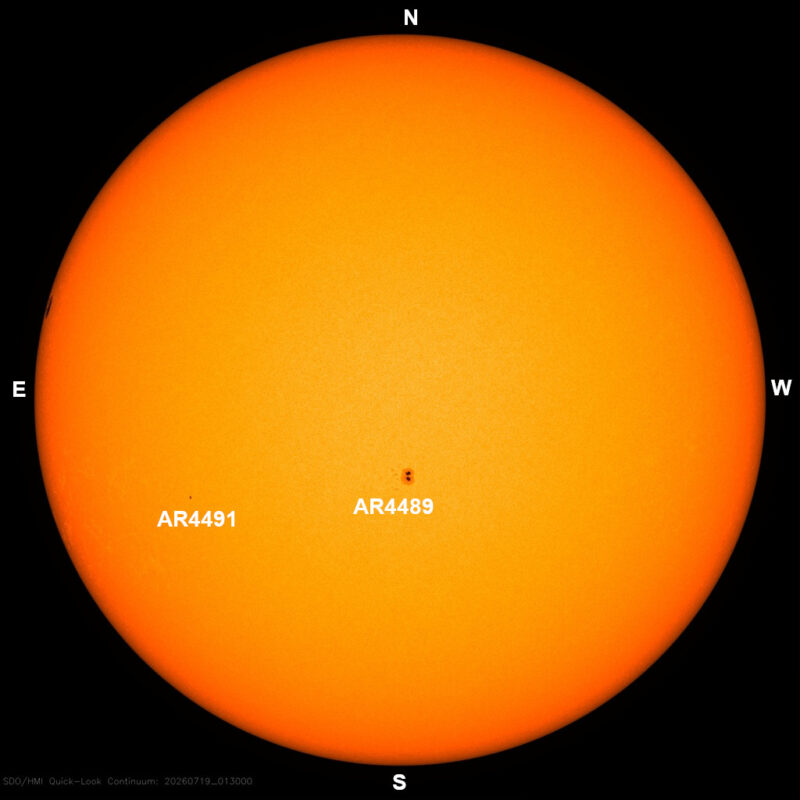 This image shows sun activity – with the most active regions labeled – as of 1 UTC on July 19, 2026. Original image, without labels, via NASA SDO. Courtesy of NASA/SDO and the AIA, EVE, and HMI science teams, with labeling by EarthSky. Armando Caussade posted today’s sun. Why are east and west on the sun reversed?Sun news July 18: Large coronal hole turns toward Earth(11 UTC July 17 – 11 UTC July 18)
An enormous coronal hole has emerged from the east. A coronal hole is a large, temporary region in the sun’s atmosphere, or corona, where the plasma is cooler, less dense, and more magnetically open than its surroundings. These open magnetic field lines let fast solar wind escape into space. This hole spans the sun’s equator, connecting the northern and southern hemispheres. Meanwhile, the sun’s rotation is carrying it westward. Soon, it will reach a position where its fast solar wind can affect Earth. As this solar wind strikes Earth and disturbs our magnetic field, we might get auroras! Stay tuned.
Past 24 hours on the sunFlare activity: Sun activity over the past day dropped from low to very low levels. A long-awaited sunspot region that’s been blasting flares from behind the sun’s southeastern horizon hasn’t proven to show an interesting magnetic complexity, and it’s not growing in size. For now, it looks quite stable with low flare potential. Over the past day, the sun produced more B (weak) flares than C (common) flares: 6 flares in total; 2 Cs and 4 Bs.
Sunspot regions: Today the sun was left again with only two numbered active regions on its Earth-viewed side. The rest decayed. There is an incomer sunspot region, as-yet-unnumbered, showing in the sun’s northeast.
Blasts from the sun? No Earth-directed coronal mass ejections (CMEs) were reported by observers from available coronagraph imagery during the past day.
Past 24 hours in space weatherSolar wind: Solar wind speeds decreased from moderate to moderate-low levels throughout the period. There is no significant space weather to report. Meanwhile, the interplanetary magnetic field showed consistently shifting between moderate to weak levels.
Bt, Bz and magnetic coupling: The Bz component pointed southward until 18 UTC on July 17. Then it started shifting consistently for short periods, from south to north. At the time of this writing the Bz component shows a weak northward orientation. The brief southward configurations do not favor auroras. Longer periods are needed to open Earth’s magnetic field to incoming solar wind energy.
Earth’s magnetic field: The geomagnetic field showed very quiet levels during this period (Kp 0–1). There was no significant geomagnetic field behavior. At the time of this writing, the Kp index sits at 1.
 Sun news July 18, 2026. The sun is in a period of low flare production. But a large coronal hole emerged from the east, and soon it will start sending its fast solar wind directly to us at Earth. That means possible auroral displays ahead! GOES-19 SUVI 195-angstrom image via NOAA.Sun news July 17: Eagerly awaited sunspot region arrives(11 UTC July 16 – 11 UTC July 17)
A long-awaited sunspot region that’s been blasting flares from behind the southeastern horizon has finally emerged into view. Meet AR4491! Its position close to the sun’s edge makes analysis difficult, but forecasters have assigned it an alpha configuration for now. The region also appears smaller than expected. But, again, its location near the horizon can make it appear smaller than it is. Its true size and power will becomer apparent in the coming days! For now, it remained the leading flare producer of the past day and also fired the strongest flare of this period, a C5.3.
Past 24 hours on the sunFlare activity: Sun activity over the past day remained at low levels. In total, the sun fired 3 C-class (common) flares.
Sunspot regions: Currently, the sun shows four numbered active regions on its Earth-viewed side. Notably, the newcomer sunspot region received its official label: AR4491.
Blasts from the sun? Observers spotted no Earth-directed coronal mass ejections (CMEs) in available coronagraph imagery during the past day.
Past 24 hours in space weatherSolar wind: Solar wind speeds continued at moderate levels throughout the period. No significant space weather occurred. Meanwhile, the interplanetary magnetic field stayed at weak levels.
Bt, Bz and magnetic coupling: The Bz component pointed northward from 21 UTC on July 16 through 2:30 UTC on July 17. For the rest of the period, it showed a southerly orientation. It still points south at the time of this writing. A southward configuration favors auroras because it opens Earth’s magnetic field to incoming solar wind energy.
Earth’s magnetic field: The geomagnetic field stayed at quiet levels during this period (Kp 1–2). At the time of this writing, the Kp index sits slightly above level 2.
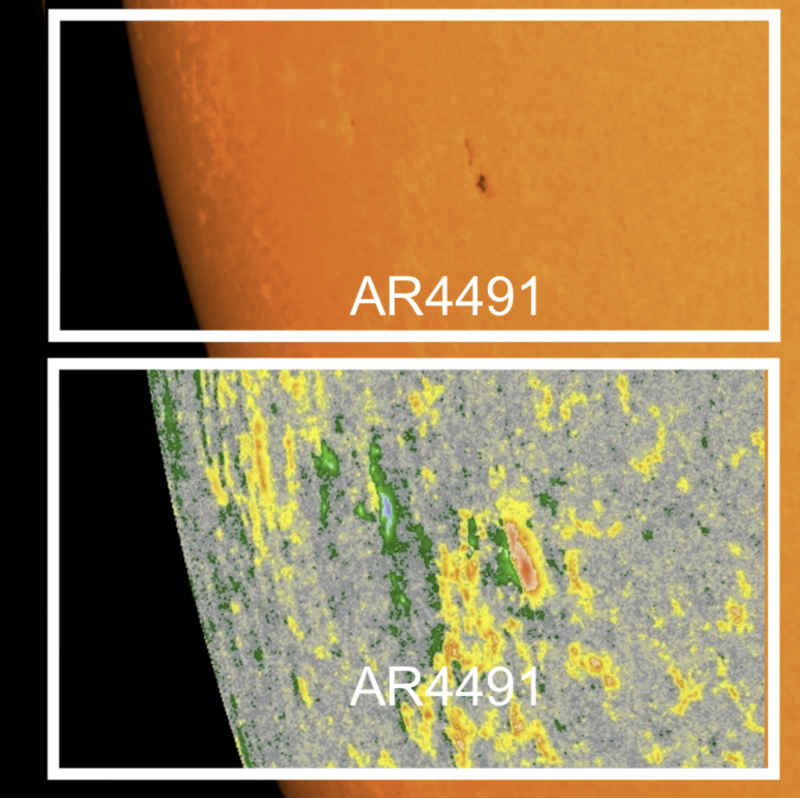 Sun news for July 17, 2026. Meet AR4491! The top panel shows the newly numbered sunspot region as a small dark sunspot near the sun’s southeastern limb (edge). The bottom panel maps its magnetic fields, with green and red-orange patches marking opposite polarities. NASA’s Solar Dynamics Observatory (SDO) captured both views. Image via NASA SDO.Sun news July 16: A fiery sunspot region is showing its nose(11 UTC July 15 – 11 UTC July 16)
A fiery sunspot region is showing its nose on the southeast solar horizon. It has not yet received an official number, since it still sits behind the edge of our star. But even so, over the past 24 hours it became the leading flare producer and fired the day’s strongest flare for the 2nd day running. Not bad for a region that hasn’t even fully arrived yet! Its strongest flare this time was a C8.9, just shy of the M (moderate) flare boundary. So all eyes are now on the southeast, where constant fiery prominences – long ropes of solar material – show that this region’s arrival is imminent. Stay tuned.
Past 24 hours on the sunFlare activity: Over the past day, solar activity continued at low levels, though it edged close to moderate. In total, the sun fired six flares: five C-class (common) and one B-class (weak).
Sunspot regions: Today, the sun continued to show two numbered active regions on its Earth-viewed side. However, the approaching sunspot region in the southeast is ready to come into view as a newcomer.
Blasts from the sun? Observers spotted no Earth-directed coronal mass ejections (CMEs) in available coronagraph imagery during the past day.
Past 24 hours in space weatherSolar wind: Solar wind speeds averaged at moderate levels during the past day. No significant space weather occurred. Meanwhile, the interplanetary magnetic field decreased from moderate levels late on July 15 to weak levels early this morning.
Bt, Bz and magnetic coupling: The Bz component pointed mostly southward throughout the period, with a few weak northward peaks in the first half. At the time of this writing, its orientation has moved slightly north. As always, a southward configuration favors auroras because it opens Earth’s magnetic field to incoming solar wind energy.
Earth’s magnetic field: The geomagnetic field ranged from quiet to unsettled levels (Kp 1–3). At the time of this writing, the Kp index sits at level 3.
Sun news July 15: Solar action is on the far side(11 UTC July 14 – 11 UTC July 15)The most exciting solar activity is currently on the sun’s far side. We can tell thanks to the fiery prominences – long ropes of solar material – on the northwestern and southwestern solar horizons. Take a look at our top image. It seems the sunspot regions that just rotated to the far side are keeping up their fiery activity, which is spilling over the western limb (edge). For example, AR4485, which rotated to the far side a couple of days ago, registered a C1.2 flare during this period. This blast was likely larger than measured, since the sun itself blocked part of its light.
Past 24 hours on the sunFlare activity: Solar activity stayed at low levels over the past day. In total, the sun fired four flares: three C-class (common) and one B-class (weak).
Sunspot regions: Today the sun shows two numbered active regions on its Earth-viewed side. Interestingly, the two sunspot regions sit in opposite directions, one in the southeast and the other in the southwest. As a result, they look almost symmetrically placed. Take a look at our sun image below.
Blasts from the sun? Observers spotted no Earth-directed coronal mass ejections (CMEs) in available coronagraph imagery during the past day.
Past 24 hours in space weatherSolar wind: Solar wind speeds increased from moderate to moderate-high levels during the period. The combined effects of weak CME arrivals and fast solar wind drove this rise. Meanwhile, the interplanetary magnetic field registered strong levels late on July 14, before decreasing to moderate levels.
Bt, Bz and magnetic coupling: The Bz component pointed northward during the first half of this period. Then, at 18 UTC on July 14, it turned southward for the rest of the period. This configuration favors auroras because it opens Earth’s magnetic field to incoming solar wind energy.
Earth’s magnetic field: The geomagnetic field ranged from quiet to active levels (Kp 2–4). The Kp index reached 4 (active) during one three-hour period at 5:54 UTC on July 15. At the time of this writing, the Kp index continues at level 4.
 Sun news for July 15, 2026. This view from the GOES-19 spacecraft, captured at 1:36 UTC on July 15, shows the sun in the 304 angstrom wavelength channel. This reveals “cooler” plasma at around 50,000 Kelvin (90,000 degrees Fahrenheit), ideal for viewing filaments and prominences. At the western horizon (right), the departed region AR4485 generates beautiful prominences as it rotates out of view. Image via NOAA.
 Sun news for July 15, 2026. This WSA-ENLIL model run from NOAA’s Space Weather Prediction Center tracks solar wind plasma density (top) and speed (bottom) as material travels from the sun. Earth is the green dot on the black orbit circle. A fast, dense stream sweeps out to the lower left, missing Earth as it traces the sun’s spiral rotation. Forecasters use the graphs at right to predict when shock waves will strike Earth. Image via NOAA.Sun news July 14: Solar eruption stirs Earth’s magnetic field(11 UTC July 13 – 11 UTC July 14)
The expected coronal mass ejection (CME) fired from the sun on July 10 did arrive. But it didn’t reach G1 (minor) geomagnetic storm levels. Instead, the geomagnetic disturbance peaked as a minor Kp 4 enhancement. Conditions reached that threshold at 00:00 UTC on July 14. The enhancement lasted for one three-hour synoptic period. What caused it? The combined punch of a waning coronal hole solar wind stream and the glancing arrival of the CME. Now we keep watching ahead, as more CMEs could brush past Earth over the next several days. So stay alert, aurora watchers!
Past 24 hours on the sunFlare activity: Solar activity continued at low levels over the past day. The sun produced a total of 6 flares: 2 C-class (common) and 4 B-class (weak).
Sunspot regions: Currently, 5 numbered active regions populate the Earth-viewed solar disk. Newcomer AR4489 received its number during this period as it showed its nose over the southeast horizon.
Blasts from the sun? Observers spotted no Earth-bound coronal mass ejections (CMEs) in available coronagraph imagery during the last 24 hours.
Past 24 hours in space weatherSolar wind: Solar wind conditions reflected the waning influence of a coronal hole’s high-speed solar wind stream. Speeds averaged moderate levels. They then decreased to moderate-low by the end of this period. Meanwhile, the interplanetary magnetic field registered moderate levels.
Bt, Bz and magnetic coupling: The Bz component showed a southerly orientation during the first half of this period. Then, at 22 UTC on July 13, it turned northward for three hours. After 2:30 UTC this morning, the Bz component tilted southward again. This configuration favors auroras because it opens Earth’s magnetic field to incoming solar wind energy.
Earth’s magnetic field: The geomagnetic field ranged from quiet to active levels. The Kp index reached 4 (active) during one three-hour synoptic period at 0:00 UTC on July 14. Outside this interval, conditions stayed generally quiet to unsettled (Kp 1–3). By the end of the reporting period, the field had settled back to quiet levels. At the time of this writing, the Kp index sits just below level 2.

 Sun news for July 14, 2026. This visualization shows the solar wind, a constant stream of charged particles from the sun, flowing past Earth. Our planet’s magnetic field deflects the particles, forcing them to stream around us. Earth’s protective magnetic bubble, called the magnetosphere, shields Earth from the brunt of the solar wind. But, over the past day, Earth felt the combined effects of a coronal hole‘s solar wind stream and a glancing coronal mass ejection (CME), briefly stirring our world’s magnetic field to minor Kp 4 conditions. Image via NASA’s Scientific Visualization Studio.
 Sun news for July 14, 2026. Active region AR4485 is still flaring at the very edge of the southwestern solar horizon, even after it has rotated out of view. Here, it produced this beautiful prominence, arcing above the limb. The GOES-19 SUVI instrument captured these images in its 304 angstrom wavelength channel. Image via NOAA.Sun news July 13: Sun-stuff could reach Earth tonight(11 UTC July 12 – 11 UTC July 13)
Earth’s magnetic field is set for another round of disturbance. A burst of sun-stuff – a coronal mass ejection (CME) – fired from the sun on July 10 is edging closer. It could give our planet a glancing blow late today or early tomorrow. This comes after our geomagnetic field already reached G1 (minor) geomagnetic storm levels yesterday. That was caused by the combined punch of a waning coronal hole solar wind stream and the glancing arrival of a CME from July 9. And looking ahead, forecasters are keeping a close eye on up to four CMEs that could brush past Earth over the next several days. Stay tuned!
Past 24 hours on the sunFlare activity: Solar activity held at low to moderate levels over the past day. Observers logged 8 flares: 4 C-class and 4 B-class events.
Sunspot regions: The Earth-facing solar disk displayed approximately 5 numbered active regions. However, the count is in flux as AR4485 departs around the west limb and a new spot emerges on the east.
Blasts from the sun? Forecasters tracked multiple CMEs during and around the reporting period. None of the newly observed events should directly impact Earth. Instead, the primary focus remains on previously launched CMEs still en route.
Past 24 hours in space weatherSolar wind: Solar wind conditions reflected the waning influence of a coronal hole’s high-speed solar wind stream, combined with the July 9 CME’s glancing arrival. Speeds steadily decreased to near normal. Meanwhile, the interplanetary magnetic field (IMF) remained normal.
Bt, Bz and magnetic coupling: The Bz component spent much of the morning hours tilted southward. This configuration favors aurora because it opens Earth’s magnetic field to incoming solar wind energy. After midday, however, the Bz turned neutral to mostly northward, closing the door for auroral activity.
Earth’s magnetic field: The geomagnetic field ranged from quiet to G1 (minor) storm levels. The Kp index reached 4 (active) during the 9–12 UTC window on July 12, meeting the G1 threshold. Outside this interval, conditions stayed generally quiet to unsettled (Kp 1–3). By the end of the reporting period, the field had settled back to quiet levels.
 Sun news for July 13, 2026. This visualization shows a giant explosion of magnetic energy from the sun – a coronal mass ejection (CME) – slamming into Earth’s magnetic field, which deflects the blast. Up to four CMEs could brush past Earth’s magnetic shield in the coming days. Image via NASA’s Scientific Visualization Studio (SVS).Sun news July 12 (UTC): M1.2 flare as CME impacts for Earth loom(11 UTC July 11 – 11 UTC July 12)
The sun maintained low-to-moderate activity over the past day. Sunspot region AR4485 fired off an M1.2 flare at 7:17 UTC on July 12, as the region approached the sun’s western limb. In turn, the flare triggered a brief R1 (Minor) radio blackout over the sunlit Eastern Hemisphere. Meanwhile, Earth’s magnetic field held mostly quiet overnight. But the calm may not last long. Up to three coronal mass ejections (CMEs) are bearing down on our planet. The first should deliver a glancing blow later today (July 12). Two more could arrive in tandem late on July 13 or early July 14. Forecasters say the combined impacts could push geomagnetic conditions to G1 (Minor) storm levels today, with a chance of G2 (Moderate) intervals. As a result, aurora watchers across Scotland, Scandinavia, and similar magnetic latitudes could stay busy into mid-week (though short summer nights will limit viewing opportunities).
Flare activity: Solar activity was at moderate levels. Observers logged six flares during the period: one M-class and five C/B-class events. All significant activity came from AR4485. Notably, the region kept producing flares even as foreshortening near the western limb made magnetic analysis increasingly difficult.
Sunspot regions: The Earth-facing solar disk displayed six numbered active regions. However, the most complex and productive of them is rapidly approaching the western limb.
Blasts from the sun? Observers spotted three CMEs during the period. Fortunately, none carry significant Earth-directed components. However, previously launched CMEs remain of interest for the forecast period.
Solar wind: Solar wind speeds reflected the persistent yet waning influence of a negative-polarity coronal hole high-speed stream. Speeds decreased from about 585 km/s at the start of the period. They gradually eased to about 490 km/s by midday on July 11. Then they rose again to near 530 km/s by the period’s end.
Meanwhile, the interplanetary magnetic field (IMF) total strength averaged roughly 5 nT. The Bz component fluctuated between +7 nT and -4 nT, staying mostly northward. This limited geomagnetic coupling and kept conditions relatively calm. The phi angle remained predominantly in the negative (toward-sun) sector.
Earth’s magnetic field: The geomagnetic field ranged from quiet to unsettled levels (Kp 1–3) under the weakening influence of the coronal hole high-speed stream. Notably, no geomagnetic storm thresholds were crossed during the period. The predominantly northward Bz orientation limited energy transfer into Earth’s magnetosphere. As a result, conditions stayed subdued despite moderately elevated solar wind speeds.
What’s ahead? Sun–Earth forecastFlare activity forecast: We expect solar activity to remain at low levels, with a chance (25%) for M-class (R1–R2) flares through July 13. The complexity and flare potential of AR4485 drives this outlook as the region transits the western limb. By July 14, AR4485 should have rotated far enough behind the limb to minimize its impact on Earth-side flare activity. The chance for an X-class event stays very low (5%).
Geomagnetic activity forecast:
 Sun news for July 12, 2026. This video documents a C6.0 solar flare before the M-class flare from active region AR4485 evolving over the sun’s coronal landscape. The event began at 00:28 UTC on July 12, as localized magnetic destabilization built into a brilliant extreme-ultraviolet flare that peaked at 00:57 UTC. Over the following hours, the active region seemed to cool. It then reconfigured into an extensive network of glowing post-flare loops, and it released an M1.2 flare. More may come as it rotates out of view. NASA’s Solar Dynamics Observatory (SDO) captured the sequence in its 193-angstrom wavelength channel. Image via NASA.
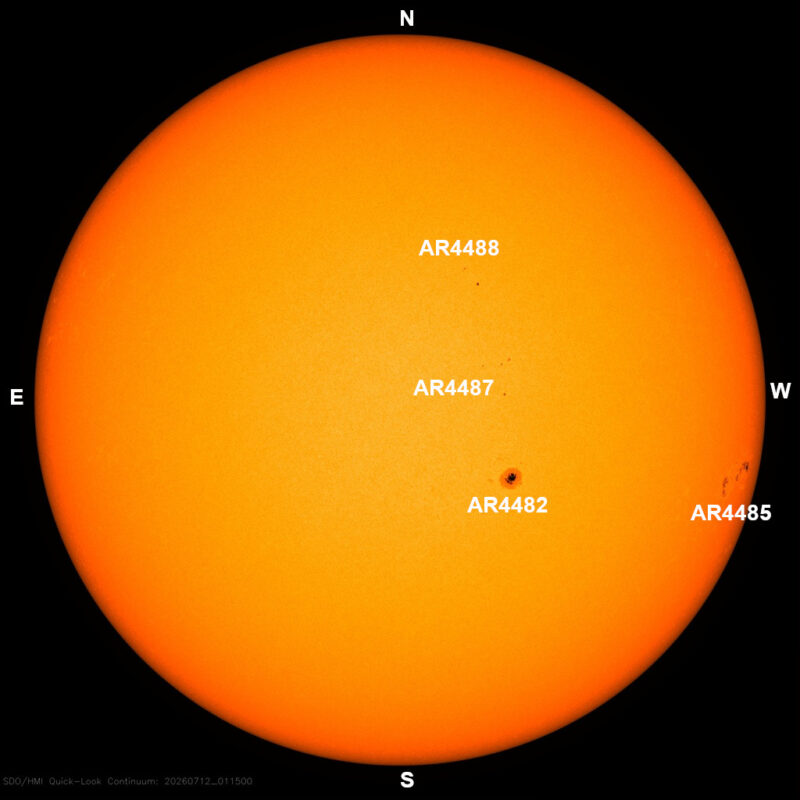 This image shows sun activity – with the most active regions labeled – as of 1 UTC on July 12, 2026. Original image, without labels, via NASA SDO. Courtesy of NASA/SDO and the AIA, EVE, and HMI science teams, with labeling by EarthSky. Armando Caussade posted today’s sun. Why are east and west on the sun reversed?Sun news July 11: Sun still quiet, but auroras possible at Earth(11 UTC July 10 – 11 UTC July 11)
Over the past day, sun activity saw a slight increase from very low to low levels thanks to a couple of C-class (common) flares. Meanwhile, a chunk of sun-stuff that left our star on July 9 might strike Earth’s magnetic field this weekend, with a glancing blow. That means G1 (minor) geomagnetic storm conditions are possible tonight and could extend through July 12.
Past 24 hours on the sunFlare activity: In total, the sun fired 6 flares: 2 C-class and 4 B-class flares.
Sunspot regions: The sun is still quiet. The Earth-viewed solar disk today shows 4 numbered active regions.
Blasts from the sun? Observers spotted a coronal mass ejection (CME) associated with the C6.0 event from AR4485 at 14:59 UTC on July 10. Initial analysis suggests the bulk of this chunk of solar stuff will pass ahead of Earth. But modeling and analysis continue. In addition, a second event hurled plasma into space: a filament eruption at 13:10 UTC from the northeast. Take a look at our lower image. Modeling of this event is ongoing.
Past 24 hours in space weatherSolar wind: Solar wind speeds showed moderate-high levels during the first half of this period. Then, at around 22:45 UTC on July 10, speeds started to decrease. They reached moderate levels by the time of this writing. Meanwhile, the total interplanetary magnetic field (IMF) held at weak levels throughout the period. The Bz component intermittently shifted between northward and southward during the first half of the period. At around 22:45 UTC on July 10, it turned mostly southward. At the time of this writing, it has turned northward. As a result, magnetic coupling stayed open for aurora activity early this morning, with a slight chance of auroral displays at high latitudes.
Earth’s magnetic field: Over the past day, the geomagnetic field ranged from quiet-to-unsettled levels (Kp 1–3+). Conditions climbed slightly above Kp 3 at 11 UTC on July 10. At the time of this writing, the Kp index sits just above level 2.
 Sun news for July 11, 2026. This animated image shows a run of the WSA-ENLIL model, which forecasters use to predict how solar wind and coronal mass ejections (CMEs) travel through the solar system. The sun is the yellow dot, and Earth marked along its orbit (green dot). This computer model tracks solar material heading out from the sun, helping forecasters estimate arrival times at Earth. Image via NOAA.
 Sun news for July 11, 2026. This animated image shows a filament eruption from the sun’s northeast at around 13:10 UTC on July 10, hurling plasma into space. Modeling of the event is ongoing. The GOES-19 SUVI instrument captured these images in its 304-angstrom wavelength channel. Image via NOAA.Sun news July 10: Is the quiet sun awaiting a big blast?(11 UTC July 9 – 11 UTC July 10)
Sun activity decreased to very low levels today, with only a few faint B-class flares. Notably, sunspot region AR4482 lost its magnetic complexity – a beta-gamma-delta complexity – which indicates a high potential for flaring. This region now shows a simpler beta configuration. But we’ve seen this before. Other sunspot regions have lost their gamma-delta complexity, then regained a lost delta, sparking stronger flares before departing to the far side. Shall we see the same behavior from AR4482? We will keep watching. Meanwhile, AR4485 continued to grow and developed a small delta in its complexity. It ranks as today’s lead flare producer. Still, only faint B-class flares have emerged from this active region. Stay with us.
Past 24 hours on the sunFlare activity: Over the past day, solar activity dropped to a very low level with only B-class (weak) flares. In total, the sun fired 6 B-class flares.
Sunspot regions: The Earth-viewed solar disk today shows 4 numbered active regions.
Blasts from the sun? Observers spotted no Earth-directed coronal mass ejections (CMEs) in available coronagraph imagery.
Past 24 hours in space weatherSolar wind: Solar wind speeds increased from moderate to moderate-high levels during the period. Fast solar wind from a coronal hole drove this rise. Meanwhile, the total interplanetary magnetic field (IMF) climbed to strong levels late on July 9. Then, at 22 UTC on July 9, it began easing back to moderate-to-strong levels. The Bz component predominantly pointed southward for most of the period, with only a few weak northward peaks. At the time of this writing, it continues to point south. As a result, magnetic coupling stayed open for aurora activity. There was a slight chance of auroral displays at high latitudes.
Earth’s magnetic field: Over the past day, the geomagnetic field ranged from quiet to active levels (Kp 1–4). Forecasters observed no geomagnetic storm levels during the period. However, conditions reached the active threshold (Kp 4) at 11:20 UTC on July 9. At the time of this writing, the Kp index sits at level 3.
 Sun news for July 10, 2026. Here’s something we haven’t seen very often in recent years, since the sun just passed the peak of its 11-year cycle of activity. This video shows a quiet sun. The time period is 7:30 UTC on July 9 to 3:30 UTC on July 10. Only faint B-class flares emerged during this period, and so, officially, solar activity dropped to very low levels over the past day. But is a bump-up in activity ahead? The GOES-19 SUVI instrument captured these images in its 171-angstrom wavelength channel. Image via NOAA.Sun news July 9: Two M flares from promising sunspot region(11 UTC July 8 – 11 UTC July 9)
Thanks to a couple of M-class flares, sun activity remained at moderate levels over the past day. Sunspot region AR4482 produced both M flares. This is the largest region on the solar disk currently, and has the maximum possible magnetic complexity: beta-gamma-delta. That means it has the potential to fire more M flares and even X flares. This region already fired an X flare when it first appeared on the northeast horizon, so let’s see if it has any more in store!
Past 24 hours on the sunFlare activity: Over the past day, solar activity continued at moderate levels thanks to a couple of M-class (moderate) flares. In total, the sun fired 7 flares: 2 M-class (moderate), 2 C-class (common), and 3 B-class (weak).
Sunspot regions: The Earth-viewed solar disk today shows 5 numbered active regions. Two newcomers were officially numbered during this period: AR4486 and AR4487.
Blasts from the sun? Observers spotted no Earth-directed coronal mass ejections (CMEs) in available coronagraph imagery.
Past 24 hours in space weatherSolar wind: Solar wind speeds averaged at moderate levels during the period. Meanwhile, the total interplanetary magnetic field (IMF) strength remained at moderate-to-strong levels. The Bz component pointed strongly southward for most of the period, with only a few weak northward peaks. At the time of this writing, it continues to point south. As a result, magnetic coupling stayed open for aurora activity.
Earth’s magnetic field: Over the past day, the geomagnetic field stayed quiet (Kp 1–3). Forecasters observed no geomagnetic storm levels during the period. At the time of this writing, the Kp index sits at level 1.
 Sun news for July 9, 2026. This video shows the full sun and then the southeastern quadrant of the sun, where active region AR4482 fired off the day’s strongest flare, an M1.5. This M flare was one of two that kept sun activity at moderate levels over the past day. The GOES-19 satellite’s SUVI instrument captured the eruption. Image via NOAA.
 Sun news for July 9, 2026. This NASA WSA-ENLIL model shows the predicted path of recent coronal mass ejections (CMEs) as they travel out through the solar system. The model helps forecasters determine whether the ejected solar material will strike Earth. In this case, the recent CMEs from the M4.0 flare and the huge northeast filament eruption are heading too far south to hit us. Image via NASA.Sun news July 8: Wham! Huge filament eruption in the northeast(11 UTC July 7 – 11 UTC July 8)
A huge, fiery eruption lit up the solar northeast at 21 UTC last night. It came in the same area we were watching on Monday, when a fiery prominence erupted almost in sync with another in the opposite direction. But last night’s eruption was much bigger and stronger. Interestingly, no flare accompanied this powerful blast, and no sunspot region sits near the area. It was simply a lifting filament – a rope of solar material and magnetic fields – that violently erupted into space. It’s a spectacular reminder that the sun doesn’t need sunspots to put on a show!
Past 24 hours on the sunFlare activity: Over the past day, solar activity increased to moderate with an isolated M-class (moderate) flare. In total, the sun fired 6 flares: 1 M-class (moderate), 4 C-class (common), and 1 B-class (weak).
Sunspot regions: Currently, our sun shows 3 numbered active regions on its Earth-facing side.
Blasts from the sun? Ejecta was observed hurtling into space during the M4.0 flare. That event is under further analysis to determine if a component is heading our way to Earth. Meanwhile, the coronal mass ejections (CMEs) seen during the northeast filament eruption appear, on initial analysis, to be directed well away from Earth.
Past 24 hours in space weatherSolar wind: Solar wind speeds were at moderate levels early in the period. But around 18 UTC on July 7, they began to decrease to moderate-to-low levels. Meanwhile, the total interplanetary magnetic field (IMF) strength stayed moderate. And the Bz component pointed southward for the whole period. It held that strong southward direction through the time of this writing. As a result, magnetic coupling stayed open for aurora activity.
Earth’s magnetic field: Over the past day, the geomagnetic field stayed quiet (Kp 0–3). At the time of this writing, the Kp index sits just above level 3.
 Sun news for July 8, 2026. This video from NOAA’s GOES-19 satellite captures a huge filament eruption blasting off the northeastern limb (edge) at 21 UTC on July 7. Video via NOAA/GOES.
 Sun news for July 8, 2026. This full-disk video from NOAA’s GOES-19 satellite captures the impulsive M4.0 flare from AR4482, peaking at 14:19 UTC on July 7. Video via NOAA/GOES.Sun news July 7: Monstrous sunspots depart with a fiery show(11 UTC July 6 – 11 UTC July 7)
The monstrous sunspot regions that put on an impressive show over the past week have now fully departed to the far side of our star. As they crossed the western horizon, these active regions continued to show off their power, producing fiery jets and prominences. Now, with the big active regions on the far side, nearly all flare responsibility on the Earth-viewed side falls to active region AR4482. And with a beta-gamma complexity, this region is showing promising potential.
Past 24 hours on the sunFlare activity: Solar activity dropped to low levels over the past day. Observers registered 5 flares, all C-class (common) events.
Sunspot regions: Currently, 4 numbered active regions appear on the Earth-facing solar disk.
Blasts from the sun? Observers spotted no Earth-directed coronal mass ejections (CMEs) in available coronagraph imagery.
Past 24 hours in space weatherSolar wind: Solar wind conditions gradually eased from moderate to moderate-low levels during this period.
Bz and magnetic coupling: Meanwhile, the interplanetary magnetic field total strength (Bt) remained relatively weak. The Bz component pointed southward during the first half of the period. Then, starting at around 0 UTC this morning, it shifted northward. It has held that direction until the time of this writing. As a result, aurora activity stayed subdued.
Earth’s magnetic field: The geomagnetic field showed very quiet levels throughout the period. This corresponds to Kp values of 0–2. At the time of this writing, the Kp index sits just below 2.
 Sun news for July 7, 2026. Several departing regions produced impressive jets and prominences over the past day. Meanwhile, a couple of synchronized prominences from opposite directions completed the show. Image via NOAA.
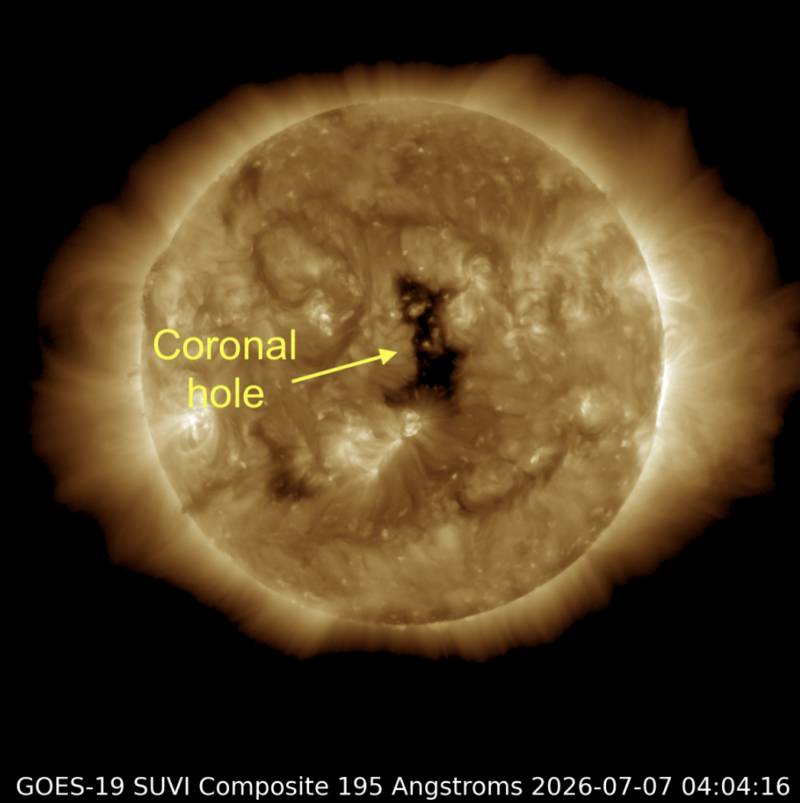 Sun news for July 7, 2026. This annotated image shows a coronal hole near the center of the Earth-facing solar disk. Coronal holes are regions of open magnetic field that let fast solar wind escape into space. The high-speed stream from this hole could reach Earth around July 9, possibly sparking minor geomagnetic storming and auroras. The GOES-19 satellite’s SUVI instrument captured this composite view on July 7, 2026. Image via NOAA.Sun news July 6: AR4479 exits the stage with a bang(11 UTC July 5 – 11 UTC July 6)
The sun fired off a barrage of flares over the past 24 hours. Forecasters logged 6 M-class (moderate) flares and 15 C-class (common) flares during the period, nearly all of which came from the prolific sunspot AR4479. The most powerful of these was an M5.3 from AR4479 at 17:51 UTC yesterday, which caused an R2 (moderate) radio blackout across the Americas. It was an impressive farewell from AR4479, with this prolific flare factory now having rotated almost fully out of view over the western horizon.
Past 24 hours on the sunFlare activity: Solar activity remained high. Observers recorded 21 flares: 6 M-class and 15 C-class events.
Sunspot regions: The Earth-facing solar disk displayed seven numbered active regions. Forecasters cataloged 2 new regions during the period.
The remaining regions hold either of alpha or beta complexity.
Blasts from the sun? Observers spotted several coronal mass ejections (CMEs) in LASCO coronagraph imagery during the period. However, the vast majority lacked an Earth-directed component.
Past 24 hours in space weatherSolar wind: Solar wind conditions gradually eased to near normal as the lingering influence of the June 30 CME faded.
Bz and magnetic coupling: Meanwhile, the interplanetary magnetic field total strength (Bt) remained relatively weak, keeping aurora activity subdued.
Earth’s magnetic field: The geomagnetic field held at a steady unsettled-to-active level throughout the period. This corresponds to Kp values of 2–3. After a round of geomagnetic storms and auroras over the weekend, no geomagnetic storm thresholds were reached over the past day.
 Sun news for July 6, 2026. This zoomed-in video shows an M5.3 (moderate) flare blasting from the northwest solar horizon. The region responsible, prolific flare producer AR4479, is rotating out of view. Yet it’s clearly not finished putting on a show. Image via NASA/ SDO.Sun news July 05 (UTC): Another X flare, as geomagnetic storms sweep Earth(11 UTC July 04 – 11 UTC July 05)
Sun activity surged to very high over the past day, as newly numbered sunspot region AR4482 burst into view on the sun’s southeast (incoming) limb with a powerful X1.3 flare. It’s the sun’s 2nd X flare this week. The flare erupted at 20:29 UTC on July 4. Boom! Fourth of July fireworks from our star. And, meanwhile, here on Earth, auroras danced across our skies last night. Geomagnetic storming reached astounding G3 (strong) levels during the early hours of July 4. In fact, the Kp index surged to 7. This opened the door for colorful displays potentially visible from New York, London, and northern France. And the sun is showing no signs of quieting down. We expect another round of geomagnetic activity over the next two days as additional coronal mass ejections (CMEs) from July 1 and 2 approach Earth. So aurora watchers could stay busy into Monday.
Flare activity: Solar activity reached very high levels over the past day. In addition to the X flare described above, another prolific sunspot region, AR4479, kept firing off flare after flare. This region, which sports a dangerous delta magnetic configuration, produced a dozen M-class flares and numerous C-class events, as it approached the sun’s western limb. Overall, the sun produced 1 X-class flare, 9 M-class flares, and 12 C-class flares during the period, for a total of 22 flares.
Sunspot regions: The Earth-facing solar disk displayed six numbered active regions. Two large, complex groups near the western limb dominated the activity. Additionally, a newly emerged region appeared on the eastern limb.
Blasts from the sun? Observers spotted multiple coronal mass ejections (CMEs) during the period. Fortunately, none of the current 24-hour window carries a significant Earth-directed component. However, CMEs from earlier eruptions on July 1 and 2 are now approaching Earth. These form the basis for the geomagnetic forecast.
Solar wind: Solar wind conditions remained disturbed throughout the period. The ongoing passage of the June 30 CME, which arrived on July 3, drove the disturbance. Solar wind speeds stayed elevated between 550 and 642 km/s. That CME left the sun on June 30 and struck Earth on July 3.
Bz and magnetic coupling: The interplanetary magnetic field (IMF) total strength (Bt) peaked at a powerful 24 nT at 00:33 UTC on July 4. It then gradually declined through the period. The Bz component plunged to a strongly southward –19 nT at 01:05 UTC on July 4. This opened the door for energetic solar wind particles to pour into Earth’s magnetosphere, energizing auroral displays. Afterward, the Bz slowly rotated northward from around 09:30 UTC on July 4, gradually reducing storm intensity.
Earth’s magnetic field: Earth’s magnetic field experienced significant storming during the period. Geomagnetic storm conditions ranged from G1 (Minor) to G3 (Strong) on July 4. The Kp index reached 7 during the 03:00–06:00 UTC interval. The sustained, deeply southward Bz drove this major storm. Locally, European stations recorded K=6 (moderate storm) during the 05:00–07:00 UTC interval. Activity gradually subsided through the remainder of the period as the Bz rotated northward and the IMF weakened. Even so, conditions remained enhanced above background.
What’s ahead? Sun–Earth forecastFlare activity forecast: We expect (70% chance) solar activity to remain at moderate levels (R1–R2) on July 5, with a slight chance (20%) for X-class flares (R3, Strong). AR4479 and AR4478 remain the primary drivers. However, both are rapidly approaching the western limb.
As AR4479 and AR4480 rotate beyond W90 by July 6, M-class flare chances will begin to decrease. Meanwhile, AR4482 on the eastern limb bears watching. Its X1.3 debut suggests it may harbor significant complexity, which will become clearer as it rotates further onto the disk. We expect activity to decline to moderate levels on July 6, then to low to moderate levels by July 7. Finally, a slight chance for an S1 (Minor) proton event persists through July 5 and 6 due to the active western-limb regions.
Geomagnetic activity forecast:
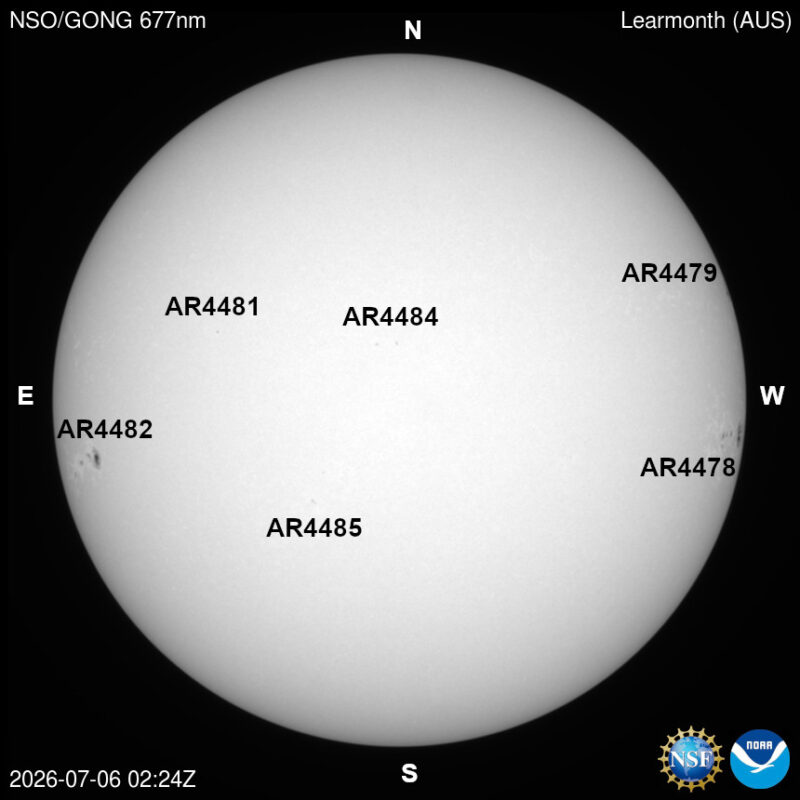 This image shows sun activity – with the most active regions labeled – as of 2 UTC on July 6, 2026, as seen from Learmonth Solar Observatory in Australia. Original image, without labels, via NSO/GONG. Data acquired by GONG instruments operated by NISP/ NSO/ AURA/ NSF with contribution from NOAA, and labeling by EarthSky. Armando Caussade posted today’s sun. Why are east and west on the sun reversed?Sun news July 4: G3 storm arrives with the fireworks!
As expected, the solar material released during this week’s powerful X1.1 flare reached Earth. But it packed a bigger punch than forecast. It arrived as a G3 (strong) geomagnetic storm. Forecasters had anticipated only G1 (minor) or G2 (moderate) levels. But the CME delivered stronger enhancements than predicted. The storm first reached G2 levels at 00:00 UTC on July 4. Then it jumped to G3 levels. The Kp 7 threshold was reached at 5:09 UTC on July 4. And the show was spectacular. Observers reported beautiful auroral displays as far south as Utah, Colorado, and Nevada in the US. Did you catch the Independence Day fireworks alongside the aurora borealis? Did you take a photo? Share it with us! And the party might not end there. A couple of additional coronal mass ejections (CMEs) that left the sun on July 1 and 2 may reach Earth around July 5. That could extend the storming and auroral displays across the whole weekend. Alert for aurora watchers!
Past 24 hours of sun news(11 UTC July 3 – 11 UTC July 4)Flare activityOver the past day, solar activity increased again to high levels. In total, the sun fired 24 flares: 13 M-class and 11 C-class. That is more M-class flares than C-class over the past 24 hours!
Currently, just 3 numbered active regions populate the Earth-facing solar disk. One carries the maximum magnetic complexity. And all three are drawing closer to the western horizon, soon to depart for the far side.
AR4479 (beta-gamma-delta) produced this week’s X1.1 flare and remains the most prolific M-class producer. It fired another strong flare this period, an M6.7, along with a long list of M and C events. It remains the primary region to watch.
AR4478 (beta-gamma) lost its delta component. But it still carries an interesting beta-gamma configuration. And it remains the largest region in extent on the disk. It produced no flares during the period. We keep watching closely.
AR4480 (beta-gamma) was the second flare producer of the period. It retained its gamma component. And it holds real flaring potential.
Blasts from the sun?A slow-moving CME first appeared in SOHO LASCO C2 imagery around 18:24 UTC on July 3. It may contain an Earth-directed component. Modeling and analysis are underway. We will confirm the results as soon as more data becomes available.
And two more CMEs from July 1 and 2 remain in the pipeline. These may reach Earth around July 5, potentially bringing a fresh round of storming.
Past 24 hours in space weatherSolar windSolar wind speeds increased from moderate to moderate-high levels throughout the period. Meanwhile, the total interplanetary magnetic field (IMF) climbed to strong levels. That reflected the arrival of the X1.1 CME.
Bz and magnetic couplingThe Bz component showed intermittent shifts between north and south early in the period. But at 0:30 UTC this morning on July 4, it turned sharply southward and held there. At the time of this writing, the Bz remains southward. The arrival of the X1.1 CME drove this shift. And as always, a sustained southward Bz is what opens the door for the strongest auroral displays. That is exactly what fueled last night’s storm.
Earth’s magnetic fieldOver the past day, Earth’s magnetic field ranged from very quiet (Kp 1) to strong storm levels (Kp 7). The calm ended and the storm arrived. It began as a G2 (moderate) storm at 0 UTC on July 4. Then it jumped to G3 (strong) levels at 5:09 UTC on July 4. At the time of this writing, the Kp index sits just above level 5, with a G1 (minor) storm ongoing.
What’s ahead? Sun–Earth forecastFlare activity forecastForecasters expect moderate to high activity to continue. The chance for M-class flares returned to 70% today. And the chance for another X-class (strong) event holds at 20% today.
AR4479 kept its beta-gamma-delta configuration and stayed fiercely flare-productive. But AR4478 and AR4480 have eased back to beta-gamma setups. The flare threat remains high for now. But a dramatic change is coming. All three regions are approaching the west limb. And flare activity may drop sharply once they rotate to the far side.
Geomagnetic activity forecastAlert for aurora watchers! Auroral displays are possible this weekend with G1 (minor) to G2 (moderate) geomagnetic storms.
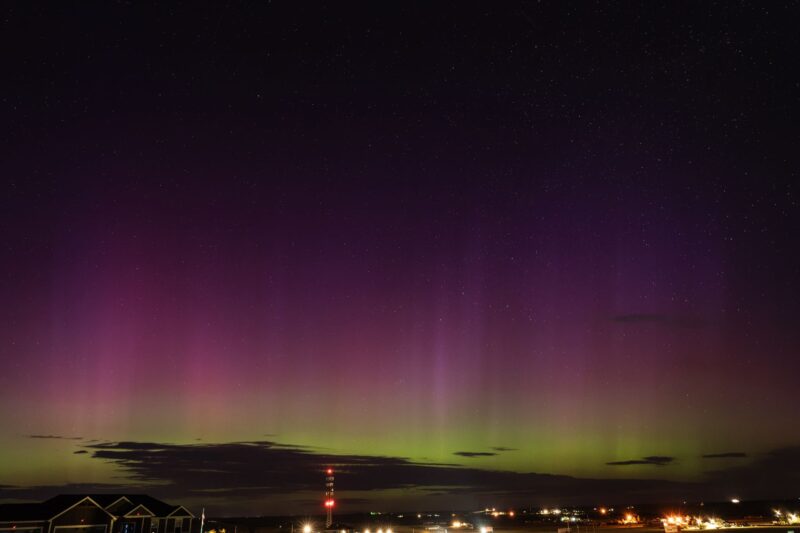 Sun news for July 4, 2026. Aurora over Cheyenne, Wyoming, on the night of July 3, 2026, at 11 p.m. local time. Martin Curran captured this beautiful display as the powerful X1.1 CME slammed into Earth’s magnetic field, sparking a G3 (strong) geomagnetic storm. The storm pushed auroral displays as far south as Utah, Colorado, and Nevada. Aurora and Independence Day fireworks on the same night! Thank you, Martin, for sharing this gorgeous capture. Image via Martin Curran.
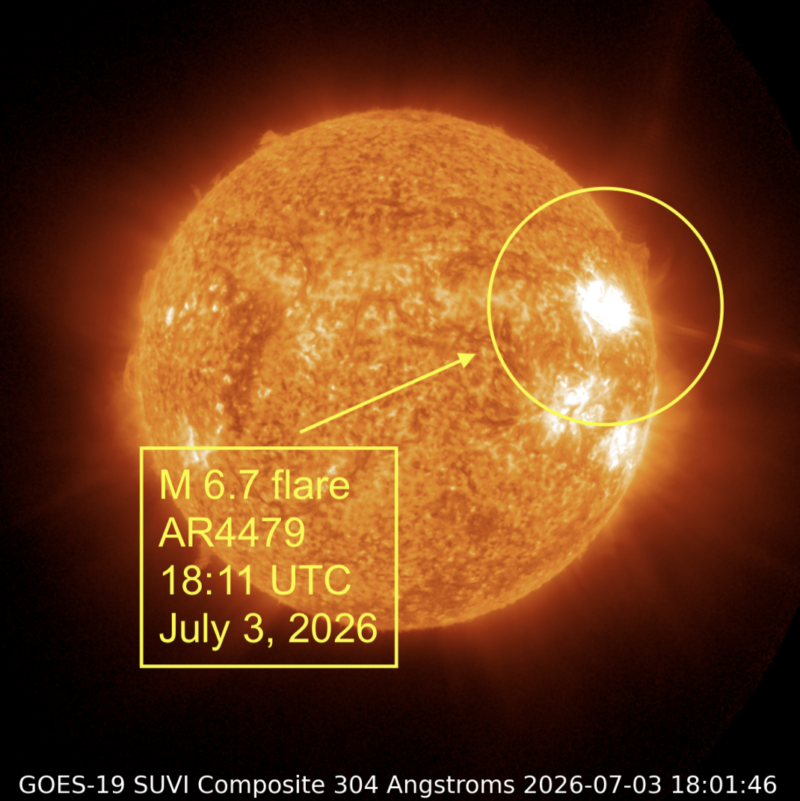 Sun news for July 4, 2026. This annotated image from NOAA’s GOES-19 SUVI in the 304 angstrom channel captures the M6.7 flare from AR4479, peaking at 18:11 UTC on July 3. The circle and arrow mark the eruption site near the western limb (edge). This M6.7 was the strongest flare of the period. Image via NOAA/GOES.Sun news July 3: Sun-stuff to reach Earth today, auroras possible!
The solar material released during Tuesday’s powerful X1.1 flare is expected to reach Earth later today. Forecasters expect it to disturb our magnetic field to G1 (minor) or even G2 (moderate) geomagnetic storm levels. Disturbances are predicted to begin late on July 3 and extend through July 4. That could mean auroras to go along with any Independence Day fireworks! And the party might not end there. A couple of additional coronal mass ejections (CMEs) that left the sun on July 1 and 2 may reach Earth around July 5. That could extend the storming and auroral displays across the whole weekend. Alert for aurora watchers!
Past 24 hours of sun news(11 UTC July 2 – 11 UTC July 3)Flare activityOver the past day, solar activity dropped to moderate. In total, the sun fired 10 flares: 2 M-class and 8 C-class.
Currently, just 3 numbered active regions populate the Earth-facing solar disk. But two carry the maximum magnetic complexity.
AR4479 (beta-gamma-delta) produced this week’s X1.1 flare and a prolific list of M-class events. It remains the primary region to watch. Will we see another powerful flare?
AR4478 (beta-gamma-delta) still carries the strongest magnetic configuration. And it remains a monster, still the largest region on the disk. It produced no flares during the period. But that quiet could mean it is building up energy for something bigger. We will keep watching closely.
AR4480 (beta-gamma) was the second flare producer of the period. It retained its gamma component and continued growing in complexity. And it holds real flare potential going forward.
AR4475 has left the building. This region has fully departed to the far side via the northwest horizon.
Blasts from the sun?The main event remains the confirmed halo CME from the X1.1 flare. Modeling places its arrival at late July 3 or early July 4. G1 (minor) to G2 (moderate) geomagnetic storm conditions are possible upon arrival.
And two more CMEs are in the pipeline. A filament eruption at 12:11 UTC on July 1 hurled a slow-moving CME with an Earth-directed component. And a second CME from a long-duration M4.2 flare from AR4479 at 2:36 UTC on July 2 also carries a chunk of solar stuff heading our way. This second CME may catch up with the first. Their estimated arrival is late July 5 or early July 6.
Past 24 hours in space weatherSolar windSolar wind speeds averaged at moderate levels throughout the period. Meanwhile, the total interplanetary magnetic field (IMF) stayed weak, with a slight increase toward the end.
Bz and magnetic couplingThe Bz component showed a couple of weak southward peaks. But it mostly pointed northward throughout the period. At the time of this writing, the Bz remains northward. That kept Earth’s magnetic shield firmly closed. But conditions could change dramatically later today with the arrival of the X1.1 CME. As always, a sustained southward Bz is what opens the door for the strongest auroral displays.
Earth’s magnetic fieldOver the past day, Earth’s magnetic field stayed very quiet (Kp 0–1). The calm before the storm? At the time of this writing, the Kp index sits just at level 1.
What’s ahead? Sun–Earth forecastFlare activity forecastForecasters expect moderate to high activity to continue. The chance for M-class flares dipped slightly to 65% today. And the chance for another X-class (strong) event also eased slightly to 15% today. Both AR4479 and AR4478 retain their beta-gamma-delta configurations. And AR4480 is developing rapidly with its new beta-gamma setup. The flare threat remains high.
Geomagnetic activity forecastAlert for aurora watchers! Auroral displays are possible this weekend with G1 (minor) to G2 (moderate) geomagnetic storms.
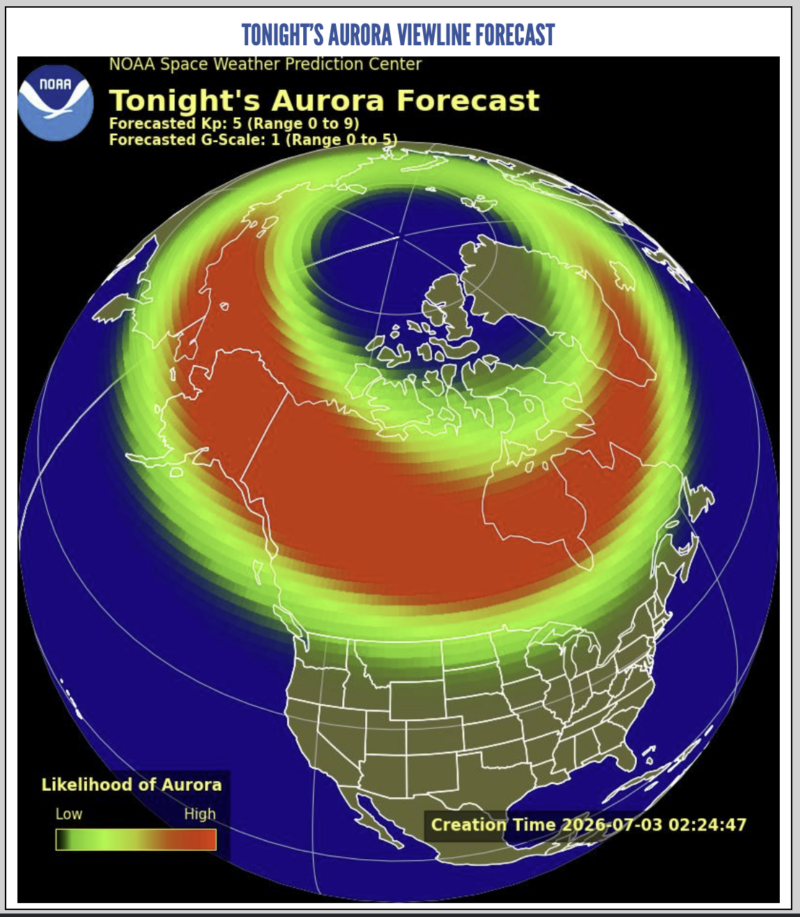 Sun news for July 3, 2026. This image shows NOAA’s OVATION aurora model from the Space Weather Prediction Center, displaying tonight’s auroral forecast as the X1.1 flare coronal mass ejection (CME) approaches Earth. The model uses real-time solar wind data to predict where aurora is most likely to appear and how far the auroral oval may expand. And tonight the outlook is exciting. Share your aurora photos with us! Image via NOAA/SWPC.
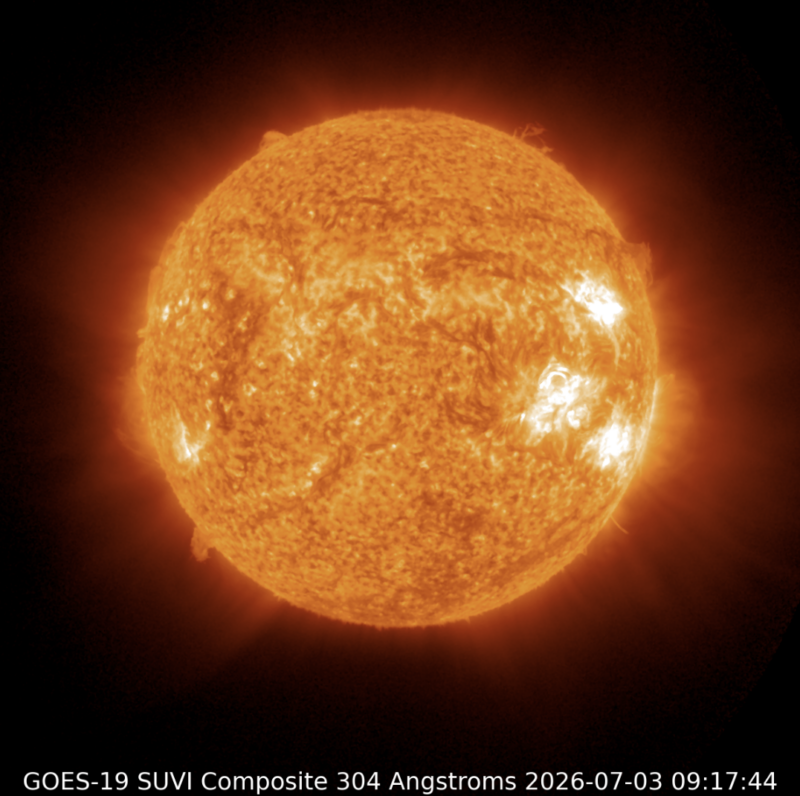 Sun news for July 3, 2026. This image from NOAA’s GOES-19 SUVI instrument reveals three bright areas on the solar disk where the action is today. The 304 angstrom wavelength makes active regions glow vividly against the darker solar surface. These three bright zones mark the locations of our current powerhouse sunspot regions. Image via NOAA/GOES.
 Sun news for July 3, 2026. This video from NOAA’s GOES-19 SUVI instrument captures the M2.8 flare from AR4480, peaking at 10:25 UTC on July 2. Video via NOAA/GOES.Sun news July 2: Confirmed! X flare sun-stuff on its way to Earth
It’s confirmed: solar material released during Tuesday’s powerful X1.1 flare is on its way to Earth. Specialists found it challenging to pin down the exact arrival time, but they’re expecting it to disturb our magnetic field late tomorrow or early on July 4. And with up to G2 (moderate) geomagnetic storms predicted, that could provide some auroras to go with any early Independence Day fireworks!
Past 24 hours of sun news(11 UTC July 1 – 11 UTC July 2)Flare activityOver the past day, solar activity remained high. In total, the sun fired 13 flares: 8 M-class and 5 C-class events.
Currently, 4 numbered active regions populate the Earth-facing solar disk. Two carry the maximum magnetic complexity, and one is developing extra strength.
AR4479 (beta-gamma-delta) retains the highest possible magnetic configuration. It produced this week’s X1.1 flare and a prolific list of M-class events. It remains the primary region to watch.
AR4478 (beta-gamma-delta) remains the largest region in extent on the disk. It produced the period’s strongest flare, the near-X-class M8.5. And its beta-gamma-delta complexity keeps it firmly on the watch list.
AR4480 (beta-gamma) is the one to watch for development. This region gained a gamma component and is growing in complexity. As it continues evolving, its flare potential increases.
AR4475 (beta) is now at the very edge of the southwest horizon. It should depart for the far side shortly.
Blasts from the sun?A filament eruption associated with an M1.3 flare peaking at 12:01 UTC on July 1 is under observation. Initial analysis shows an Earth-directed component. But further analysis is necessary to confirm the arrival time and potential impact.
And the main event remains the confirmed halo CME from the X1.1 flare. Modeling places its arrival at late July 3 or early July 4. G1 (minor) to G2 (moderate) geomagnetic storm conditions are possible upon arrival.
Past 24 hours in space weatherSolar windSolar wind speeds averaged low-to-moderate levels throughout the period. Meanwhile, the total interplanetary magnetic field (IMF) held at strong levels for the early portion of the period. Then, at around 0:30 UTC on July 2, it dropped to weak levels.
Bz and magnetic couplingThe Bz component pointed northward throughout the whole period. At the time of this writing, the Bz remains northward. That kept Earth’s magnetic shield firmly closed. But conditions could change dramatically on July 3 with the arrival of the X1.1 CME. As always, a sustained southward Bz is what opens the door for the strongest auroral displays.
Earth’s magnetic fieldOver the past day, Earth’s magnetic field stayed at quiet levels (Kp 1–3). At the time of this writing, the Kp index sits slightly above level 1. But that calm may not last long.
 Sun news for July 2, 2026. This animation shows NASA’s solar wind prediction model, tracking the sun-stuff fired out by the X1.1 flare on Tuesday. The sun sits as the larger white dot at the center, while Earth is the yellow dot to the right. You can see the solar material expanding out from the sun and reaching our planet, expected tomorrow or early Saturday. Animation via NASA/M2MSWAO.
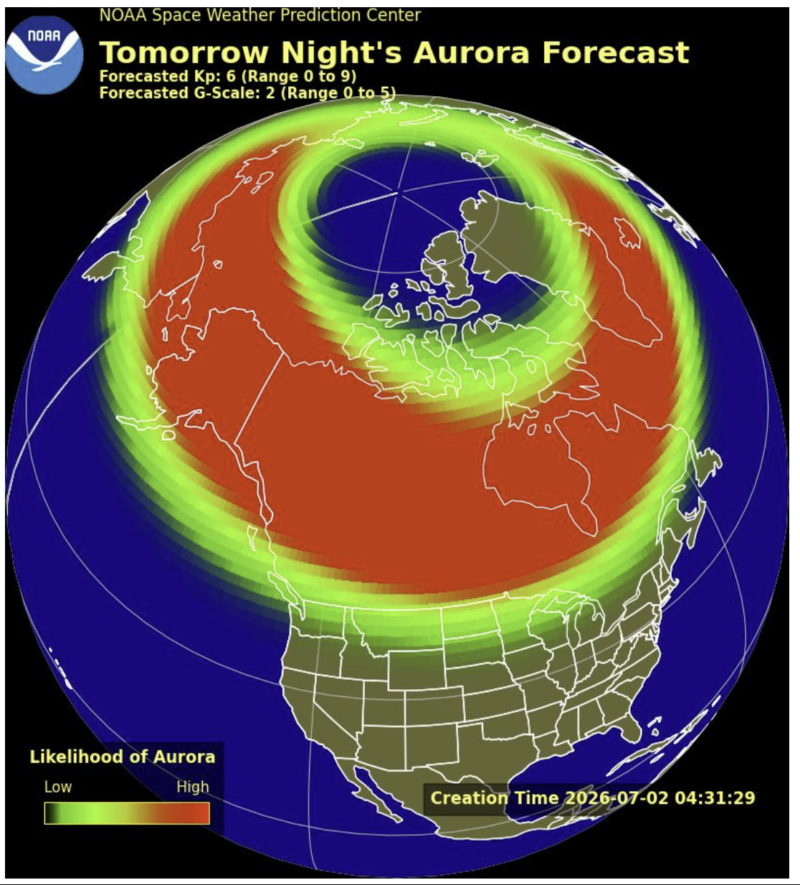 Sun news for July 2, 2026. This image shows NOAA’s OVATION aurora model from the Space Weather Prediction Center, displaying tomorrow night’s auroral forecast ahead of the anticipated CME arrival. The model uses real-time solar wind data to predict where aurora is most likely to appear and how far the auroral oval may expand. Image via NOAA/SWPC.
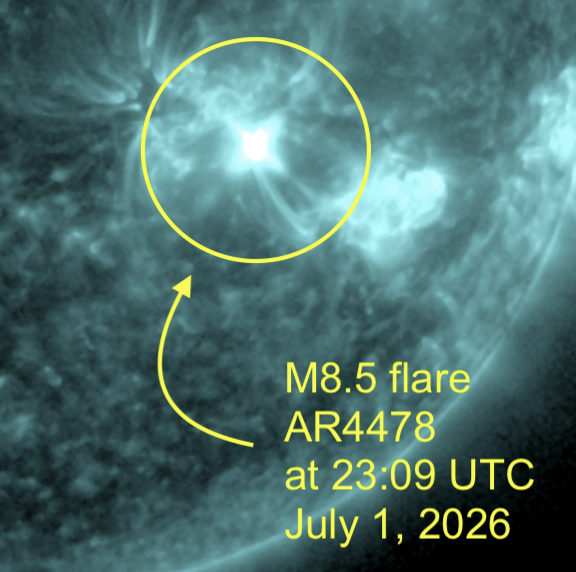 Sun news for July 2, 2026. This annotated image from NOAA’s GOES-19 SUVI captures the M8.5 flare from AR4478, peaking at 23:09 UTC on July 1. Image via NOAA/GOES.Sun news July 1: X flare! Sun-stuff speeding to Earth?
BAM! At 20:50 UTC last night, sunspot region AR4479 unleashed an X flare, the most powerful class of solar flare. A dimming in the extreme ultraviolet wavelength confirmed to experts that this X1.1 flare released solar material into space. And radio wave data revealed that this sun-stuff left our star at a staggering 1,500 kilometers per second, or over 3.3 million miles per hour! It was then the turn of the SOHO spacecraft, which recorded a halo coronal mass ejection (CME), meaning the eruption expanded in all directions around the sun as seen from Earth. That’s a strong sign that solar material from this blast might reach our planet’s magnetic field. If so, it could potentially trigger geomagnetic storms and auroras in the coming days. Confirmation to come. Stay tuned!
Past 24 hours of sun news(11 UTC June 30 – 11 UTC July 1)Flare activityOver the past day, solar activity jumped to high. In total, the sun fired 16 flares: 1 X-class, 6 M-class, and 9 C-class events.
Currently, the Earth-facing solar disk shows 5 numbered active regions. Two carry notable magnetic complexity.
AR4479 (beta-gamma-delta) retains its maximum-complexity magnetic configuration. It was the undisputed lead flare producer of the period. And it still carries real potential for further significant eruptions.
AR4478 (beta-gamma-delta) remains the largest region on the disk. It showed slight growth in its intermediate area. And as it moves toward the disk center, its potential for Earth-affecting blasts grows.
AR4475 (beta) lost its gamma-delta component and now carries a simpler beta configuration. It is approaching the southwest horizon and should soon depart for the far side.
Blasts from the sun?The X1.1 flare is being modeled and analyzed to determine whether any of the sun-stuff it released is heading our way to Earth. The shock speed, estimated at roughly 1,500 km/s, tells us this was a fast, powerful eruption. And the halo coronal mass ejection, picked up by the SOHO spacecraft’s LASCO C2 and LASCO C3 instruments, is a classic signature of an Earth-directed event. However, we’re waiting for the results of a full analysis.
Past 24 hours in space weatherSolar windSolar wind speeds held at moderate levels throughout the period. Meanwhile, the total interplanetary magnetic field (IMF) climbed to strong levels for most of the period. That reflected the arrival of a CME from June 26.
Bz and magnetic couplingThe Bz component initially pointed southward. Then it shifted northward, starting at 18 UTC on June 30, and maintained that orientation for the rest of the period. At the time of this writing, the Bz remains northward. As always, a sustained southward Bz is what opens the door for the strongest auroral displays.
Earth’s magnetic fieldOver the past day, Earth’s magnetic field reached G1 (minor) geomagnetic storm levels (Kp 5), driven by the arrival of the June 26 CME. At the time of this writing, the Kp index sits slightly below level 2.
 Sun news for July 1, 2026. X flare! Sunspot region AR4479 produced the X1.1 at 20:50 UTC on June 30, 2026. We has been hoping for a big blast, seeing as the Earth-viewed sun included 3 active sunspot regions with potent beta-gamma-delta magnetic configurations, the highest complexity possible. GOES-19 image via NOAA.
 Sun news for July 1, 2026. This video from the SOHO LASCO C2 coronagraph captures two remarkable events in one stunning sequence. A space rock soars to a fiery demise, before a blast of solar material soars into space. We can see these events because the LASCO C2 coronagraph blocks the blinding light of the solar disk with an occulting disk, revealing the faint structures of the outer corona. Video via ESA/ NASA SOHO.
| # | Наименование новости | Тональность | Информативность | Дата публикации |
|---|---|---|---|---|
| 1 | Sun activity archive for June 2026 | 0 | 8.84 | 01-06-2026 |
| 2 | Sun activity archive for April 2026 | 0 | 8.84 | 01-04-2026 |
| 3 | Sun activity archive for May 2026 | 0 | 8.84 | 01-05-2026 |
| 4 | Sun activity archive for March 2026 | 0 | 8.84 | 01-03-2026 |
| 5 | Sonnenaufnahme vom 01.07.2026 mit großen Fleckengruppen | 0 | 19.58 | 31-07-2026 |
| 6 | Total solar eclipse August 12, 2026: Best images | 0 | 12.78 | 12-08-2026 |
| 7 | Солнце успокоилось: завершился один из самых мощных всплесков активности 2026 ... | 0 | 10.09 | 05-08-2026 |
| 8 | На Солнце завершился один из сильнейших в году всплесков активности | 0 | 5 | 07-07-2026 |
| 9 | Наука > Космос [В июле 2026 на Солнце произошли восемь ... | 0 | 7 | 04-07-2026 |
| 10 | Ученые ИКИ РАН сообщили о завершении мощного всплеска активности на Солнце | 0 | 7 | 07-07-2026 |