Просмотр новости
Найдите то, что Вас интересует
 Спутники
 РН
РН SpaceX
 Роскосмос
 NASA
NASA
СпутникиРНSpaceXРоскосмосNASALow-lying fog clouds host living microbes. That may be good news, because some of them can remove toxic air pollutants, such as formaldehyde.
A bank of fog might seem gloomy. But that mist may carry an unexpected community of environmental helpers. Ground-dwelling clouds can house bacteria that clean the air, a new study finds.
Microbes can find air a harsh place, notes Kathleen Weathers. Temperatures can fluctuate broadly. And even in fog, there can be a high risk of drying out. A fog scientist, Weathers works at the Cary Institute of Ecosystem Studies in Millbrook, N.Y. But, she adds, fog hosts many things needed for those microbes to “make a living.” These include moisture, nutrients and comfortable temperatures.
Yet until now, scientists hadn’t known microbes could actually live there, says Weathers, who did not take part in the new work.
It took Thi Thuong Thuong Cao, a chemist who loves hiking on foggy mountainsides, to show microbes not only can live in fog, but also grow and reproduce.
Collecting cloudsAs a chemist, Cao wondered what might be inside fog droplets. At first, she focused on their chemistry. Soon, though, she teamed up with other scientists to see what microbes might hitchhike in fog — and what they might be doing.
At the time, Cao was a graduate student at Arizona State University in Tempe. Part of her team traveled to Pennsylvania, where another team member was based. The area had great spots to collect fog.
This team focused its hunt on a special type of low-lying cloud: radiation fog. It forms at night when the ground cools and then lowers the air’s temperature. Cooler air can’t hold much water. So it sheds the excess into the air as small droplets, creating fog.
Radiation fog doesn’t roll in. Instead, it forms in place. So any microbes should be local, not ones carried in from elsewhere.
Over about two years, the team collected samples of water from 32 “fog events.” They used a device called a cloud-water collector. It pulls air into a chamber containing strings.
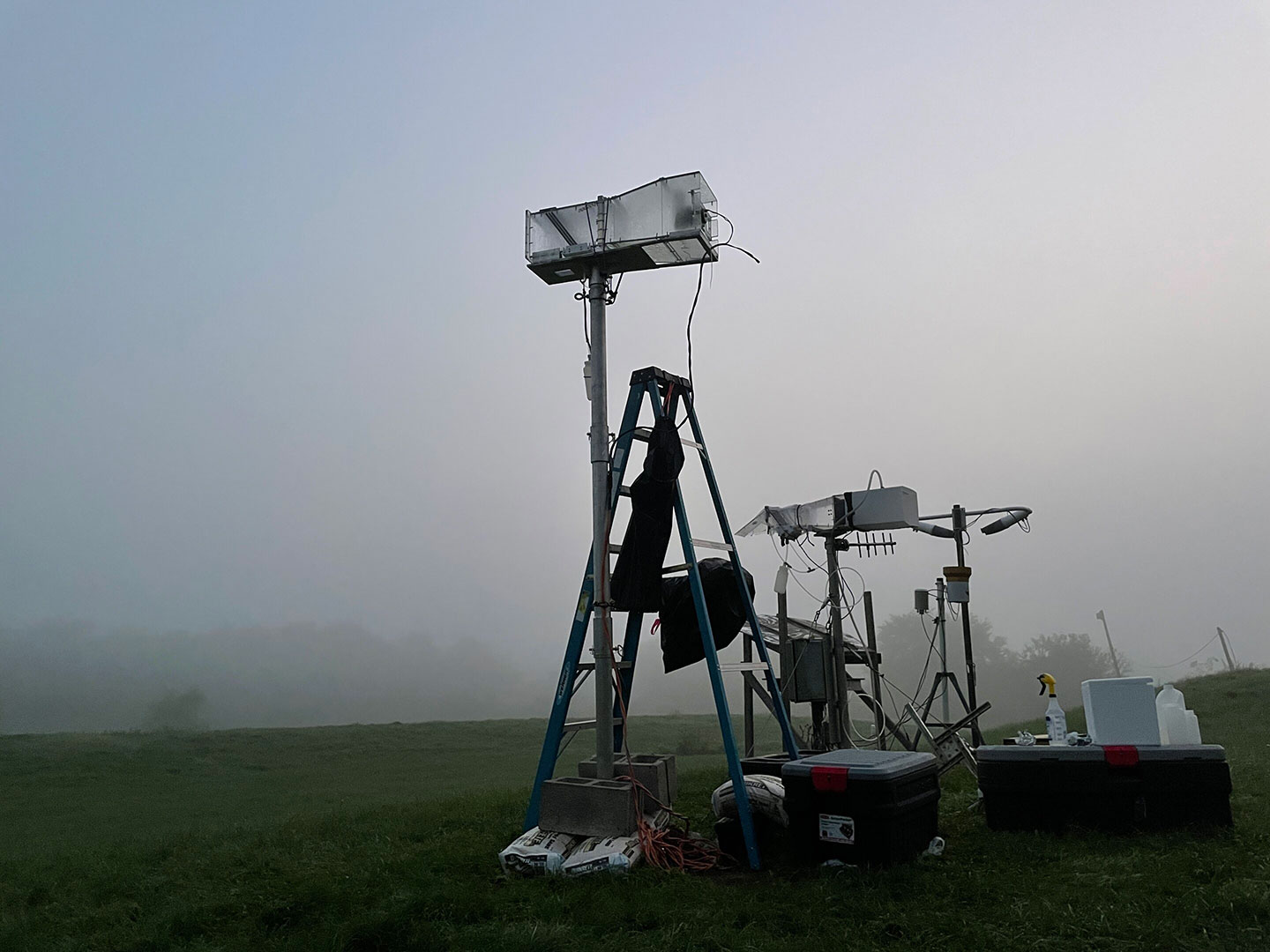 Researchers assembled this setup in a Pennsylvania field to collect fog samples. They were looking to capture not only fog but also anything that might be living in the airborne water droplets.T.T.T. Cao
As fog condenses on the strings, it forms droplets that drip into a bottle below. The scientists collected up to 200 milliliters (about 7 ounces) of fog water per event. That’s roughly the volume of a juice box. They also collected samples of the air in between the fog droplets. They trapped similar air samples before and after fog events.
The fog samples housed a multitude of microbes. In fact, fog water is about as densely populated with microbes as ocean or lake water. When examined under a microscope, many fog-water microbes seemed to have been dividing when they were collected. That led the researchers to conclude the microbes had been growing in the fog.
Next, the team extracted the fog-dwellers’ RNA, a type of genetic information. Cao’s team compared these types of genetic maps to those in a database on known microbes. That helped them identify the fog’s inhabitants.
An average of 188 unique genetic patterns showed up in each fog event. Each represented a unique type of bacteria. The communities of microbes present were similar across all fog samples. But they differed quite a bit from those found in air without fog.
Cao and her team shared their findings in mBio on May 22.
Submit your question here, and we might answer it an upcoming issue of Science News Explores
Their analyses showed Methylobacterium was the most abundant microbe in fog water. It accounted for up to half of all microbes present.
To grow in fog, the team reasoned, those Methylobacteria must have found something in it to eat. This microbe is known to consume carbon-containing chemicals, such as formaldehyde.
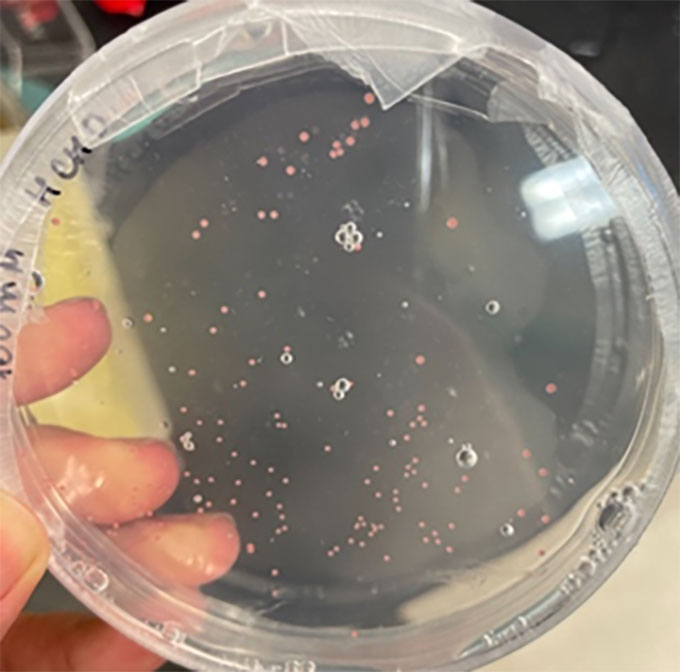 Researchers grew colonies of Methylobacterium in this dish, feeding them only formaldehyde, a toxic chemical. “[T]hey have [a] pink pigment,” says Thi Thuong Thuong Cao. “They’re really cute.”T.T.T. Cao
Formaldehyde is a common and toxic air pollutant. Breathing it can cause harm. Some formaldehyde comes from natural sources, such as rotting plant materials. Human activities, such as construction and burning fossil fuels, also release it. It’s even one of the chemicals that makes cigarette smoke harmful.
Methylobacteria are well suited for dealing with this chemical, Cao says. “They can survive formaldehyde at a concentration higher than other bacteria [can].” They break it down hundreds of times faster than other microbes, too.
Her group measured formaldehyde in freshly collected fog water. Over several hours, levels of the chemical fell surprisingly fast.
The researchers also isolated Methylobacterium from fog water and then grew it on its own. These bacteria were able to quickly remove formaldehyde when exposed to an artificial fog water containing the chemical.
It disappeared so quickly, in fact, that the bacteria couldn’t have used it all for growth. The microbe may break the chemical down as well as eat it, the team concludes. Such a strategy might keep formaldehyde from reaching toxic levels.
This all seems to confirm Methylobacterium can remove formaldehyde from fog. The researchers don’t yet know how the bacteria might affect air quality. But their new data now point to fog as a potential ecosystem.
Fog can transport water and microbes across a landscape. These data now suggest that as it does, it may play a role in shaping the chemistry of the environment.
average: (in science) A term for the arithmetic mean, which is the sum of a group of numbers that is then divided by the size of the group.
bacteria: (singular: bacterium) Single-celled organisms. These dwell nearly everywhere on Earth, from the bottom of the sea to inside other living organisms (such as plants and animals). Bacteria are one of the three domains of life on Earth.
chemical: A substance formed from two or more atoms that unite (bond) in a fixed proportion and structure. For example, water is a chemical made when two hydrogen atoms bond to one oxygen atom. Its chemical formula is H2O. Chemical also can be an adjective to describe properties of materials that are the result of various reactions between different compounds.
chemistry: The field of science that deals with the composition, structure and properties of substances and how they interact. Scientists use this knowledge to study unfamiliar substances, to reproduce large quantities of useful substances or to design and create new and useful substances.
cloud: A plume of molecules or particles, such as water droplets, that move under the action of an outside force, such as wind, radiation or water currents.
concentration: (in chemistry) A measurement of how much of one substance has been dissolved into another.
database: An organized collection of related data.
ecosystem: A group of interacting living organisms — including microorganisms, plants and animals — and their physical environment within a particular climate. Examples include tropical reefs, rainforests, alpine meadows and polar tundra. The term can also be applied to elements that make up some artificial environment, such as a company, classroom or the internet.
environment: The sum of all of the things that exist around some organism or the process and the condition those things create. Environment may refer to the weather and ecosystem in which some animal lives, or, perhaps, the temperature and humidity (or even the placement of things in the vicinity of an item of interest).
fluctuate: (n. fluctuation) To vary at irregular intervals and often by amounts that are hard to predict.
fog: A thick cloud of water droplets that touches the ground.
formaldehyde: A widely used and toxic chemical that manufacturers add to plastics, resins, some fertilizers, dyes, medicines and embalming fluids. It’s even in the treatments used to keep fabrics from wrinkling.
fossil fuel: Any fuel — such as coal, petroleum (crude oil) or natural gas — that has developed within the Earth over millions of years from the decayed remains of bacteria, plants or animals.
genetic: Having to do with chromosomes, DNA and the genes contained within DNA. The field of science dealing with these biological instructions is known as genetics. People who work in this field are geneticists.
genetic sequence: A string of DNA bases, or nucleotides, that provide instructions for building molecules in a cell. They are represented by the letters A,C,T and G.
graduate student: Someone working toward an advanced degree by taking classes and performing research. This work is done after the student has already graduated from college (usually with a four-year degree).
microscope: An instrument used to view objects — such as bacteria or the single cells of plants or animals — that are too small to be visible to the unaided eye.
moisture: Small amounts of water present in the air, as vapor. It can also be present as a liquid, such as water droplets condensed on the inside of a window, or dampness present in clothing or soil.
molecule: A group of atoms that represents the smallest possible amount of a chemical compound. Molecules can be made of single types of atoms or of different types. For example, the oxygen in air is made of two bound oxygen atoms (O2). Water is made of two hydrogen atoms and one oxygen atom (H2O).
nutrient: A vitamin, mineral, fat, carbohydrate or protein that a plant, animal or other organism requires as part of its food in order to survive.
pollutant: A substance that taints something — such as the air, water, our bodies or products. Some pollutants are chemicals, such as pesticides. Others may be radiation, including excess heat or light. Even weeds and other invasive species can be considered a type of biological pollution.
radiation: (in physics) One of the three major ways that energy is transferred. (The other two are conduction and convection.) In radiation, electromagnetic waves carry energy from one place to another. Unlike conduction and convection, which need material to help transfer the energy, radiation can transfer energy across empty space.
risk: The chance or mathematical likelihood that some bad thing might happen. For instance, exposure to radiation poses a risk of cancer. Or the hazard — or peril — itself. (For instance: Among cancer risks that the people faced were radiation and drinking water tainted with arsenic.)
RNA: A molecule that helps “read” the genetic information contained in DNA. A cell’s molecular machinery reads DNA to create RNA, and then reads RNA to create proteins.
smoke: Plumes of microscopic particles that float in the air. They can be comprised of anything very small. But the best known types are pollutants created by the incomplete burning of oil, wood and other carbon-based materials.
strategy: A thoughtful and clever plan for achieving some difficult or challenging goal.
toxic: Poisonous or able to harm or kill cells, tissues or whole organisms. The measure of risk posed by such a poison is its toxicity.
unique: Something that is unlike anything else; the only one of its kind.
Lily Burton was the Spring 2026 science writing intern at Science News. She holds a bachelor’s degree in Molecular and Cell Biology and Anthropology from UC Berkeley. She also has a Ph.D. in Biochemistry and Molecular Biophysics from the University of Chicago where she researched circadian rhythms in photosynthetic bacteria and the role they play in metabolism. She was a 2024 AAAS Mass Media Fellow where she reported on local science at WUNC – North Carolina Public Radio.
| # | Наименование новости | Тональность | Информативность | Дата публикации |
|---|---|---|---|---|
| 1 | Выявлены бактерии микрофлоры, поглощающие "вечные" токсичные соединения фтора | 0 | 0 | 01-07-2025 |
| 2 | Эксперты заявили, что дым от лесных пожаров сокращает продолжительность жизни в Калифорнии | 0 | 0 | 29-08-2023 |
| 3 | Role of Future Climate Change, Air Pollution Control and Methane Mitigation in Driving Hydroxyl Radical (OH) and Methane Lifetime | 0 | 4.71 | 15-07-2026 |
| 4 | Scientists say this algae could remove microplastics from drinking water | 0 | 11.14 | 12-05-2026 |
| 5 | Учёные выяснили, что грибы в океане могут спасать климат | 0 | 7.5 | 23-08-2026 |
| 6 | Wildfires are polluting the air far more than thought | 0 | 8.39 | 07-01-2026 |
| 7 | Polluted air quietly erases the benefits of exercise | 0 | 8.94 | 28-11-2025 |
| 8 | W.A. Parish coal plant leads region in cloud-forming pollution, researchers find | 0 | 11.26 | 16-07-2026 |
| 9 | Best home air purifiers to lessen the harmful effects of traveling wildfire smoke | 0 | 11.23 | 15-07-2026 |