Просмотр новости
Найдите то, что Вас интересует
 Спутники
 РН
РН SpaceX
 Роскосмос
 NASA
NASA
СпутникиРНSpaceXРоскосмосNASAA deep partial lunar eclipse of the full Sturgeon Moon takes place on August 27-28, 2026. Will you be able to see it? Maps and details here.
The post Deep partial lunar eclipse overnight first appeared on EarthSky.
Get pointers on viewing the August 27-28 nearly total lunar eclipse from EarthSky’s Deborah Byrd. Watch in the player above, or on YouTube.
People in Africa, Europe, most of the Americas and the eastern Pacific Ocean will see a deep lunar eclipse overnight on August 27-28, 2026. The eclipse won’t be total. But it’ll be nearly total, with 96% of the moon within the Earth’s dark umbral shadow at mid-eclipse.
Lunar eclipses are a whole-Earth event. But you must be in nighttime when the eclipse happens, in order to see it. The half of Earth facing the full moon – that is, the whole half of Earth that’s in nighttime – will see the lunar eclipse during the exact same moments. Of course, the times shown on our clocks will be different!
From start to finish, the eclipse will last 339 minutes. And the moon will be in Earth’s dark shadow – during the partial phases of the eclipse – for 199 minutes.
Check timeanddate.com for precise timing from your location.
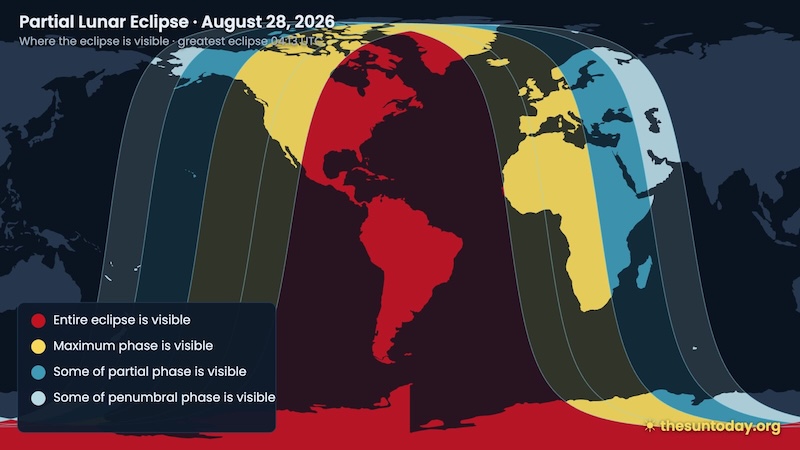 Here’s a global map showing where the August 27-28, 2026, partial lunar eclipse is visible. Image via thesuntoday.org.What will you see?
You don’t need any special equipment to view a lunar eclipse. Lunar eclipses are safe to view with the eye alone. But binoculars and telescopes do enhance the view.
Lunar eclipses start with a subtle kind of eclipse called a penumbral eclipse. That’s when the moon is in the lighter part of Earth’s shadow, called the penumbra. Very observant people do notice Earth’s shadow on the moon during the penumbral phases of a lunar eclipse. Don’t worry if you can’t see it. The eclipse is happening! It’s just very subtle at this phase.
You will see the eclipse, for sure, when the partial eclipse begins. Then it’ll look as if a dark bite has been taken out of the moon’s face. That darkness will slowly creep across the moon’s face until the moon is almost fully submerged in Earth’s shadow.
As the eclipse become deeper – and approaches maximum – you should begin to notice a red glow on the moon. There are varying opinions as to when this red color might become visible. Some say by 90%. Some say 95%. The darker your sky, the better chance you’ll have of seeing the red color sooner. Since 96% of the moon will be in Earth’s shadow at mid-eclipse, you’ll hopefully see some redness by then.
And you should see a bright white patch along the moon’s northeastern limb. That is the portion of the moon not yet submerged in the shadow. In other words, that’s the unshaded, daytime part of the moon.
Note: People in wildfire areas might have a darker eclipse. If that’s you, you might notice more of the red color during the eclipse. Or you might just see a dark eclipse. Much of your individual experience will depend on the condition of your local sky.
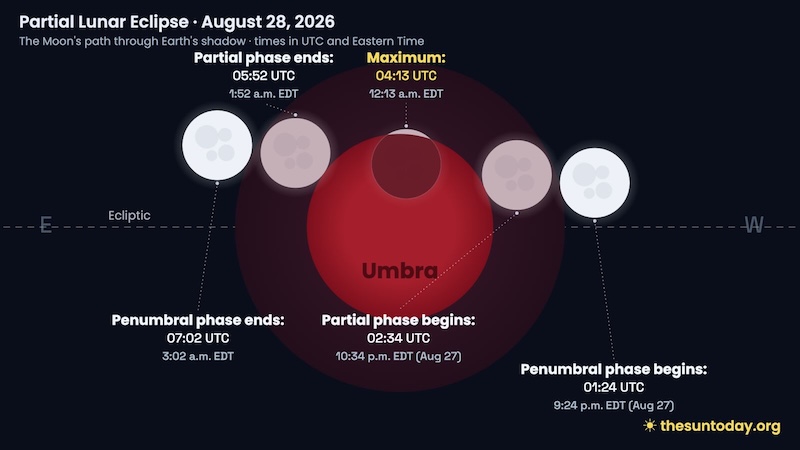 Chart showing the stages of the August 28, 2026, partial lunar eclipse. The maximum eclipse is at 04:13 UTC on August 28. Image via thesuntoday.org.When the lunar eclipse occurs worldwide
Penumbral eclipse begins at 1:24 UTC on August 28, 2026. That’s 8:24 p.m. CDT on August 27. Earth’s lighter penumbral shadow will begin crossing the moon’s face. You probably won’t notice it at first. But, as the eclipse progresses, you should see a subtle shading on the moon.
Partial eclipse begins at 2:34 UTC on August 28, 2026. That’s 9:34 p.m. CDT on August 27. As the partial eclipse begins, it’ll appear as if a tiny, but dark, bite is taken from one edge of the moon.
Greatest eclipse at 4:13 UTC on August 28, 2026. That’s 11:13 p.m. CDT on August 27. At maximum eclipse, about 96% of the moon’s disk will lie inside Earth’s dark umbral shadow.
Partial eclipse ends at 5:52 UTC on August 28, 2026. That’s 12:52 a.m. CDT.
Penumbral eclipse ends at 7:02 UTC on August 28, 2026. That’s 2:02 a.m. CDT.
By the way, the moment of greatest eclipse takes place 5.8 days after the moon reaches apogee, its farthest point from Earth for the month of August, 2026. So the moon will be at more or less an average distance from Earth when this eclipse takes place.
Animated map of the lunar eclipse.
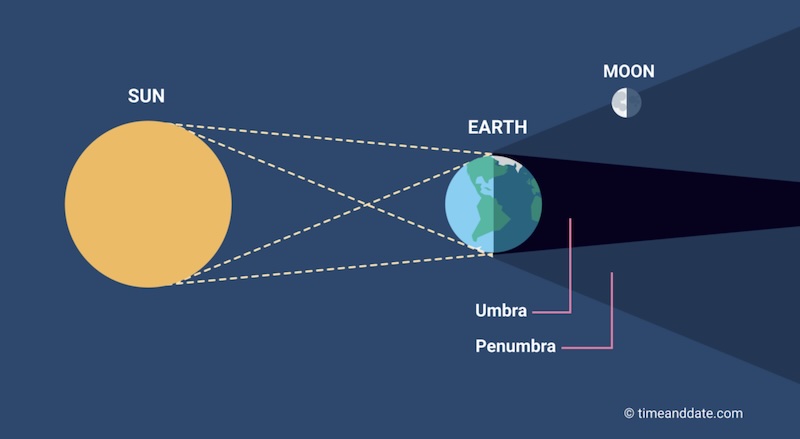 During a lunar eclipse, Earth’s shadow falls on the moon. So if the moon passes through the dark central shadow of Earth – the umbra – a partial or total lunar eclipse takes place. But if the moon only passes through the outer part of the shadow (the penumbra), a subtle penumbral eclipse occurs. Diagram via timeanddate.com. Used with permission.
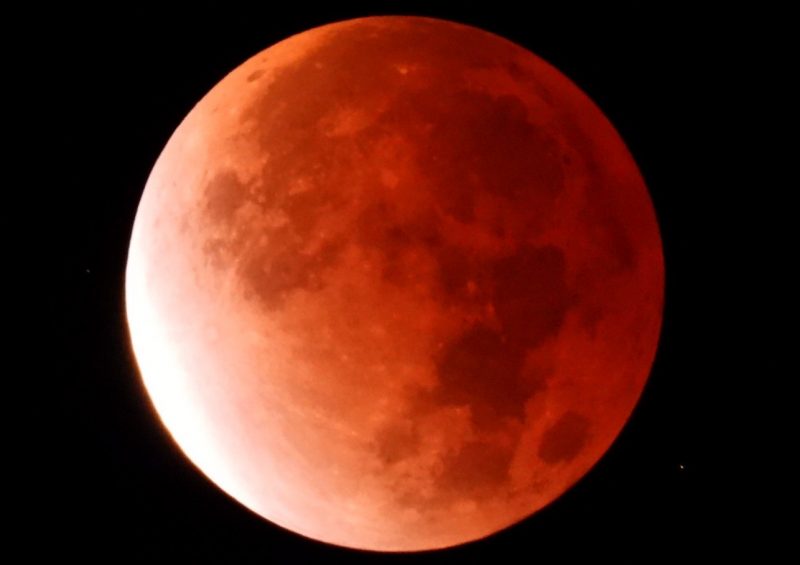 View at EarthSky Community Photos. | Robert Hall in South Mississippi took this image of the lunar eclipse on November 19, 2021. He wrote: “The moon turned red once it was 90% eclipsed.” Thank you, Robert! See more lunar eclipse images below.Moon and saros
The saros catalog describes the periodic recurrence of solar and lunar eclipses over time. Eclipses separated by one saros period (18 years, 11 days and 8 hours) belong to the same saros series and share nearly identical elements (including distance from Earth, season of the year and eclipse duration).
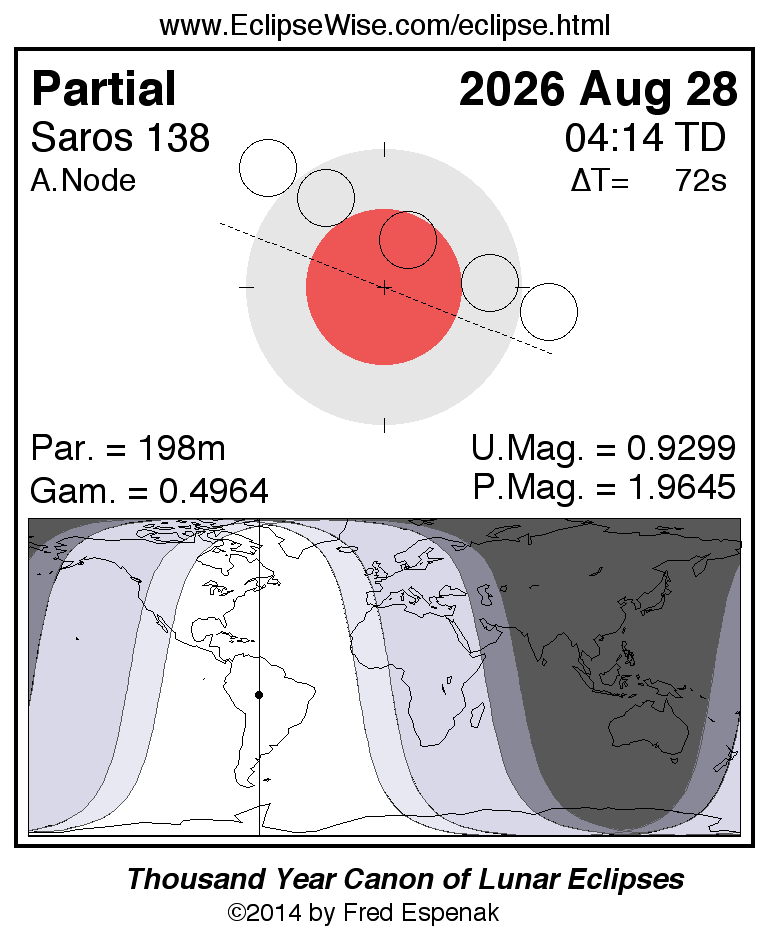
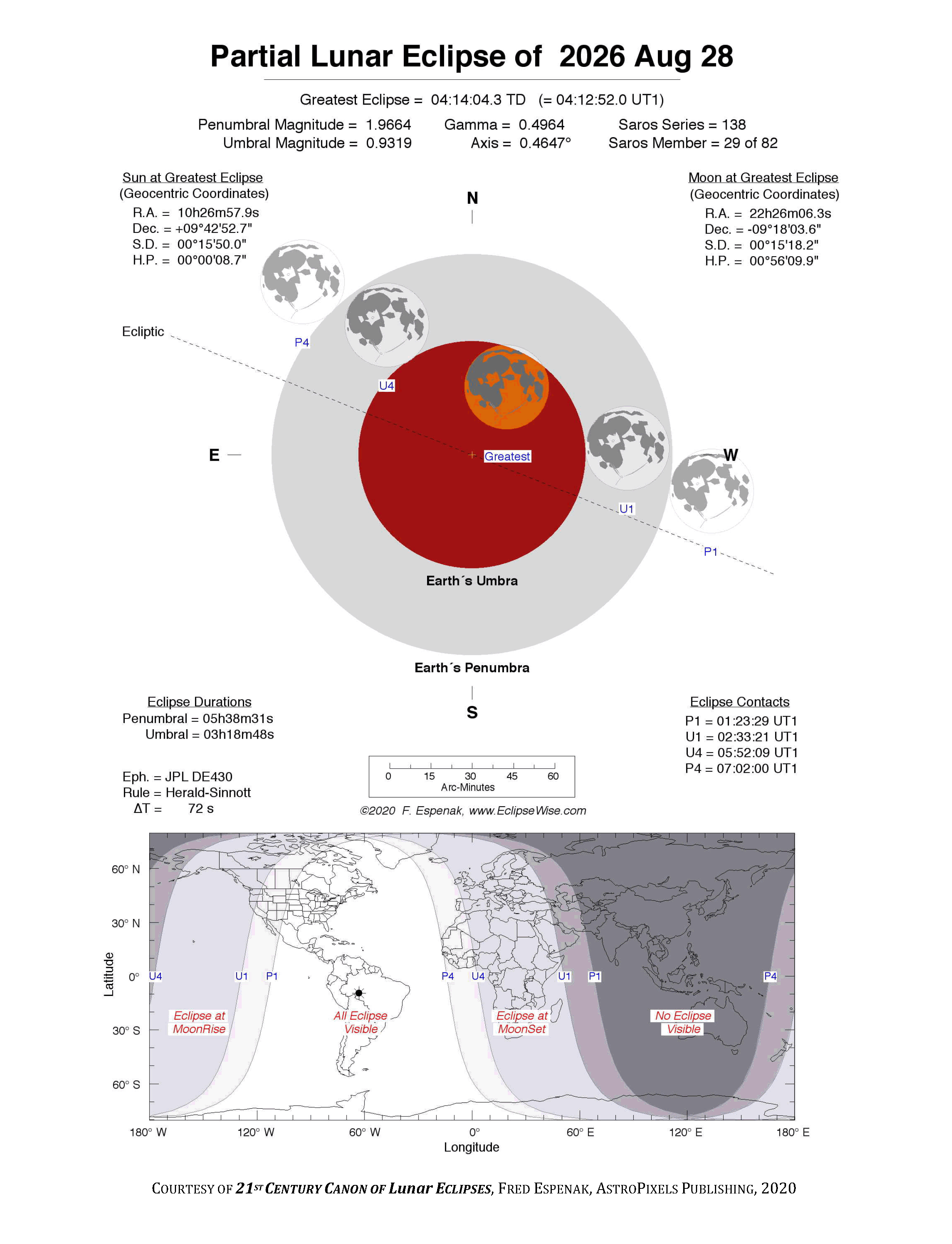
This August 27-28 total lunar eclipse belongs to Saros 138. It is number 29 of 82 lunar eclipses in the series. All eclipses in this series occur at the moon’s ascending node (where the moon’s path cut northward along the ecliptic, or Earth-sun plane). The moon will move southward with respect to this node with each succeeding eclipse in Saros 138.
The instant of greatest eclipse – when the axis of Earth’s shadow cone passes closest to the moon’s center – takes place at 4:12 UTC on August 28.
At that time, the moon will lie at zenith (directly overhead) at a point in the Brazilian Amazon. But, again, all of us on Earth’s night side at that moment will see the greatest eclipse.
Will everyone see the eclipse equally well?A full moon is up all night. And – as mentioned above – a lunar eclipse is visible from all parts of Earth that are experiencing night while the eclipse is taking place.
But some will see the eclipse more clearly, or more thoroughly, than others, depending on location.
For example, some will see it at moonrise or moonset, when the moon is low in the sky.
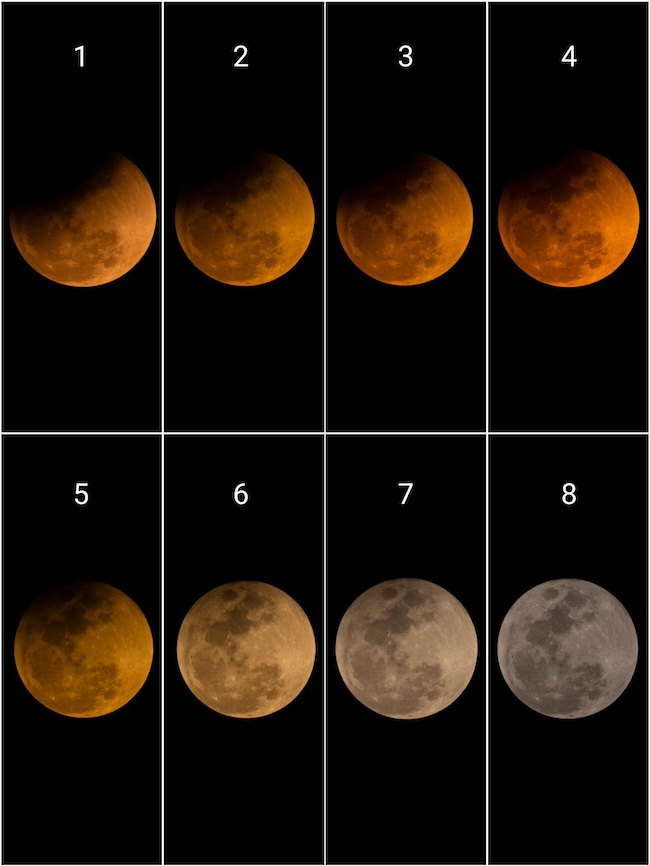 View at EarthSky Community Photos. | Atharva Maurya shared this composite image from India and wrote: “This image showcases the different phases of lunar eclipse of March 3, 2026.” Thank you, Atharva!The constellation behind the partial lunar eclipse
The lunar eclipse occurs when the moon is in the constellation of Aquarius the Water Bearer.
Find the moon’s path with respect to Earth’s dark umbral and lighter penumbral shadows below.
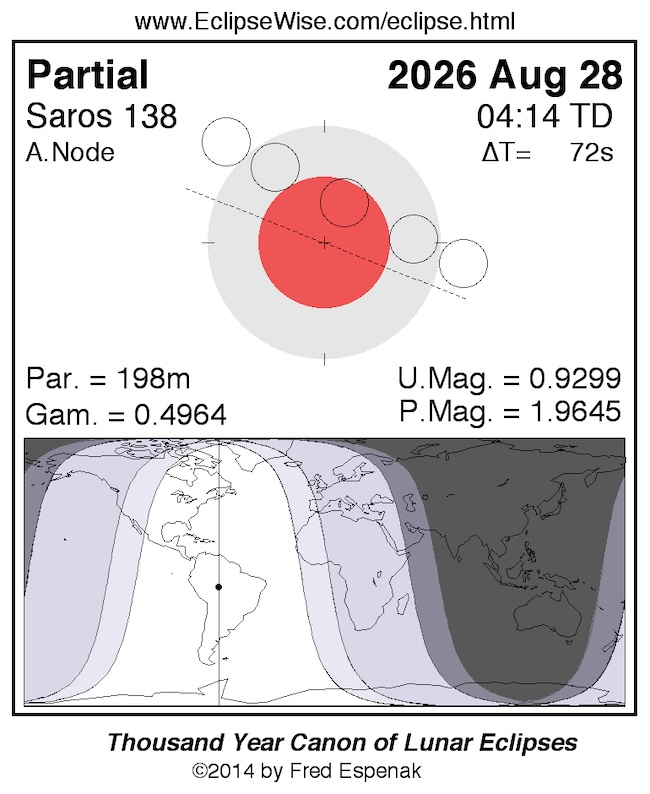 A map for the partial lunar eclipse on August 27-28, 2026. It sweeps across Africa, Europe, parts of Greenland, Antarctica, most of the Americas and eastern Pacific Ocean. Areas in white on the map will see all of the partial eclipse. The line down the middle notes where the greatest eclipse occurs. Shaded areas will see part of the eclipse and dark areas are where the eclipse is not visible. Note the difference between UTC and TD (terrestrial dynamical time, often abbreviated TT as well). Key to lunar eclipse maps here. Image via Fred Espenak/ EclipseWise. Used with permission.Maps and data for the total lunar eclipse
See Spectacular total lunar eclipse images from March 2-3, 2026
How to photograph a lunar eclipse
Submit your lunar eclipse photo to EarthSky here.
EarthSky’s monthly night sky guide: Visible planets and more
Bottom line: A deep partial lunar eclipse takes place on August 27-28, 2026, visible in Africa, Europe, most of the Americas and eastern Pacific Ocean. Maps and details here.
Meet Marcy Curran, our voice of the night sky on EarthSky YouTube. Check out her popular short videos in the Sky category on our YouTube channel. When she's not making videos, Marcy is an EarthSky editor, helping to keep our night sky guide up-to-date and just generally helping to keep the wheels turning around here. Marcy has enjoyed stargazing since she was a child, going on family camping trips under the dark skies of Wyoming. She bought her first telescope in time to see Halley’s Comet when it visited the inner solar system in 1986. She co-founded her local astronomy club and remains an active board member. Marcy taught astronomy at her local community college for over 20 years. She and her husband live in Wyoming, in a rural location, with an all-sky camera and super-good horizon views! And, they built an observatory to capture images of the night sky.
| # | Наименование новости | Тональность | Информативность | Дата публикации |
|---|---|---|---|---|
| 1 | Best eclipse photos! Nearly total lunar August 27-28 | 0 | 7.62 | 28-08-2026 |
| 2 | APOD: 2026 September 1 – A Plane Lunar Eclipse | 0 | 7.28 | 01-09-2026 |
| 3 | Агидель: Ночь 20 дек, Чт | 0 | 0 | 19-12-2018 |
| 4 | В Кузнецке прошел городской конкурс «А ну-ка, парни!» | 0 | 0 | 21-02-2025 |
| 5 | ☝Мамы, хотите действительно отдохнуть и не думать как накормить любимых, ... | 5 | 6 | 29-06-2026 |
| 6 | Bill Snyder: We get to see a partial lunar eclipse | 0 | 7.14 | 28-08-2026 |
| 7 | Siblings seek to swap interest in inherited properties | 0 | 0 | 09-02-2023 |
| 8 | Минобороны РФ показало кадры уничтожения взводного опорного пункта ВСУ | 0 | 0 | 10-03-2023 |
| 9 | Нижегородские экспортеры могут определить условия поставки товаров за рубеж с помощью конструктора Incoterms - Лента новостей Нижнего Новгорода | 0 | 0 | 24-02-2025 |
| 10 | В здравом уме такого не говорят: Куницын о желании Потураева сбросить бомбу на Россию | 0 | 0 | 02-03-2020 |