Просмотр новости
Найдите то, что Вас интересует
 Спутники
 РН
РН SpaceX
 Роскосмос
 NASA
NASA
СпутникиРНSpaceXРоскосмосNASAScientists said tinamou birds evolved to lay bright egg colors to help closely related species recognize each other and avoid breeding with the wrong species.
The post Why do tinamou birds lay such colorful eggs? first appeared on EarthSky.
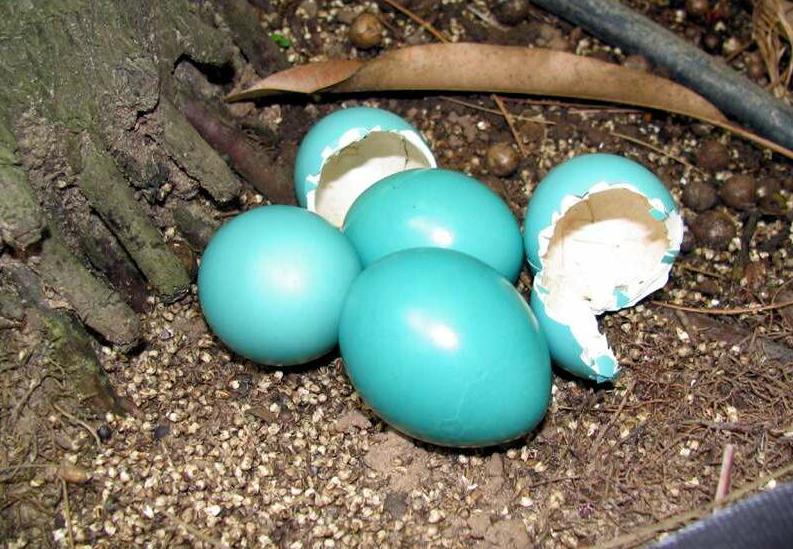 Nope. Not dyed Easter eggs. These turquoise eggs are from the white-throated tinamou. Images via Manuel Anastácio/ (Wikimedia Commons CC BY 3.0)Why do tinamou birds lay such colorful eggs?
Most birds of a similar species lay eggs of a similar color. That’s why the myriad egg colors of tinamou birds have long fascinated scientists. The eggs range from brilliant pinks and blues to rich purples and greens. So similar species … same habitat pressures … but different egg colors? Scientists think the diverse colors might be a social mating signal. And the latest research shows that various colors might help these ground-nesting birds differentiate their eggs from those of closely related species.
A team of researchers published their findings on Tinamou egg color in the peer-reviewed journal Evolution in May of 2023.
 Meet the elegant crested tinamou (Eudromia elegans). Many bird species that are closely related will lay eggs that are similar in color. But tinamou birds, which live in habitats ranging from Mexico down through South America, lay eggs that come in a variety of colors. Image via Scott Hecker/ Flickr (CC BY 2.0).What determines egg colors?
Scientists have a decent grasp on the broad factors that influence what color eggs a bird will have. These factors include nesting location and habitat, competition and predation by other species, and mating and incubation cues. Ground-nesting birds, such as killdeers and piping plovers, typically lay pale, speckled eggs that provide camouflage from predators. Meanwhile, birds that are cavity nesters, such as red-bellied woodpeckers and barred owls, lay white eggs. That’s because color would have little benefit in the dark and not be worth the energy investment. Then there are birds that lay brightly colored eggs, such as American robins. The robin’s-egg-blue pigment – or biliverdin – is thought to protect the developing embryo from harmful ultraviolet light.
Tinamou birds, which are native to Mexico, Central America and South America, use an assortment of vibrant egg colors. These colors may seem perplexing at first glance. Because these birds are ground nesters, we might expect cryptic (camouflaging) egg coloration to fool predators. But tinamou birds have a well-camouflaged mottled plumage, and they sit on the nests, guarding and incubating the eggs. Thus, the eggs are not readily visible to predators. So other evolutionary driving forces must be at play.
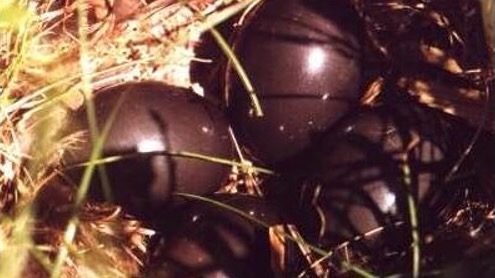 The tinamou bird lays a variety of colors of eggs. Here are chocolate-colored eggs from the spotted nothura species of tinamou. Image via Manuel Anastácio/ (Wikimedia Commons CC BY 3.0)Tinamou egg color as a mating cue
The hypothesis proposed by the team of scientists – Qin Li, Dahong Chen and Silu Wang – in the 2023 study is that egg color serves as a mating signal that contributes to tinamou speciation, which is the process by which new species are formed. They collected data on egg color of 32 tinamou species, using both community science databases and museum collections.
The findings showed that divergent egg colors were more common among species living in the same ecoregions.
Their conclusion was that egg colors evolved partly to help species recognize each other and avoid mating mistakes in areas where similar species live. In the wild, a female would see eggs already in a nest when she approaches a male to mate. The color of the eggs help her determine which species the nest belongs to. Thus, she can decide whether or not to lay eggs with that male and avoid breeding with the wrong species.
In tinamou birds, the females mate with multiple males, and it is the male (not the female) that sits on the nest to incubate the eggs. The nests may contain eggs from multiple females of the same species but not eggs from different species. Possibly, the egg colors could also serve as a cue to the male to incubate only those eggs from his species.
 More turquoise eggs from a great tinamou. Image via Andres Cuervo/ Flickr (CC BY 2.0).A theory that extends back to Darwin
Tinamou birds appear to be displaying a phenomenon that biologists call character displacement. In character displacement, species living in the same habitat evolve to have different traits to avoid competition. The classic example of character displacement is Darwin’s beloved Galapagos finches. They evolved to have divergent beak shapes, allowing each species to specialize in eating different types of seeds.
Additional reasons for varying egg colorsThere might not be only one reason for why tinamou birds lay various colored eggs. Besides helping females find the nests of their own species, predation could still play a role.
Evolutionary biologist Patricia Brennan conducted an earlier study in which she proposed that tinamou egg color may be a signal to other female birds promoting synchronous laying. The idea is that if multiple females can find a nest easily because of the colorful eggs, they may be compelled to lay their eggs at the same time in the same nest as a form of communal nesting. Then, at least some of the eggs would likely survive attacks by predators, such as snakes, foxes and hawks, because there’s safety in numbers. In other words, the sheer number of eggs produced at once increases the odds that at least some will survive.
As egg color expert Dan Ardia, in an interview in the Cornell Laboratory of Ornithology’s Living Bird magazine, said:
There are many competing hypotheses to explain egg coloration and they’re not all mutually exclusive. Pigment function is almost surely a complicated combination of factors depending on the idiosyncrasies of each species.
If you plan to decorate eggs for Easter, you can sneak in some science lessons on how egg color can be used by ground-nesting birds for camouflage and for finding nests. Do you think kids will have a hard time finding camouflaged eggs? EarthSky would love to see science-themed Easter egg photos. Submit them to us!
Bottom line: Why do tinamou birds lay such colorful eggs? Scientists think the many egg colors evolved in part to help closely related species recognize each other and avoid competition from other species at their nest sites.
Source: Character displacement of egg colors during tinamou speciation
Read more: Wisdom, oldest bird, returns with mate to Midway Atoll!
Deanna Erin Conners is a biologist and science communicator from Western New York who has been contributing to the conversations on EarthSky since 2011. Her overarching hypothesis is that we have vastly underestimated the intelligence of non-human species. She is endlessly fascinated by the interconnectedness in nature and occasionally chimes in with stories about birding, Earth science, and the Great Lakes. (Portrait taken at Buckhorn Island State Park, NY, appears courtesy of Karen Lee Lewis.)
| # | Наименование новости | Тональность | Информативность | Дата публикации |
|---|---|---|---|---|
| 1 | Los investigadores de Doñana ya saben cómo disminuir la hibridación en las aves: el secreto está en su canto, no en el color de las plumas | 5 | 7 | 16-07-2026 |
| 2 | How does smoke from wildfires affect birds? | 0 | 7.27 | 15-07-2026 |
| 3 | Цвет, который видно изнутри | 0 | 8.14 | 27-08-2026 |
| 4 | 5 amazing places to see migrating birds in spring | 0 | 7.09 | 30-04-2026 |
| 5 | У птерозавров нашли следы радужного окраса | 0 | 9.1 | 24-08-2026 |
| 6 | Эволюция наоборот: как человек лишил цыплят лесного камуфляжа и перекрасил в желтый | 0 | 9.49 | 14-10-2026 |
| 7 | Чаму мужчын прыцягваюць жаночыя азадкі? Навукоўцы і гэта патлумачылі | 0 | 10 | 06-08-2026 |
| 8 | Las hembras de papamoscas priorizan el éxito de su nidada ante un desafío inmunitario | 0 | 8.62 | 28-04-2026 |
| 9 | Las variaciones del cambio climático que influyen en la interacción entre aves y parásitos dependen de la latitud | 0 | 8.92 | 12-05-2026 |
| 10 | Los beneficios del ayuno en las truchas dependen de la temperatura del agua | 0 | 8.52 | 16-04-2026 |

