Просмотр новости
Найдите то, что Вас интересует
 Спутники
 РН
РН SpaceX
 Роскосмос
 NASA
NASA
СпутникиРНSpaceXРоскосмосNASAAntineutrinos from residual radioactive decay can reveal activity inside nuclear reactors even after they have been shut down. A nuclear reactor does not become completely silent when it shuts down. Long after power production stops, radioactive, long-lived fission products continue decaying for months or years, releasing a faint stream of particles called antineutrinos. (Anti)neutrinos are [...]
 Even after a nuclear reactor shuts down, radioactive fission products continue producing a faint antineutrino signal. Researchers have now measured this lingering emission directly, opening a new window into what happens inside reactors and spent-fuel systems after power generation ends. Credit: Stock
Antineutrinos from residual radioactive decay can reveal activity inside nuclear reactors even after they have been shut down.
A nuclear reactor does not become completely silent when it shuts down. Long after power production stops, radioactive, long-lived fission products continue decaying for months or years, releasing a faint stream of particles called antineutrinos. (Anti)neutrinos are the lightest and among the most elusive particles known in the Universe, passing through reactor structures and shielding with little obstruction.
The Double Chooz collaboration has now directly measured this lingering antineutrino emission for the first time. Led by Anthony Onillon and Thierry Lasserre of the Max-Planck-Institut für Kernphysik (MPIK) in Heidelberg, Germany, the research was recently published in Physical Review Letters.
The finding shows that antineutrino detectors can gather information from reactors even when they are offline, potentially expanding their usefulness for reactor monitoring, nuclear safety, and safeguards.
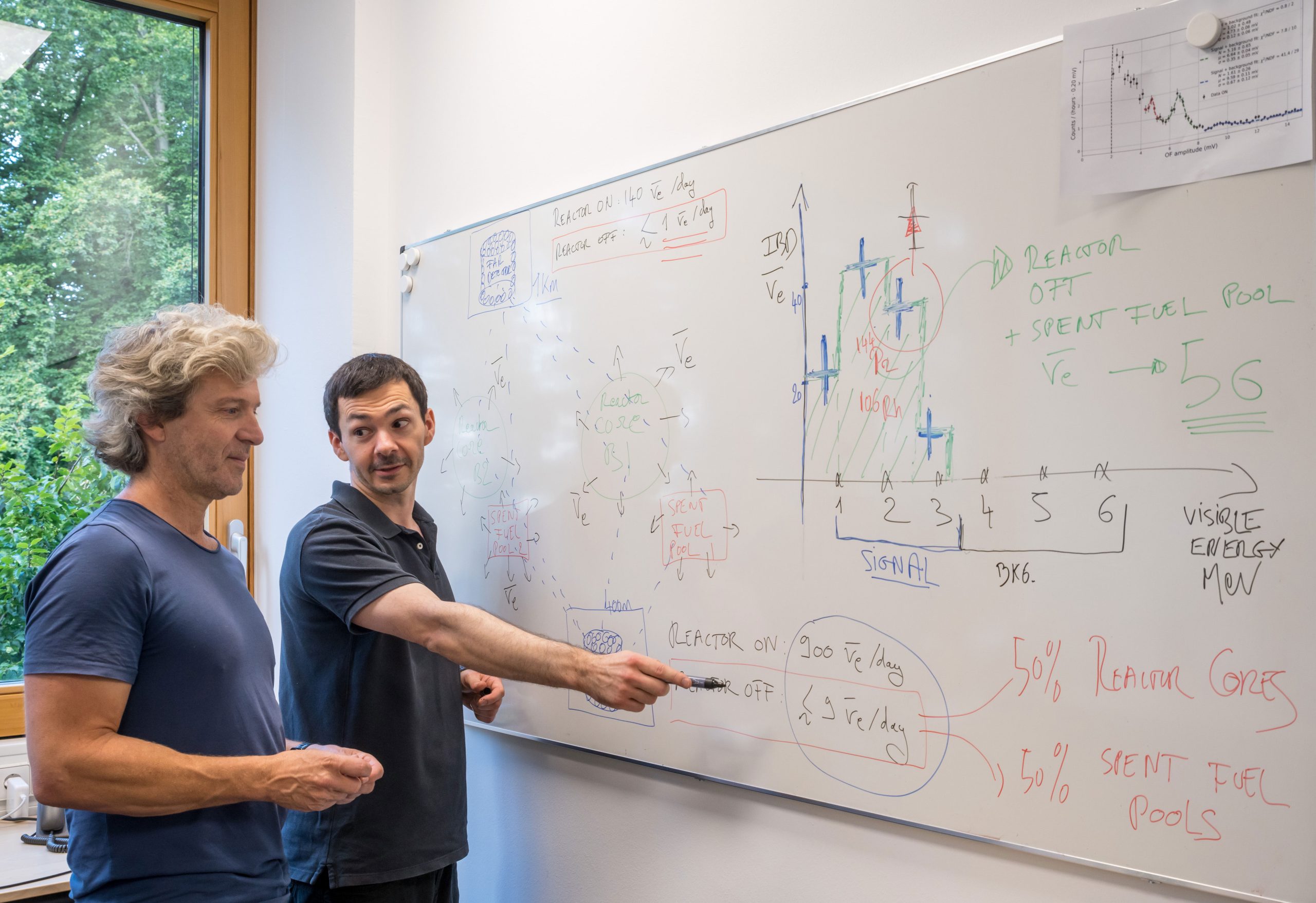 Thierry Lassere and Anthony Onillon discussing the data. Credit: R. Lackner/MPIKA detector listens after shutdown
The researchers made the measurement at the Chooz nuclear power plant in northern France. About 400 meters from its two reactor cores, the Double Chooz detector sits underground and contains more than 30 cubic meters of liquid scintillator, a material that produces tiny flashes of light when an antineutrino interacts within it.
“Antineutrinos interact only extremely rarely with matter. However, when one interacts within the Double-Chooz detector, a characteristic double-light signal is produced that can be distinguished from background events”, explains Thierry Lasserre from the independent research group OMINA, also located at MPIK. Those distinctive signals allow the reactor antineutrinos to be identified.
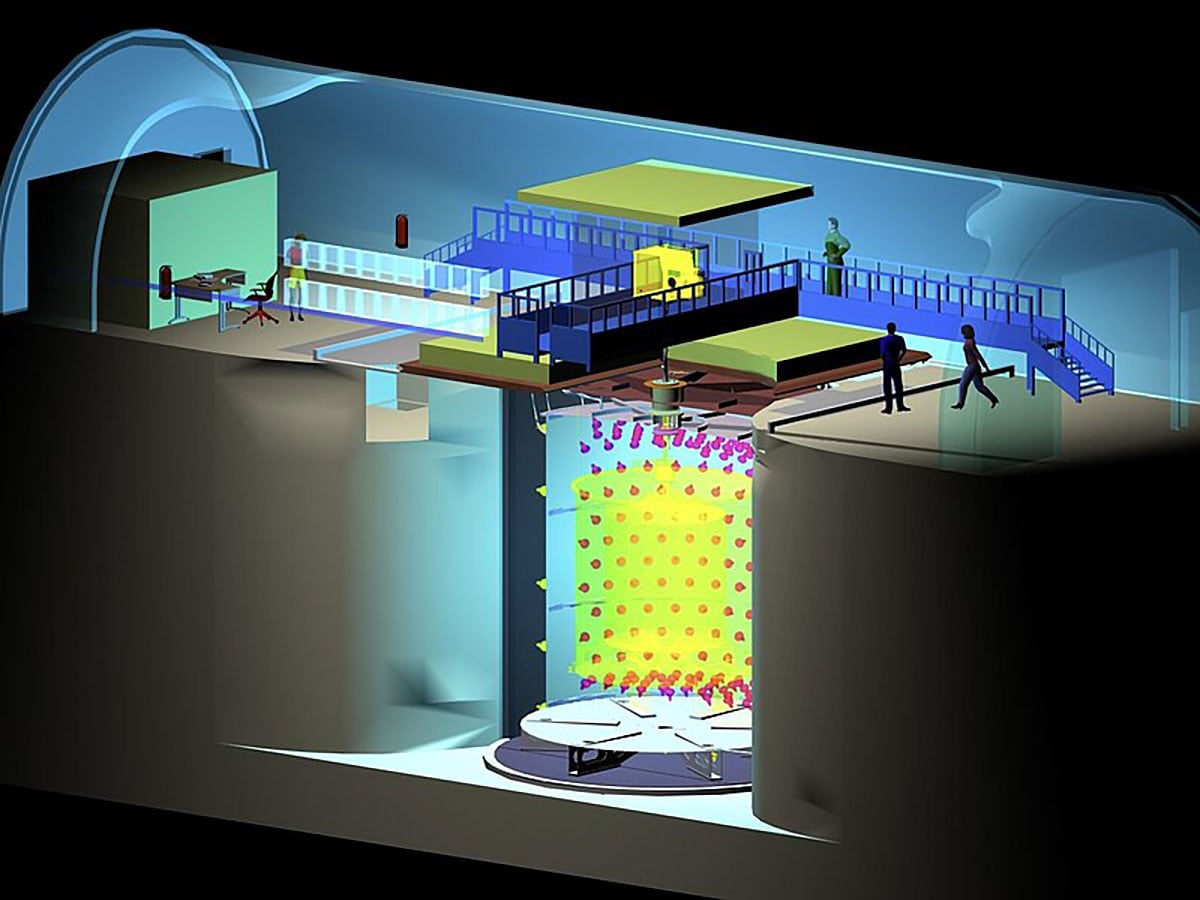 Double-Chooz detector. Credit: Double-Chooz collaboration
The collaboration analyzed 17.2 days of observations collected while both reactor units were fully shut down. During that interval, the detector recorded roughly 100 candidate antineutrino events associated with residual radioactivity in the reactor cores and nearby spent-fuel cooling pools.
Measurements match predicted residual emissionsThe observed signal closely matched detailed simulations based on the remaining nuclear fuel inventory and the continuing decay of long-lived fission products. This provides the first direct experimental confirmation of predictions for antineutrino emissions from shut-down reactors and spent fuel.
“Until now, reactor antineutrino experiments have mainly focused on operating reactors, where the antineutrino flux is much larger. Detecting the tiny residual signal after shutdown required exceptionally low backgrounds and careful analysis techniques developed by the Double Chooz collaboration over many years,” adds Dr Onillon.
 Site of the Double Chooz experiment. Credit: DoubleChooz collaboration
Other experiments are already beginning to investigate the same faint signal. Initial results from JUNO-TAO, presented at Neutrino 2026, use reactor-off observations in an effort to separate antineutrinos produced by spent nuclear fuel. The Double Chooz measurement now supplies the first published reference point for studying these residual emissions from shut-down reactors and spent-fuel pools.
Shutdown signals could aid reactor monitoringThe finding suggests that future antineutrino detectors could provide useful information not only while reactors are operating, but also during maintenance and after shutdown. Such measurements could eventually contribute to independent verification of reactor status and spent-fuel inventories.
Double Chooz was originally built to investigate neutrino oscillations and played a key role in measuring the neutrino mixing angle θ13, a fundamental quantity describing how neutrinos change between different types as they travel.
That result helped enable future investigations of matter-antimatter asymmetries involving neutrinos. The latest work adds another first for the experiment by detecting the faint antineutrino emission that persists after a reactor has gone dark.
Reference: “First Measurement of Neutrino Emissions from Spent Nuclear Fuel by the Double Chooz Experiment” by T. Abrahão, H. Almazan, J. C. dos Anjos, S. Appel, J. C. Barriere, I. Bekman, T. J. C. Bezerra, L. Bezrukov, E. Blucher, E. Blucher, C. Bourgeois, C. Buck, J. Busenitz, A. Cabrera, M. Cerrada, E. Chauveau, P. Chimenti, O. Corpace, J. V. Dawson, J. F. Du, Z. Djurcic, A. Etenko, H. Furuta, I. Gil-Botella, A. Givaudan, H. Gomez, M. C. Goodman, T. Hara, J. Haser, D. Hellwig, A. Hourlier, M. Ishitsuka, J. Jochum, C. Jollet, K. Kale, M. Kaneda, M. Karakac, T. Kawasaki, E. Kemp, D. Kryn, M. Kuze, T. Lachenmaier, C. E. Lane, T. Lasserre, D. Lhuillier, H. P. Lima, Jr., M. Lindner, J. M. LoSecco, B. Lubsandorzhiev, J. Maeda, C. Mariani, J. Maricic, J. Martino, T. Matsubara, G. Mention, A. Meregaglia, T. Miletic, R. Milincic, A. Minotti, X. Mougeot, D. Navas-Nicolás, Y. Nikitenko, P. Novella, L. Oberauer, M. Obolensky, A. Onillon, A. Oralbaev, C. Palomares, I. M. Pepe, L. Perisse, G. Pronost, J. Reichenbacher, S. Schönert, S. Schoppmann, L. Scola, R. Sharankova, V. Sibille, V. Sinev, M. Skorokhvatov, P. Soldin, A. Stahl, I. Stancu, M. R. Stock, L. F. F. Stokes, F. Suekane, S. Sukhotin, T. Sumiyoshi, C. Veyssiere, B. Viaud, M. Vivier, S. Wagner, C. Wiebusch, G. Yang and F. Yermia, 4 August 2026, Physical Review Letters.
DOI: 10.1103/dr26-j19g
Never miss a breakthrough: Join the SciTechDaily newsletter.
Follow us on Google and Google News.
| # | Наименование новости | Тональность | Информативность | Дата публикации |
|---|---|---|---|---|
| 1 | Nuclear Reactors Keep Emitting a Hidden Signal Long After They Shut Down | 0 | 17.78 | 07-08-2026 |
| 2 | Scientists detect a nuclear reactor’s ghostly afterglow for the first time | 0 | 8.26 | 14-08-2026 |
| 3 | 🔍💡 Реактор выключили — а он всё "шепчет" о себе ... | 0 | 8.91 | 14-08-2026 |
| 4 | Scientists Discover Extreme Acceleration Inside a Nuclear Fireball | 0 | 19.44 | 04-08-2026 |
| 5 | Physicists Hunted a Mysterious Particle – and Found Two Unexpected Structures Instead | 0 | 16.79 | 26-08-2026 |
| 6 | CERN Experiment Finds Gluons Behaving Strangely Deep Inside Atomic Nuclei | 0 | 17.3 | 17-08-2026 |
| 7 | Hidden magnetism inside atoms may explain mysterious gamma rays | 0 | 8.63 | 21-08-2026 |
| 8 | Scientists simulated a nuclear fireball and found a surprise in the fallout | 0 | 6.85 | 03-06-2026 |
| 9 | Quantum Experiment Breaks a Long-Standing X-Ray Energy Limit | 0 | 24.22 | 23-08-2026 |
| 10 | Neutronen verschwinden nicht in die Spiegelwelt | 0 | 18.17 | 28-07-2026 |